May 26, 2026
Whole Mouse Brain Gelation and Digestion
- Rajvi Javeri1,
- Laura Roy1,
- Naveen Ouellette1,
- Molly Logsdon1,
- Kevin Cao1,
- Andrew Recknagel2,
- Holly Myers1,
- Judith Baka1,
- Jayaram Chandrashekar1
- 1Allen Institute / Neural Dynamics;
- 2Janelia Research Campus
- Allen Institute for Neural Dynamics



Protocol Citation: Rajvi Javeri, Laura Roy, Naveen Ouellette, Molly Logsdon, Kevin Cao, Andrew Recknagel, Holly Myers, Judith Baka, Jayaram Chandrashekar 2026. Whole Mouse Brain Gelation and Digestion. protocols.io https://dx.doi.org/10.17504/protocols.io.rm7vz6814gx1/v1
License: This is an open access protocol distributed under the terms of the Creative Commons Attribution License, which permits unrestricted use, distribution, and reproduction in any medium, provided the original author and source are credited
Protocol status: Working
We use this protocol and it's working
Created: April 01, 2025
Last Modified: June 02, 2026
Protocol Integer ID: 125902
Keywords: Expansion Microscopy, Whole Brain , Hydrogel, Tissue Clearing, whole mouse brain gelation, digestion whole brain sample, following gelation, swellable hydrogel, fluorescent label, structural protein, enzymatic digestion, biomolecule, tissue, improving effective imaging resolution, effective imaging resolution, disrupting structural protein, transparent sample, light scattering, polymer network
Abstract
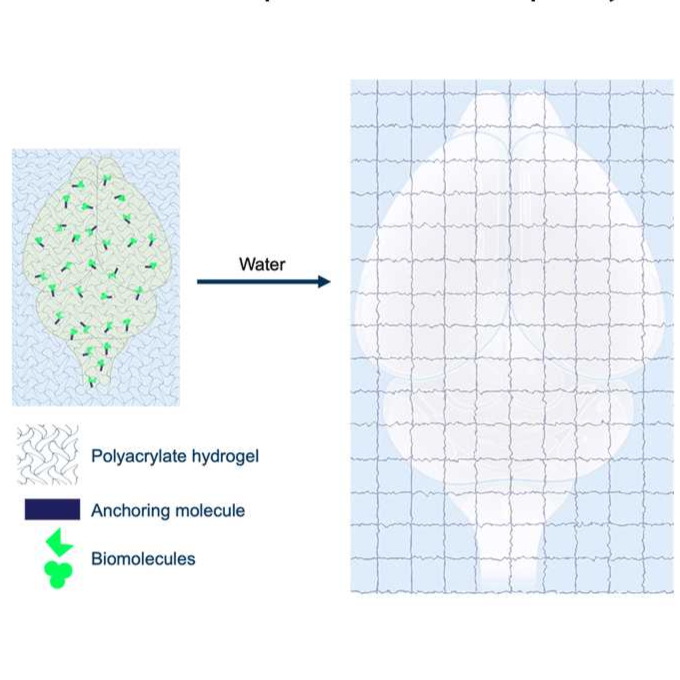
Whole brain samples are embedded in a swellable hydrogel that enables isotropic expansion, improving effective imaging resolution. Biomolecules or fluorescent labels are covalently anchored to the polymer network so their spatial organization is preserved during expansion. Following gelation, enzymatic digestion with Proteinase K homogenizes the tissue by disrupting structural proteins, allowing uniform expansion and resulting in an optically transparent sample with reduced light scattering.
Guidelines
While performing gelation steps, use 4 mL glass vials with PTFE screw-top caps to ensure that the vials are compatible with the chemicals used.
During AcX treatment, use anhydrous DMSO to dissolve the AcX so that the AcX remains stable and does not undergo hydrolytic degradation.
Continually replace the ice the samples are kept on and ensure the samples are cold to prevent premature polymerization of the StockX.
Gelled brains can have a few bubbles when removed from the oven due to slight disturbances caused during coverslipping. These typically fill in during the final washes with PBS.
It is recommended to etch identification information on the glass vial. Ink or label adhesive may dissolve if exposed to the solvents used for gelation.
Materials
MES or 2-(N-Morpholino)ethanesulfonic acidMerck MilliporeSigma (Sigma-Aldrich)Catalog #M3671
10N NaOHMerck MilliporeSigma (Sigma-Aldrich)Catalog #SX0607N-6
Acryloyl-X, SE, 6-((acryloyl)amino)hexanoic Acid, Succinimidyl EsterThermo FisherCatalog #A20770
DMSO, AnhydrousThermo FisherCatalog #D12345
5M Sodium Chloride, 1000mlPromegaCatalog #V4221
AcrylamideMerck MilliporeSigma (Sigma-Aldrich)Catalog #A9099
N,N′-MethylenebisacrylamideMerck MilliporeSigma (Sigma-Aldrich)Catalog #M7279
Sodium Acrylate (purity note:*) Merck MilliporeSigma (Sigma-Aldrich)Catalog #408220
Sodium Azide, 5% (w/v), Ricca ChemicalfisherCatalog #71448-16
Acrylic acidMerck MilliporeSigma (Sigma-Aldrich)Catalog #147230-5G
Proteinase K, Molecular Biology Grade - 2 mlNew England BiolabsCatalog #P8107S
Tris-HCl, pH 8.0 (UltraPure)Thermo Fisher ScientificCatalog #15568025
EDTA (0.5 M), pH 8.0Life TechnologiesCatalog #AM9260G
Triton X-100Merck MilliporeSigma (Sigma-Aldrich)Catalog #T8787-50ML
PBS - Phosphate-Buffered Saline (10X) pH 7.4Thermo Fisher ScientificCatalog #AM9625
Equipment
Hefty Slider Freezer Storage Bags, Gallon Size, 56 Count
NAME
Hefty
BRAND
COMINHKG109462
SKU
LINK
1 gallon
SPECIFICATIONS
Equipment
Vacutherm Vacuum Heating and Drying Ovens
NAME
Themo Scientific
BRAND
51014551
SKU
LINK
Equipment
PYREX™ Reusable Petri Dishes: Complete
NAME
Dish
TYPE
Fisher Scientific
BRAND
08-747A
SKU
LINK
Equipment
Cover glass
NAME
Epredia
BRAND
12-455-S
SKU
LINK
24x55 mm
SPECIFICATIONS
Equipment
Microscope Slides
NAME
slides
TYPE
EMS
BRAND
71867-01
SKU
LINK
25x75mm, thickness: 1mm, Frosted End
SPECIFICATIONS
Equipment
Single Edge Carbon Steel Razor
NAME
blade
TYPE
EMS
BRAND
71960
SKU
LINK
Equipment
Silicone Isolators
NAME
Electron Microscopy Sciences
BRAND
70337
SKU
LINK
0.5, 1.0, 2.0, 2.5 mm depths. S/S or S/A
SPECIFICATIONS
Equipment
WHEATON® Shorty Vials clear with PTFE faced rubber lined cap
NAME
vial
TYPE
WHEATON
BRAND
DWKW224607
SKU
LINK
Equipment
3 oz Plastic Vials
NAME
Uline
BRAND
S-19523
SKU
LINK
3oz, opening diameter 1 3/8"
SPECIFICATIONS
RECIPES:
MBS solution: 100mM MES Buffered Saline, 150mM NaCl, pH 6.0
Combine the following reagents at Room temperature until fully dissolved. Adjust to pH 6. Store for a few months at Room temperature .
| Reagent | Volume | Final Concentration | |
| MES | 1 g | 100 mM | |
| 5M NaCl | 1.5 mL | 150 mM | |
| 10N NaOH | 200 uL | ||
| Milli-Q Water | 48 mL | ||
| Total | 50 mL |
10 mg/mL Acryloyl-X (AcX) in DMSO:
To make 10 mg/mL AcX, add DMSO directly to the bottle of AcX. Vortex to dissolve. Aliquot and store at -20 °C in a desiccated environment. Aliquots should be used within one month.
| Reagent | B | C | |
| Acryloyl X | 5 mg | 10 mg/mL | |
| Dimethyl Sulfoxide (DMSO) | 500 uL |
10% (w/v) VA-044 (polymerization initiator):
Combine the following reagents and stir On ice until dissolved. Store at -20 °C
| Reagent | Volume | Final Concentration | |
| VA-044 | 1 g | 10% | |
| Milli-Q water | 10 mL |
Stock X (Monomer Solution) Preparation:
To make the Stock X solution, the following stock solutions must be prepared in advance:
- 50% (w/v) Acrylamide
- 2% (w/v) N,N Methylene-bis-acrylamide
- 4.04M Sodium acrylate (2 options: made from acrylic acid or powder form)
50% (w/v) Acrylamide:
Combine the following reagents and stir until dissolved. Store at -20 °C .
| Reagent | Volume | Final Concentration | |
| Acrylamide | 5 g | 50% | |
| Milli-Q water | 10 mL |
2% (w/v) N,N Methylene-Bis-Acrylamide
Combine the following reagents and stir until dissolved. Store at -20 °C .
| Reagent | Volume | Final Concentration | |
| N,N Methylene-bis-acrylamide | 0.2 g | 2% | |
| Milli-Q water | 10 mL |
4.04M Sodium Acrylate
Add 22.5 mL milli-Q water into a 250 mL glass bottle and cool the solution down to 0 °C on ice. Slowly add in 27.5 mL acrylic acid with stirring until fully mixed. Cover the bottle to the neck with ice and then, with stirring, add 36 mL 10N NaOH over the course of 00:10:00 . Make sure to keep the solution at 0 °C .
Insert a pH meter and begin adding 1N NaOH in 1 mL increments until pH 7.6 – 8.0. Keep track of the volume needed to reach this range.
Once desired pH is reached, let the solution warm to Room temperature and check the pH to make sure it is still in correct range. Add water to a final volume of 100mL and store at -20 °C .
| A | B | |
| 14.6M Acrylic acid | 27.5 mL | |
| Milli-Q water | 22.5 mL + extra to reach 100mL | |
| 10N NaOH | 36 mL | |
| 1N NaOH | ~5-10 mL |
4.04M Sodium Acrylate (from powder form)
Combine the following reagents and stir until dissolved. Store at -20 °C up to one month.
| A | B | C | |
| Sodium acrylate | 18.99 g | 4.04 M or 38% | |
| Milli-Q water | 50 mL |
Note
Powder Sodium Acrylate can be used. However, a yellow solution indicates low purity. If this is observed, discard and use a different batch.
Stock X (Monomer Solution)
Combine the following 0 °C . Aliquot and store at -20 °C .
| Reagent | Amount | Final Concentration | |
| 4.04M Sodium acrylate | 4.554 mL | 9.2% | |
| 50% Acrylamide | 1 mL | 2.7% | |
| 2% N,N Methylene-bis-acrylamide | 1.5 mL | 0.16% | |
| 5M NaCl | 8 mL | 12% | |
| 10X PBS | 2 mL | 1X | |
| Milli-Q water | 1.745 mL | ||
| Total | 18.799 mL |
Proteinase K Digestion Buffer: 50mM Tris-HCl pH 8, 1mM EDTA, 0.5% TritonX, 50mM NaCl, 0.3%SDS
Combine the following reagents. Store at Room temperature for several months.
| Reagent | Amount | Final Concentration | |
| 1M Tris-HCl pH 8 | 2 mL | 50 mM | |
| 10% Triton X-100 | 2.5 mL | 0.5% | |
| 5M NaCl | 500 uL | 50 mM | |
| 0.5M EDTA | 100 uL | 1 mM | |
| 10% SDS | 1.5 mL | 0.3% | |
| Milli-Q Water | 42.9 mL | ||
| Total | 50 mL |
Safety warnings
Acrylamide powders and solutions are toxic if swallowed, inhaled, or absorbed through the skin. It is a mutagen, teratogen and a carcinogen.
Dispose of acrylamide and any contaminated consumables in a hazardous waste stream.
Ethics statement
The protocols.io team notes that research involving animals and humans must be conducted according to internationally-accepted standards and should always have prior approval from an Institutional Ethics Committee or Board.
Before start
Start with a brain that has been delipidated using the Tetrahydrofuran and Dichloromethane Delipidation of a Whole Mouse Brain and Aqueous (SBiP) Delipidation of a Whole Mouse Brain protocols. The sample may or may not be immunolabeled using the Immunolabeling of a Whole Mouse Brain protocol. The sample preparation room should also be equipped with a nitrogen gas line.
For all ExM steps, use small-volume glass tubes or vials to hold the brain. This way, we ensure that smaller amounts of valuable reagents are used and less waste is generated. We typically use a 4 mL glass vial that has a wide enough opening to fit an adult mouse brain.
Day 1 – MBS equilibration
18h
Transfer brain samples to the 4 mL glass vials.
Wash sample in MBS at Room temperature . Using a transfer pipette, fill vial to the top (typically 4 mL ). This will minimize the amount of air bubbles in the vial. Replace solution for each step:
- MBS for 01:00:00
- MBS for 01:00:00
2h
Replace MBS again and store On ice at 4 °C Overnight .
16h
Day 2-5 – Acryloyl X (AcX) treatment
4d
Prepare a new tube or vial with 3 mL MBS for each brain. Place On ice .
Dissolve 5 mg AcX in 500 µL of anhydrous DMSO to create a 10 mg/mL solution and vortex to combine.
Mix the dissolved AcX with MBS (2500 µg per brain or 250 µL of 10 mg/mL AcX with 3 mL MBS) for each whole brain and fill the remaining space with more MBS to minimize air.
Incubate On ice at 4 °C , mix by inverting tubes once per day for 4 days.
4d
Day 6-7 – PBS washes
2d
Replace solution with cold 1X PBS, mix by inverting, keep on On ice at 4 °C , Overnight .
16h
Replace solution with cold 1X PBS, mix by inverting, keep on On ice at 4 °C , Overnight .
16h
Day 8-11 – Stock X equilibration
4d
Prepare Stock X on On ice .
Safety information
Acrylamide powders and solutions are toxic if swallowed, inhaled, or absorbed through the skin. It is a mutagen, teratogen and a carcinogen.
Dispose of acrylamide and any contaminated consumables in a hazardous waste stream.
To activate Stock X, add VA-044. The amount of VA-044 required is equal to 1.2% of the total volume of Stock X used. (Typically we add 234 µL of 10% (w/v) VA-044 in ~20 mL Stock X).
Fill each whole brain tube with activated Stock X solution to minimize air.
Save any extra activated Stock X solution on On ice .
Incubate on On ice at 4 °C , mix by inverting tubes once per day for 4 days.
4d
Day 12 – Gelation and Proteinase K
3d 4h
Bring brain vials and activated Stock X solution to Room temperature on the bench. Swirl Stock X conical tube carefully to avoid bubbles.
Note
Typically a 5 mL preparation of activated Stock X is more than sufficient for gelling one adult mouse brain. If more activated Stock X is required, a fresh preparation may be added to the Stock X left over from the previous step.
De-gas activated Stock X solution in a vacuum chamber ~ 00:20:00 . This reduces the formation of bubbles during polymerization.
Prepare polymerization chamber by stacking silicone isolator gaskets of various thicknesses to reach a height of 6.5mm on an uncharged 1"x3" microscope slide. The gaskets should be stacked high enough so the entire mouse brain will be embedded within the hydrogel. Typically, we stack the gaskets to allow about 2 mm of gel to polymerize around the brain. Inspect chamber for dust and debris before beginning embedding process.
Add activated Stock X to partly fill polymerization chamber.
Avoid and eliminate all bubbles.
Transfer brain to chamber and fill with Stock X just to the top.
Seal chamber with a clean, long coverslip, taking care to avoid bubbles.
Place in petri dish, and seal in 2 sequential zip lock bags, each thoroughly purged with nitrogen gas.
Incubate at 37 °C for 04:00:00 + .
4h
Remove coverslip and gasket; gel should be firm without extra liquid dripping out.
Cut gel with a razor blade, making a rectangular cuboid shape. Leave about a 2 mm border of gel on all sides of the brain. If needed, the gel may be trimmed down further after expansion.
Wash in 50 mL 1X PBS at Room temperature in a 50 mL conical tube for about 00:03:00 with swirling.
Replace solution with 40 mL Proteinase K (ProK) buffer spiked with 100U ProK (~126 µL ); incubate at Room temperature with gentle swirling or rocking on a nutator for 3 days.
Note
Store Proteinase K at -20 °C and keep On ice until added to the ProK Buffer.
3d
Day 18 – Proteinase K digest (continued)
5d
Swirl whole brain conical tube carefully and thoroughly.
Add 126 µL (100U) Proteinase K to the tube.
Move to 37 °C and incubate 5 days+. Cortex should look transparent and the white matter should look mostly clear. Digestion time may be extended if needed.
5d
Day 23 – Final washes (after judging that digest is complete)
2d 2h
Wash brain in ~50 mL 1X PBS briefly at Room temperature , then replace with enough 1X PBS to fill the 50 mL conical tube; wash at Room temperature with gentle swirling or rocking for 2 days.
2d
Replace 1X PBS solution for a few hours and/or Overnight .
2h
Change final wash with 1X PBS Azide 0.05% and store at 4 °C until ready for expansion.