Jun 24, 2025
Whole Genome Sequencing of Hepatitis B Virus
- Myat Htut Nyunt1,
- Wah Wah Aung2,
- Yi Yi Kyaw2
- 1Advanced Molecular Research Centre, Department of Medical Research, Republic of the Union of Myanmar;
- 2Department of Medical Research



Protocol Citation: Myat Htut Nyunt, Wah Wah Aung, Yi Yi Kyaw 2025. Whole Genome Sequencing of Hepatitis B Virus. protocols.io https://dx.doi.org/10.17504/protocols.io.e6nvwqx1zvmk/v1
License: This is an open access protocol distributed under the terms of the Creative Commons Attribution License, which permits unrestricted use, distribution, and reproduction in any medium, provided the original author and source are credited
Protocol status: Working
We use this protocol and it's working
Created: June 24, 2025
Last Modified: June 24, 2025
Protocol Integer ID: 220786
Keywords: HBV, whole genome sequencing, hepatitis B virus, next-generation sequencing, sequencing, hbv across different genotype, universal primers for hbv, procedure for whole genome sequencing, standardized method for whole genome sequencing, generation sequencer, hbv, genome, different genotype, genotype, using universal primer
Abstract
This standard operating procedure (SOP) describes the procedure for whole genome sequencing (WGS) of the hepatitis B virus using a next-generation sequencer. Next-generation sequencing (NGS) has been widely used for genome-wide studies in many aspects of infectious as well as non-communicable diseases. However, there is no standardized method for whole genome sequencing of HBV across different genotypes. This SOP was developed using universal primers for HBV genomes across genotypes A to G.
Guidelines
Follow the Good Laboratory Practice in all steps.
Use powder-free gloves to handle the reagents and all libraries.
Use filtered-tips for pipetting.
Materials
1. General
- Micropipettes and tips (10 μL, 200 μL, 1000 μL)
- Disposable powder-free gloves
- 2N NaOH stock
- Microcentrifuge tubes (low bind)
- 15ml tube
- Vortex
- Microcentrifuge
- Centrifuge
- PCR plates with adhesive seals
- Kimwipes
- Lens tissue
2. Targeted amplifications
- GoTaq Long PCR Master Mix (M4021)
- Primers
- Set 1: 251F (GAC TYG TGG TGG ACT TCT C)
1797R (CCA ATT TMT GCY TAC AGC CTC)
- Set 2: 2300F (CCA CMW AAT GCC CCT ATC)
654R (GSC CCA MBC CCA TAG G)
- Set 3: 1859F (ACT NTT CAA GCC TCC RAG CTG)
2835R (GTT CCC AVG WAT AWG GTG AYC C)
- Set 4: 1584F (ACT TCG MBT CAC CTC TGC ACG T)
2396R (GTC KGC GAG GYG AGG GAG TT)
3. Library Preparation Kit
- Illumina Microbial Amplicon Prep (iMAP)
- PhiX Control Kit, version 3 (10 μL at 10 nM) (#15017666)
- Illumina DNA/RNA UD Indexes Sets A–D (Catalog nos. 20091654, 20091656, 20091658, and 20091660)
- MiSeq Reagent Kit, version 2 (300 cycles)
4. Other reagents
- Squeeze bottles
- pH sticks
- Molecular grade distilled water
- Tween 20
- Isopropyl Alcohol
- Absolute Ethanol
- Ice bucket with ice
- Water bath
Before start
DNA extraction should be done accordingly using the QIAamp DNA Kit (QIAGEN) in accordance with the manufacturer’s instructions.
General Precaution before the procedure
Follow the Good Laboratory Practice in all steps.
Use powder-free gloves to handle the reagents and all libraries.
Use filtered-pipette tips for pipetting.
DNA extraction should be done accordingly using the QIAamp DNA Kit (QIAGEN) in accordance with the manufacturer’s instructions.
Amplification
PCR preparation
Thaw the Long PCR mastermix.
Prepare the PCR reactions as follows: Long PCR mix (2X), DNA template, DDW, Total 20 μL.
PCR Amplification
Prepare the PCR conditions as follows: Initial denaturing 02:00, 01:00, 01:00 35 cycles, 01:15, 05:00, Hold.
Gel-electrophoresis
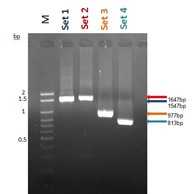
Confirm the amplification of the samples using 1% agarose gel-electrophoresis.
Library preparation
Tagment PCR amplicons
5 μL each from four PCR amplicons were pooled together in a tube. (Total 20 μL)
Thaw EBLTS HT (4°C) at RT and vortex thoroughly before use.
Thaw TB1HT (-20°C) at RT and vortex thoroughly before use.
Prepare the reagent mix: 12 μL TB1 HT, 4 μL EBLTS HT, 20 μL H2O.
Use 30 μL of reagent mix to each sample (Add 30 μL of mix to the sample) (Total 50 μL).
Seal and shake 1600 rpm for 1 min.
Centrifuge 1000 g for 1 min.
Run: 55°C for 5 min, 10°C Hold (lid-heated, 50 μL volume).
Post Tagmentation Cleanup
Keep ST2 HT (RT) vortex before use.
TWB HT (4°C) at RT and vortex before use.
Centrifuge the plate for 1 min.
Add 10 μL of ST2 HT.
Seal and shake.
Centrifuge.
Incubate at RT for 5 min.
Place on magnetic stand until clear (~3 min).
Remove supernatant.
Wash the bead by: Remove from magnetic stand, Add 100 μL TWB, Seal and shake (pipette mix), Centrifuge prn, Place on magnetic stand until clear (about 3 min), Remove supernatant.
Wash again a second time, but leave the supernatant until the next step.
Amplify Tagmented Amplicons
Thaw EPM HT (-20°C) on ice until use (mix by inverting).
Index 10 bp adapter (-20°C), thaw RT and centrifuge after vortex.
Prepare the PCR mix by 20 μL of EPM + 20 μL of H2O.
Vortex to mix the PCR mix.
Remove the supernatant wash in previous cleanup.
Use 10 μL tips to remove residual wash solution.
Remove from magnetic stand.
Add 40 μL of PCR mix.
Add 10 μL of index.
Seal and shake.
Centrifuge briefly.
Run inside a thermocycler as follows: 72°C for 3 min, 98°C for 3 min, 7 cycles of 98°C for 20 sec, 60°C for 30 sec, 72°C for 1 min, 72°C for 3 min, Hold at 10°C (lid heated 100°C, vol 50 μL).
Pool and cleanup libraries
Take 7 μL each from libraries and pool to 1.5 ml tube.
Add 0.9 x of the IPB.
Shake well and briefly spin down.
Incubate at RT for 5 min.
Place on magnetic stand for 3 min.
Discard supernatant.
Add 500 μL of freshly prepared 80% Ethanol (while keeping the tube on magnetic stand).
Remove the supernatants.
Add a second time 500 μL of 80% Ethanol.
Remove the supernatant.
Use 10 μL pipette to remove extra reagents.
Air dry (about 3 min).
Add RSB 55 μL to the bead after removing from magnetic stand.
Incubate 2 min.
Place to magnetic stand for 2 min.
Elute 50 μL of pooled libraries.
Check Qubit and the initial result showed too high. So 5 μL of the library was diluted with 25 μL of the EBT and measured again.
After diluting to 4 nM, recheck the concentration. (ng/μL that is equal to nM. We proceed accordingly).
Denaturing and running in MiSeq
Prepare the 0.2N NaOH (0.2N NaOH = 100 μL of 1N NaOH + 400 μL of LGW).
5 μL of lib + 5 μL of 0.2N NaOH.
Incubate for 5 min at RT.
Add prechilled HT 990 μL (to become 24 pM, 1000 μL).
Combine 311 μL of 24 pM + 288 μL of prechilled HT (600 μL of 12.5 pM lib).
Prepare 12.5 pm (100 μL) of PhiX (by dilute 63 μL of 20 pM + 38 μL of HT).
Add 5% (30 μL) of PhiX control to load.
Protocol references
MiSeq System: Denature and Dilute Libraries Guide. Illumina Docunment #15039740 v01.
Chook JB, Teo WL, Ngeow YF, Tee KK, Ng KP, Mohamed R. Universal primers for detection
and sequencing of hepatitis B virus genomes across genotypes A to G. J Clin
Microbiol. 2015 Jun;53(6):1831–1835. doi:10.1128/JCM.03449-14
Illumina, Inc. Protocol (v00): Illumina Microbial Amplicon Prep (IMAP) library preparation protocol [Internet]. San Diego (CA): Illumina; 2023 [cited 2025 Jun 16]. Document No. 200039808.
Available from: https://support-docs.illumina.com/LP/IMAP/Content/LP/IMAP/Protocol%28LibPrep%29_IMAP.htm