Jul 22, 2025
Using Repeated Single-Criterion Card Sorting to Elicit User Perceptions and Constructs
- 1Keele University



External link: https://doi.org/10.1093/iwc/iwac002
Protocol Citation: Ed de Quincey 2025. Using Repeated Single-Criterion Card Sorting to Elicit User Perceptions and Constructs. protocols.io https://dx.doi.org/10.17504/protocols.io.q26g7nbm8lwz/v1
Manuscript citation:
Ed de Quincey, James Mitchell, Card Sorting for User Experience Design, Interacting with Computers, Volume 33, Issue 4, July 2021, Pages 442–457, https://doi.org/10.1093/iwc/iwac002
License: This is an open access protocol distributed under the terms of the Creative Commons Attribution License, which permits unrestricted use, distribution, and reproduction in any medium, provided the original author and source are credited
Protocol status: In development
I have used this protocol but need to tweak it to make sure the steps are clear.
Created: July 15, 2025
Last Modified: July 22, 2025
Protocol Integer ID: 222531
Keywords: Card Sorting, Information Architecture, UX, User Centred Design, criterion card, personal classification system, understanding personal classification system, same set of card, card, elicit user perception, repeated single, useful in user research, user research, mental model, set of item, multiple time, item, text description, choosing, participant, design
Abstract
This protocol describes how to apply repeated single-criterion card sorting (Rugg and McGeorge, 1997) to uncover how individuals categorise a set of items - such as images, physical objects, or text descriptions -using their own constructs. The process involves participants sorting the same set of cards multiple times, each with a different criterion of their choosing. This method is useful in user research, education, design, and other domains where understanding personal classification systems or mental models is important.
Guidelines
Participants
- 6–20 participants
- Participants should be representative of your target user or audience group
Materials
"The first step is to decide what will go on the cards. Most researchers use between about eight and twenty cards – much fewer, and it can get a bit silly, much more and it can become unmanageable. The cards should all be at about the same semantic level, so that the participants are comparing like with like: for instance, it would usually be fine to have cards with names like “bicycle” and “car”, but not to have one card named “vehicle” and another named “Y registration Ford Mondeo hatchback”.
Once this has been done, you need to number each card to make recording easier; we usually put the number on the front of the card in the top right corner. We’ve used cards of various sizes, from playing card size up to A4 screenshots of web sites, without significant problems. It can be more challenging if you’re getting participants to sort items (e.g. mineral samples or engine parts) rather than cards, if the items are bulky, fragile or messy. An advantage of using images or physical items is that participants can usually sort them into groups, even if the participant doesn’t know exactly what the item is, or what it’s called."
Rugg (2013)
- A set of **8–20 cards** (e.g. photos, object names, or descriptive words)
- Table or surface for sorting
- Sticky notes or labels for naming categories
- Pens or pencils
- Paper or recording sheet to log results
- Optional: audio recorder or camera for documenting sorts
Setup
Explain the task:
- Participants will sort the same set of cards multiple times.
- Each time, they should use a different criterion of their own choosing.
- There are no right or wrong answers.
- Groups can include “don’t know” and “not applicable”
Give a brief demonstration of card sorts from a domain that won’t suggest categories relevant to the domain you’re investigating e.g. if you’re investigating people’s categorisations of men’s clothing, you could demonstrate card sorts with the domain of car types.
Card Sorting (Repeated Sorts)
Ask the participant to choose a criterion to sort the cards into groups/categories of their choosing. They should only use one criterion at a time, so if they try using “big and expensive”, you should stop them and check whether they could sort once on the criterion of size, and then sort again on the criterion of cost.
As they create the groups/category piles they should give each a label.
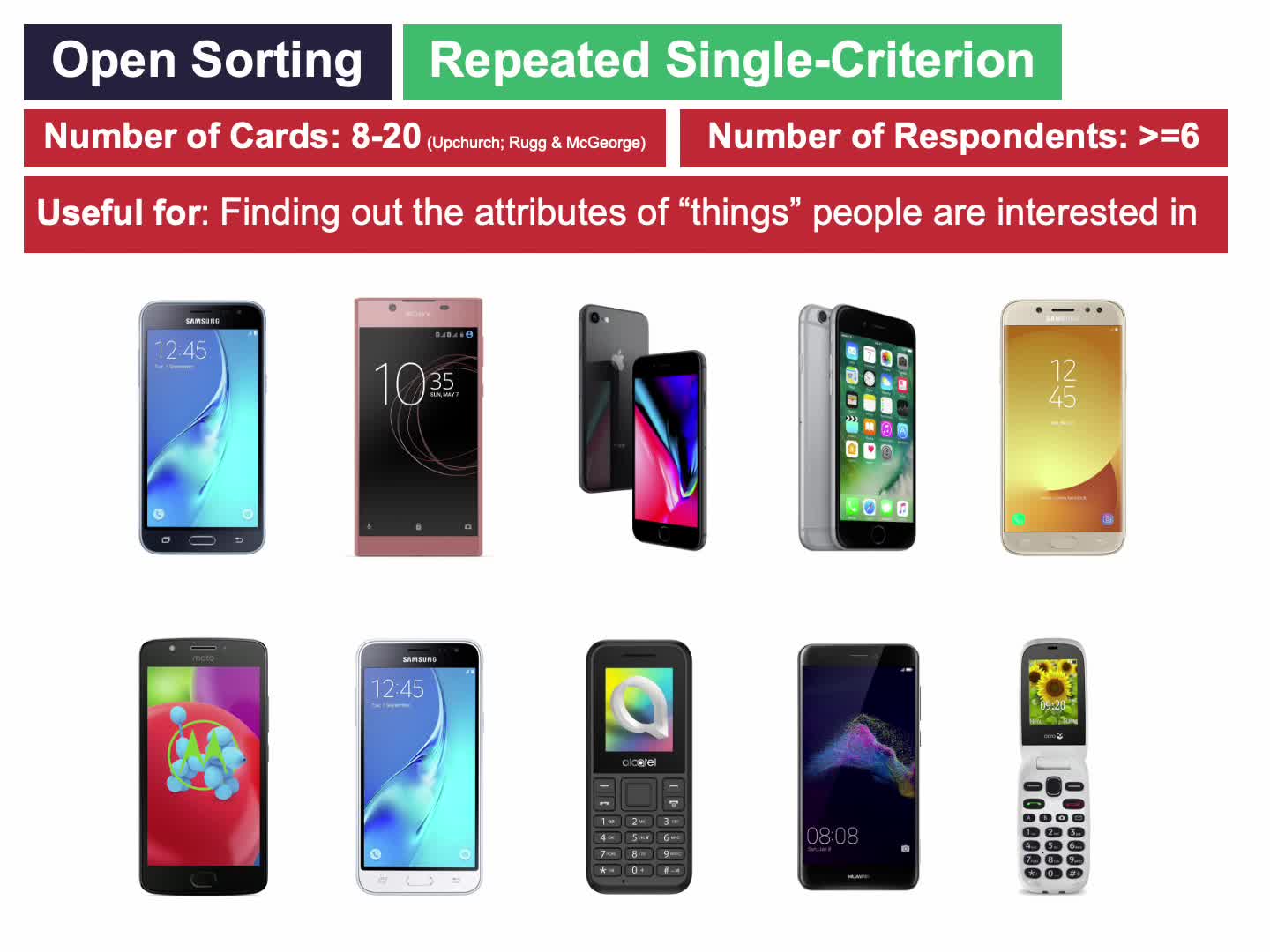
This video, shows a short example sort with mobile phones.
Record:
- The criterion they used (e.g., “emotion,” “size,” “usefulness”).
- The assignment of cards to each category and the name of each category.
Here’s what the results so far could look like with the result recorded in a recording sheet (bottom white box).
Card Sort Recording Sheet (Rugg, 2013)
Repeat the process (Steps 2 and 3) with a new criterion until the participant runs out of ideas ("drying up") or chooses to stop.
Drying Up
Once participants dry up you can often "reset" them and elicit further criteria by picking 2 random cards and asking them:
“Can you think of a way these are different that could be used for another sort?”
Protocol references
Rugg, G. and McGeorge, P. (1997) The sorting techniques: a tutorial paper on card sorts, picture sorts and item sorts. Exp. Syst., 14, 80–93.
Rugg, G. (2013) A Card Sorts Tutorial. [online] Hyde & Rugg. Available at: https://hydeandrugg.wordpress.com/2013/06/11/a-card-sorts-tutorial/ [Accessed 18 July 2025].
Acknowledgements
Dr Gordon Rugg for his articles on Card Sorts which form the basis of this protocol.