Jun 18, 2026
Universal HMW genomic DNA extraction protocol for long reads sequencing
- 1CNRS
- Abdelmalek Alioua: AEG Genomics core facility manager
- High molecular weight DNA extraction from all kingdomsTech. support email: [email protected]



Protocol Citation: Abdelmalek Alioua 2026. Universal HMW genomic DNA extraction protocol for long reads sequencing. protocols.io https://dx.doi.org/10.17504/protocols.io.ewov19rz7lr2/v1
License: This is an open access protocol distributed under the terms of the Creative Commons Attribution License, which permits unrestricted use, distribution, and reproduction in any medium, provided the original author and source are credited
Protocol status: Working
We use this protocol and it's working
Created: October 11, 2024
Last Modified: June 18, 2026
Protocol Integer ID: 109693
Keywords: DNA, HMW, Sequencing, long read, Nanopore, Pacbio, Plant, Universal, high, quality, Mouse, Bacteria, Fungus, cells, Mycelium, Solanum, Arabidopsis, Vitis, universal hmw genomic dna extraction protocol, extraction of high molecular weight dna, extraction of these high molecular weight dna, high molecular weight dna, dna with high quality, plant tissue, sequencing technology, dna, high molecular weight, oxford nanopore technology, particularities of plant cell, plant cell, fungal tissue, plant, extraction, genome size, diversity of genome size
Abstract
Long-read sequencing technologies, notably Oxford Nanopore technology, require high molecular weight (HMW) DNA with high quality and purity. Depending on the organism and the starting tissue, the extraction of high molecular weight DNA can become a real challenge. Plants occupy a class of their own. The particularities of plant cells, the diversity of genome sizes, the presence of carbohydrates, polysaccharides, polyphenols and secondary metabolites in some plant tissues make the extraction of these high molecular weight DNA very difficult and uncertain despite several protocols and kits are available. The proposed protocol was initially developed for the extraction of high molecular weight DNA from plant tissues. But it has proven itself on animal, bacterial and fungal tissues, which makes it universal.
Attachments

NanoPlot Report Aspe...
11.8MB
Guidelines
Always work with fresh tissues
Use wide bore tips
All steps are carried out at room temperature
Materials
| Designation | Provider | reference | |
| Dnazol-ES | Euromedex | DN128-50 | |
| PEG8000 | Sigma Aldrich Chimie | P5413-500G | |
| PVP40 | Sigma Aldrich Chimie | PVP40-100G | |
| EDTA 0,5 M | Sigma Aldrich Chimie | E7889-100ML | |
| Tris-HCl 1,0 M pH 8.0 | VWR International | ROCKMB-005 | |
| Nacl 5M | Ozyme | LON51202 | |
| Chloroform:Isoamyl alcohol 24:1 | Sigma Aldrich Chimie | C0549 | |
| Ampure XP beads | Agencourt | A63880 | |
| Ethanol absolut anhydrous pure | Carlo Erba | 528131 | |
| Buffer EB pH 8,5 | Qiagen | 19086 | |
| Nuclease free water | Sigma Aldrich Chimie | 102755025 | |
| QUBIT dsdna hs assay kit | Life Technologies SAS | Q32854 | |
| Proteinase K 20mg/ml | Thermoscientific | EO0491 | |
| Rnase A/T1 Mix | Thermoscientific | EN0551 | |
| Agarose standard | Euromedex | LE-8200-B | |
| Quick-Load 1 kb Extend DNA Ladder | New England Biolabs | N3239S | |
| TBE 10X | Euromedex | ET020-C | |
| Tube DNA LoBind 1,5 ml PCR clean | D.Dutscher | 033871 | |
| Tube DNA LoBind 2 ml PCR clean | D.Dutscher | 033872 |
| Tube magnetic separation rack | |
| Nanodrop spectrophotometer (or equivalent) | |
| Qubit fluorometer (or equivalent) | |
| Heat incubator ThermoStat C (or equivalent) | |
| Tubes Rotary agitator (Hula mixer or equivalent) |
Safety warnings
This protocol requires the use of toxic products such as DNAZol, Chloroform and ethdium bromide.
Take precautions when handling these products or consider an alternative
Before start
Preparation of solutions :
DNAzol - 1%PVP - 1,5M Nacl
- 7 mL Dnazol
- 0,1 g PVP-40
- 3 mL Nacl 5M
Purification & size-selection for fragments above 1.5-2 kb buffer preparation
According the protocol provided by Oxford Nanopore : https://nanoporetech.com/document/extraction-method/spri-size-selection
Samples
- Plant
- Grind carefully 0,5 to 1 g tissue in mortar with liquid nitrogen.
- Transfer the powder in a 2 mL or 5 mL tube & keep it in liquid nitrogen.
- Fungus mycelium
- Collect the mycelium by filtration through Miracloth.
- Use 2 x ½ 2 mL Eppendorf tube of mycelium per extraction.
- Store in ice (4°C).
- Mouse embryonic stem cells (mESCs)
mESCs were separated from feeders by incubating the cell suspension after trypsinization on a polymerized gelatin layer (PAN Biotech, P06-20410) for 1.5 h at 37°C and 5% CO₂, and collected by flushing mESCs from the surface. mESCs were washed with 1× PBS, centrifuged at 600 × g for 5 min at room temperature, flash-frozen in liquid nitrogen, and immediately stored at -80°C.
Cell lysis
30m
Cell lysis
Add 500 µL of DNAzol - 1 % (v/v) PVP - 1.5 Molarity (M) Nacl – Mix well by vortexing
Incubation 00:15:00 –25 °C
Add 1 V of Chloroform/isoamyl alcohol 24:1 - Room temperature
Mix by inverting on a hula mixer 20 rpm, Room temperature , 00:05:00
Centrifuge 10000 x g, Room temperature, 00:10:00
Take the upper aqueous phase (Use wide bore tips) and put it in a new 2 ml tube.
25m
DNA precipitation 1
31m
DNA precipitation
Add 1 V of 100 % volume Absolut ethanol Room temperature
Mix well by soft inverting (20 times) & Incubate 00:05:00 - Room temperature
Centrifuge 5000 rpm, Room temperature, 00:05:00
Remove ethanol as much as possible without disturbing the pellet
Dry the DNA for 00:01:00 at 50 °C
Add 100 µL of 50 °C pre-warmed EB buffer or nuclease free water pH 8.0
Gently flick the tube to ensure that DNA is resuspended in the buffer or water
Incubate for 00:20:00 - 40 °C . Gently flick the tube every 5 min to help resuspension of DNA
31m
RNA , proteins & contaminants removal
1h 5m
RNA , proteins & contaminants removal
Add 2 V of1 % (v/v) PVP - 1.5 Molarity (M) Nacl solution; mix well by flicking
Add 20 µL of RNAse A/T1 , mix well by flicking and incubate 00:30:00 at 37 °C
Add 5 µL Proteinase K 20 mg/mL , mix well by flicking and incubate 00:20:00 at 56 °C
Allow the sample to reach at Room temperature
Add 1 V of Chloroform/isoamyl alcohol 24:1 - Room temperature
Mix by inverting on a hula mixer 20 rpm, Room temperature , 00:05:00
Centrifuge 10000 x g, Room temperature, 00:10:00
Take upper aqueous phase (Use wide bore tips) and put it in a 1,5 ml tube
1h 5m
DNA precipitation 2
10m
Add 1 V of 100 % volume Absolut ethanol Room temperature
Mix well by soft inverting (20 times) & Incubate 00:05:00 - Room temperature
Centrifuge 5000 rpm, Room temperature, 00:05:00
Remove ethanol as much as possible without disturbing the pellet
10m
DNA wash
31m
Add 1 mL of 70% Ethanol to the pellet
Mix well by soft inverting (20 times) & Incubate 00:05:00 - Room temperature
Centrifuge 5000 rpm, Room temperature, 00:05:00
Remove the 70% Ethanol as much as possible without disturbing the pellet
Dry the DNA for 00:01:00 at 50 °C
Add 100 µL of 50 °C pre-warmed EB buffer or nuclease free water pH 8.0
Gently flick the tube to ensure that DNA is resuspended in the buffer or water
Incubate for 00:20:00 - 40 °C . Gently flick the tube every 5 min to help resuspension of DNA
31m
Size selection & final DNA purification
51m 32s
DNA purification & size-selection for fragments above 1.5-2 kb
According the protocol provided by Oxford Nanopore : https://nanoporetech.com/document/extraction-method/spri-size-selection
Resuspend the magnetic beads by vortexing
Transfert the DNA (100 µL) in a new 2,0 ml tube (Use wide bore tips)
Add 70 µL (0,7X) of prepared beads to the DNA and mix gently by flicking the tube
Rotate the tube on a rotator mixer at 20 rpm, Room temperature , 00:20:00
Spin down the sample at 1000 x g, Room temperature, 00:00:02
Place the tube on a magnetic until all beads bind at the back of the tube and the solution becomes clear 00:05:00
Keep the tube on the magnetic rack and discard the supernatant
Keeping the tube on the magnetic rack, add 400 µL of freshly prepared 70 % volume ethanol without disturbing the pellet
Remove the 70% ethanol after 00:00:30
Repeat one 70 % volume ethanol wash
Spin down the sample for 2 s, place the tube back on the magnetic rack & remove any residual ethanol
Dry the beads for 00:01:00 at 50 °C
Add 50 µL of 50 °C pre-warmed EB buffer or nuclease free water pH .0
Gently flick the tube to ensure that beads are resuspended in the buffer or water
Incubate for 00:20:00 - 40 °C . Gently flick the tube every 5 min to help elution of DNA
Pellet the beads on magnet until the eluate is clear and colorless 00:10:00
Pipette off50 µL (Use wide bore tips) of eluate into a clean 1.5 ml tube
51m 32s
HMW gDNA QC
2h 30m
Proceed to Nanodrop QC (1 µL), Qubit DNA dosage (1µl)
Note :
The expected results are : OD260/280 value is between 1,75 – 1,85 (ideally 1,8) and the OD260/230value is > 2.
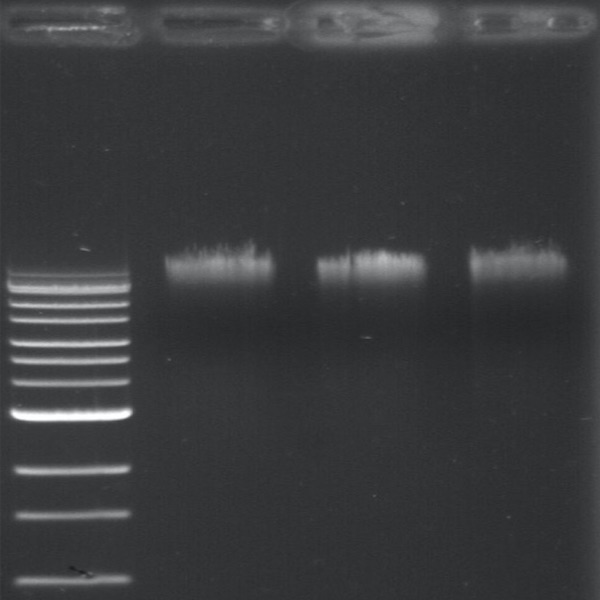
QC by migration on agarose gel 0,8% (70 ng DNA & 48,5 kb ladder)
The HMW DNA can be stored at 4 °C for several weeks
2h
Protocol references
1992: A quick and inexpensive method for removing polysaccharides from plant genomic DNA.
1995: Preparation of megabase-size DNA from plant nuclei
2008: Optimization of Binding, Washing and Elution Buffer for Development of DNA Isolation Kit
Chong Li Weng, Hafiz Yazid1, Suganthi Appalasamy, Boon Jia Geng, Wan Mohd Nazdrol Wan Mohd Nasir, Nik Maheran Nik Muhammad, Abd Hamid Mar Iman, Jayaraj Vijaya Kumaran
IOP Conf. Series: Earth and Environmental Science 596 (2020) 012008 doi:10.1088/1755-1315/596/1/012008
2012: Co-extraction of high-quality RNA and DNA from rubber tree (Hevea brasiliensis)
Zewei An, Qitong Wang, Yanshi Hu, Yanhong Zhao, Yacao Li, Han Cheng, Huasun Huang
African Journal of Biotechnology Vol. 11(39), pp. 9308-9314, 15 May, 2012
DOI: 10.5897/AJB12.136
2019: High molecular weight DNA isolation method from diverse plant species for use with Oxford Nanopore sequencing
Brieanne Vaillancourt and C. Robin Buel
bioRxiv preprint first posted online Sep. 26, 2019; doi: http://dx.doi.org/10.1101/783159.
2020: Bead-free long fragment LSK109 library preparation
John Tyson
https://dx.doi.org/10.17504/p rotocols.io.7eshjee
2020: High-molecular weight DNA extraction and small fragment removal of Ascochyta lentis
Johannes Wolfram JWD Debler , Ashley Jones , Ramawatar Nagar ,Anna Sharp , Benjamin Schwessinger
dx.doi.org/10.17504/protocols.io.bgw5jxg6
2021: HMW DNA extraction from diverse plants species for PacBio and Nanopore sequencing
https://dx.doi.org/10.17504/protocols.io.5t7g6rn
2021: Sequencing DNA with nanopores: Troubles and biases
Clara Delahaye, Jacques Nicolas
PLoS ONE 16(10): e0257521. https://doi.org/10.1371/ journal.pone.0257521
2022: Low-Input High-Molecular-Weight DNA Extraction for Long-Read Sequencing From Plants of Diverse Families
Alessia Russo, Baptiste Mayjonade, Daniel Frei, Giacomo Potente,
Roman T. Kellenberger, Léa Frachon, Dario Copetti, Bruno Studer, Jürg E. Frey, Ueli Grossniklaus and Philipp M. Schlüte
Frontiers in Plant Science , May 2022 | Volume 13 | Article 883897. doi: 10.3389/fpls.2022.883897
2022: Extraction and Oxford Nanopore sequencing of genomic DNA from filamentous Actinobacteria
Maria Alvarez-Arevalo, Eva Baggesgaard Sterndorff, David Faurdal, Tue Sparholt Jørgensen, Anna-Sophie Mourched, Oliwia Vuksanovic, Subhasish Saha, Tilmann Weber
2023: Optimization of Fruit DNA Extraction by Kitchen Kit Method with Isopropanol and Absolute Ethanol
Umi Kulsum Nur Qomariah
AGARICUS: Advances Agriculture Science & Farming - Vol.3No.1June2023, Page.6-10 E-ISSN: 2797-0884 e
Acknowledgements
I thank my colleagues who provided me with the samples for the development of this protocol:
Margaux Cheminat; Théo Guillaumot; Dimitri Heintz; Christophe Himber; Jean Molinier; Claire Villette & Julie Zumsteg (UPR2357 - Strasbourg). Christophe Papin (UMR7104 - Strasbourg)