Jul 24, 2025
Twenty-Six Body Measurements for the Somatomap App
- Katalin Groe1,
- Bea Calahong1,
- Joel P Diaz-Fong2,1,3,
- Sameena Karsan1,
- Jamie Feusner1,3,4,5
- 1Centre for Addiction and Mental Health;
- 2Semel Institute for Neuroscience and Human Behavior, University of California Los Angeles;
- 3Institute of Medical Science, University of Toronto;
- 4Department of Psychiatry, University of Toronto;
- 5Department of Women's and Children's Health, Karolinska Institutet



Protocol Citation: Katalin Groe, Bea Calahong, Joel P Diaz-Fong, Sameena Karsan, Jamie Feusner 2025. Twenty-Six Body Measurements for the Somatomap App. protocols.io https://dx.doi.org/10.17504/protocols.io.j8nlkoqzwv5r/v1
Manuscript citation:
License: This is an open access protocol distributed under the terms of the Creative Commons Attribution License, which permits unrestricted use, distribution, and reproduction in any medium, provided the original author and source are credited
Protocol status: Working
We use this protocol and it's working
Created: February 09, 2024
Last Modified: July 24, 2025
Protocol Integer ID: 94997
Keywords: Somatomap 3D, body measurements, body image, body size estimation, six body measurements for the somatomap app, body size estimation accuracy, specific to somatomap 3d, somatomap 3d application, six body measurement, somatomap 3d, comparison to body size alteration, body size alteration, somatomap app, different body part, physical measurement, standardized measurement, body part, digital avatar tool, shape, size, accuracy
Funders Acknowledgements:
National Institute of Mental Health (NIMH)
Grant ID: 3R01MH121520-04S1
Disclaimer
We are not responsible for the accuracy or reliability of measurements collected by users. Anyone using this protocol should undergo proper training and establish inter-rater reliability prior to data collection.
Abstract
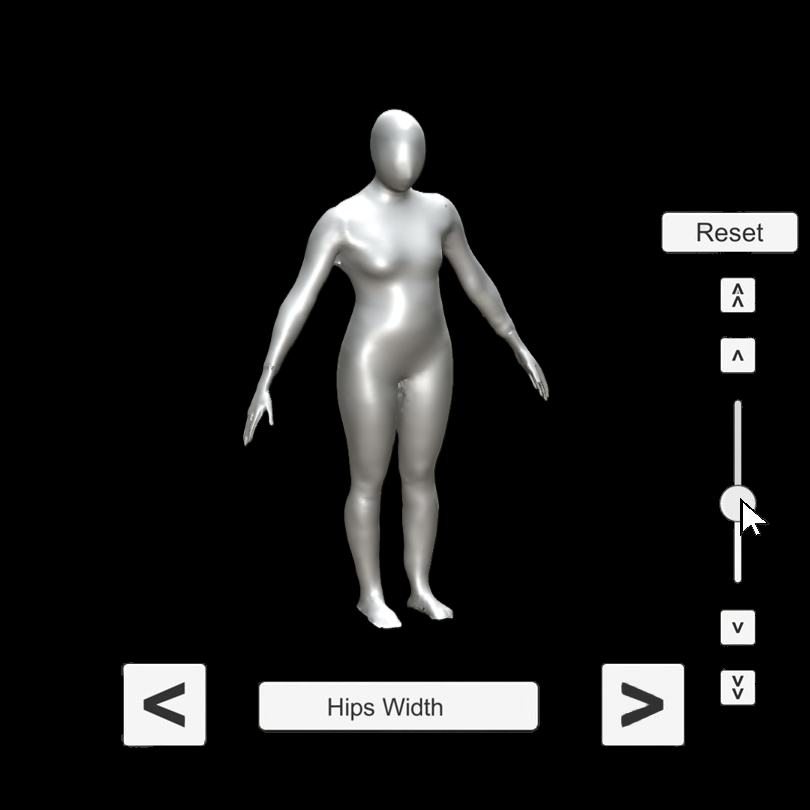
The present protocol describes the standardized measurements for the 26 body parts corresponding to the Somatomap 3D application. Somatomap 3D is a digital avatar tool which enables one to alter the size/shape of 26 different body parts. The physical measurements recorded by this protocol can be used in comparison to body size alterations on the application to calculate body size estimation accuracy. This protocol is specific to Somatomap 3D to promote accuracy and consistency in data.
Image Attribution
Screenshot of Somatomap 3D avatar, modified by the author. Used with permission.
Guidelines
After reviewing the protocol measurement details, take the participant's measurements using a tape measure and stadiometer.
- Ensure the participant is standing upright, looking straight ahead.
- Have a copy of the protocol measurements sheet on hand and follow it closely.
- Record all measurements on either a paper form or an electronic data capture form.
- Pull the tape measure snugly and evenly across the body (horizontally), and record measurements to the nearest 1 cm.
- Measure at the "0" point or at the end of the tape, depending on where "0" starts on your tape measure.
- Take measurements on both the right and left sides and record the mean value.
Materials
- Sewing tape measure
- Stadiometer
- Scale (for measuring body weight)
- Body composition device (e.g., DXA scanner or BIA device)
Before start
Warning: Do not let participants see the protocol or their measurements.
Basic measuring pointers
- Ask the participant to remove any heavy or bulky clothing, shoes, and socks.
- Ask the participant to stand straight, facing forward, with arms hanging naturally at their sides and feet parallel on the ground.
- Ask the participant to take a deep breath, exhale fully, and then take measurements in this relaxed state.
Standard Protocol Measurement
26m
Neck Girth
Ask the participant to stand upright, looking straight ahead. Measure the neck circumference at the midpoint (1/2-way point) of the measured neck length.
1m
Neck Height
Ask the participant to stand with their head tilted upward, looking above them. Measure the distance from the suprasternal notch (the dip at the base of the throat between the collarbones) to the angle of the mandible (the corner of the lower jaw). Take measurements on both the right and left sides.
1m
Shoulder Width
Ask participant to stand straight, with their chin perpendicular to the ground and arms relaxed at their side. Measure from the most lateral point of one acromion process, across the front of the upper chest, to the most lateral point of the opposite acromion process. The acromion process is the bony prominence at the highest point of the shoulder.
1m
Bust Girth:
Measure the circumference of the participant's upper body (around the back and chest), aligning the tape measure at the level of the nipples. The participant's arms should hang naturally at their sides in a relaxed position.
1m
Chest Girth
Measure the circumference of the participant's upper body (around the back and chest), aligning the tape measure at the level of the axilla (armpits). The participant's arms should hang naturally at their sides in a relaxed position.
1m
Abdomen Protrusion (Stomach Form)
Measure the length along the curvature of the abdomen at the midline, from the xiphoid process (the small bony tip at the bottom of the sternum) to the upper edge of the pubic symphysis (the joint at the front of the pelvis where the two pubic bones meet). The participant's arms should hang naturally at their sides in a relaxed position.
1m
Upper Arm (Bicep) Girth
Measure the circumference at the midpoint (1/2-way point) between the acromion process (the bony prominence at the highest point of the shoulder) and the olecranon process (the bony prominence of the elbow). The participant's arms should hang naturally at their sides in a relaxed position. Take measurements on both the right and left sides and record the mean.
1m
Upper Arm Length
Measure vertically from the acromion process (the bony prominence at the highest point of the shoulder) to the olecranon process (the bony prominence of the elbow). The participant's arms should hang naturally at their sides in a relaxed position. Take measurements on both the right and left sides and record the mean.
1m
Elbow Girth
Locate the olecranon process (the bony prominence of the elbow) and measure the circumference around the elbow at that level. If the olecranon is difficult to locate, ask the participant to bend their elbow slightly, as this will make the protrusion more prominent. Take measurements on both the right and left sides and record the mean.
1m
Lower Arm (Forearm) Girth
Measure the circumference at the midpoint (1/2-way point) between the olecranon process (the bony prominence of the elbow) and the crease of the wrist at the base of the hand on the palmar side. The participant's arms should hang naturally at their sides in a relaxed position. Take measurements on both the right and left sides and record the mean.
1m
Lower Arm (Forearm) Length
Measure vertically from the olecranon process (the bony prominence of the elbow) to the crease of the wrist at the base of the hand on the palmar side. The participant's arms should hang naturally at their sides in a relaxed position. Take measurements on both the right and left sides and record the mean.
1m
Wrist Girth
Measure the circumference of the wrist, over the ulnar styloid (bony prominence of the wrist, on the pinky side). Arms should be hanging naturally at the sides in a relaxed position. Take measurements on both the right and left sides and record the mean.
1m
Hand Size
Measure the circumference of the hand above the base of the thumb across the palm Take measurements on both the right and left hands and record the mean.
1m
Hand Length
Measure the vertical length of the hand from the top of the middle finger to the first wrist crease on the palmar side. Take measurements on both the right and left sides and record the mean.
1m
Torso Length
Ask the participant to tilt their head forward and to place their hands on their iliac crests (typically at the level of the navel). Measure vertically from the bony prominence at the base of their neck down the spine to the midpoint between participant's hands, as they rest them on their iliac crests.
1m
Waist Size
Measure the circumference at the midpoint (1/2-way point) between the lowest rib and the highest point of the iliac crest (typically at the level of the navel), at the end of the participant's normal expiration. The participant's arms should hang naturally at their sides in a relaxed position.
1m
Hip (Buttocks) Size
Measure the circumference at the widest part of the hips and buttocks. This area typically falls 18-20 cm below the natural waist, which is located midway between the lower ribs and the iliac crest. Use the greater trochanter of the femur (the bony prominence at the upper outer thigh) as a bony landmark to help locate the widest point of the hip.
Before measuring, ask the participant to stand with their legs close together. Anchor one end of the tape measure at the widest point of one hip and hold it firmly in place while wrapping the other end of the tape measure around the hips. Ensure the tape measure remains horizontal and parallel to the floor throughout the measurement.
1m
Hip Width:
Use the same landmarks as for hip (buttocks) size (widest point of the hips, near the level of the greater trochanter). Instead of measuring around the body, measure the straight lateral distance from the outermost point of one hip to the outermost point of the other, in the front.
1m
Thigh Girth
Measure the circumference at the midpoint (1/2-way point) of the thigh height. Take measurements on the right and left thigh girth to obtain the mean.
1m
Thigh Length
Measure vertically from the iliac crest to the top of the patella (kneecap). Take measurements on the right and left thigh height to obtain the mean.
1m
Knee Girth
Locate the middle of the patella and measure horizontally all the way around the knee. Take measurements on both the right and left sides and record the mean.
1m
Lower Leg Length
Measure vertically from the top of the patella (commonly known as the kneecap) down to the lateral malleolus (bony prominence on the outer side of your ankle). Take measurements on both the right and left sides and record the mean.
1m
Lower Leg (Calf) Girth
Measure the circumference of the calf at the upper 1/3 of the distance from the top of the patella to the medial malleolus. Take measurements on both the right and left sides and record the mean.
1m
Ankle Girth
As participant stands with legs apart, measure at narrowest point of the ankle. Move the tape measure up and down the area until the narrowest point is located. Take measurements on both the right and left sides and record the mean.
1m
Feet Width
Measure horizontally across the widest part of the foot (typically across the ball of the foot). Take measurements on both the right and left sides and record the mean.
1m
Feet Length
Measure vertically from the longest toe (typically the big toe or second toe) to the back of the heel. Take measurements on both the right and left sides and record the mean.
1m
Additional Body Measurements
2m
Height (in cm)
Ask the participant to remove hair ornaments, jewelry, buns, or braids from the top of the head that may interfere with the measurement. Shoes and socks should also be removed. Ask the participant to stand straight against the backboard, with body weight evenly distributed and both feet flat on the stadiometer platform. The participant's feet should be positioned with the heels together and toes pointed slightly outward, approximately at a 160-degree angle. Check to ensure that the back of the head, shoulder blades, buttocks, and heels make contact with the stadiometer backboard.
NOTE: Depending on the individual's overall body conformation, all four contact points—head, shoulders, buttocks, and heels—may not full contact the backboard. In such cases, obtain the best measurement possible according to the protocol.
Once positioned, lower the stadiometer headpiece so that it rests firmly on top of the participant's head, with sufficient pressure to compress the hair. Instruct the participant to stand as tall as possible, take a deep breath, and hold this position. Taking a deep breath helps straighten the spine and yields a more consistent and reproducible stature measurement. You may notice that inhalation causes the headpiece to rise slightly.
As soon as the participant inhales and holds the position, record the measurement. After recording, instruct the participant to relax. Raise the stadiometer headpiece and have the participant step away from the stadiometer.
Adjustments for hair: If participants are unable to remove braids, buns, or headwear that interferes with the measurement, measure the distance from the scalp to the top of the hair using a small ruler, to the nearest 0.1 cm. Subtract this distance from the original stature measurement to obtain a corrected height value.
Adapted from the NHANES Anthropometry Procedures Manual (CDC, 2007).
1m
Weight (in kg):
Ask the participant to stand on the scale with feet evenly distributed on the platform and maintain a straight, upright posture with arms hanging naturally at their sides. Instruct the participant to remain still and wait for the scale to stabilize. Record the displayed weight once it is steady.
Body Composition
The preferred method for body composition assessment in the lab is dual-energy X-ray absorptiometry (DXA), as it provides both whole-body and regional measurements with available normative references. If using bioelectrical impedance analysis (BIA), first calibrate the device using a 5 kg or 10 kg reference weight. After entering the participant's age, gender, and height, instruct them to stand barefoot on the foot conductors and to firmly grip the hand-held conductors. The participant's arms should be extended straight down and slightly forward, without touching the body.
Fat %:
Muscle %:
BMI:
1m
Protocol references
Centers for Disease Control and Prevention. (2007). National Health and Nutrition Examination Survey 2007-2008 Anthropometry procedures manual. Retrieved from https://wwwn.cdc.gov/nchs/data/nhanes/public/2007/manuals/manual_an.pdf
Acknowledgements
The Somatomap Software used in this research was created by Jamie D. Feusner, Armen C, Arevian, and Nanthia Suthana (UCLA); and Sahib S. Khalsa and Christina Ralph-Nearman (Laureate Institute for Brain Research). ‱ 2023 UCLA. Originally published in JMIR Mental Health (http://mental.jmir.org), 29.10.2019. Ralph-Nearman, C., Arevian, A. C., Puhl, M., Kumar, R., Villaroman, D., Suthana, N., Feusner, J. D., & Khalsa, S. S. (2019). A Novel Mobile Tool (Somatomap) to Assess Body Image Perception Pilot Tested With Fashion Models and Nonmodels: Cross-Sectional Study. JMIR mental health, 6(10), e14115. https://doi.org/10.2196/14115