Aug 12, 2022
Transforming yeast
This protocol is a draft, published without a DOI.
- 1University of Wisconsin - Stout
- Yeast ORFans CURE



Protocol Citation: Brian Teague 2022. Transforming yeast. protocols.io https://dx.doi.org/
License: This is an open access protocol distributed under the terms of the Creative Commons Attribution License, which permits unrestricted use, distribution, and reproduction in any medium, provided the original author and source are credited
Protocol status: Working
We use this protocol and it's working
Created: August 12, 2022
Last Modified: August 12, 2022
Protocol Integer ID: 68576
Keywords: yeast, transformation, plasmid, dna, transforming yeast, yeast in the same way, linear dna, genomic location
Abstract
In the same way that we transformed E. coli by making them take up a plasmid, we will transform yeast by inducing them to take up both a plasmid (to cut your genomic location) and some linear DNA to repair that location.
Image Attribution
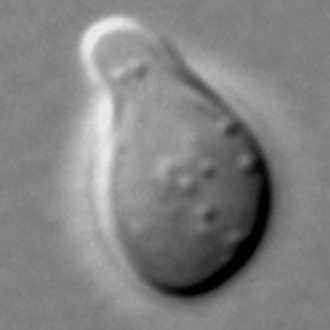
Masur, Public domain, via Wikimedia Commons
Materials
Equipment
- Hot water bath (or dry bath or incubator) set to 42 °C
- Vortexer
- Microcentrifuge
- Incubator set to30 °C
Materials
- 1 tube of frozen competent yeast cells, stored at -80 °C
- Polyethylene Glycol (PEG) 3350Electron Microscopy SciencesCatalog #19760 solution, 50 Mass / % volume
- Lithium Acetate DihydrateMerck MilliporeSigma (Sigma-Aldrich)Catalog #L4158 solution, 1 Mass Percent
- Salmon Sperm DNAResearch Products International Corp (RPI)Catalog #D52150 , 2 mg/mL
- Plasmid DNA to transform
- URA3 PCR product
- Sterile water
- 1 yeast media plate without uracil
- 1 yeast media plate without leucine
- Glass beads 5 mmVWR International (Avantor)Catalog #26396-596
Protocol materials
Salmon Sperm DNAResearch Products International Corp (RPI)Catalog #D52150
Polyethylene Glycol (PEG) 3350Electron Microscopy SciencesCatalog #19760
Lithium Acetate DihydrateMerck MilliporeSigma (Sigma-Aldrich)Catalog #L4158
Glass beads 5 mmVWR International (Avantor)Catalog #26396-596
Safety warnings
Lithium acetate can cause serious eye and skin irritation. Wear appropriate PPE, including a lab coat, gloves, and safety glasses.
- Compute the volume of your Cas9 plasmid that contains 1 µg of DNA.
- Compute the volume of your URA3 PCR product that contains 500 ng of DNA.
- If you don't have enough DNA for one or both of these, check with an instructor.
Immediately upon retrieving a tube of yeast cells from the -80 °C freezer, thaw them rapidly by putting them in the 42 °C water bath for 00:00:30
30s
Centrifuge 13.000 x g, 00:02:00 . Remove and discard the supernatant.
2m
Add the following to the tube of yeast cells in order:
- 260 µL Polyethylene Glycol (PEG) 3350Electron Microscopy SciencesCatalog #19760 50 Mass / % volume
- 36 µL Lithium Acetate DihydrateMerck MilliporeSigma (Sigma-Aldrich)Catalog #L4158 1 Mass Percent
- 50 µL Salmon Sperm DNAResearch Products International Corp (RPI)Catalog #D52150 2 mg/mL
- Enough plasmid DNA to equal 1 µg of DNA (computed above)
- Enough PCR product to equal 500 ng of DNA (computed above)
Vortex vigorously to resuspend the pellet in the transformation mix.
Note
(This may take from 30 seconds to a minute -- be patient!
Incubate in the 42 °C water bath for 00:30:00
Note
Use a water bath float so you don't have to stand there!
30m
Centrifuge 13000 x g, 00:00:30 . Aspirate the supernatant.
30s
Pipette 1 mL of sterile water into the transformation tube. Stir the pellet with a micropipette tip to break up the cell pellet, then vortex to thoroughly resuspend the pellet.
Pour 5-10 glass beads on a Uracil dropout plate. Pipette 100 µL of cells onto it. Shake the plate to spread the cells out.
Pour 5-10 glass beads on a Leucine plate. Pipette 100 µL of cells onto it. Shake the plate to spread the cells out.
Incubate 48-72 hours upside down at 30 °C .