Feb 13, 2026
The Lamprey field sampling kit : a protocol for plankton biomass DNA sampling
- Erwan Legeay1,2,
- Noan Le Bescot3,2,
- Colomban De Vargas1,2,4
- 1Sorbonne Université, CNRS, UMR7144 Adaptation et Diversité en Milieu Marin, ECOMAP, Station Biologique de Roscoff, F-29680 Roscoff, France;
- 2Plankton Planet Non-Governmental Organization (NGO), Station Biologique de Roscoff, 29680 Roscoff, France;
- 3SeaLabX SAS, Plougastel-Daoulas, France;
- 4Research Federation for the study of Global Ocean Systems Ecology and Evolution, FR2022 Tara GOSEE, F-75016 Paris, France



Protocol Citation: Erwan Legeay, Noan Le Bescot, Colomban De Vargas 2026. The Lamprey field sampling kit : a protocol for plankton biomass DNA sampling. protocols.io https://dx.doi.org/10.17504/protocols.io.rm7vz63y5gx1/v1
License: This is an open access protocol distributed under the terms of the Creative Commons Attribution License, which permits unrestricted use, distribution, and reproduction in any medium, provided the original author and source are credited
Protocol status: Working
We use this protocol and it's working
Created: April 07, 2025
Last Modified: February 13, 2026
Protocol Integer ID: 126250
Keywords: Lamprey, plankton, eDNA, protocol for plankton biomass dna sampling, plankton biomass dna sampling, core component of the lamprey protocol, lamprey protocol, lamprey field, fresh waters for subsequent dna extraction, plankton biomass, concentration of plankton biomass, plankton, contained mobile water filtration unit, mobile water filtration unit, total dna for future laboratory analysis, dna, subsequent dna extraction, membrane, sampling kit, filtler, total dna, rna shield, diameter filter membrane, fresh water
Abstract
The Lamprey protocol is based on a cost-effective and field-friendly kit designed for sampling and concentration of plankton biomass from marine or fresh waters for subsequent DNA extraction and analyses. The core component of the Lamprey protocol is a self-contained mobile water filtration unit (35 x 30 x 15 cm). It uses a peristaltic pump, and a magnetic filter holder to pass water through a 47mm-diameter filter membrane and collect plankton biomass. The variable porosity of the membranes allows for the selection of different size fractions of plankton. The filtler-membranes are then stored in a buffer solution (DNA/RNA shield) in order to preserve total DNA for future laboratory analyses.
Image Attribution
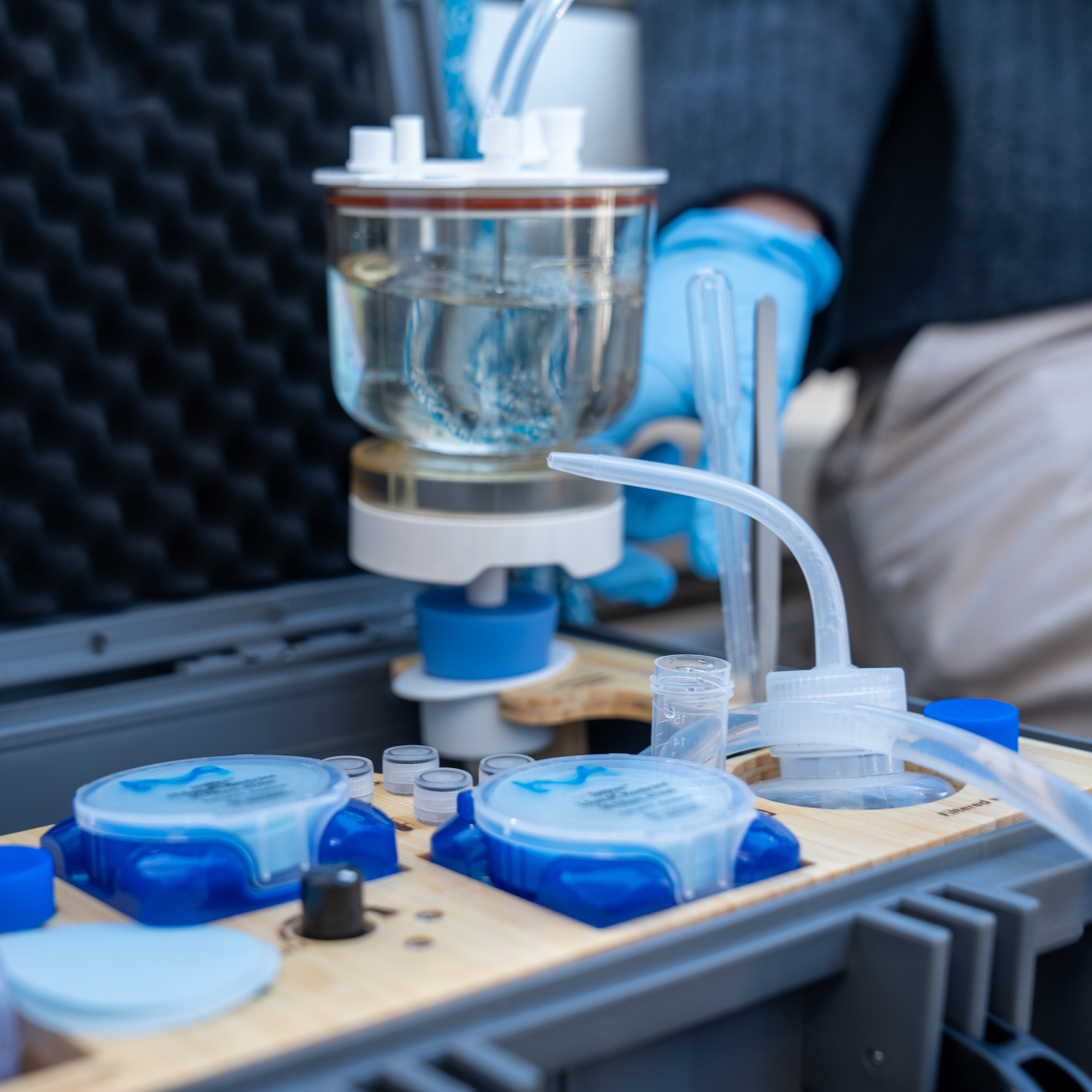
Protocol Image - Marée Montante Films©
Materials
- Gloves
- Lamprey kit
- Bashingbead Lysis tubes (S6012-50 Zymo Research)
- DNA/RNA Shield (R1100 Zymo research)
Before start
- Prepare a 10% dilution of bleach solution to fill the dedicated 15 mL tube in the Lamprey kit
- Prepare filtered seawater (FSW) to fill the dedicated 15 mL tube and the 150 mL squeeze bottle in the kit
- Clean the tweezers using the 10% bleach solution, followed by rinsing in the FSW
- Ensure thet the battery is fully charged
- Prepare bashingbead lysis tubes with 1mL of DNA/RNA Shield
Assembling the Lamprey filtration system
The case contains all the components needed to assemble the filtration system and handle the filter-membranes without contamination (Fig. 1). It is crucial to wear gloves when handling the filter-membranes and keep the instrument as clean as possible.
Figure 1 : Lamprey kit
Support assembly
Open the case, remove the components, and begin assembling the filter-holder support by following the steps shown (Fig. 2).
Figure 2 : How to assemble the support
Next, place all components in their designated positions (Fig. 3) and install the filter holder on the support (Fig. 4).
Figure 3 : Assemble the Lamprey v4.0. A) Filter holder,
B) Tweezers, C) Wash bottle, D) Silicone tubing,
E) Membrane, F) Tube holder, G) Potentiometer,
H) Lithium battery / Waterproof box, I) Peristaltic
pump, J) Bleach tube
Figure 4 : Lamprey magnetic filter holder
MF 3pro 47mm manufactured by Rocker.
A) Funnel lid, B) Magnetic Funnel 300mL
capacity, C) Magnetic support base,
D) Silicone stopper
Pump connection
Now that the Lamprey is assembled, connect the filter holder to the peristaltic pump using the specified pipe (Fig. 5). Position the outlet pipe outside the case. The outlet can be directed into a waste container or a bottle to collect the filtrate (e.g. filtered seawater).
Figure 5 : Peristaltic pump, rotation 300 rpm, flow rate 700mL/min
Battery setup
The pump is powered by a 12V Lithium battery, housed in a waterproof box. Connect the battery to the pump (ensure the button is set to ON, depending on the battery version). To recharge the battery, first disconnect it from the pump and then connect it to the charger. A red light indicates that the battery is charging, and it turns green when fully charged (Fig. 6).
Figure 6 : Battery connection. A) Waterproof box, B) battery connected to the pump, C) Battery in charge
The Lamprey can also be operated from mains supply. In this case the battery must be disconnected from the pump. Use a appropriate cable and converter (220V transformers output 12V, different from the one used to recharge the battery) and connect the pump to the mains supply (Fig. 7).
Figure 7 : Lamprey power supply
Before starting filtration
- Prepare bleach solution to fill the dedicated 15 mL tube.
- Prepare filtered seawater (FSW) to fill the dedicated 15 mL tube and the 150 mL squeeze bottle
- Clean the tweezers
- Ensure that the battery is fully charged
Filtering plankton biomass using the Lamprey system
- Wear gloves and keep them on throughout the procedure.
- Open the filter holder and spray FSW onto the support screen using the squeeze bottle to wet it.
- Using clean tweezers, take a filter-membrane out of its box, and place it onto the filter holder, maintaining the same orientation (the side that faces up in the box has to face up also on the support), and making sure that the filter-membrane lies flat (not folded) on the support screen.
- Carefully close the magnetic filter holder without its lid on, and gently stire the plankton sample to ensure its homogeneity. Pour the sample into the funnel using a graduated cylinder. Turn on the peristaltic pump. Perform a step-by-step filtration of 100 mL aliquots, and stop whenever the filter membrane becomes saturated and clogs. Record the volume of the sample poured into the funnel. During filtration, check that there is no leakage from the connections or the filter holder.
- Once all the sample has been filtered (i.e. when the filter is saturated), rinse the graduated cylinder and then the funnel with FSW from the wash bottle to recover any plankton particles adhering to the walls.
- When all the water has passed through, leave then the pump running until the filter is completely dry.
- Switch off the pump and open the magnetic filter holder. Using the tweezers, carefully fold the filter and place it in a tube containing beads and DNA/RNA Shield (Fig. 8). Invert the tube several times to impregnate the entire filter. Make sure that the filter stays immersed in the buffer. Label and store the tube at -20°C for long-term storage.
- Clean the tweezers with 10% bleach, followed by rinsing in FSW before using another filter.
Figure 8 : How to fold the membrane
Cleaning
15m
- Position a container to collect rinse water, and rinse all the filtration system with freshwater.
- Fill the system with bleach solution, activate the pump to fill the pipes, and stop the pump once the system is full, wait 10 minutes before empty the system.
- Rinse residual bleach with water (preferably MilliQ water if available) by activating the pump until as much water as possible is removed.
- Clean the surface of the Lamprey, especially areas exposed to seawater. If the Lamprey system is not used for an extended period of time, ensure that is completely dry.
Troubleshooting
Leaks from the filter holder
There might be water or detritus between the two magnetic parts of the filter holder.
Solution : Clean and dry all components carefully between each filtration to prevent leaks.
Water in the pump chamber
This may occur if connectors are dislodged or if the tube is punctured.
Solution : Disassemble the pump chamber, inspect the silicone tube and connections, replace them if necessary.
The pump does not work
The battery may be disconnected or discharged.
If it is the first use, the mechanism is potentially blocked, and the battery does not give enough power.
Solution : Check the battery connections and charge. Connect the pump directly to DC.
External links
Technical sheet SeaLabX
Lamprey Slack channel
Plankton Planet website