Oct 06, 2025
Technology Integration Approaches for Multi-Site Healthcare Education Delivery: A Scoping Review Protocol
- Raed Rafeh1,
- Sara Kazim2,
- Wail Bamadhaf3,
- Zeyad Alrais4,
- Aysha Alsharhan5,
- Jukha Shater Al Marzooqi6,
- Khadija Mohd AlSulaimi7,
- Mersiha Kovacevic8,
- Nabil Zary8
- 1DAI, Dubai Health;
- 2Emergency Medicine Department, Dubai Health;
- 3Graduate Medical Education, Mohammed Bin Rashid University of Medicine and Health Sciences, Dubai Health;
- 4Critical Care Department, Dubai Health;
- 5Hamdan Bin Rashid Cancer Hospital, Dubai Health;
- 6Al Jalila Children’s Specialty Hospital, Dubai Health;
- 7Latifa Hospital, Dubai Health;
- 8Institute of Learning, Mohammed Bin Rashid University of Medicine and Health Sciences, Dubai Health
- NeuroInk



Protocol Citation: Raed Rafeh, Sara Kazim, Wail Bamadhaf, Zeyad Alrais, Aysha Alsharhan, Jukha Shater Al Marzooqi, Khadija Mohd AlSulaimi, Mersiha Kovacevic, Nabil Zary 2025. Technology Integration Approaches for Multi-Site Healthcare Education Delivery: A Scoping Review Protocol. protocols.io https://dx.doi.org/10.17504/protocols.io.14egnrnkpl5d/v1
License: This is an open access protocol distributed under the terms of the Creative Commons Attribution License, which permits unrestricted use, distribution, and reproduction in any medium, provided the original author and source are credited
Protocol status: Working
We use this protocol and it's working
Created: October 06, 2025
Last Modified: October 06, 2025
Protocol Integer ID: 229175
Keywords: Distributed medical education, digital infrastructure, educational technology, learning management systems, technology integration, digital equity, technical support systems, telemedicine education, virtual learning environments, healthcare education technology, infrastructure maturity, distributed healthcare education, healthcare education across multiple location, distributed healthcare education network, healthcare education delivery, adaptable academic health system, healthcare education network, academic health system, healthcare education, decisions in academic health system, planned technology integration, it integration strategy, databases such as pubmed, technology infrastructure, integrating technology, best technology infrastructure model, scoping review protocol background, scoping review protocol, research gaps within digital infrastructure, consistent educational quality across various geographic area, digital platform, existing evidence on the specific technology need, technology planning, spec
Abstract
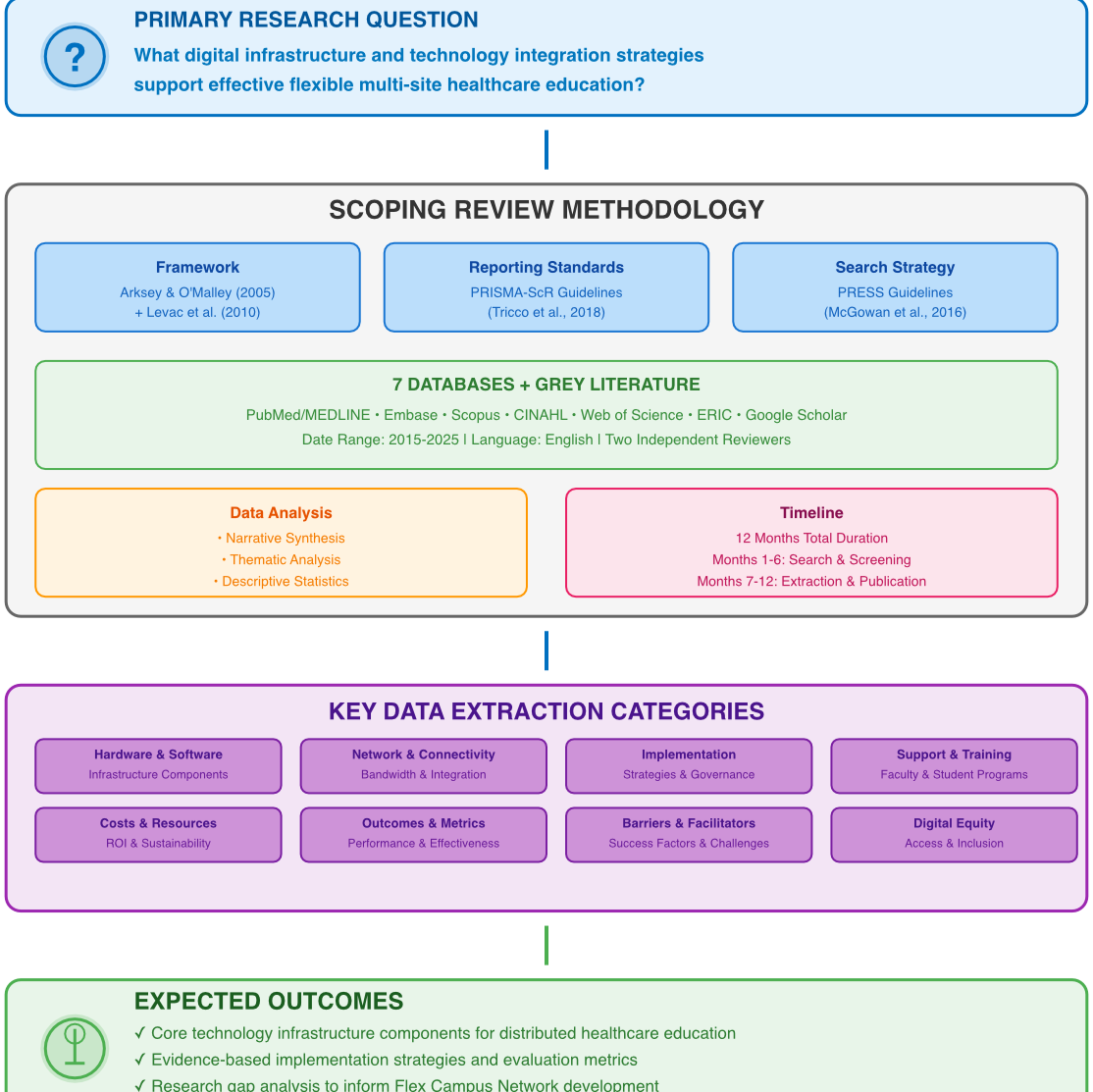
Background: Expanding distributed healthcare education networks depends on strong digital infrastructure and well-planned technology integration. Nonetheless, existing evidence on the specific technology needs, implementation methods, and effectiveness assessments for multi-site healthcare education is scattered. Identifying the best technology infrastructure models is essential for creating scalable and adaptable academic health systems that ensure consistent educational quality across various geographic areas.
Objective: To systematically identify and compile existing evidence on the needs for digital infrastructure and strategies for integrating technology that facilitate effective distributed healthcare education across multiple locations.
Methods: This scoping review will adhere to the methodological framework set out by Arksey and O'Malley (2005), with refinements from Levac et al. (2010), and will be reported following the PRISMA Extension for Scoping Reviews (PRISMA-ScR) guidelines. Our search will include databases such as PubMed/MEDLINE, Embase, Scopus, CINAHL, Web of Science, ERIC, along with grey literature sources, targeting studies published from 2015 to 2025. We will include studies focusing on technology infrastructure, digital platforms, learning management systems, simulation technologies, and IT integration strategies in distributed healthcare education. Screening and data extraction will be performed independently by two reviewers. The results will be summarized through narrative synthesis and thematic analysis, with additional reporting via descriptive statistics.
Expected Outcomes:This review will pinpoint essential technology infrastructure components, strategies for implementation, evaluation criteria, and research gaps within digital infrastructure for distributed healthcare education. The insights gained will guide technology planning for adaptable campus networks and support evidence-based decisions in academic health systems.
Image Attribution
Created using Affinity Designer 2 (NZ)
Guidelines
- PRISMA Extension for Scoping Reviews (PRISMA-ScR) Checklist
- Arksey and O'Malley Scoping Review Framework (with Levac refinements)
- PRESS (Peer Review of Electronic Search Strategies) guidelines
Materials
- Computers with internet access
- Reference management software (Mendeley, EndNote, or Zotero)
- Covidence systematic review management software
- Access to academic databases (PubMed/MEDLINE, Embase, Scopus, CINAHL, Web of Science, ERIC)
- Microsoft Word and Excel for data management
Objectives
Systematically map the literature on digital infrastructure and technology integration in distributed healthcare education systems.
Characterize infrastructure maturity across four dimensions:
(a) Infrastructure Capacity
(b) Technical Support Systems
(c) Pedagogical Integration
(d) Digital Equity Orientation.
Identify technology models supporting distributed education across infrastructure maturity levels.
Examine strategies promoting digital equity and infrastructure parity across distributed sites.
Analyze technology-related challenges and solutions specific to distributed healthcare education.
Synthesize outcomes associated with different infrastructure maturity levels and integration approaches.
Research Questions
Primary Research Question
What digital infrastructure and technology integration strategies support effective, flexible multi-site
healthcare education delivery?
Secondary Research Questions
- What specific hardware, software, networking, and connectivity requirements have been identified for synchronous and asynchronous distributed healthcare education?
- What learning management systems, video conferencing platforms, simulation technologies, and educational tools are utilized in multi-site healthcare education contexts, and what evidence exists regarding their effectiveness?
- What integration strategies enable interoperability between educational technologies and clinical/administrative systems in distributed academic health networks?
- What implementation approaches, change management strategies, and governance models facilitate successful technology deployment across multiple sites?
- What are the reported barriers, facilitators, and critical success factors for digital infrastructure implementation in distributed healthcare education?
- What evaluation frameworks, metrics, and assessment methods are used to measure technology infrastructure effectiveness in multi-site educational settings?
- What technical support models, training programs, and professional development initiatives support faculty and student technology adoption across distributed campuses?
- What are the cost considerations, resource requirements, and sustainability factors associated with technology infrastructure for distributed healthcare education?
- How do technology infrastructure approaches address digital equity, accessibility, and inclusion across diverse geographic and socioeconomic contexts?
- What research gaps and future priorities exist regarding technology infrastructure for distributed healthcare education
Methodology Overview
Follow Joanna Briggs Institute (JBI) methodology for scoping reviews and report according to PRISMA-ScR guidelines.
Register protocol on protocols.io prior to search execution.
Conduct systematic search across multiple databases (MEDLINE, Embase, ERIC, Web of Science) and gray literature sources (2000-2025).
Use duplicate independent screening and data extraction processes.
Apply the Four-Dimensional Digital Infrastructure Maturity Model for systematic characterization.
Present findings with dimensional analysis, descriptive statistics, narrative synthesis, and visual presentations.
Conceptual Framework
Apply the Four-Dimensional Digital Infrastructure Maturity Model with five maturity levels (1-5) across each dimension:
DIMENSION 1: Infrastructure Capacity (Hardware, Software, Connectivity, Platforms)
- Level 1: Minimal/Inconsistent - Basic computers, unreliable internet
- Level 2: Foundational - LMS adopted, basic video conferencing, reliable connectivity at most sites
- Level 3: Comprehensive Integrated - Standardized equipment, high-speed internet at all sites, interoperability
- Level 4: Advanced Technology-Enhanced - VR/AR, AI platforms, learning analytics, enterprise connectivity
- Level 5: Cutting-Edge Transformative - Emerging technologies, next-gen networks, technology leadership
DIMENSION 2: Technical Support Systems (IT Support, Maintenance, Training, Responsiveness)
- Level 1: Ad Hoc/Reactive - No dedicated educational tech support, crisis-driven
- Level 2: Basic Support - Help desk available, 1-2 staff at main campus
- Level 3: Comprehensive Multi-Site - Support at ≥50% sites, regular faculty development
- Level 4: Strategic Distributed Network - Support at all sites, 24/7 for critical systems, proactive monitoring
- Level 5: Transformative Ecosystem - Embedded specialists, AI-enhanced support, continuous innovation
DIMENSION 3: Pedagogical Integration (How Technology is used in Teaching, Learning, and Assessment)
- Level 1: Minimal/Substitute - Rarely used, simple substitution (PDF vs. paper)
- Level 2: Functional Enhancement - Content delivery, recorded lectures, basic online quizzes
- Level 3: Intentional Systematic - Flipped classroom, interactive LMS, technology integral to design
- Level 4: Transformative Innovation - VR/AR, AI-facilitated personalization, new pedagogies enabled
- Level 5: Continuous Pedagogical Innovation - Cutting-edge pedagogies, theinstitution is leader
DIMENSION 4: Digital Equity Orientation (Awareness, Actions, Outcomes Related to Technology Equity)
- Level 1: No Explicit Consideration - Equity not discussed, disparities accepted
- Level 2: Awareness and Documentation - Disparities recognized and documented
- Level 3: Active Equity Initiatives - Equity explicit priority, dedicated budget, measurable gap reduction
- Level 4: Systematic Equity-Driven - Equity embedded in culture, infrastructure parity achieved
- Level 5: Equity Leadership and Innovation - Institution is an equity leader, full parity sustained
Rate each distributed system on all four dimensions (1-5) separately, enabling analysis of strengths, gaps, and dimensional relationships.
Search Strategy
Three-concept search strategy requiring distributed context: (Healthcare Education) AND (Distributed/Multi-Site - REQUIRED) AND (Technology/Infrastructure)
Concept 1: Healthcare Education
Medical education OR nursing education OR health professions education OR clinical education OR healthcare students OR medical students OR nursing students OR residents OR fellows OR academic health systems
Concept 2: Distributed/Multi-Site Education (REQUIRED in all searches)
Distributed medical education OR distributed education OR regional medical campus OR rural education OR rural medical education OR multi-site OR multisite OR satellite campus OR branch campus OR community-based education OR remote learning sites OR geographically distributed OR decentralized education
Concept 3: Digital Infrastructure and Technology
Educational technology OR digital technology OR e-learning OR digital learning OR learning management system OR LMS OR video conferencing OR synchronous learning OR virtual classroom OR simulation OR virtual reality OR augmented reality OR digital infrastructure OR technology infrastructure OR technology integration OR digital equity OR digital divide OR technology access OR technical support OR IT support OR learning analytics OR mobile learning OR telemedicine education OR interoperability OR digital platforms
Sample search strategy (MEDLINE via Ovid):
1. exp Education, Medical/ OR exp Education, Nursing/ OR "health professions education".mp.
2. "distributed medical education".mp. OR "regional campus".mp. OR "rural education".mp. OR "multisite education".mp. OR "satellite campus".mp. OR "community-based education".mp.
3. "educational technology".mp. OR exp Educational Technology/ OR "learning management system".mp. OR "digital infrastructure".mp. OR "video conferencing".mp. OR "technology integration".mp. OR "digital equity".mp. OR "technical support".mp. OR simulation/
4. 1 AND 2 AND 3
5. Limit to English language, year 2000-current
Search execution across databases:
- MEDLINE (Ovid)
- Embase (Ovid)
- ERIC (EBSCOhost)
- Web of Science Core Collection
- Cochrane Central Register of Controlled Trials
- ProQuest Dissertations and Theses Global
Gray literature sources:
- MedEdPORTAL
- AMEE conference proceedings
- AAMC publications
- Relevant organizational websites (WONCA, NOSM, regional medical education organizations)
- Google Scholar (first 200 results)
Peer review search strategy using PRESS (Peer Review of Electronic Search Strategies) checklist with health sciences librarian.
Study Selection
Title and Abstract Screening
Two independent reviewers screen all titles/abstracts using Covidence.
Inclusion criteria:
- Population: Healthcare professions learners in distributed education programs (≥2 geographically separate sites)
- Concept: Digital infrastructure, educational technology, technology integration
- Context: Distributed healthcare education, any location, any educational level
- Source types: All study designs, gray literature
Exclusion criteria:
- Single-site programs
- Technology for patient care without educational component
- Fully online programs without distributed physical clinical sites
- Published before 2000
- Non-English language
Pilot screening on 50 citations to calibrate reviewers and refine criteria.
Calculate inter-rater reliability (Cohen's kappa) after first 100 citations; target κ ≥ 0.70.
Resolve disagreements through discussion or third-reviewer arbitration.
Full-Text Review
Two independent reviewers assess all full texts against inclusion criteria.
Document reasons for exclusion systematically.
Resolve disagreements through discussion or arbitration.
Conduct citation chaining: hand-search reference lists and forward citation search (Web of Science, Google Scholar).
Data Extraction
General Study Characteristics
- Author, year, country, publication type
- Study design and methodology
- Healthcare profession(s), educational level
- Number of distributed sites, site characteristics (urban/rural, resource level)
- Sample size, duration
- Funding source (particularly technology vendor funding)
Four-Dimensional Infrastructure Maturity Extraction
DIMENSION 1: Infrastructure Capacity (Rate 1-5)
Extract:
- Hardware: Computers, video conferencing equipment, simulation technology, mobile devices
- Software/Platforms: LMS (name, usage), video tools, assessment platforms, collaboration tools, clinical systems used educationally
- Connectivity: Internet bandwidth, reliability, backup systems
- Platforms: Integration, interoperability, cloud vs. on-premise.
DIMENSION 2: Technical Support Systems (Rate 1-5)
Extract:
- Support Model: Centralized, distributed, hybrid
- Staffing: Number, types, and locations of support staff
- Availability: Support hours, weekend/after-hours coverage, response times
- Training: Faculty development, student technology orientation
- Response: Ticketing, SLAs, proactive vs. reactive
DIMENSION 3: Pedagogical Integration (Rate 1-5)
Extract:
- Teaching Applications: How is technology used in teaching
- Learning Activities: How students use technology
- Assessment Approaches: Technology-supported assessment
- Collaboration: Technology-enabled collaboration within/across sites
- Curriculum Design: Technology integration in curriculum planning
DIMENSION 4: Digital Equity Orientation (Rate 1-5)
Extract:
- Equity Awareness: Recognition of infrastructure disparities
- Equity Assessment: Measurement/documentation of disparities
- Equity Policies: Strategic priorities related to technology equity
- Equity Actions: Specific interventions (equipment programs, connectivity support, targeted investments)
- Equity Outcomes: Infrastructure parity achievement, remaining gaps
Main Campus vs. Distributed Site Comparison
For each dimension, extract whether distributed sites achieve parity with the main campus or show disparities.
Technology-Specific Information
- Specific technologies used (list with descriptions)
- Technology purposes (teaching, assessment, collaboration, administration)
Challenges and Solutions
- Challenges reported across any dimension (infrastructure, support, integration, equity)
- Solutions implemented
- Barriers and facilitators
- Lessons learned
Outcomes (if reported)
- Learning outcomes
- Educational quality indicators
- Learner and faculty satisfaction
- Equity outcomes (disparity reductions)
- Program reach/scalability
- Cost data
Framework Rating Calibration
Four-Phase Calibration Process
Phase 1: Training
- All extractors complete detailed training on four-dimensional framework
- Review all level definitions with concrete examples
- Discuss boundary cases and decision rules
Phase 2: Pilot Rating
- Extractors independently rate 10 diverse pilot studies across all four dimensions
- Team meeting to discuss every rating and resolve discrepancies
- Identify ambiguous cases and develop decision rules
- Document consensus ratings and rationale
Phase 3: Calibration Sample
- After ~25% of the included studies, extractors independently rate an additional 10 studies.
- Calculate inter-rater reliability (Cohen's kappa) for each dimension (target κ ≥ 0.70 per dimension)
- If the reliability is lower, conduct an additional calibration discussion
Phase 4: Ongoing Calibration (Throughout Extraction)
- Monthly calibration meetings to discuss challenging cases
- Document all decision rules in a shared log
- Random audit of 10% of extractions by a second reviewer
- Address any rating drift immediately
Data Synthesis
Descriptive Analysis
Create tables presenting:
- Study characteristics
- Distribution of systems across maturity levels for each dimension
- Technologies used by dimension maturity level
- Digital equity strategies and frequencies
- Challenges and solutions by dimension
- Outcomes by maturity level
Dimensional Analysis
Distribution of studies across 5 levels for each dimension
Patterns: Are systems typically strong in certain dimensions and weak in others?
Main campus vs. distributed site comparisons across all four dimensions
Dimensional relationships: How do the four dimensions relate? Common maturity profiles?
Narrative Synthesis
Infrastructure Maturity Patterns
Overall maturity distribution, common patterns and gaps, variation by profession, region, program type.
Site Parity Analysis
Main campus vs. distributed site disparities across dimensions; which dimensions show the most significant gaps?
Infrastructure Models
Description of models and configurations; effective practices for different distribution types.
Pedagogical Integration Factors
What enables high Pedagogical Integration (Dimension 3)?
Relationship between Infrastructure Capacity and Pedagogical Integration.
Digital Equity Synthesis - Standalone Section
- Equity awareness: How many systems explicitly address equity?
- Equity strategies: Comprehensive description organized by type (infrastructure investments, equipment programs, connectivity support, enhanced support, digital literacy, policy approaches)
- Equity effectiveness: Evidence of strategies achieving parity
- Equity gaps: Significant gaps in consideration or action
- Equity recommendations: Best practices for achieving infrastructure equity
Technical Support Models
Support models (centralized, distributed, hybrid); effective practices; relationship between support and other dimensions.
Challenges and Solutions Thematic Analysis
Challenges categorized by dimension: solution effectiveness, success factors, and barriers.
Outcomes Synthesis
Educational outcomes associated with maturity levels; preliminary relationships; gaps in research.
Dimensional Relationships
Statistical description of dimension co-occurrence, common maturity profiles, and interdependencies.
Visual Presentations
- PRISMA flow diagram
- Bar charts: Distribution across maturity levels per dimension
- Heat map: Dimensional relationships (Infrastructure Maturity × dimension combinations)
- Comparison charts: Main campus vs. distributed site ratings
- Technology landscape visualization
- Digital equity strategies concept map
- Geographic distribution map
- Challenges-Solutions-Outcomes framework
Gap Analysis
Identify under-researched dimensions, geographic/profession gaps, infrastructure models that have not been evaluated, equity gaps, research design gaps, and outcomes gaps.
Timeline
12-Month Study Timeline
Month 1: Protocol refinement, search strategy development and PRESS review, protocol registration
Month 2: Search execution, citation screening begins
Month 3: Title/abstract screening with inter-rater reliability testing and calibration
Month 4: Full-text review
Month 5: Data extraction pilot on 10 studies, framework rating calibration (Phases 1-2)
Months 6-8: Full data extraction with ongoing monthly calibration meetings
Month 9: Data analysis and dimensional synthesis
Months 10-11: Manuscript drafting
Month 12: Manuscript revision and submission
Quality Assurance
Methodological Rigor
- JBI methodology adherence
- PRISMA-ScR reporting
- Protocol registration
- Comprehensive search with PRESS review
- Duplicate independent processes
- Inter-rater reliability monitoring (κ ≥ 0.70 per dimension)
- Transparent reporting
Conceptual Quality
- Four-dimensional framework provides comprehensive, nuanced characterization
- Systematic assessment across all dimensions
- Digital equity as explicit dimension (not secondary consideration)
- Dimensional analysis revealing relationships and patterns
Practical Considerations
- Recognition of conflicts of interest (technology vendor funding)
- Multiple stakeholder perspectives
- Real-world challenges and solutions focus
- Actionable synthesis for distributed education leaders
- Equity-centered throughout
Expected Outputs
Dissemination Plan
Primary Output
Full scoping review manuscript submitted to: Medical Education, Academic Medicine, Medical Teacher, or Advances in Health Sciences Education
Secondary Outputs
- Conference presentations (AMEE, AAMC, regional conferences)
- Infographic summarizing the four-dimensional framework
- Policy brief on digital equity in distributed healthcare education
- Webinar for stakeholders
- Open-access supplementary materials (search strategies, extraction forms, dimensional rating tools)
Target Audiences
- Distributed program leaders
- Educational technology officers
- Accreditation organizations
- Policy makers and funders
- Researchers in educational technology and digital equity
Protocol references
Arksey H, O'Malley L. Scoping studies: towards a methodological framework. Int J Soc Res Methodol.
2005;8(1):19-32.
Levac D, Colquhoun H, O'Brien KK. Scoping studies: advancing the methodology. Implement Sci.
2010;5:69.
McGowan J, Sampson M, Salzwedel DM, Cogo E, Foerster V, Lefebvre C. PRESS Peer Review of Electronic Search
Strategies: 2015 Guideline Statement. J Clin Epidemiol. 2016;75:40-46.
Tricco AC, Lillie E, Zarin W, et al. PRISMA Extension for Scoping Reviews (PRISMA-ScR): Checklist and
Explanation. Ann Intern Med. 2018;169(7):467-473.
Acknowledgements
We acknowledge CORE/IoL for assistance with search strategy development and validation.