Aug 16, 2024
Techniques for the detection and counting of starch particles in the atmosphere
- Claudio Pérez1,2,
- Soledad Maciel Ramos Mejía1,
- María Gassmann1,2,
- Rubén . Iacono3,
- Mauricio C. De Marzi4,5,
- Mauro Covi1
- 1Departamento de Ciencias de la Atmósfera y los Océanos, Facultad de Ciencias Exactas y Naturales, Universidad de Buenos Aires, Buenos Aires, Argentina;
- 2Consejo Nacional de Investigaciones Científicas y Técnicas (CONICET);
- 3Facultad de Farmacia y Bioquímica, Cátedra de Inmunología e Instituto de Estudios de la Inmunidad Humoral, Universidad de Buenos Aires, Buenos AIres, Argentina;
- 4Grupo de Investigaciones Básicas y Aplicadas en Inmunología y Bioactivos, Instituto de Ecología y Desarrollo Sustentable (Universidad Nacional de Luján – CONICET);
- 5Universidad Nacional de Luján, Departamento de Ciencias Básicas, Buenos Aires, Argentina



Protocol Citation: Claudio Pérez, Soledad Maciel Ramos Mejía, María Gassmann, Rubén . Iacono, Mauricio C. De Marzi, Mauro Covi 2024. Techniques for the detection and counting of starch particles in the atmosphere. protocols.io https://dx.doi.org/10.17504/protocols.io.n2bvjnzzwgk5/v1
License: This is an open access protocol distributed under the terms of the Creative Commons Attribution License, which permits unrestricted use, distribution, and reproduction in any medium, provided the original author and source are credited
Protocol status: Working
We use this protocol and it's working
Created: July 24, 2024
Last Modified: August 16, 2024
Protocol Integer ID: 103987
Keywords: airborne starch, aerobiology, sampling, starch particle, presence of starch, flour derivatives like starch, counting of starch particle, aerosol, starch, particles in the atmosphere, flour derivative, particle, atmosphere, air, detection, visibility
Funders Acknowledgements:
Universidad de Buenos Aires
Grant ID: UBACyT 20020190100142BA
Abstract
Suspended particles in the atmosphere (aerosols) can impact visibility, the radiation budget, architectural heritage, agricultural activity, and human health (Pérez et al., 2020). Recent studies suggest that flour derivatives like starch are present in the environment (de Diego et al., under revision). This research protocol outlines a list of suitable techniques for detecting and recording the presence of starch in the air.
Image Attribution
Images drawn and provided by the authors.
Materials
Silicone grease
Acetone
Phenol
Carbon tetrachlorideMerck MilliporeSigma (Sigma-Aldrich)
GlycerolBio Basic Inc.Catalog #GB0232.SIZE.500ml
Distilled Water
Polyvinyl Alcohol
Ethanol 10%
Safety warnings
Manipulation and preparation of the adhesive mix require following safety guidelines such as using gloves in well-ventilated spaces far from any ignition source.
Ethics statement
Not applicable
Before start
Carefully wipe all surfaces, materials, and tools with ethanol to avoid any starch contamination during the preparation of samples.
Preparation of the adhesive mixture and mounting media
2d
Several recipes are in the literature (eg. Käpylä, 1989). But we recommend the following one.
20 g Silicone grease
500 mL Acetone
500 mL Carbon tetrachloride (optional)
60 rpm, Room temperature , 48:00:00 or intermittent manual procedure
Weigh 20 g of silicone grease and add to a 1L caramel-colored jar.
Pour the carbon tetrachloride into the jar and gently shake the bottle by opening the lid from time to time to evacuate any vapors that accumulate inside. Let it rest for a day and repeat the shaking operation. Generally, between 24 and 48 hours of this procedure are required until the silicone is completely dissolved. Once the silicone grease has completely dissolved, fill up with 500 mL of acetone.
Carbon tetrachloride can be replaced with 500 mL of acetone, although the silicone solubility is lower and the procedure will require more time.
Note
This adhesive mixture can be prepared and stored in a cool place. It is useful for studying aerosols using gravimetric or volumetric methods. Depending on the ambient temperature, the solution may appear cloudy. This does not affect its use.
The preferred mounting media is glycerine with a small amount of phenol to prevent fungal growth. Store in a bottle.
50 mL Glycerol
2 mg Phenol
Decide what type of sampling to deploy in the field (fig.1).
Figure 1. Types of sampling methodologies, supporting surfaces, and counting techniques for airborne starch sampling
Gravimetric sampling4 steps
Instructions to perform a gravimetric sampling
This technique relies on gravity to deposit aerosols suspended in the air. We developed a wooden box trap that prevents the repulsion or attraction of aerosols caused by static charges (Fig. 2, 3). The collected material is supported on a coated slide, and the particles enter through a known size slot. The box trap is positioned horizontally without any surrounding obstacles.
Figure 2. Box trap scheme
Figure 3. Wooden box trap. (a) Exterior and (b) interior view with the slide
Preparation of adhesive surfaces
Prepare sticky slides spreading the adhesive mixture with a soft brush. The duration of exposure varies according to the research goals.
Preparation of slides
Add 5 to 6 drops of mounting media (glycerol + phenol) to each exposed slide, cover them with a clean coverslip, and seal them with nail polish.
Note
To increase the fluidity of the mounting medium, it can be gently heated no more than 35 or 40°C in a water bath.
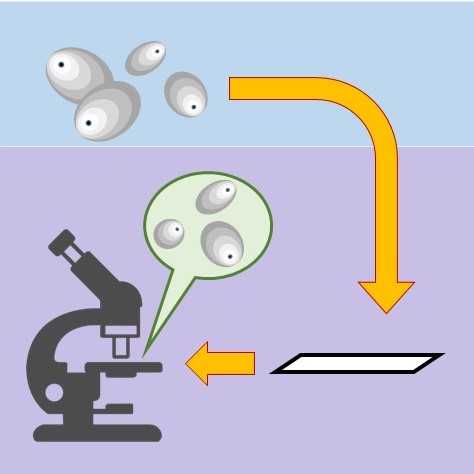
Detection and counting of starch particles
Samples are studied with an optical microscope with a final magnification of 400 or 1000X according to particle size.
Gravimetric samples require inspection of the total surface of the slide. By performing a simple calculation, we can determine the deposition rates in terms of the number of particles per square centimeter over a specific period. The reference area for this calculation is the area of the wooden slot. We performed one-month exposure periods.
Starch granules appear under the optical microscope as hyaline particles that are difficult to separate from mineral dust like quartz crystals, which are very common in aerosol samples (Fig. 4 a,c,e) However, polarized light illumination allows starch to be recognized from a cross-shaped mark (Fig. 4 b,d,f) that identifies it among the rest of the aerosols in the sample (Moss, 1976).
Expected result
Figure 4. Starch granules at 400 x magnification. Reference flour starch without (a) and with (b) polarized light. Starch granules from gravimetric samples without (c) and with (d) polarized light. Starch granules from volumetric samples without (e) and with (f) polarized light. Red arrows show starch granules.
Protocol references
de Diego, G.; Cerny, N.; Tolosa, G.; et al. Prevalence of celiac disease-specific antibodies and their association with clinical status and environmental factors. Under revision. Available at: http://dx.doi.org/10.2139/ssrn.4808573
Hirst J.M., 1952. An automatic volumetric spore trap. Ann. Appl. Biol. 39: 259 – 265.
Käpylä, M. 1989. Adhesives and mounting media in aerobiological sampling. Grana 28: 215–218.
Käpylä, M., Penttinen, A., 1981. An evaluation of the microscopical counting methods of the tape in Hirst-Burkard pollen and spore trap. Grana 20: 131-141.
Moss G.E. 1976. The Microscopy of Starch. En: Radley, J.A. (Ed) Examination and Analysis of Starch and Starch Products. Springer, Dordrecht. Netherlands, 1 - 32 pp.
Perez, C.F.; Gassmann, M.I.; Tonti, N.E.; Curto, L. 2020. Panorama sobre la producción, el transporte y depósito de aerosoles de origen biológico. Meteorologica 45: 1 - 24.