Jul 16, 2025
Version 2
Tea Bag Index: version adapted for spring measurements in Belgian winter cereals V.2
- 1PEPA lab: Plant Ecology, ecoPhysiology and sustainable Agriculture, Earth & Life Institute, UCLouvain, Louvain-la-Neuve, Belgium
- Ecosystem Services indicators



Protocol Citation: Lola Leveau 2025. Tea Bag Index: version adapted for spring measurements in Belgian winter cereals. protocols.io https://dx.doi.org/10.17504/protocols.io.n92ld6y88g5b/v2Version created by Lola Leveau
License: This is an open access protocol distributed under the terms of the Creative Commons Attribution License, which permits unrestricted use, distribution, and reproduction in any medium, provided the original author and source are credited
Protocol status: Working
We use this protocol and it's working
Created: July 16, 2025
Last Modified: July 16, 2025
Protocol Integer ID: 222626
Keywords: tea bag index, TBI, decomposition rate, stabilization ratio, original tea bag index, burying tea bag, tea bag, walloon winter cereal fields within experimental plot, soil, spring measurements in belgian winter, labile fraction of organic matter, labile organic matter, tea, walloon winter cereal field, dynamics of labile organic matter, organic matter, defined burial procedure
Abstract
The original Tea Bag Index (TBI) protocol was developed by Keuskamp et al. (2013). By burying tea bags, this method measures two variables related to the dynamics of labile organic matter in soil: (1) Decomposition rate (k), the rate at which the labile fraction of organic matter (tea) is mineralized in the soil, (2) Stabilization factor (S), the extent to which environmental conditions inhibit the decomposition of the labile fraction.
The version presented here is adapted from the original protocol for use in Walloon winter cereal fields within experimental plots of one hectare. Modifications include an increased number of samples per plot and a more precisely defined burial procedure.
Image Attribution
Lola Leveau
Materials
Per experimental plot
- 12 green tea bags (Lipton Indonesian tea Sencha tradition, EAN 87 22700 05552 5)
- 12 red tea bags (Lipton Infusion Rooibos, EAN 5 063270 101612)
- 24 cross stakes, 42 cm high, to mark individual tea bag positions
- 6 flags, 120 cm high, to mark start and end points of subplot lines
For the study overall
- Spade
- Precision balance (±0.001 g)
- Drying oven (40°C or more)
- Permanent marker resistant to heat, water, and sunlight. It is strongly recommended to test the marker on a trial tag and leave it outdoors for one month to verify that the writing remains legible before deciding to use it for the experiment.
- 5 green tea bags, for determining tare weight and tea water content
- 5 red tea bags, for determining tare weight and tea water content
NB: Unfortunately, Lipton discontinued the type of green tea used in this protocol in 2024 (Teatime4Science, 2024). Because calculations of S and k are based on the specific properties of this green tea (Keuskamp et al., 2013), these variables cannot be calculated for other green tea types without new laboratory characterization of the tea composition.
Safety warnings
Unfortunately, Lipton discontinued the type of green tea used in this protocol, which is Lipton Indonesian tea Sencha tradition (Teatime4Science, 2024). Because calculations of S and k are based on the specific properties of this green tea (Keuskamp et al., 2013), these variables cannot be calculated for other green tea types without new laboratory characterization of the tea composition. Specifically, the hydrolysable fraction of the new green tea should be measured, and the fact that it decomposes in less than 90 days of burial should be verified.
Before start
The original TBI protocol was described in:
Keuskamp, J. A., Dingemans, B. J. J., Lehtinen, T., Sarneel, J. M., & Hefting, M. M. (2013). Tea Bag Index: A novel approach to collect uniform decomposition data across ecosystems. Methods in Ecology and Evolution, 4(11), Art. 11. https://doi.org/10.1111/2041-210X.12097
Experimental season
Tea bags remain buried in the field for approximately 90 days. In Walloon winter cereal fields, tea bags are typically buried from late February or early March, as soon as the soil is no longer waterlogged or frozen, until late May or early June.
Pre-burial laboratory preparation
Preparation of tea bags for field burial
For the twelve green and twelve red tea bags per experimental plot:
Air-dry the tea bags.
Label each tea bag tag on both sides with a permanent marker using the format “X-YY”, where X is the plot identifier and YY the tea bag identifier.
The double labelling is crucial as the label might disappear on the tag side that is exposed to sunlight, even with a permanent marker.
Weigh each tea bag using a precision balance (±0.001 g).
Group the tea bags into three sets of eight (four green and four red), corresponding to the three subplots. Place each set in a separate bag for efficient field installation and label these bags “X-A”, where X is the plot identifier and A the subplot identifier.
Determination of dry tea weights
The dry weight of tea contained in each tea bag before burial is determined by (1) subtracting the mean container tare from the total tea bag weight, and (2) correcting for the water content of the air-dried tea, based on its mean humidity.
Establishing the mean container tare
- Air-dry five green tea bags and five red tea bags under the same conditions (period, duration, room, arrangement) as those prepared for field burial.
- Open the bags and remove the tea, keeping only the emptied bag, string, and tag.
- Weigh these containers and calculate a mean container weight for each tea type (red or green).
Establishing the mean humidity content of the air-dried tea
- Dry the tea removed from the same five red and green tea bags at 40°C for 3 days.
- Weigh the dried tea to determine moisture loss and calculate from this the mean humidity content of the air-dried tea for each tea type (red or green).
Subplot layout and burial method
For one hectare of arable land, establish three subplots, each with eight tea bags (four green and four red).
- In long plots (e.g. 40 × 250 m), distribute subplots along the length of the strip.
- In square plots (e.g. 100 x 100 m), position subplots at the corners of an equilateral triangle (~40 m sides), centered within the field.
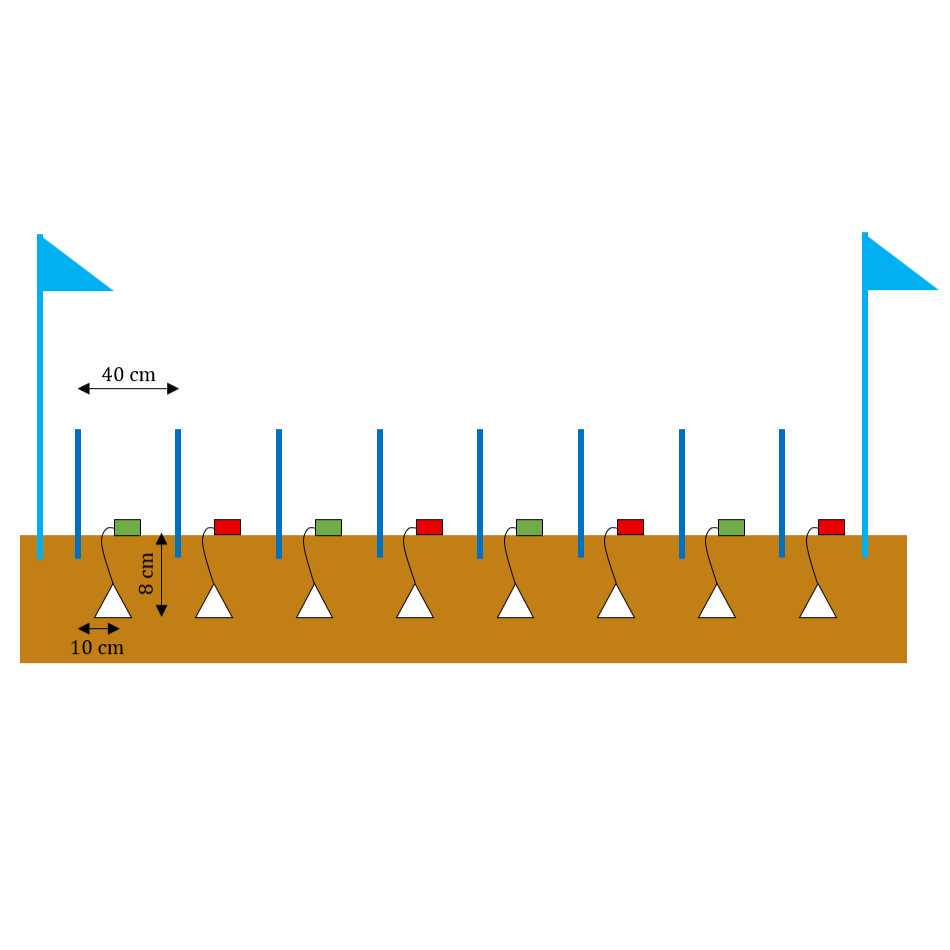
Within each subplot, bury tea bags in a line, alternating green and red, with 40 cm spacing between two bags. Align each line at a 45° angle relative to the crop rows. Follow this burial procedure:
Make a vertical cut in the soil with a spade to approximately 5 cm depth.
Make a second vertical cut to 10 cm depth, perpendicular to the first cut and touching it at its midpoint – so the first cut forms the horizontal bar of a “T” and the second cut forms its vertical bar.
Lift the soil block using the spade still inserted in the second cut; the block should split naturally along the initial cut.
Place the tea bag into the fissure, beneath the smoothed surfaces created by the spade.
Close the soil block, ensuring the tea bag tag remains above ground, attached by its string.
Insert a stake into the soil approximately 10 cm from the tea bag, along the axis of the first cut. Maintain this configuration consistently for all tea bags.
Repeat every 40 cm along the line for the remaining tea bags, alternating red and green.
Mark the locations of the first and last tea bags in the line with 120 cm flags, to facilitate retrieval in tall cereals and to indicate tea bag positions to farmers cultivating the field.
Layout of one subplot, with four green tea bags and four red tea bags.
Record the burial date.
Field retrieval and laboratory processing
In each experimental plot
Carefully excavate around each tea bag, and remove it without tearing the mesh or breaking the string.
Record the retrieval date.
Calculate t, the duration of soil burial in days for each tea bag.
In the laboratory, for each tea bag
Gently remove all adhering soil particles and roots.
Exclude tea bags that were torn during retrieval or perforated by large roots.
Dry at 40°C for three days.
Remove the dried tea from the bag and weigh it using a precision balance.
Calculate the fraction of dry weight lost by the tea during soil burial, corresponding to ag for green tea and W(t) for red tea (see equations below).
Calculation of k and S variables
The decomposition rate (k) and the stabilization factor (S) for labile organic matter are calculated per subplot, based on mean dry weight losses and burial durations. These calculations follow the equations described by Keuskamp et al. (2013) and use the labile matter characteristics provided by the TBI project (Teatime4Science, 2018).
First, the stabilization factor S is determined from the green tea decomposition. Given that the entire decomposable fraction of green tea (ag) is assumed to decompose within 90 days (Keuskamp et al., 2013), S is calculated as:
Where Hg is the hydrolysable fraction of green tea, measured in laboratory analyses, with a constant value
of 0.842 (Source: TeaTime4Science, datasheet for TBI calculation for non-woven tea bags).
Next, assuming that S is equivalent for green and red tea, the decomposable fraction of red tea (ar), which decomposes over a period longer than 90 days, is calculated as:
Where Hr is the hydrolysable fraction of red tea, with a constant value of 0.552 (Source: TeaTime4Science, datasheet for TBI calculation for non-woven tea bags).
Finally, the decomposition rate k is derived from the relationship:
Where t is the duration of tea bag burial (in days), and W(t) is the fraction of red tea mass remaining after t days.
It is important to note that the variables S and k describe the decomposition and stabilization of exogenous labile organic matter excluding macrofauna activity, as the mesh size of the tea bags prevents larger soil organisms from accessing the tea.
Experimental data may be uploaded to www.teatime4science.org to contribute to the international database of TBI results.
Protocol references
Keuskamp, J. A., Dingemans, B. J. J., Lehtinen, T., Sarneel, J. M., & Hefting, M. M. (2013). Tea Bag Index: A novel approach to collect uniform decomposition data across ecosystems. Methods in Ecology and Evolution, 4(11), Art. 11. https://doi.org/10.1111/2041-210X.12097
Teatime4Science. (2024). Availability of tea. https://www.teatime4science.org/method/availability-of-tea/
Vanwindekens, F., Hardy, B., Leroy, C., & Delporte, F. (2020). Évaluer les fonctions physiques et
biologiques des sols à l’aide d’approches pragmatiques [Conférence]. Intersoil 2020, Bruxelles.
https://frdvnw.gitlab.io/intersoil2020/