Aug 13, 2025
T7 In Vitro mRNA Synthesis with Separate Capping and PolyA (V1 08.11.25)
- 1University of Utah
- Jolly Protocols



Protocol Citation: Jeffery Jolly 2025. T7 In Vitro mRNA Synthesis with Separate Capping and PolyA (V1 08.11.25). protocols.io https://dx.doi.org/10.17504/protocols.io.kqdg319yzl25/v1
License: This is an open access protocol distributed under the terms of the Creative Commons Attribution License, which permits unrestricted use, distribution, and reproduction in any medium, provided the original author and source are credited
Protocol status: Working
We use this protocol and it's working
Created: August 11, 2025
Last Modified: August 13, 2025
Protocol Integer ID: 224420
Keywords: mRNA synthesis, in vitro transcription, T7 RNA polymerase, Faustovirus capping enzyme, cap-0, polyadenylation, E. coli Poly(A) Polymerase, LiCl precipitation, RNA stability, zebrafish microinjection, translation efficiency, RNA purification, mrna synthesis with separate capping, polyadenylated messenger rna, neb hiscribe t7 high yield rna synthesis kit, t7 in vitro, yield uncapped rna, uncapped rna, capping enzyme, mrna synthesis, t7 promoter, separate enzymatic capping, synthetic mrna, translational competence in zebrafish embryo, rna purification, messenger rna, mrna, final mrna product, rna, transcription, guidelines for rnase, quality synthetic mrnas with customizable feature, rna stability, based rna quantification, using t7, rnase, rna quantification, t7, polymerase, dna template, zebrafish embryo, enzymatic step, cap structure, following capping, suitable for zebrafish microinjection, separate capping, unincorporated nucleotide, enzyme, transcript, dna
Disclaimer
DISCLAIMER – FOR INFORMATIONAL PURPOSES ONLY; USE AT YOUR OWN RISK
The protocol content here is for informational purposes only and does not constitute legal, medical, clinical, or safety advice, or otherwise; content added to protocols.io is not peer reviewed and may not have undergone a formal approval of any kind. Information presented in this protocol should not substitute for independent professional judgment, advice, diagnosis, or treatment. Any action you take or refrain from taking using or relying upon the information presented here is strictly at your own risk. You agree that neither the Company nor any of the authors, contributors, administrators, or anyone else associated with protocols.io, can be held responsible for your use of the information contained in or linked to this protocol or any of our Sites/Apps and Services.
Abstract
This protocol describes the stepwise synthesis and preparation of capped, polyadenylated messenger RNA (mRNA) suitable for zebrafish microinjection, using T7 in vitro transcription followed by separate enzymatic capping and poly(A) tailing. The workflow begins with the preparation of a DNA template containing a T7 promoter, which is transcribed in vitro using the NEB HiScribe T7 High Yield RNA Synthesis Kit to generate high-yield uncapped RNA. The transcript is subsequently capped using the Faustovirus capping enzyme (FCE) to produce a type 1 5′ cap structure (m⁷GpppNm), which enhances translation efficiency and stability in eukaryotic systems. Following capping, a poly(A) tail is enzymatically added using E. coli poly(A) polymerase to improve RNA stability, nuclear export, and translational competence in zebrafish embryos. Each enzymatic step is followed by RNA purification using lithium chloride precipitation to remove unincorporated nucleotides, enzymes, and buffer components. The protocol includes quality control measures such as spectrophotometric or fluorescence-based RNA quantification, optional gel electrophoresis for integrity assessment, and guidelines for RNase-free handling. Final mRNA products are resuspended in low-salt Tris-HCl buffer (pH 7.5–8.0) and aliquoted for storage at −80 °C to maintain long-term stability. This method provides a robust and flexible approach for generating high-quality synthetic mRNAs with customizable features, suitable for functional studies and developmental biology applications in zebrafish.
Image Attribution
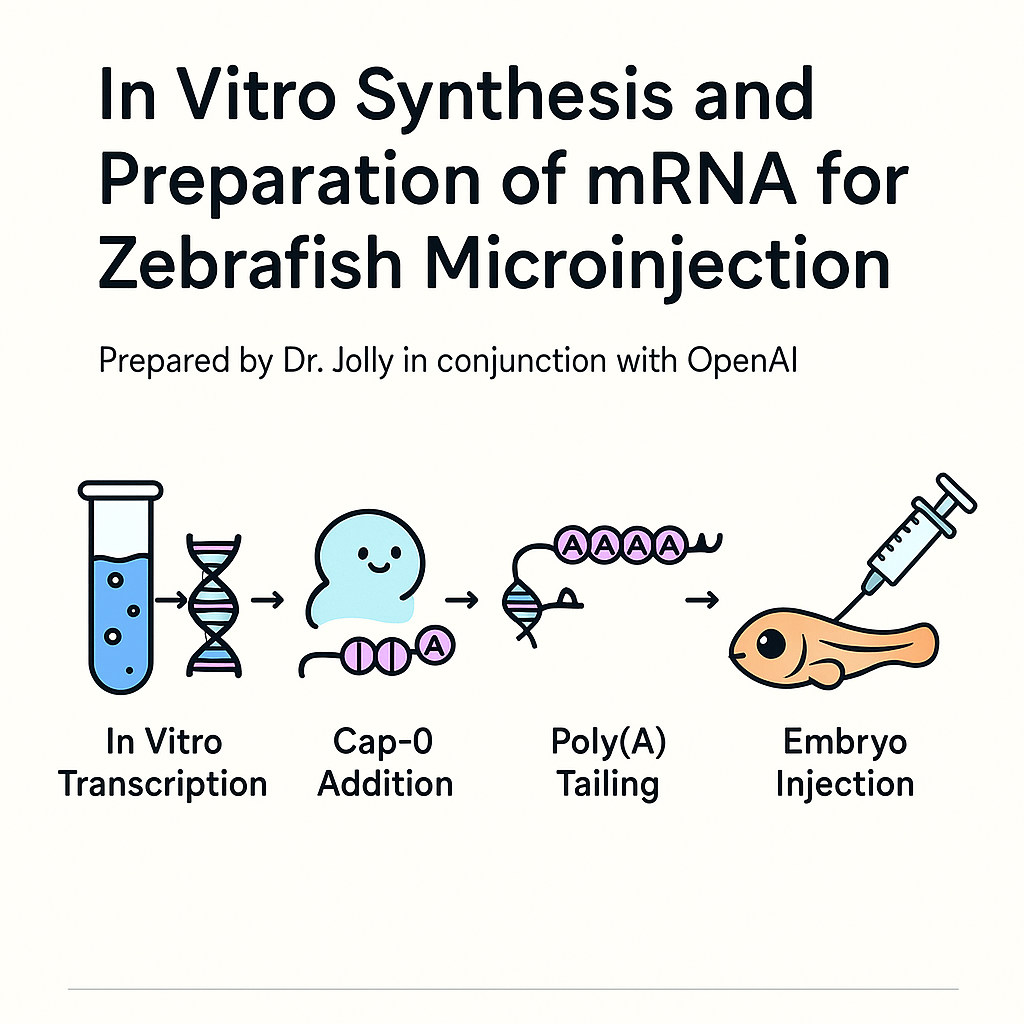
Images made in conjunction with OpenAI
Guidelines
- Always work in a clean, RNase-free environment to prevent RNA degradation. Use dedicated RNase-free pipettes, filter tips, and certified RNase-free consumables.
- Wear powder-free gloves and change them frequently to avoid introducing nucleases.
- Use freshly prepared or thawed reagents; avoid repeated freeze–thaw cycles of enzymes and RNA.
- Keep RNA and enzyme-containing reactions on ice whenever possible, except during incubation steps.
- Follow the manufacturer’s instructions for enzyme storage and handling (e.g., NEB kits, Faustovirus capping enzyme, Poly(A) Polymerase).
- Use proper molecular-grade water (nuclease-free, DEPC-treated or equivalent) for all dilutions and resuspensions.
- Carefully plan the workflow to minimize RNA handling time between steps (e.g., transition directly from capping to polyadenylation).
- For zebrafish microinjection, prepare RNA fresh or thaw aliquots immediately prior to use to ensure maximum activity in vivo.
Materials
1. DNA Template Preparation
- Q5 High-Fidelity 2X Master Mix – New England Biolabs (NEB #M0492)
- Primers – Custom-synthesized, HPLC purified (Integrated DNA Technologies, or similar)
- Nuclease-free water – Invitrogen UltraPure‱ (ThermoFisher #10977015)
- Optional: PCR purification kit – Monarch‱ PCR & DNA Cleanup Kit (NEB #T1030) or AMPure XP beads (Beckman Coulter #A63881)
2. In Vitro Transcription (IVT)
- HiScribe‱ T7 High Yield RNA Synthesis Kit – New England Biolabs (NEB #E2040)
- Nuclease-free tubes – Axygen Maxymum Recovery, RNase/DNase-free (Corning #MCT-150-C)
- Nuclease-free water – Invitrogen UltraPure (ThermoFisher #10977015)
- RiboLock RNase Inhibitor – ThermoFisher Scientific (#EO0381)
- Ethanol (Molecular Biology Grade) – ≥99.5%, RNase-free (Sigma #E7023)
3. LiCl RNA Purification
- Lithium Chloride Solution (8 M) – ThermoFisher Scientific (#AM9480)
- 70% Ethanol (made fresh, RNase-free) – Prepared from molecular biology grade ethanol and nuclease-free water
- Microcentrifuge tubes – RNase-free, low-bind (Eppendorf DNA LoBind, #022431021)
4. Capping Reaction
- Vaccinia Capping Enzyme (FCE) – New England Biolabs (NEB #M2080)
- S-adenosylmethionine (SAM) – Supplied with FCE kit (NEB #B9003)
- GTP (10 mM) – Supplied with FCE kit (NEB #N0450)
- Capping buffer – Supplied with FCE kit
5. Poly(A) Tailing
- E. coli Poly(A) Polymerase – New England Biolabs (NEB #M0276)
- ATP (10 mM) – Supplied with NEB Poly(A) Polymerase kit
- 10X Reaction buffer – Supplied with NEB Poly(A) Polymerase kit
- RNase Inhibitor (Murine) – Optional, NEB #M0314
6. Final RNA Handling and Injection Prep
- Injection buffer – Example Blackburn Lab/Jolly et al.: 0.2 M KCl, 0.1% Phenol Red, RNase-free water
- Borosilicate glass capillaries – 1 mm OD, 0.78 mm ID (World Precision Instruments #TW100F-4)
- Microloader pipette tips – Eppendorf (#930001007)
- Zebrafish embryos – From IACUC-approved facility
Safety warnings
- RNase contamination risk: Even trace RNases will rapidly degrade RNA. Do not reuse consumables and avoid contact with skin.
- Phenol–chloroform safety: If phenol–chloroform extraction is performed, handle in a fume hood, wear eye protection, and avoid skin contact.
- LiCl toxicity: Lithium chloride is harmful; avoid inhalation or ingestion, wear gloves when handling.
- High-temperature incubation risk: Heating RNA (e.g., 65°C to reduce secondary structure) can promote degradation if performed for extended times; adhere strictly to recommended incubation times.
- Injection volume accuracy: For zebrafish microinjection, ensure droplet calibration to prevent embryo damage from over-injection.
- Ethics: Follow institutional animal care guidelines for zebrafish handling, injection, and disposal of embryos.
- Enzyme performance: Excessive storage at room temperature or multiple freeze–thaw cycles will reduce enzyme efficiency, potentially leading to incomplete capping or tailing.
Ethics statement
All procedures involving zebrafish (Danio rerio) must comply with institutional animal care and use committee (IACUC) protocols and local/national regulations. Embryo injections should be performed only by trained personnel to minimize stress and injury. Embryos not used for further analysis should be euthanized humanely according to approved protocols (e.g., overdose with tricaine). All hazardous chemical waste, including phenol–chloroform and LiCl solutions, must be disposed of in accordance with institutional environmental health and safety (EHS) guidelines.
Before start
- Ensure all reagents are thawed, mixed, and kept on ice.
- Prepare a clean workspace and wipe surfaces and tools with RNase decontamination solution (e.g., RNaseZap).
- Confirm that the DNA template is fully linearized and clean (OD 260/280 ratio ~1.8–2.0, no visible degradation on agarose gel).
- Pre-cool centrifuge to 4°C for RNA precipitation and wash steps.
- Label all tubes in advance to avoid delays once RNA is exposed.
- Set up a time plan for sequential steps: IVT → LiCl precipitation → capping → polyadenylation → final cleanup → storage.
- Prepare injection buffer (as per Blackburn Lab/Jolly et al.) if proceeding directly to zebrafish injections.
- If using phenol–chloroform extraction or LiCl precipitation, ensure proper waste disposal containers are ready for hazardous material.
Part 1: Assess and Prepare DNA Template
10h
Assess the target sequence to ensure proper placement and orientation of the T7 site.
Explanation: This ensures that transcription initiates at the correct position and yields the intended RNA product.
- This protocol will utilize the pENTR plasmid pENTR-EGFP as an example.
- Note that the T7 site on this plasmid is not in the proper orientation to allow IVT of the EGFP product.
- We will do a PCR to add T7 to the 5' of this sequence and amplify the new construct T7-EGFP-STOP for IVT.
- Note that if the product already has the T7 in the proper location, a PCR must still be performed to amplify the DNA template, as this is necessary for purification to ensure a clean IVT reaction. Also confirm STOP is present on GOI.
Note
SnapGene view of pENTR-EGFP. Note the incorrect location of the T7 promoter.
We want to get rid of this and add a T7 site in front of our GOI (EGFP)
Design primers based on template needs.
Explanation: Proper primer design ensures specific amplification of the target sequence and compatibility with the transcription requirements.
For general amplification of a product that already has the T7:
- Design primers ~10-15 nucleotides upstream of the T7 site and ~10-15 nucleotides downstream of the STOP codon. DO not attempt to amplify PolyA sequences. This will be added later, and there is no benefit at this stage.
For Middle Entry Vectors (pME or pENTR) where you want to add the T7 in the proper location these primers targeting the universal attL1/L2 sites have been effective:
- FWD: TAATACGACTCACTATAGGGATAATACAAAAAAGCAGGCT (adds T7 Site)
- REV: CTTATAATGCCAACTTTGTACAAGAAAGCTGGGT
Note
General primer design notes for Q5 PCR:
For optimal primer design with NEB's Q5 High-Fidelity DNA Polymerase, aim for primers that are 20-30 nucleotides long, with a GC content of 40-60%, and melting temperatures (Tm) between 50-72°C. Primer pairs should have Tms within 5°C of each other. When using Q5, use higher annealing temperatures (typically 0-3°C above the lowest primer Tm) and longer extension times (30 seconds per 1000 base pairs for high complexity templates).
Perform PCR to amplify the IVT template.
Explanation: An enriched DNA template can increase yield during IVT. Using a plasmid backbone will yield a heterogeneous mixture of RNA lengths.
Perform a single PCR to amplify the target if the T7 is already in place. Perform two rounds of PCR if you are adding the T7 site. Set up the second reaction with a small amount of product from the first to remove any contamination of T7 that was on the starting plasmid in the incorrect orientation.
2h
r righResuspend the primers to make a 100 micromolar (µM) stock and store at -20 °C .
Explanation: A universal resuspension method allows for consistency across protocols.
Note
Resuspend primers in ddH2O. Move the decimal of the nmol value one place to the right to determine how much water to add to make the 100 micromolar (µM) stock. For example, a 22.8 nmol primer will get 228 µL ddH2O. Store in the freezer for long-term.
Create a master mix (MM) containing 5 micromolar (µM) of each primer.
Explanation: This master mix will reduce the number of pipetting steps to enhance reproducibility.
Note
Primer 5 micromolar (µM) MM:
- First, make 10 micromolar (µM) working solutions of each primer by diluting the 100 micromolar (µM) stock 1:10 with ddH2O.
- Mix these 10 micromolar (µM) primer dilutions in a 1:1 ratio to make the MM.
- Store at -20 °C
Generalized Q5 PCR Reaction using Q5 High-Fidelity 2X Master Mix (NEB M0492S):
Reaction Setup:
We recommend assembling all reaction components on ice and quickly transferring the reactions to a thermocycler preheated to the denaturation temperature (98°C). All components should be mixed prior to use.
| Component | 25 µl Reaction | 50 µl Reaction | Final Concentration | |
| Q5 High-Fidelity 2X Master Mix | 12.5 µl | 25 µl | 1X | |
| 5 µM Primer MM | 2.5 µl | 5 µl | 0.5 µM | |
| 1 ng Template DNA | variable | variable | < 1,000 ng | |
| Nuclease-Free Water | to 25 µl | to 50 µl |
Q5 Reaction Mixture
Combine the above items and gently mix the reaction in a PCR tube. Collect all liquid to the bottom of the tube by a quick spin if necessary. Overlay the sample with mineral oil if using a PCR machine without a heated lid.
Transfer PCR tubes to a PCR machine and begin thermocycling.
Thermocycling Conditions for a Routine PCR using NEB Q5 2X Master Mix:
1. Initial Denaturation: 98 °C for 00:00:30
2. Cycling (30 Cycles)
- Denature: 98 °C for 00:00:10
- Anneal: 50-72 °C for 00:00:10 .
Use the NEB Tm calc: https://tmcalculator.neb.com/#!/main (will be higher than normal PCR protocols)
- Extension: 72 °C for 00:00:15 per kb of the amplicon size
3. Final Extension: 72 °C for 00:02:00
4. Hold: 12 °C
Example: PCR for pENTR-EGFP using the above primers to add the T7 site:
- 25 µL reaction with 1 ng of plasmid. 30 Cycles. Anneal 68 °C for 00:00:10 , elongate 72 °C for 00:00:15 .
- Take 0.5 µL of the product and repeat the reaction, but with a 70 °C annealing temperature, 40 cycles, 50 µL reaction to obtain a large amount of DNA.
Confirm DNA templates by running 1 µL (or less) of the PCR products on an agarose gel and confirm single band of predicted molecular weight.
Explanation: Confirming the proper size and purity of the DNA template is essential for proper mRNA synthesis.
PCR products can be stored at -20 °C
1h
Clean and purify the linear DNA template via Phenol:Chloroform extraction.
Explanation: "It is of the utmost importance to begin the HiScribe T7 Quick High Yield RNA Synthesis Kit with highly purified, completely linearized plasmid template. Quality of the template DNA affects transcription efficiency, as well as the integrity of the RNA synthesized. Yield is commensurate with template purity. Any purification method may be used, as long as the product is predominately supercoiled and free of contaminating RNase, protein, RNA and salts. To produce an RNA transcript of defined length, plasmid DNA must be completely linearized with a restriction enzyme, downstream of the insert to be transcribed. In contrast, circular plasmid templates will generate long heterogeneous RNA transcripts in higher quantities because of the high processivity of T7 RNA Polymerase."
Note
Notes for phenol:chloroform extraction:
Description:
This protocol describes the extraction of DNA from aqueous samples using phenol-chloroform and ethanol precipitation. Steps are designed to minimize contamination with proteins, RNA, and lipids.
Before You Begin:
- Bring sample volume to 200 µL with nuclease-free ddH₂O for easier handling.
- Ensure all reagents are chilled if working with temperature-sensitive samples.
Materials:
- 0.5 Molarity (M) EDTA
- Phenol:Chloroform (buffered, stored at 4 °C)
- Chloroform
- 6 Molarity (M) Sodium Acetate
- Isopropanol
- 70 % (v/v) Ethanol (cold)
- Nuclease-free ddH₂O
4h
Bring the sample volume to 200 µL with nuclease-free ddH₂O.
Explanation: Regardless of the starting volume and concentration, filling to 200 µL is best to allow easy manipulation for the protocol.
Add EDTA Add 1/10 volume (20 µL ) of 0.5 Molarity (M) EDTA to the sample and mix well. Explanation: Chelates divalent cations to inactivate nucleases and disrupt protein–DNA binding.
Add Phenol:Chloroform: Add 1 volume (220 µL ) of buffered phenol:chloroform.
Explanation: Phenol:chloroform separates proteins into the organic phase while retaining DNA in the aqueous phase.
Note
Pipette from the lower (phenol) layer of the stock solution, not the top buffer layer (chloroform). Slight pink is okay, but if it is dark pink (heavy oxidation), discard the chemical.
Mix and Separate Phases: Vortex for 00:00:30 , centrifuge at max speed (at least 12,000 RCF) at 4 °C for 00:10:00 .
10m
Recover Aqueous Phase: Carefully transfer the upper aqueous layer (contains DNA) to a clean tube without disturbing the interphase or bottom organic layer. Discard the bottom layer and tube. Explanation: The upper aqueous phase contains DNA, the lower phase contains RNA/lipids, and the interphase contains proteins.
Tip: If the organic phase is accidentally aspirated, re-spin and repeat separation.
Chloroform Wash: Add 1 volume of chloroform to the aqueous phase, vortex 00:00:30 , and centrifuge at max speed for00:10:00 at 4 °C .
Explanation: Removes residual phenol to improve downstream enzymatic reactions.
10m 30s
Recover Aqueous Phase: Carefully transfer the upper layer to a clean tube without disturbing the lower layer.
Explanation: This is the layer with the DNA.
Precipitate DNA: Add 1/10 volume of 6 Mass Percent sodium acetate (or 2/10 volume of 3 Mass Percent ), followed by 0.7× total volume of isopropanol. Vortex to mix.
Explanation: Sodium acetate and isopropanol precipitate DNA by reducing solubility.
Incubate to Enhance Precipitation: Place on ice for at least 00:10:00 or in the -20 °C freezer for 02:00:00 for maximum yield.
Explanation: Placing the mixture on ice slows molecular motion, allowing DNA strands to aggregate more efficiently after precipitation. The reduced temperature increases precipitation efficiency, especially for smaller DNA fragments or low-concentration samples, making it easier to pellet the DNA during centrifugation.
2h
Pellet DNA: Centrifuge at max speed (>16,000 RCF) for 00:20:00 at 4 °C .
20m
Remove Supernatant: Discard supernatant without disturbing pellet.
Explanation: This leaves a purified DNA pellet. Might be a visible while pellet.
Wash Pellet: Add 300 µL of cold70 % (v/v) ethanol.
Explanation: Removes residual salts and impurities while keeping DNA insoluble.
Centrifuge: Spin at max speed (>16,000 RCF) for 00:05:00 .
Explanation: Re-pellets the DNA after the ethanol wash so it can be recovered cleanly.
5m
Remove Ethanol: Discard ethanol and air-dry pellet for ~00:10:00 .
Explanation: Removes ethanol, which can inhibit downstream reactions.
10m
Resuspend DNA: Dissolve pellet in nuclease-free ddH₂O. Store at -20 °C .
Resuspension volume depends on downstream applications. Start with a low volume, quantify via NanoDrop or Qubit, then dilute further from there.
Note
The IVT reaction suggest 1 µg of DNA per 20 µL reaction.
The max volume for DNA addition in the IVT is 7 µL .
Therefore, we will need at least 7 µL of 143 ng/µL PCR product.
Part 2: In Vitro Transcription
10h 45m
Prepare 1 µg DNA for IVT with the HiScribe T7 Quick High-Yield RNA Synthesis Kit (NEB #E2050S/L)
Set up the 20 µL IVT reaction mix in this order at Room temperature :
- XXX µL ddH2O (Fill to 20 µL )
- 10 µL of NTP Buffer
- XXX µL template DNA (7 µL possible volume, 1 µg DNA recommended)
- 1 µL of 0.1 Molarity (M) DTT
- 2 µL of T7 Polymerase
Note
RNAse Contamination:
- Use RNase-free reagents and consumables Only use certified RNase-free tubes, tips (with aerosol barriers), and water. This prevents introducing RNases from manufacturing or handling.
- Wear fresh gloves and change them often RNases are abundant on skin, so frequent glove changes reduce the chance of transfer.
- Wipe down work surfaces and equipment Clean benches, pipettes, and racks with RNase decontamination solutions (e.g., RNaseZap, RNase AWAY) before starting.
- Dedicate equipment to RNA work Have separate pipettes, tips, and racks that are only used for RNA experiments.
- Avoid talking, coughing, or sneezing near open tubes RNases are present in saliva and respiratory droplets, which can easily contaminate samples.
- Keep samples and reagents on ice when possible Cold temperatures slow RNase activity.
- Use RNase inhibitors when compatible Adding inhibitors (e.g., RNasin) can protect RNA during enzymatic reactions.
- Aliquot reagents Prevents multiple freeze-thaw cycles, which can introduce RNases from repeated handling.
Mix thoroughly, spin down, and let incubate at 37 °C for 02:00:00 .
Explanation: During this time the IVT will be occurring to synthesize the RNA.
Expected product when starting with 1 µg DNA is ~150-250 µg RNA.
2h
DNAse Treatment to remove template DNA: Add 30 µL nuclease-free water to each 20 µL reaction, followed by2 µL of DNase I (RNase-free), mix and incubate for 00:15:00 at 37 °C .
Explanation: This step uses RNase-free DNase I to degrade any residual DNA template that may remain after in vitro transcription. Removing template DNA is essential to prevent it from interfering with downstream RNA analyses, quantification, or applications such as translation assays and qPCR.
15m
Clean and purify the RNA with LiCl for future use.
Explanation: Lithium chloride (LiCl) precipitation is a widely used method for purifying RNA, including in vitro transcribed (IVT) mRNA, after enzymatic reactions such as transcription, capping, and polyadenylation. LiCl selectively precipitates RNA while leaving DNA, proteins, free nucleotides, and many other contaminants in solution. The process relies on Li+ ions binding to the negatively charged phosphate backbone of RNA, reducing solubility and causing it to form a pellet upon centrifugation.
This method is volume-based rather than mass-based, meaning the amount of LiCl to add depends on the reaction volume rather than the total RNA mass. Final RNA concentration and recovery efficiency can be influenced by starting RNA amount, incubation conditions, and pellet handling.
Note
Starting RNA Amount – Does It Matter?
LiCl precipitation efficiency is determined by the final LiCl concentration in the mixture, not directly by the amount of RNA present. However, the amount of RNA can influence pellet visibility and recovery efficiency, particularly at very low concentrations.
Practical guidelines:
- Recovery is generally efficient for ≥0.1 µg total RNA.
- Best results for IVT mRNA are achieved with ≥1 µg RNA in the precipitation reaction.
- RNA concentration should ideally be ≥50 ng/µL before precipitation to avoid significant losses.
- Very dilute RNA (<50 ng/µL) may result in an invisible pellet and reduced yield; avoid carriers if RNA will be injected into zebrafish.
4h
Ensure template DNA has been removed by DNase I treatment before RNA precipitation.
Explanation: LiCl precipitation selectively precipitates RNA but does not efficiently remove DNA. DNase I digests DNA into short oligonucleotides that remain soluble in LiCl. Removing DNA before precipitation prevents contamination of the final RNA preparation.
Transfer RNA to an RNase-free microcentrifuge tube.
Explanation: RNase contamination is a major risk for RNA degradation. Using RNase-free tubes ensures the surface does not contain adsorbed RNases that could hydrolyze RNA. The hydrophilic polymer coatings in RNase-free plastics also minimize nonspecific binding of RNA to tube walls.
Add LiCl to achieve a final concentration of 2.5 Mass Percent .
• For 7.5 Mass Percent LiCl stock: Add 1 volume LiCl for every 2 volumes RNA solution.
• For 8 Mass Percent LiCl stock: Volume to add (µL) = (Reaction volume × 2.5) ÷ 8
Explanation: Lithium ions (Li+) strongly interact with the negatively charged phosphate backbone of RNA, reducing its hydration shell and solubility. At ≥2.5 M LiCl, high-molecular-weight RNA precipitates, while most DNA, protein, and small RNA fragments remain soluble due to differences in solubility and ionic shielding effects
Mix gently by flicking or pipetting; avoid vortexing.
Explanation: Gentle mixing ensures uniform distribution of LiCl without shearing RNA strands. RNA is more susceptible to mechanical shear than DNA, especially at high ionic strengths where it is partially dehydrated.
Incubate at -20 °C for at least 03:00:00 (up to overnight for low-concentration RNA).
Explanation: Lowering the temperature decreases RNA solubility by reducing molecular motion and increasing Li+–RNA interactions. Cold incubation also slows RNase activity, providing additional protection during precipitation.
3h
Centrifuge at >16,000 RCF for 00:15:00 at 4 °C .
Explanation: High-speed centrifugation forces the aggregated RNA molecules out of solution, forming a compact pellet at the bottom of the tube. Cold temperature maintains RNA stability and minimizes salt precipitation artifacts.
15m
Carefully remove supernatant without disturbing the pellet.
Explanation: The supernatant contains salts, free nucleotides, proteins, and degraded nucleic acids. The pellet may be translucent and loosely attached to the tube, so gentle handling prevents accidental loss.
Wash pellet with 1 mL cold 70% ethanol.
Explanation: Ethanol wash removes residual LiCl and other soluble contaminants. At 70% ethanol, RNA remains precipitated because organic solvent reduces the dielectric constant of the solution, keeping the phosphate backbone charge neutralized. The 30% water ensures salts are soluble and washed away.
Centrifuge at 12000 rcf for 00:05:00 at 4 °C .
Explanation: A short spin re-pellets the RNA after ethanol washing. Cold temperature minimizes re-dissolution of RNA and prevents premature drying artifacts.
5m
Remove ethanol and air-dry pellet for 00:10:00 ; do not over-dry.
Explanation: Drying removes ethanol, which can interfere with downstream enzymatic reactions. Over-drying can cause RNA to form strong intermolecular hydrogen bonds, making it difficult to fully resuspend.
10m
Resuspend in 10 millimolar (mM) Tris-HCl, pH 7.5-8.0. Target concentration is ~2 µg/µL
Explanation: RNA is highly soluble in low-salt aqueous buffers. Tris-HCl maintains a stable pH near physiological conditions to prevent acid- or base-catalyzed hydrolysis. Try to omit EDTA to avoid future disruptions.
Quantify RNA concentration (NanoDrop or Qubit) and check purity using a bleached gel.
Note
Bleach–Agarose Gel for RNA Analysis:
1. Prepare 1% agarose in 1× TAE or 1× TBE
- Cool molten agarose to ~60 °C.
- Add unscented household bleach (sodium hypochlorite) to a final concentration of 0.5–1% v/v.
- Swirl to mix thoroughly.
- Note: Bleach denatures RNA and inactivates RNases, replacing toxic formaldehyde.
2. Pour gel and allow to set
- Insert comb and let gel solidify at room temperature.
3. Prepare RNA samples
- Mix RNA (~100ng) with RNA-safe loading dye containing EDTA.
- Optional: Heat-denature at 65 °C for 5 minutes, then place on ice.
- Note: Denaturation in the gel is sufficient for most samples, but heating can improve sharpness.
4. Run gel
- Place gel in 1× TAE or 1× TBE running buffer.
- Load samples and run at 4–6 V/cm until desired separation.
- Note: Bleach in the gel maintains denaturation during electrophoresis.
5. Visualize RNA
- Stain with SYBR Green II, GelRed, or ethidium bromide (pre-cast or post-stain).
- Note: High-quality eukaryotic RNA shows two sharp rRNA bands (28S:18S ~2:1 intensity). IVT RNA appears as a single sharp band near expected size.
1h
Aliquot and store at -80 °C ; avoid repeated freeze–thaw cycles.
Optional: add RNase inhibitor (1 U/µL ).
Explanation: Aliquoting minimizes freeze–thaw damage, which can shear RNA and promote hydrolysis. At −80°C, molecular motion is greatly reduced, slowing all chemical degradation processes. RNase inhibitors can protect against trace RNase contamination during storage.
Part 3: 5' Capping Reaction
35m
Collect purified RNA for 5' capping reaction using the Faustovirus Capping Enzyme
Explanation: The Faustovirus capping enzyme modifies the 5′ triphosphate end of IVT RNA into a type 1 cap (m⁷GpppN) through sequential triphosphatase, guanylyltransferase, and N7-methyltransferase activities. This cap protects RNA from 5′ exonuclease degradation, enhances recognition by the eukaryotic translation machinery, and improves RNA stability and expression efficiency.
The Faustovirus capping enzyme produces a Cap‑0 structure (m⁷GpppN)—it does not create Cap‑1 on its own. The “type 1 cap” phrase is misleading because in biochemical terms, 'type 1' refers specifically to Cap‑1 (which includes additional 2′‑O‑methylation).
In reality:
- Cap‑0 (m⁷GpppN): Created by FCE through combined triphosphatase, guanylyltransferase, and N7‑methyltransferase activities. Wikipedia+12Fisher Scientific+12BIOKÉ+12
- Cap‑1 (m⁷GpppNm): Requires an additional 2′‑O‑methyltransferase step, such as using NEB's Cap 2′‑O‑MTase. PubMed+6Danaher Life Sciences+6The Scientist+6
So, in short: FCE alone generates Cap-0. To make Cap-1, you need an extra enzymatic methylation step.
The Cap-0 is efficient for zebrafish embryos that do not have much of an immune response.
Resuspend up to 25-50 µg RNA in 19 µL H2O or use RNA stock straight if the concentration is less than 2.6 ng/µL .
The more concentrated the starting RNA, the better to allow dilution of the other components.
Heat RNA at 65 °C for 00:05:00 and place back on ice.
Explanation: This is to remove any RNA secondary structure that could disrupt capping.
5m
Prepare the 25 µL Capping Reaction:
Mix the components in the order described:
- 19 µL RNA (25-50 µg RNA)
- 2.5 µL of 10X Capping Buffer
- 1.25 µL of 2 millimolar (mM) SAM (Diluted from 32 mM Stock)
- 1.25 µL of 10 millimolar (mM) GTP
- 1 µL of FCE (25 U/µL )
Optional: Add RiboLock RNase inhibitor at a concentration of 0.75 U/µL
Explanation: Largely inert and the added volume is negligible. Highly recommend.
Incubate the reaction at 37 °C for 00:30:00 .
Explanation: The capping reaction is occurring.
30m
Part 4: Poly(A) Reaction
5h 30m
Prepare 20 µg of capped RNA (as determined by input in the capping reaction) for the Poly(A) reaction.
Poly(A) Tailing of RNA using E. coli Poly(A) Polymerase (NEB #M0276)
Gently mix and spin down the NEB E. coli Poly(A) Polymerase kit components and keep them on ice.
Explanation: This is to ensure the kit reagents are properly mixed.
Prepare the 40 µL Poly(A) Reaction:
Mix the components in the order described:
- XXX µL of nuclease-free water to 40 µL .
- 20 µg of RNA (up to 30uL of available volume)
- 4 µL of 10X E. coli Poly(A) Polymerase Reaction Buffer
- 4 µL of 10mM ATP
- 2 µL of E. coli Poly(A) Polymerase (5 U/µL )
Optional: Add RiboLock RNase inhibitor at a concentration of 0.75 U/µL
Explanation: Largely inert and the added volume is negligible. Highly recommend.
Incubate the reaction at 37 °C for 00:30:00 .
Explanation: The Poly(A) reaction is occurring.
The samples can then be returned to -80 if pause is needed.
30m
Purify the final capped and poly(A) mRNA product via LiCl precipitation (STEP 9).
Optional if making extreme dilutions into zebrafish injection buffer.
Might be able to infer final RNA concentrations from input RNA from capping and polyA reactions.
Not required but highly recommended.
Note
Previous Observations for Zebrafish Injections:
I took the EGFP naive mRNA, Capped mRNA, and the Cap+mRNA and made 50 ng/ul (calculated from theamount of RNA put in) solutions in injection buffer (5 mM Tris‑HCl, 0.5 mM EDTA, 100 mM KCl). I did not clean the Capping or Capping + PolyA mixes before injections.
Injected 0.1ul into the yolk of casper fish.
Imaged at 5 and 20 hours.
Only the RNAs with the Cap + PolyA worked.
5 HPF
20 HPF
4h
Visualize final mRNA product concentrations. Run all products of this protocol (RNA, Capped RNA, Capped RNA + Poly(A)) side by side on a bleached gel (See note in STEP 9.12).
Should see a clean MW band for the RNA with maybe a slight increase in MW with the capping reaction, then a higher MW smear as a result of the poly(A) reaction.
1h
Freeze the final mRNA products in 10 millimolar (mM) Tris-HCl (pH 7.4–7.5), 0.1 millimolar (mM) EDTA, supplemented with 1 U/µL RiboLock.
Make very small aliquots in PCR strip tubes to prevent repeated freeze-thaw and store at -80 °C .