Oct 28, 2019
Steps for Building an Open Source EI-MS Mass Spectral Library for GC-MS -based Metabolomics
- Biswapriya Misra1
- 1Wake Forest School of Medicine
- Metabolomics Protocols & WorkflowsTech. support email: [email protected]



Protocol Citation: Biswapriya Misra 2019. Steps for Building an Open Source EI-MS Mass Spectral Library for GC-MS -based Metabolomics. protocols.io https://dx.doi.org/10.17504/protocols.io.8txhwpn
License: This is an open access protocol distributed under the terms of the Creative Commons Attribution License, which permits unrestricted use, distribution, and reproduction in any medium, provided the original author and source are credited
Protocol status: Working
We use this protocol and it's working
Created: October 28, 2019
Last Modified: October 28, 2019
Protocol Integer ID: 29271
Keywords: library, database, resource, spectra, m/z, EI-MS, electron impact, electron ionization, GOLM, MoNA, mass bank, ms spectral data for metabolomics research, golm metabolome database, metabolomics research, ms mass spectral library for gc, metabolomic, metabolomics the objective, ms mass spectral library, metabolome, ms spectral data, spectral library, spectral data, ms mass, open source ei
Abstract
The objective of this protocol is to provide a set of instructions/ steps to guide ANY NEW USER to generate an open source EI-MS mass spectral library to aid in interpretation of GC-EI-MS spectral data for metabolomics research. Users need to appreciate and acknowledge the efforts of developers who have helped build and released their EI-MS spectral data and associated meta-data for free use and distribution from Mass Bank of North America (MoNA), RIKEN, GOLM Metabolome Database, Cayman, SWGDRUG, and NIST among others.
Troubleshooting
From individual open source libraries download all the ".msp" or “.txt” files. Save them locally somewhere in a new folder. The names and links of the available open source spectral / retention time EI-MS libraries are:
MoNA- Mass bank of North America: https://mona.fiehnlab.ucdavis.edu/downloads
RTX5 Fiehnlib (1,118 spectra)
GC-MS Spectra (15,114 spectra)
ReSpect (6,374 spectra)
HMDB (8,540 spectra)
MetaboBASE (1,254 spectra)
Fiehn BinBase DB (Rtx5-Sil MS, predicted Kovats RI, 1021 records)
RIKEN DB (Rtx5-Sil MS, Kovats RI, 241 records)
Kazusa DB (Rtx5-Sil MS, Kovats RI, 273 records)
GL-Science DB (InertCap 5MS-NP, Kovats RI, 494 records)
Osaka Univ. DB (CPSil-8CB, Kovats RI, 430 records)
Fiehn BinBase DB (Rtx5-Sil MS, FAMEs RI, 1021 records)
RIKEN DB (Rtx5-Sil MS, predicted Fiehn RI, 241 records)
Kazusa DB (Rtx5-Sil MS, predicted Fiehn RI, 273 records)
GL-Science DB (InertCap 5MS-NP, predicted Fiehn RI, 494 records)
Osaka Univ. DB (CPSil-8CB, predicted Fiehn RI, 430 records)
Cayman Spectral Library (70eV EI mass spectral data of hundreds of Cayman Chemical's emerging forensic drug standards): https://www.caymanchem.com/forensics/publications/csl Needs registration and then one can download these spectra for free.
GOLM Metabolome Database (mass spectral reference library from biological specimens) : http://gmd.mpimp-golm.mpg.de/download/ (several options available depending on the column-type (VAR5/ MDN35) and RI marker used: FAME or Alkane mixes)
NIST, USA offers several EI-MS spectra for free as well: https://chemdata.nist.gov/dokuwiki/doku.php?id=chemdata:start
NIST 17 GC Method / Retention Index MS Library- Extensive collection of GC retention indices with method information
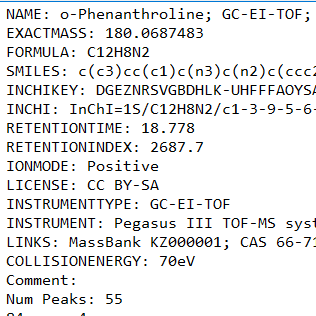
Now, open a notepad (.txt) file (do not save!) and drag one of these (any!) .msp library file onto this file and now save it as "YOUR NAME Library" (no file extension needed) just as it is (then it automatically is saved as .msp file format and you can scroll through to see the format/ style.
Now open, multiple .txt Notepad files and keep dragging the individual .msp files into these .txt files.
Copy these spectral information from the open .msp files one by one and copy out to "YOUR NAME Library" and let it keep growing. Just copy entire text files one after the other sequentially into a single .msp file.
That's it, “YOUR NAME GC-EI-MS” open source library is ready to go and be used for MS-DIAL spectral matching for spectra and/ RI or can be added to your AMDIS (NIST, USA) search as well.