Jul 01, 2026
Step-by-step guide to molecular docking using freeware
- 1College of Natural Sciences, Can Tho University



Protocol Citation: Cuong-Quoc NGUYEN 2026. Step-by-step guide to molecular docking using freeware. protocols.io https://dx.doi.org/10.17504/protocols.io.3byl4mk82lo5/v1
Manuscript citation:
1. Nguyen, C. Q., Phien, H. H., Son, N. H., Le Dang, Q., Phuong, L. V., Thi, N. Y. N., ... & De Tran, Q. (2025). Pharmacoinformatics model based on the para-aminochalcone core to screening dual alpha-amylase/alpha-glucosidase and β-TC-6 inhibitors: Combining experimental and machine learning for diabetes drug discovery. Journal of Molecular Structure, 1346, 143193.
2. Nguyen, C. Q., Le Dang, Q., Tran, Q. D., Van Dung, L., Thuy, V. T. B., Hung, N. M., ... & Khang, T. D. (2025). Antifungal and Repellent Efficacy of Boesenbergia rotunda and Kaempferia galanga Essential Oils: In vitro and Field tests. Journal of Natural Pesticide Research, 100178.
3. Nguyen-Ngoc, H., Nguyen, C. Q., Vo, K. A. T., Nguyen, T. T. T., Nghiem, D. T., Ha, N. T., ... & Le Dang, Q. (2023). Insight into the role of phytoalexin naringenin and phytohormone abscisic acid in defense against phytopathogens Phytophthora infestans and Magnaporthe oryzae: In vitro and in silico approaches. Physiological and Molecular Plant Pathology, 127, 102123.
4. De, T. Q., Nguyen, C. Q., Le Dang, Q., Thi, N. Y. N., Tuan, N. T., Suh, D. H., ... & Lim, H. J. (2024). Rational design of novel diaryl ether-linked benzimidazole derivatives as potent and selective BACE1 inhibitors. Biochemical and Biophysical Research Communications, 698, 149538.
5. De Tran, Q., Nguyen, C. Q., Dang, Q. L., Minh Nguyen, T. H., Buu Hue, B. T., Thi Le, M. U., ... & Nguyen, H. P. (2023). ZIKV Inhibitors Based on Pyrazolo [3, 4-d] pyridazine-7-one Core: Rational Design, In Vitro Evaluation, and Theoretical Studies. ACS omega, 8(51), 48994-49008.
License: This is an open access protocol distributed under the terms of the Creative Commons Attribution License, which permits unrestricted use, distribution, and reproduction in any medium, provided the original author and source are credited
Protocol status: Working
We use this protocol and it's working
Created: June 30, 2026
Last Modified: July 01, 2026
Protocol Integer ID: 320089
Keywords: Molecular docking, Crystallographic, PyRx, in silico, chalcone, SARS-CoV-2, Bioinformatic, drug, SAR
Abstract
Molecular docking plays a crucial role in drug discovery by predicting the binding modes and affinities of small molecules with target proteins. This protocol provides a comprehensive tutorial on molecular docking using PyRx tools, an open-source software with a user-friendly interface compatible with various operating systems.
Before start
Removal of co-crystallized ligands, water molecules, and other non-essential heteroatoms is essential before molecular docking to avoid interference with ligand binding.
**Note**
For improved structural reliability, optimize the protein geometry after preprocessing using software such as YASARA, Swiss-PDB Viewer, MOE, or Schrödinger Maestro*. Structural optimization should ideally produce a protein with acceptable Ramachandran plot statistics.
Step 1. Retrieve the protein structure from the Protein Data Bank
Access the RCSB Protein Data Bank (PDB) database.
Search for the target protein using the keyword "SARS-CoV-2 PLpro".
Select the appropriate protein structure for the study. In this protocol, PDB ID: 7CJM was used.
Click Download Files and select PDB Format to download the protein structure.
Step 2. Prepare the protein structure using Discovery Studio Visualizer
Open Discovery Studio Visualizer.
Import the downloaded protein structure (File → Open).
If necessary, enable the Hierarchy and Data Table panels from the View menu.
Remove all heteroatoms (HETATM) by selecting the corresponding entries and choosing Remove Group.
Delete all co-crystallized ligands from Ligand Groups. If water molecules are present, remove them using Water → Delete.
Save the processed protein structure as a Protein Data Bank (*.pdb) file (File → Save As).
Step 3. Retrieve and prepare the ligand structure
Download the ligand structure from the PubChem database in SDF format.
In this protocol, GRL0617 was selected because it has been experimentally
validated as a potent inhibitor of the SARS-CoV-2 papain-like protease.
Open the downloaded SDF file in Chem3D (File → Open).
Perform energy minimization by pressing Ctrl + M, which applies the MM2 force-field optimization.
Save the optimized ligand in SYBYL Mol2 (*.mol2) format (File → Save As).
Step 4. Perform molecular docking using PyRx 0.8
Open PyRx 0.8.
Import the prepared protein structure (File → Load Molecule) or use the Load Molecular (MolKit) toolbar button.
Import the optimized ligand (Mol2 format) using the same procedure. PyRx integrates Open Babel, allowing direct ligand conversion and energy minimization (Minimize All or Minimize Selected)
without additional software.
In the Navigator panel, select the protein (7CJM) and choose AutoDock → Make Macromolecule.
Select the ligand (GRL0617) and choose AutoDock → Make Ligand.
Open Vina Wizard, select Select Molecules, verify the selected receptor and ligand, and click Forward.
Define the docking search space (grid box) in the Run Vina tab by dragging the grid box to cover the ligand-binding pocket. For this protocol, the grid box was centered at: Center X = 6.004522, Center Y = 26.075304, Center Z = -0.336000
Click Forward to initiate docking.
Monitor the docking process in the Command Prompt window until the progress reaches 100%.
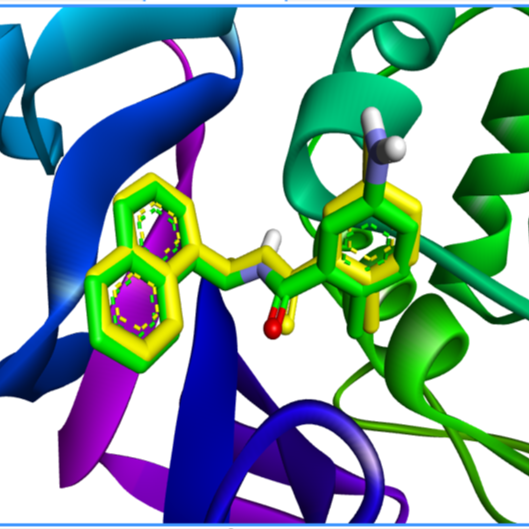
Docking of GRL0617 against SARS-CoV-2 PLpro (PDB ID: 7CJM) should produce a best binding affinity of approximately –9.3 kcal/mol, consistent with the crystal binding mode.
Step 5. Export docking results
Export docking scores as a Comma-Separated Values (*.csv) file using Save as CSV in the Controls panel.
In the Navigator panel, right-click the preferred docking pose (typically Mode 1) and select Save as PDB to export the docking model.
PyRx automatically stores docking results in PDBQT format under the user directory, for example: Users/username/.mgltools/PyRx/Macromolecules/7CJM/
Step 6. Visualize protein–ligand interactions using Discovery Studio Visualizer
Open Discovery Studio Visualizer.
Import the exported docking model (PDB) using File → Open. Alternatively, drag and drop the PDBQT docking output into the previously opened protein structure.
Generate the two-dimensional interaction map by selecting: Receptor–Ligand Interactions → Show 2D Diagram.
The docking model generated using PyRx 0.8 should closely match the original X-ray crystal structure of SARS-CoV-2 PLpro (PDB ID: 7CJM). In this protocol, the docking validation produced an RMSD of 0.4867 Å, indicating excellent agreement with the experimental structure and high docking reliability. The docked ligand also retained key interactions with the active-site residues Asp164, Pro247, Pro248, Tyr264, Tyr268, Gln269, and Tyr273, confirming successful reproduction of the native binding mode.
Protocol references
1. Nguyen, C. Q., Phien, H. H., Son, N. H., Le Dang, Q., Phuong, L. V., Thi, N. Y. N., ... & De Tran, Q. (2025). Pharmacoinformatics model based on the para-aminochalcone core to screening dual alpha-amylase/alpha-glucosidase and β-TC-6 inhibitors: Combining experimental and machine learning for diabetes drug discovery. Journal of Molecular Structure, 1346, 143193.
2. Nguyen, C. Q., Le Dang, Q., Tran, Q. D., Van Dung, L., Thuy, V. T. B., Hung, N. M., ... & Khang, T. D. (2025). Antifungal and Repellent Efficacy of Boesenbergia rotunda and Kaempferia galanga Essential Oils: In vitro and Field tests. Journal of Natural Pesticide Research, 100178.
3. Nguyen-Ngoc, H., Nguyen, C. Q., Vo, K. A. T., Nguyen, T. T. T., Nghiem, D. T., Ha, N. T., ... & Le Dang, Q. (2023). Insight into the role of phytoalexin naringenin and phytohormone abscisic acid in defense against phytopathogens Phytophthora infestans and Magnaporthe oryzae: In vitro and in silico approaches. Physiological and Molecular Plant Pathology, 127, 102123.
4. De, T. Q., Nguyen, C. Q., Le Dang, Q., Thi, N. Y. N., Tuan, N. T., Suh, D. H., ... & Lim, H. J. (2024). Rational design of novel diaryl ether-linked benzimidazole derivatives as potent and selective BACE1 inhibitors. Biochemical and Biophysical Research Communications, 698, 149538.
5. De Tran, Q., Nguyen, C. Q., Dang, Q. L., Minh Nguyen, T. H., Buu Hue, B. T., Thi Le, M. U., ... & Nguyen, H. P. (2023). ZIKV Inhibitors Based on Pyrazolo [3, 4-d] pyridazine-7-one Core: Rational Design, In Vitro Evaluation, and Theoretical Studies. ACS omega, 8(51), 48994-49008.
6. Luu, P. V., Nguyen, C. Q., Ton-Nu, H. L., Phan, T. T. T., Huynh, Q. D. T., Pham, N. T., ... & Lai, K. H. (2026). Stereoselective AChE/BChE/BACE1 inhibition by enantiomeric norsesquiterpenoids with an unprecedented oxatricyclo [7.2. 1.01, 9] dodecane scaffold from the soft coral Sclerophytum humesi. Bioorganic Chemistry, 109652.
7. Nguyen, C. Q., Phuong, L. V., Le Dang, Q., Bang, H. H., Van Dung, L., Tuan, N. T., ... & Tran, Q. D. (2025). Simplified Extraction of Berberine from Coscinium fenestratum Combined with Semi‐Synthesis of Derivatives: In Vitro Biological Activities and In silico Insights. ChemistrySelect, 10(37), e03218.
8. Nguyen-Ngoc, H., Thu Trang, B. T., Nguyen, C. Q., Tran, Q. D., Ngoc Quang, D., Dinh Hoang, V., ... & Dang, Q. L. (2025). A new ursane-type triterpene and potent antibacterial alkylbenzoquinones from the aerial parts of M aesa balansae. Natural Product Research, 1-11.
9. Nguyen, C. Q., Phien, H. H., Son, N. H., Le Dang, Q., Phuong, L. V., Thi, N. Y. N., ... & De Tran, Q. (2025). Pharmacoinformatics model based on the para-aminochalcone core to screening dual alpha-amylase/alpha-glucosidase and β-TC-6 inhibitors: Combining experimental and machine learning for diabetes drug discovery. Journal of Molecular Structure, 1346, 143193.
10. Le Dang, Q., Nguyen, C. Q., Vo, T. K. A., Nguyen, T. T. T., Pham, Q. D., Nguyen, T. X., ... & Nguyen, T. B. H. (2024). A botanical nanoemulsion against phytopathogenic fungi Colletotrichum sp. and Fusarium oxysporum: Preparation, in vitro and in vivo bioassay. Journal of Natural Pesticide Research, 10, 100099.
11. Hue, B. T. B., Giang, H. N. H., Nguyen, C. Q., Chou, F. P., Thanh, D. L. D., De Tran, Q., ... & Wu, T. K. (2024). Discovery of a novel benzimidazole conjugated quinazolinone derivative as a promising SARS-CoV-2 3CL protease inhibitor. RSC advances, 14(46), 33820-33829.
12. Tuấn, N. D., Quốc, N. C., Đệ, T. Q., & Khang, T. D. (2025). HƯỚNG DẪN TỪNG BƯỚC THỰC HIỆN DOCKING PHÂN TỬ BẰNG CÔNG CỤ MIỄN PHÍ PyRx 0.8 VÀ DỰ ĐOÁN TƯƠNG TÁC CỦA CÁC DẪN XUẤT CHALCONE-AMIDE CHỐNG LẠI PLPRO SARS-COV-2. TNU Journal of Science and Technology, 230(01), 63-72.