Aug 21, 2025
Sociodemographic and Biomechanical risk factors of Knee OA
- JIBON ROY AKASH1,
- MD.ZAHID HOSSAIN1
- 1Jashore univeristy of science and technology



Protocol Citation: JIBON ROY AKASH, MD.ZAHID HOSSAIN 2025. Sociodemographic and Biomechanical risk factors of Knee OA. protocols.io https://dx.doi.org/10.17504/protocols.io.3byl46qpogo5/v1
License: This is an open access protocol distributed under the terms of the Creative Commons Attribution License, which permits unrestricted use, distribution, and reproduction in any medium, provided the original author and source are credited
Protocol status: Working
We use this protocol and it's working
Created: August 21, 2025
Last Modified: August 21, 2025
Protocol Integer ID: 225189
Keywords: Knee Osteoarthritis, Risk Factors, Sociodemographic, Biomechanical, REBA, ergonomics., IPAQ, biomechanical risk factors of knee oa, risk of knee oa, knee osteoarthritis, knee oa, biomechanical risk factor, knee alignment, biomechanical contributor, significant sociodemographic factor, posture, physical activity, ergonomic modification, developing preventive strategy
Disclaimer
Note
This protocol is intended solely for research and academic purposes. It does not substitute for professional medical advice, diagnosis, or treatment. Ethical approval and informed consent must be obtained prior to data collection. The authors are not responsible for any misuse, misinterpretation, or unintended outcomes resulting from the application of this protocol.
Abstract
This protocol outlines a descriptive cross-sectional study designed to identify sociodemographic and biomechanical risk factors associated with knee osteoarthritis (OA) in the Jashore region of Bangladesh. A total of 383 patients clinically or radiologically diagnosed with knee OA will be recruited, and data will be collected through structured questionnaires and standardized tools including REBA, IPAQ, and Q-angle measurements.
The expected results will highlight significant sociodemographic factors (age, sex, BMI, occupation) and biomechanical contributors (posture, physical activity, and knee alignment) that increase the risk of knee OA. Findings will support healthcare providers and policymakers in developing preventive strategies, ergonomic modifications, and community-based awareness initiatives tailored to at-risk populations.
This is the first version of the protocol; no prior updates or forks have been made.
Attachments

Guidelines
- Ensure prior ethical approval is obtained from the Institutional Review Board (IRB) before starting the study.
- Obtain written informed consent from all participants before any data collection or assessment.
- Use standardized and validated tools (REBA, IPAQ, Q-angle) consistently for biomechanical assessments.
- Maintain participant confidentiality at all stages of data collection, storage, and analysis.
- Ensure all data collectors are trained in study procedures, ergonomic assessment, and questionnaire administration.
- Adjust sociodemographic and biomechanical measures when replicating the protocol in different populations or settings.
Materials
Data Collection Tools:
- Structured sociodemographic questionnaire (age, sex, BMI, occupation, socioeconomic status)
- Biomechanical assessment checklist
Assessment Tools:
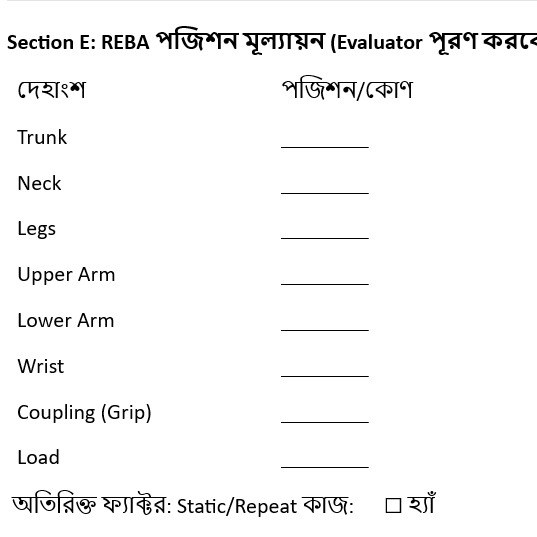
- REBA scoring sheet (Rapid Entire Body Assessment)
- IPAQ (International Physical Activity Questionnaire)
- Goniometer (for Q-angle measurement)
Documentation:
- Informed consent form (written)
- Data entry sheets / Excel template
Software:
- SPSS version 20 (for data analysis)
- Microsoft Excel (data entry and management)
- epi info 7.0 for sample size calculation
Other Materials:
- Pen, clipboard, measuring tape
- Ergonomic setup for posture assessment
Safety warnings
- Medical Safety: Do not include participants with recent knee surgery, acute injury, inflammatory arthritis, or systemic diseases as this may pose health risks.
- Physical Assessment Risk: While performing REBA, Q-angle, or other physical assessments, ensure proper posture and supervision to avoid injury.
- Data Accuracy: Misreporting or incomplete questionnaire data may affect study validity.
- Ethical Compliance: Conduct all procedures only after obtaining IRB approval and written informed consent.
- Replication Caution: When replicating this study in other populations, modify assessment procedures according to local safety and ethical standards.
Ethics statement
This study involves human participants and will be conducted in accordance with internationally-accepted ethical standards, including the Declaration of Helsinki. Prior ethical approval has been obtained from the Institutional Review Board (IRB) of the Physiotherapy and Rehabilitation Department, Jashore University of Science and Technology. All participants will provide written informed consent before inclusion, and their confidentiality will be strictly maintained throughout the study.
- Ethics Committee: IRB, Physiotherapy and Rehabilitation Department, Jashore University of Science and Technology IRB NUMBER: PTR-JUST/IRB/202504/23
Before start
- Ethical Approval: Ensure that the study has prior ethical approval from the Institutional Review Board (IRB) of the Physiotherapy and Rehabilitation Department, Jashore University of Science and Technology.
- Informed Consent: Obtain written informed consent from all participants before any data collection or assessment.
- Participant Safety: Exclude individuals with recent knee surgery, injury, inflammatory arthritis, or any systemic disease to prevent harm.
- Standardized Tools: Use validated instruments for assessment including REBA, IPAQ, and Q-angle measurements. Follow standardized procedures strictly to ensure reliability.
- Data Confidentiality: Maintain participant confidentiality at all stages of data collection, storage, and analysis.
- Pre-Start Check: Verify that all data collectors are trained in the protocol procedures, ergonomic assessments, and questionnaire administration.
- Replicability Note: When replicating this study in other populations or regions, adjust sociodemographic and biomechanical measures according to local context.
Protocol references
- Hunter DJ, Bierma-Zeinstra S. Osteoarthritis. Lancet. 2019;393(10182):1745–1759.
- Felson DT. Risk factors for osteoarthritis: Understanding joint vulnerability. Clin Orthop Relat Res. 2004;427:S16–S21.
- Choi Y, et al. Biomechanical risk factors for knee osteoarthritis: A systematic review. BMC Musculoskelet Disord. 2021;22:456.
- McAtamney L, Corlett EN. RULA: a survey method for the investigation of work-related upper limb disorders. Appl Ergon. 1993;24(2):91–99.
- Craig CL, et al. International Physical Activity Questionnaire: 12-country reliability and validity. Med Sci Sports Exerc. 2003;35(8):1381–1395.
- Kellgren JH, Lawrence JS. Radiological assessment of osteo-arthrosis. Ann Rheum Dis. 1957;16(4):494–502.Hunter DJ, Bierma-Zeinstra S. Osteoarthritis. Lancet. 2019;393(10182):1745–1759.
Acknowledgements
he authors would like to acknowledge the guidance and support of the faculty of the Physiotherapy and Rehabilitation Department, Jashore University of Science and Technology. We are grateful to the Institutional Review Board for ethical approval and to all data collectors who contributed to this study. Finally, we thank all participants for their voluntary participation. Special thanks to my supervisor, Dr. Md. Zahid Hossain, Asst. Professor,
Department of Physiotherapy and Rehabilitation, JUST for his supreme support.