Apr 29, 2026
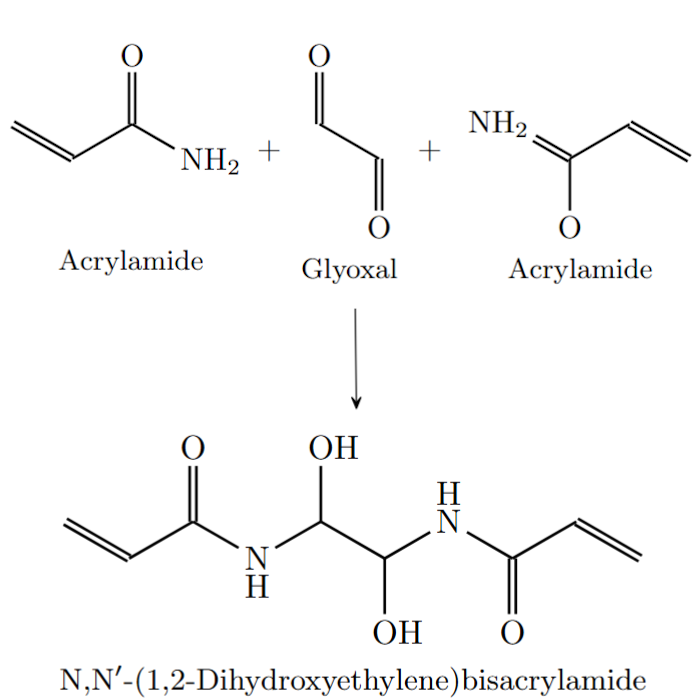
Simple low-cost Synthesis of crosslinker DHEBA (N,N′-(1,2-dihydroxyethylene)bis-acrylamide)
- Rocky An1,
- Manu Prakash2
- 1Stanford University;
- 2Stanford



Protocol Citation: Rocky An, Manu Prakash 2026. Simple low-cost Synthesis of crosslinker DHEBA (N,N′-(1,2-dihydroxyethylene)bis-acrylamide). protocols.io https://dx.doi.org/10.17504/protocols.io.36wgqx8b3lk5/v1
License: This is an open access protocol distributed under the terms of the Creative Commons Attribution License, which permits unrestricted use, distribution, and reproduction in any medium, provided the original author and source are credited
Protocol status: Working
We use this protocol and it's working
Created: April 29, 2026
Last Modified: April 29, 2026
Protocol Integer ID: 315942
Keywords: method of the synthesis, chemical crosslinker, crosslinker, cleavable crosslinker, PAGE, Expansion Microscopy, cost synthesis of crosslinker dheba, crosslinker dheba, dheba crosslinker, iterative ultrastructure expansion microscopy, expansion microscopy, dheba, used crosslinker, acrylamide, crosslinker, optical visualization of specific molecule, time issues with dheba, specific molecule
Abstract
For expansion microscopy and iterative ultrastructure expansion microscopy (ExM, iU-ExM) (16-22 times magnification), a crosslinker that is dissolvable in pH > 13.3 is useful. DHEBA crosslinker (N,N′-(1,2-dihydroxyethylene)bis-acrylamide) is a commonly used crosslinker, usually in the range of 0.05% to 0.1% w/v% concentration. There are cost, purity and lead-time issues with DHEBA purchased from vendors. (All-optical visualization of specific molecules in the ultrastructural context of brain tissue | Nature Biotechnology).
Guidelines
The protocol is intended for non-commercial research use only.
Materials
Acrylamide 40% w/v Electrophoresis grade (Bio-Rad 1610140)
Sodium Hydroxide 10N
Glyoxal 40 wt.% water (Sigma-Aldrich) ← note we successfully used an unopened decades-old bottle, or TCI America 107-22-2
pH test strips
Safety warnings
Both Acrylamide and NaOH are either carcinogenic, corrosive, toxic, and harmful. Glyoxal is moderately toxic, glyoxal is flammable. DHEBA is predicted to be similarly at least as hazardous as acrylamide and glyoxal. Handle under a fume hood with appropriate PPE.
Synthesis
2h 10m
Beginning with Acrylamide 40 Mass / % volume , initially around 5 . In a fume hood, bring pH between 8 to9 using NaOH 10 Molarity (M) . Do not use an electrode pH meter on acrylamide.
5m
Glyoxal 40 Mass Percent in water is viscous and a density of 1.24 g/mL. It is most accurate to mass out 2.9 mg/mL of desired volume. Ex. to make 10 mL of mixed solution (39% acrylamide 0.4% crosslinker w/v%), mass out 29 mg of glyoxal 40% per 10mL total solution.
5m
Mix Glyoxal and Acrylamide in closed Falcon tube and keep shaking at Room temperature for 02:00:00 . Protect from light.
2h
Store at 4 °C protected from light. The solution lasts at least a month in these conditions if not longer.