Jun 18, 2026
Sexing - short fragment (cetacean only)
- Christine Konrad1,
- Timothy Frasier2
- 1Dalhousie University;
- 2Saint Mary's University



Protocol Citation: Christine Konrad, Timothy Frasier 2026. Sexing - short fragment (cetacean only). protocols.io https://dx.doi.org/10.17504/protocols.io.4r3l2177qg1y/v1
License: This is an open access protocol distributed under the terms of the Creative Commons Attribution License, which permits unrestricted use, distribution, and reproduction in any medium, provided the original author and source are credited
Protocol status: Working
We use this protocol and it's working
Created: August 07, 2025
Last Modified: June 18, 2026
Protocol Integer ID: 224191
Keywords: Short fragment, Sexing, degraded DNA, DNA, ZFX, ZFY, sperm whale, including sperm whale, variety of cetacean species, pilot whale, cetacean species, sexing method, grey whale, north atlantic right whale, finned pilot whale, right whale, beluga whale, zfy fragment, short fragment, zfx fragment, fragment, sexing, primer pair, basepair, sex
Abstract
This sexing method from Konrad et al (2017) has been tested on a variety of cetacean species including sperm whale, long finned pilot whale, North Atlantic right whale, beluga whale, grey whale, and humpback. It involves the use of one primer pair that targets sex-specific restriction sites. The ZFX fragment is then digested into two fragments, one 37 basepairs (bp) and the other 57bp. The ZFY fragment is uncut at 94 bp. If this protocol is used, please also cite Konrad et al. (2017).
Image Attribution
Konrad, CM, Dupuis A, Gero S, Frasier T (2017) A sexing technique for highly degraded cetacean DNA. Aquatic Mammals, 43(6): 655-660.
Guidelines
If opening a new reagent or starting PCR for the first time, aliquots of each reagent should be made to decrease the number of freeze thaw cycles and to avoid contaminating whole stock bottles. Mix reagents well before aliquoting. Label each aliquot with a number and keep track of which aliquots have been previously used by putting a star on the lid and recording the aliquot number in your lab book.
Dilutions of primer stock should also be tracked to reduce freeze thaw cycles. If you see primer dilutions getting low, make more. Be sure to check the stock concentration to ensure you are correctly diluting to a concentration of 10 µm using TE.
A dNTP mix is created by combining each of the 4 bases to a concentration of 2mM each. This mix is what is used in the PCR.
Materials
Most of the supplies needed for this protocol are general/generic lab supplies. However, a few key materials for which it is important to know the details are below.
UltraPure™ BSA (50 mg/mL)(non acetylated)InvitrogenCatalog #AM2616
dNTP Set (100 mM)InvitrogenCatalog #10297018
Low DNA Mass LadderInvitrogenCatalog #10068013
Water, HPLC, LabChemFisher ScientificCatalog #LC267604
TaqI (10 U/μL)InvitrogenCatalog #ER0671
Primer sequences are listed below:
CetSex94-F: 5' - AGA GCC ACA AGC TGA CC - 3'
CetSex94-R: 5' - CAT TTT GTG AGT AAA CAA AGC C - 3'
Safety warnings
Ethidium bromide is a hazardous chemical and should be used with caution. Read the SDS before using. Proper PPE, including a lab coat, gloves, long pants, and closed toe shoes should be worn while working with this chemical. Always be aware of equipment that has been contaminated and ensure it does not leave the ethidium bromide contaminated bench. Any ethidium bromide contaminated waste should be disposed of properly.
Preparing Sample Dilutions for PCR
Whether to make a dilution or run straight DNA stock for PCR is decided based on Qubit readings. Generally, 40ng of DNA is used (4µl of a 5 ng/µl dilution), however if samples appear to be of already low concentration the stock itself may be used. Use the flow chart below to determine what concentration of DNA you should use.
Flow chart for deciding how to prepare samples for shot fragment sexing PCR.
Along with your samples of interest, you will also need to include known male and female controls from your project for verification of sex and functionality, as well as positive and negative extraction controls to evaluate extraction success.
Initial PCR
Pull out all aliquots of PCR reagents needed:
- Reagent water (ddH2O)
- 5X Buffer
- dNTPs
- BSA
- MgCl2
- Primers SexCet94-F, SexCet94-R
- Taq
- DNA (samples and 2 controls – 1 male 1 female)
Allow reagents to thaw and then mix well.
Calculate the volume of reagents to add using the stock concentration, desired concentration, and number of samples. See the table below for an example. Record all calculations in your lab book. *See Appendix for concentration justifications.*
| Number of Samples | Volumes | |
| Controls: 2 | Total reactions = 15 | |
| PCR Negative: 1 | Each reaction volume = 20µL | |
| Samples: 10 | Total cocktail volume ("V2")= 300µL | |
| Extras: 2 | DNA [ ]: 5ng/µL |
| Reagent | Initial Concentration ("C1") | Desired Concentration ("C2") | Volume to Add ("V1") | |
| Buffer | 5X | 1X | 60 µl | |
| dNTPs | 2 mM (each) | 0.2 mM (each) | 30 µl | |
| BSA | 3 µg/µl | 0.4 µg/µl | 40 µl | |
| MgCl2 | 25 mM | 1.5 mM | 18 µl | |
| CetSex94-F | 10 µm | 0.3 µm | 9 µl | |
| CetSex94-R | 10 µm | 0.3 µm | 9 µl | |
| Taq | 5 U/µl | 0.05 U/ | 3 µl | |
| DNA | 5 ng/μl | 4 µl/rxn | 60 µl | |
| ddH2O | - | To volume (300 μl) | 71 μl |
Example table of calculating volumes of reagents needed for the number of samples.
Example of C1V1=C2V2 calculation for 5X buffer:
C1V1=C2V2
(5x)(V1)=(1x)(300µl)
V1=(1x)(300µl)/5x=60µl
To make the PCR cocktail, mix together the water, buffer, dNTPs, BSA, MgCl2, primers, and Taq. Add the Taq last and only right before adding to the samples.
Add 16 µL of cocktail to 4 µL of DNA for each sample.
If using PCR tubes and not a plate, distribute the tubes across the PCR machine to distribute the pressure from the lid and ensure even temperature.
Set up the PCR machine to run the following PROPDNR cycle conditions.
| Temperature | Time | Cycles | |
| 94°C | 5 minutes | 1 | |
| 94°C | 30 seconds | 30 | |
| 55°C | 1 minute | ||
| 72°C | 1 minute | ||
| 72°C | 10 minutes | 1 | |
| 10˚C | Forever | 1 |
PCR cycling conditions for short fragment sexing PCR.
Record the name of the PCR machine used in your lab book.
Restriction cycle
Once the sexing PCR is done, prepare the following reagents by thawing and mixing well:
- Reagent water (ddH2O)
- Taq I Buffer
- Taq I Enzyme
- BSA
Calculate the volume of reagents to add using the stock concentration, desired concentration, and number of samples. Note that an extra negative should be added here to ensure the reagents in the restriction cycle are clean.
| Number of Samples | Volumes | |
| Controls: 2 | Total reactions = 15 | |
| PCR Negative: 2 | Each reaction volume = 20µL | |
| Samples: 10 | Total cocktail volume ("V2")= 300µL | |
| Extras: 1 |
| Reagent | Initial Concentration | Desired Concentration | Volume per Sample | Total Volume | |
| ddH2O | - | To volume | 6.83 µl | 102.45 µl | |
| Taq I Buffer | 10X | 1X | 2 µl | 30 µl | |
| Taq I Enzyme | 10 U/µl | 0.25 U/µl | 0.5 µl | 7.5 µl | |
| BSA | 3 µg/µl | 0.1 µg/µl | 0.67 µl | 10.05 µl |
Example table of calculating volumes of reagents needed in restriction cycle for the number of samples.
To make cocktail, mix together all reagents. Add 10 µL of cocktail to 10 µL of PCR product.
Set up PCR machine to run the following cycling conditions titled "Restriction".
65˚C for 60minutes
10˚C for forever.
Making and Running Gel
To make a 3% gel the weight and volume will depend on if you are making a large gel or a small gel.
For a large gel, weigh out 3 g of agarose powder and measure 100 mL of 0.5x TBE buffer. Mix together well in beaker or flask.
For a small gel, weigh out 7.5 g of agarose powder and measure 250 mL of 0.5x TBE buffer. Mix together well in beaker or flask.
Microwave gel on high for 3 minutes for a small gel and 4 min for a large gel, stopping every 45 seconds to swirl and mix the solution. Keep a close eye on the solution as it is heated so it does not boil over.
CAUTION: Glass beaker/flask will be very hot. Always use a silicone hot hand protector to grab the glassware from the microwave to prevent yourself from burns.
CAUTION: The gel may bubble up slightly when mixing while hot. Swirl gently and slowly to ensure it does not bubble over.
Check that all the agarose has dissolved in the TBE. If so, move on, otherwise continue to microwave in short segments.
Let gel cool slightly so that it is still warm, but the flask can be handled.
For a large gel, add 12.5 µL of ethidium bromide to gel and swirl to mix. For a small gel, add 5 µL of ethidium bromide to gel and swirl to mix.
The volumes above are based on the fact that Ethidium Bromide stains DNA efficiently at a concentration of 0.5 µg/mL (Sambrook and Russel 2001). The stock solution is at 10,000 µg/mL. Therefore, for a small gel of 100 mL, using C1V1=C2V2:
(10,000 µg/mL)(V1) = (0.5 µg/mL)(100 mL)
V1 = 0.005 mL = 5 µL of Ethidium Bromide
Pour gel mixture into gel mold, pop any bubbles, and add combs. Let large gel set for 90 minutes and a small gel for 45 minutes.
Mix 20 µL of post restriction product with 5 µL of Orange G dye. The ratio of dye:sample should always be at least 1:4 in order to make the solution dense enough to sink into the well.
Pour buffer over set gel, remove combs, and load5 µL of low mass ladder (mixed with Orange G) into first wells of each row.
Load 20 µL of PCR product+Orange G dye mix into wells. Run large gel at 145V for ~60 minutes and small gel at 80V for ~60-75 minutes.
The times above are based on the fact that using too high a voltage will warm the gel and change its electrophoretic properties, but we also don't want to use such a low voltage that we are waiting all day for the gel to run. Sambrook and Russel (2001) report that using a range of 1-5V/cm is a good balance of these two ends of the spectrum, where cm refers to the distance between the positive and negative electrodes. This distance is 16 cm for our small gel rigs, and therefore 80V = 5 V/cm.
Record gel loading order in lab book.
Visualize the gel under a UV box and take a picture of the gel for your records.
Assessing Results
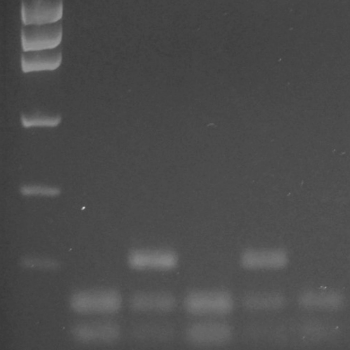
Print the gel image and paste/tape it into your lab book. Write the appropriate sample ID over each well as well as the sexing result. If there are two bands (37 bp and 57 bp) that is a female. If there are three bands (37 bp, 57 bp, and 94bp) then it is male. Check your positive and negative controls to make sure your reaction worked and there was no contamination.
Add the determined sex and sexing method used to the database.
Protocol references
Konrad, CM, Dupuis A, Gero S, Frasier T (2017) A sexing technique for highly degraded cetacean DNA. Aquatic Mammals, 43(6): 655-660.
Sambrook, J., & Russell, D.W. (2001) Molecular Cloning: A Laboratory Manual. 3rd Edition, Vol. 1, Cold Spring Harbor Laboratory Press, New York.