Aug 18, 2025
Selective Isolation of Lipid Classes from cold-water corals via SPE for Quantitative Fatty Acid Profiling
- Audrey M. Pruski1,
- Gilles Vétion1
- 1Laboratoire d’Ecogéochimie des environnements benthiques, Sorbonne Université
- Hussain's den



Protocol Citation: Audrey M. Pruski, Gilles Vétion 2025. Selective Isolation of Lipid Classes from cold-water corals via SPE for Quantitative Fatty Acid Profiling. protocols.io https://dx.doi.org/10.17504/protocols.io.5qpvodx37g4o/v1
Manuscript citation:
In situ diet patterns and health status of cold-water corals in the Lacaze-Duthiers canyon (NW Mediterranean Sea): insights from fatty acid biomarkers on lipid classes. Audrey M. Pruski, Gilles Vétion, Franck Lartaud, Erwan Peru, and Nadine Le Bris. Deep Sea Research Part I, accepted with minor modifications
License: This is an open access protocol distributed under the terms of the Creative Commons Attribution License, which permits unrestricted use, distribution, and reproduction in any medium, provided the original author and source are credited
Protocol status: Working
We use this protocol and it's working
Created: July 01, 2025
Last Modified: August 18, 2025
Protocol Integer ID: 221340
Keywords: Lipids, Fatty acids, Solid Phase Extraction, Corals, extraction of total lipid, water corals via spe, coral polyp sample, selective isolation of lipid class, separation of lipid class, quantitative fatty acid profiling, quantitative fatty acid profiling this protocol, fatty acid methyl ester, water coral, total lipid, lipid class, extraction, solid phase extraction, step acidic transesterification
Abstract
This protocol describes the extraction of total lipids from coral polyp samples using the method of Bligh and Dyer (1959), followed by the separation of lipid classes via solid phase extraction (SPE) on aminopropyl (NH₂) silica cartridges as described by Kaluzny et al. (1985). A one-step acidic transesterification, adapted from Indarti et al. (2005) and Christie (2003), is then applied to produce fatty acid methyl esters (FAMEs) for GC-MS analysis.
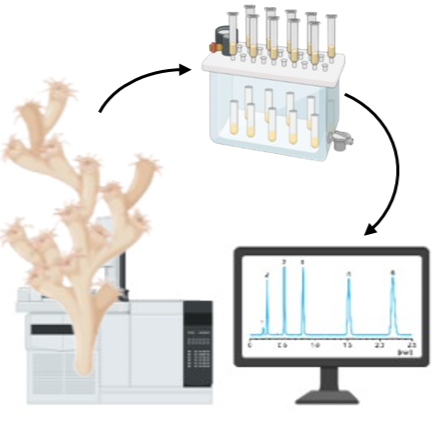
Protocol flowchart
Image Attribution
Pruski Audrey M.
Guidelines
Sample Handling: Handle sample quickly after collection to prevent lipolysis
Equipment: Ensure all glassware, tubes, and Pasteur pipettes are pre-burnt (450 °C ) to avoid contamination
Chemicals and solvents: Use GC-MS or HPLC reagent grade products
Internal Standard: Nonadecanoic acid (C19:0) is used to correct for extraction losses during transesterification
Temperature Control: Maintain precise heating and cooling conditions to ensure consistent results
Storage: Keep eluates and FAME extracts at -20 °C if not analyzed immediately
Materials
Equipments:
- Freeze dryer (Christ Alpha 1-4)
- TissueLyser II (QIAGEN)
- Solid phase extraction manifold (Phenomenex®)
- Hand-operated vacuum pump
- Rotary shaker (Bioblock)
- Ultracentrifuge (Sigma 6K-15)
- Speed-Vac concentrator (Thermo Scientific™ Savant™)
- GC-MS system (Agilent)
Materials:
- Strata NH₂ cartridges (Phenomenex®)
- 20 and 30 ml Borosilicate glass tubes round bottom with PBT red screw cap & PTFE liner
- 20 ml Borosilicate glass tubes conical bottom with PBT red screw cap & PTFE liner
- 2ml GC vials with 200µl insert
- Polar capillary column (e.g. VF-Wax-MS or ZB-WAX-MS)
Chemicals and reagents (HPLC or GC grade):
- Acetic acid (CH3CO2H)
- Butylated hydroxytoluene (BHT)
- Chloroform (CH3Cl)
- Dichloromethane (CH2Cl2)
- Diethyl ether ((C2H5)2O)
- Ethyl acetate (C4H8O2)
- Hexane (C6H14)
- Hydrochloric acid (HCl)
- Methanol (CH3OH)
- Nonadecanoic acid (C19:0= internal standard) (C19H38O2)
- Phosphoric acid (H3PO4)
- Potassium bicarbonate (KHCO3)
- 2-Propanol (C3H8O)
- Sodium chloride (NaCl)
- Sodium hydroxide (NaOH)
- Sulphuric acid (H2SO4)
- Water (ultrapure)
- Commercial FAME standards (Qualmix Fish Synthetic, Ladoran Fine Chemicals, INTERCHIM, France; Supelco 37, PUFA No. 1 and No. 3, SUPELCO France) for GC-MS calibration
Note: use GC/HPLC grade reagents
Biological samples:
- Coral nubbins
Safety warnings
Safety information
- Always wear safety goggles and gloves
- Work in a fume hood when handling solvents
- Dispose of waste in appropriate containers
Lipid Extraction from the Biological Matrix (Cold-water coral nubbins)
1d 9h 6m
Sample Preparation
Flash-freeze coral nubbins on board to prevent degradation
10m
Freeze-dry samples and store at -80 °C until analysis
1d
Grind freeze-dried coral nubbins into a fine powder using a bead mill homogenizer while keeping the chamber filled with liquid nitrogen to prevent heating
10m
Preparation of Working Solutions
4h
Chloroform/methanol/water (1:2:0.8) reagent: 5.265 mL CHCl₃, 10.525 mL CH3OH and 4.21 mL H₂O. Keep at 4 °C in a flammable storage refrigerator
1M NaCl solution in ultrapure water (58g.L-1). Keep at 4 °C in a refrigerator
0.3N NaOH solution (12 g.L-1). Keep at 4 °C in a refrigerator
0.2M H₃PO₄ solution (19.6g.L-1). Keep at 4 °C in a refrigerator
BHT (butylated hydroxytoluene) at 50 mg.mL-1 in Chloroform. Keep at 4 °C in a flammable storage refrigerator
Total lipid extraction
Note
Total lipids are extracted using a modified version of the Bligh and Dyer method (1959), optimized to improve extraction efficiency.
4h
Place the freeze-dried coral nubbins (~3 g ) in a 30 mL glass tube (round bottom, screw tap with PTFE liner)
Add 20 mL of CHCl₃/CH₃OH/H2O (1:2:0.8) with 1M NaCl + 0.2M H₃PO₄
Note
The solution of NaCl 1M-H3PO4 0.2M increases protein unwinding and lipid recovery
Sonicate 00:05:00 (On ice if needed ), then rotate 00:20:00 at Room temperature
25m
Add 2.5 mL CHCl₃, then2.5 mL H₂O. Shake 00:05:00
5m
2500 rpm, 4°C, 00:05:00 . Recover the organic phase (bottom) using a Pasteur pipette
5m
Repeat extraction 3 times with 5 mL CHCl₃
Pool all organic phases (final volume ≈ 22.765 mL) and vortex. ⚠ Keep organic phase cold On ice
Wash organic phase with 2.5 mL cold 0.3N NaOH. Shake 00:01:00
1m
2500 rpm, 4°C, 00:05:00 and recover the organic phase
5m
Take 20 mL or more into a new glass tube (conical bottom, screw tap with PTFE liner) and evaporate at 40 °C under vacuum (rotary evaporator)
Note
⚠ Lipid extracts should never be allowed to dry out!
Cool at -20 °C and redissolve in 400 µL CHCl₃ + BHT (50 mg.L-1)
Note
BHT is added optionally to chloroform to prevent lipid oxidation during extraction!
Centrifuge 2000 rpm, 4°C, 00:05:00
Store at -20 °C
5m
Lipid Class Separation by Solid Phase Extraction (SPE)
1d
Solvent Preparation
Solvent A: Chloroform:2-propanol (2:1 v/v)
Solvent B: 2% Acetic acid in diethyl ether
Solvent C: Methanol
Solvent D: Hexane
Solvent E: 1% Diethyl ether + 10% Dichloromethane in hexane
Solvent F: 5% Ethyl acetate in hexane
Solvent G: 15% Ethyl acetate in hexane
Solvent H: Chloroform:Methanol (2:1 v/v)
Note
Keep all solvents at 4 °C in a flammable storage refrigerator!
Separation of neutral lipids, fatty acids and phospholipids
Note
3 Strata NH₂ (aminopropyl silica) cartridges (Phenomenex) are needed per sample.
7 lipid fractions are efficiently recovered from the initial chloroform extract with minimal impurities.
1d
Condition the first cartridge (C1) with 2 × 2 mL hexane, vacuum dry 2–5 min
Load 390 µL lipid extract. Vacuum to dryness
Elute neutral lipids (E1): 4 × 2 mL solvent A
Elute free fatty acids (E2): 4 × 2 mL solvent B
Elute phospholipids (E3): 4 × 2 mL solvent C
Store eluates at -20 °C .
Neutral Lipid Fractionation
Note
In the original method by Kaluzny et al. (1985), the elution of steryl esters was demonstrated using commercially available lipid standards, which did not include wax esters. However, based on our experimental results, wax esters appear to co-elute with steryl esters under the same solvent conditions used for fraction E4.
Condition a second cartridge (C2) as above with hexane
Load 390 µL from E1. No need to dry
Elute wax esters and sterol esters (E4): 4 × 2 mL solvent D
Note
Note: Mono-, di-, and triglycerides and sterols are retained on C2.
Condition a third cartridge (C3) as above
Stack C2 onto C3 using an adapter
Elute triglycerides (E5): 6 × 2 mL solvent E
Elute sterols (E6): 9 × 2 mL solvent F
Remove and discard C3, place C2 back on manifold
Elute diglycerides (E7): 4 × 2 mL solvent G
Elute monoglycerides (E8): 4 × 2 mL solvent H
Evaporation of lipid fractions
Evaporate under vacuum all eluates (45 °C )
Redissolve in 100 µL CHCl₃ + BHT. Store at -20 °C
Note
Eluates for GC-MS analysis of fatty acids are E2 (Free Fatty Acids), E3 (Phospholipids), E4 (Wax esters and Sterol esters), E5 (Triglycerides), E7 (Diglycerides), and E8 (Monoglycerides). E6 may be used for sterol analysis!
One-Step Acidic Transesterification
1d
Lipid extraction and Transesterification
Preparation of Working Solutions
- Transmethylation reagent: 3.4 mL Methanol + 0.6 mL H₂SO₄ (98%), and 4.0 mL CHCl₃ with BHT (50 mg/L). Keep at 4 °C in a flammable storage refrigerator
Note
Reagent should be cold and freshly prepared
- C19:0 (internal standard) stock solution ~1 mg.mL‑1 in hexane. The solution is diluted before use (1/9). Keep at -20 °C
Note
Adjust the concentration of the internal standard so that its peak on the chromatogram falls within the range of peak intensities, ideally between the most abundant and the least abundant fatty acids. This ensures accurate quantification across the entire dynamic range
To the eluates: add 20 µL internal standard C19:0 + 8 mL of transmethylation reagent. Cap and shake
Incubate 01:30:00 at 90 °C . Shake occasionally (3-4 times)
1h 30m
Phase Separation
Cool (On ice or -20 °C ). Open carefully
Add 2 mL cold H₂O. Vortex.300 rpm, 4°C, 00:05:00 Centrifuge 5 min, 3000 rpm, 4°C
Recover lower organic phase in a new glass tube
Organic Phase Wash
Re-extract aqueous phase 2 times with 2 mL cold hexane:CHCl₃ (4:1)
Combine all organic phases (~8–9 mL)
Final Purification
Wash with 4 mL cold 2% K₂CO₃. 3000 rpm, 4°C, 00:05:00
Discard the upper polar layer and transfer6-9 mL of the lower organic phase to a clean screw-cap tube
Drying and Dissolving FAMEs
Evaporate solvent in a SpeedVac concentrator at Room temperature . Cool at -20 °C
Redissolve in 30-50 µL pure hexane. Vortex, 3000 rpm, 4°C, 00:05:00
10m
Transfer to GC vials with a 200 µl insert. Store at -80 °C
Fatty acid methyl extracts are ready for GC-MS analysis
Note
In this study, the analyses were carried out using the instrumental conditions described in a companion protocol developed by our group (Pruski & Vétion, 2024).
Protocol references
Bligh, E.G., Dyer, W.J., 1959. A rapid method of total lipid extraction and purification. Canadian Journal of Biochemistry and Physiology, 37, 911–917.
Christie, W.W., 2003. Lipid analysis, volume 15 : isolation, separation, identification and structural analysis
of lipids. Third edition. The Oily Press, Bridgawater, England.
Indarti, E., Majid, M.I.A., Hashim, R., Chong, A., 2005. Direct FAME synthesis for rapid total lipid analysis from fish oil and cod liver oil. Journal of Food Composition and Analysis, 18, 161–170. https://doi.org/10.1016/j.jfca.2003.12.007
Kaluzny, M. A., Duncan, L. A., Merritt, M. V., & Epps, D. E., 1985. Rapid separation of lipid classes in high yield and purity using bonded phase columns. Journal of Lipid Research, 26, 135–140
Pruski, A.M., Vétion, G. 2024. Comparison of direct transesterification and conventional multi-step methods for fatty acid analysis in marine sediments. protocols.io. https://dx.doi.org/10.17504/protocols.io.81wgbrz3ylpk/v1
Simpson, N.J.K. 2000. Solid-Phase Extraction: Principles, Techniques, and Applications. CRC Press.