Jul 15, 2025
Seawater sampling for environmental DNA metabarcoding - rocky intertidal habitats
- 1University of California, Santa Barbara


Protocol Citation: Mary McElroy 2025. Seawater sampling for environmental DNA metabarcoding - rocky intertidal habitats. protocols.io https://dx.doi.org/10.17504/protocols.io.eq2lypymplx9/v1
Manuscript citation:
In prep
License: This is an open access protocol distributed under the terms of the Creative Commons Attribution License, which permits unrestricted use, distribution, and reproduction in any medium, provided the original author and source are credited
Protocol status: Working
We use this protocol and it's working
Created: September 26, 2021
Last Modified: July 15, 2025
Protocol Integer ID: 53547
Keywords: seawater sampling, environmental DNA, metabarcoding, rocky intertidal, eDNA, seawater sampling for environmental dna metabarcoding, environmental dna metabarcoding, seawater sampling, seawater sample, dna metabarcoding, environmental dna, rocky intertidal habitats this protocol, rocky intertidal monitoring site, targeting marine macrophyte, term rocky intertidal monitoring site, marine macrophyte, rocky intertidal habitat, metabarcoding analysis, daytime low tide, macroinvertebrate, habitat, dna
Funders Acknowledgements:
Zegar Family Foundation
Grant ID: SB200094
Abstract
This protocol describes the collection of 1-L seawater samples from rocky intertidal habitats for environmental DNA (eDNA) metabarcoding. This protocol was optimized for sampling long-term rocky intertidal monitoring sites in southern and central California (USA) during daytime low tides for metabarcoding analyses targeting marine macrophytes and macroinvertebrates.
Image Attribution
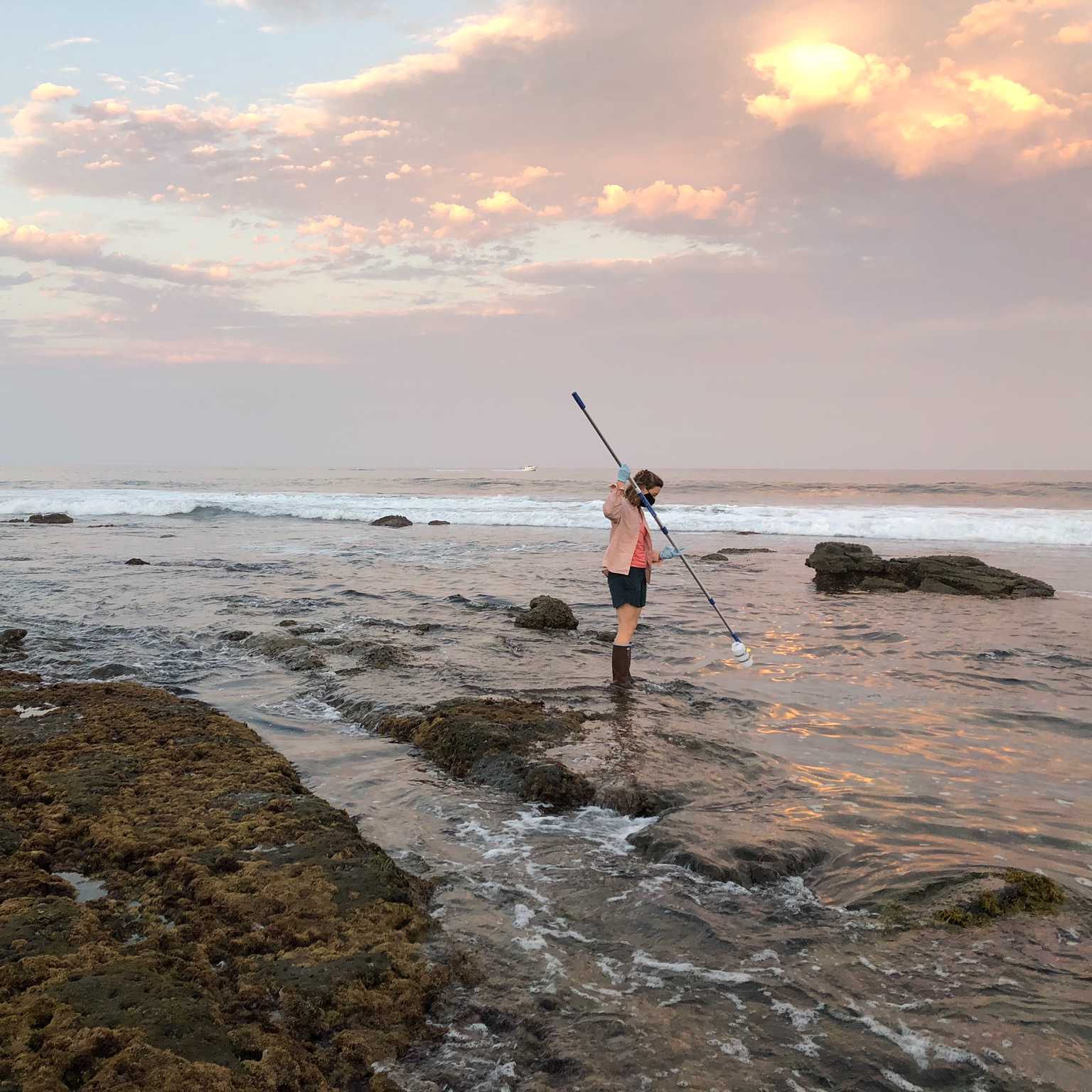
M. McElroy
Materials
Nitrile gloves
Rubber boots
11 - 1L Nalgene sampling bottles
1 - Ettore telescopic pole with custom bottle attachment
1 - Large backpack with clean plastic lining, storage bin, or cooler large enough to transport and store samples
1L laboratory-grade water in 1L Nalgene (field blank, negative control)
Safety warnings
Take care to avoid getting bleach on your eyes and skin - irritation may occur. Use bleach in a well-ventilated area to avoid inhalation of harmful fumes. Dispose of excess bleach safely - bleach is an environmental hazard.
Sampling in rocky intertidal habitats can be dangerous due to slippery rocks, steep terrain, and high or unpredictable surf. Plan carefully for access in these areas, which can be remote and difficult to navigate.
Before start
You must properly decontaminate sampling gear and materials that have been used previously at other sampling locations or were otherwise acquired as non-sterile from a manufacturer. Proper decontamination of field supplies consists of 30-minute (up to overnight) exposure to a household bleach solution diluted to 10% strength in clean water. After bleach application, rinse supplies thoroughly with laboratory grade water when available - clean tap water from a sink, spigot, or garden hose can also be used for rinsing bulky items like boots, waders, etc. Store decontaminated field gear and materials in a clean storage location until you reach the sampling location.
Be aware of the tide cycle and water level at your field site prior to access on the day of sampling.
Wearing gloves, attach a 1L bottle to the sampling pole.
1m
Remove the cap and submerge the bottle in seawater at your sampling location. Be careful not to stir up sand or sediment in shallow areas. Fill the bottle completely and rinse once with seawater. Discard this rinse on the shore or sufficiently away from the point of collection. When possible, collect samples from a distance using the telescopic pole to avoid contaminating point of sample collection with trace DNA on footwear.
3m
Refill bottle and securely replace the cap. Avoid touching the interior surfaces of the bottle and cap.
Detach bottle from the sampling pole and place it in a storage bag, bin, or cooler. Add ice to cooler if storing samples for more than 1 hour before filtration. Keep 1L field blank in the storage bin alongside biological samples.
1m
Repeat for 10x 1L bottle samples, collecting samples spread across discrete tide pools and in the surf zone on lower edge of exposed rocky shore. Label samples accordingly.
30m
Record the time, water level, and note any relevant site conditions.