Jul 14, 2025
Seawater filtration and preservation for environmental DNA metabarcoding - rocky intertidal habitats
- 1University of California, Santa Barbara


Protocol Citation: Mary McElroy 2025. Seawater filtration and preservation for environmental DNA metabarcoding - rocky intertidal habitats. protocols.io https://dx.doi.org/10.17504/protocols.io.bp2l6b5o1gqe/v1
Manuscript citation:
In prep
License: This is an open access protocol distributed under the terms of the Creative Commons Attribution License, which permits unrestricted use, distribution, and reproduction in any medium, provided the original author and source are credited
Protocol status: Working
We use this protocol and it's working
Created: September 25, 2021
Last Modified: July 14, 2025
Protocol Integer ID: 53548
Keywords: seawater filtration, environmental DNA, metabarcoding, rocky intertidal, eDNA, seawater sampling, preservation for environmental dna metabarcoding, filtered environmental dna sample, environmental dna metabarcoding, environmental dna sample, seawater sample, seawater filtration, environmental dna, dna metabarcoding, dna isolation, dna extraction, storage methods for aqueous macrobial edna, marine macrophyte, targeting marine macrophyte, situ filtration, rocky intertidal habitats this protocol, rocky intertidal monitoring site, dna, term rocky intertidal monitoring site, rocky intertidal habitat, optimized extraction protocol, isoamyl alcohol dna extraction, preservation, aqueous macrobial edna, peristaltic pump, extraction protocol, habitat, daytime low tide, macroinvertebrate, room temperature preservation
Funders Acknowledgements:
Zegar Family Foundation
Grant ID: SB200094
Abstract
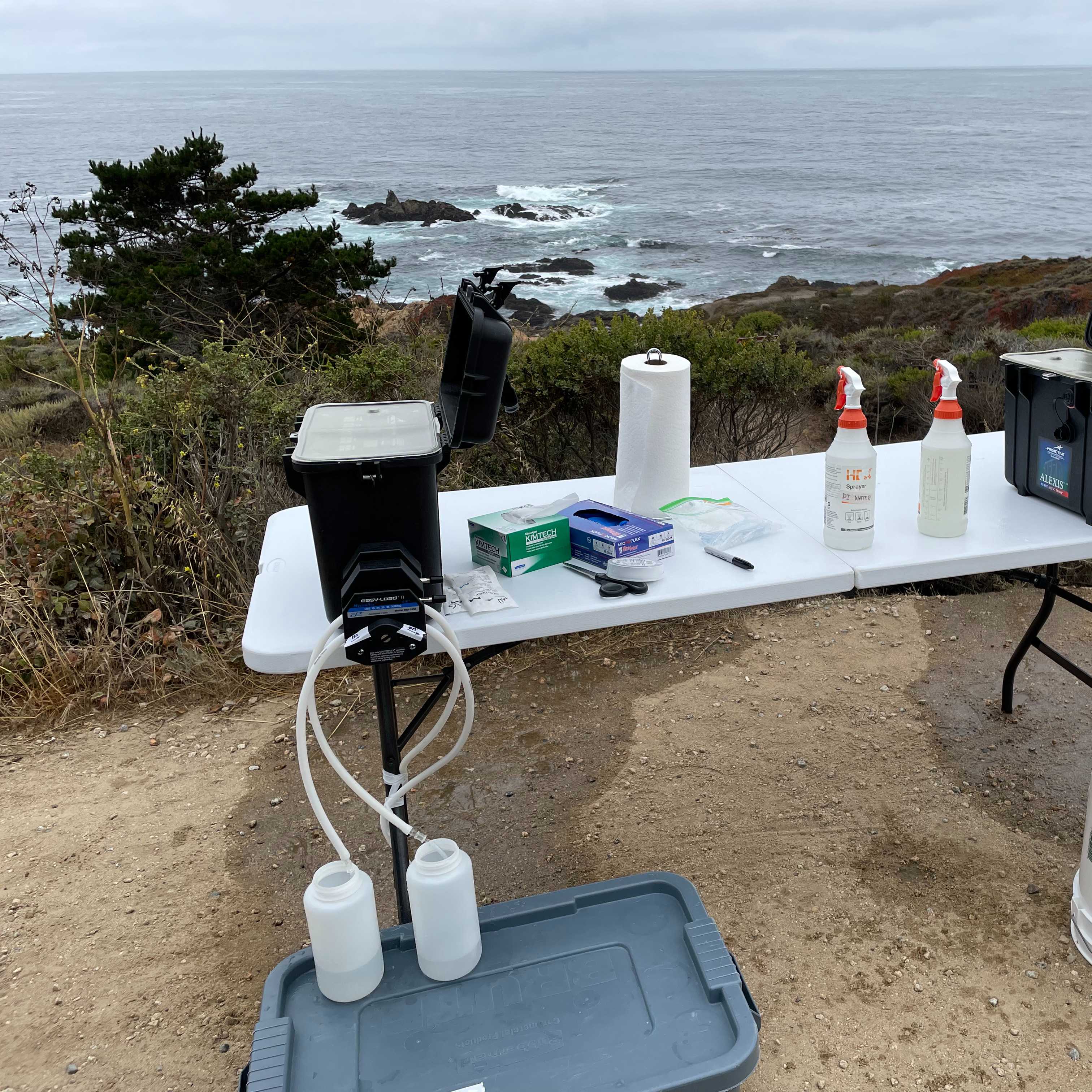
This protocol describes in-situ filtration and preservation of 1-L seawater samples from rocky intertidal habitats for environmental DNA (eDNA) metabarcoding. This protocol was optimized for samples collected from long-term rocky intertidal monitoring sites in southern and central California (USA) during daytime low tides and subsequent metabarcoding analyses targeting marine macrophytes and macroinvertebrates. For this study, we acquired two peristaltic pumps - one with a single pump head and one with a double pump head, which allowed us to filter 3 samples at once. We preserved filters with Longmire's lysis buffer, which allowed for easy transport over multiple days in the field and up to 18 months of room-temperature storage prior to DNA extractions.
Longmire's lysis buffer was prepared according to:
Longmire J.L., Maltbie M., and Baker R.J., 1997. Use of ‘lysis buffer’ in DNA isolation and its implications for museum collections. Museum of Texas Tech University, 163, pp.1-3.
Renshaw, M.A., Olds, B.P., Jerde, C.L., McVeigh, M.M. and Lodge, D.M., 2015. The room temperature preservation of filtered environmental DNA samples and assimilation into a phenol–chloroform–isoamyl alcohol DNA extraction. Molecular Ecology Resources,15(1), pp.168-176.
Following Longmire's additions, DNA extractions were performed according to:
Spens, J., Evans, A.R., Halfmaerten, D., Knudsen, S.W., Sengupta, M.E., Mak, S.S., Sigsgaard, E.E. and Hellström, M., 2017. Comparison of capture and storage methods for aqueous macrobial eDNA using an optimized extraction protocol: advantage of enclosed filter. Methods in Ecology and Evolution,8(5), pp.635-645.
Attachments

Image Attribution
M. McElroy
Materials
2 - Alexis Peristaltic pumps with single and double Thermo Scientific Masterflex P/S Easy-Load II Pump Heads (ALXPERRI-20000, Proactive Environmental Products)
3 - 1-m pieces Masterflex Precision pump tubing, size 24
11 - Two-way tubing connectors with 1/3-in inlet, 1/5-in outlet (uxcell)
11 - 10-cm pieces PVC tubing with 1/8-in ID, 1/4-in OD
11 - 10x 1L seawater samples plus 1 field blank
11 - 0.45μm Sterivex-HV Pressure Filter Units with Male Luer Lok (SVHVL10RC, EMD Millipore)
25 - Sterile dual-end Luer Lok caps, 2 per filter unit plus 1 for Longmire's syringe
1 - 30-ml aliquot of Longmire’s lysis buffer
1 - 30-ml sterile Luer Lok syringe
11 - 5-cm pieces PVC tubing with 1/8-in ID, 1/4-in OD
Nitrile gloves
2 spray bottles - one with 10% bleach, one with deionized water
Paper towels, KIM wipes
Permanent marker and clear tape
Small plastic bags - Ziploc or similar
*There is adaptability here for different sizes of tubing and syringes, depending on your preferences, supply availability, and compatibility with available equipment. If using Sterivex filter units, your tubing and caps must fit the inlet and outlet ends of the capsule. Find the Sterivex User Guide here. Find the Alexis Pump Manual here.
Safety warnings
Take care to avoid getting bleach on your eyes and skin - irritation may occur. Use bleach in a well-ventilated area to avoid inhalation of harmful fumes. Dispose of excess bleach safely and away from the sampling location - bleach is an environmental hazard.
Before start
All re-usable filtration materials (tubing and connectors) must be decontaminated prior to each sampling event. For this protocol, decontamination consisted of an application of 10% household bleach solution for at least 30 min followed by an overnight soak in room-temperature, lab-grade water. You may additionally UV-irradiate these materials to further minimize contamination risk. Store decontaminated materials in clean bags or bins until you are ready to begin filtering. Do not store these materials in the same area as seawater samples and only handle them with clean gloves.
Prepare a sufficient quantity of Longmire's lysis buffer to accommodate the number of filters you intend to preserve. Sterivex capsules can each hold 2.2 ml solution.
If possible, treat working surfaces with 10% bleach. The lids of storage bins, coolers, a compact folding table, or a plastic sheet over a picnic table can all be made into clean working surfaces. Keep Longmire's materials away from samples and pump equipment.
Filtration
45m
Wearing gloves, set up peristaltic pumps and secure Masterflex pump tubing into each pump head, leaving enough length on the 'in' side of the pump head to place the 10-cm tubing plus attached filter into the open sample. Leave enough room on the 'out' side of the pump head to make sure you can control the out-flow of water.
5m
From clean storage, retrieve a new piece of 10-cm tubing with a tubing connector fit to one end. Attach the free end of the connector to the 'in' side of Masterflex tubing at the pump head. Carefully open a new Sterivex filter and attach the outlet end to the 10-cm tubing.
3m
Now grab a seawater sample, invert it a few times, and remove the cap. Using the Masterflex tubing to guide placement, carefully submerge the Sterivex capsule into the sample. The 10-cm tubing will be partially submerged as well. With a 1-L wide-mouth Nalgene, the Sterivex should reach the bottom of the bottle. Ensure the Masterflex tubing does not make contact with the sample.
3m
Turn on the pump and filter the sample at recommended Sterivex specifications (flow rate of approx. 100 mL/min at a speed of 60 rpm). Ensure filter inlet is submerged as sample is drawn up from bottle. Once the sample has completely filtered or filter becomes clogged, allow air to evacuate the filter for a few seconds. Filtration may take fewer than 5 minutes per 1L or up to 30 minutes per 1L depending on sample particulate load. Avoid filtering any sand, sediment, or large pieces of biological material that settle out on the bottom of the bottle.
30m
Turn off the pump and carefully detach the lower tubing from the Masterflex tubing. There may be some resistance here because a slight vacuum formed during filtration. Once released, carefully detach the Sterivex capsule from the tubing. At this point, handling the exterior of the capsule does not present a contamination risk. Discard 10-cm tubing and tubing connector.
3m
Use new 10-cm tubing and connectors for each sample and wipe the end of the Masterflex tubing with 10% bleach followed by deionized water. Change gloves often to avoid cross-contamination, or spray your gloves with 10% bleach and deionized water between samples.
3m
Preservation / Longmire's addition
6m
Wearing clean gloves, add 30ml Longmire’s buffer to a new 30ml Luer Lok syringe and set aside in a clean area away from samples and pump equipment. At colder temperatures, Longmire's buffer will form precipitates, so try to warm up and re-dissolve the solution before adding to samples (body heat works).
5m
Attach a clean 5-cm tubing to the Longmire's syringe being careful not to touch the syringe tip. Keep remaining 5-cm tubing pieces in a clean plastic bag and only handle with clean gloves.
15s
Attach the outlet end of the newly filtered Sterivex to the open end of the 5-cm tubing. Slowly push the plunger to add ~2.2 ml Longmire's to the capsule. Do not overfill and try to avoid air bubbles.
15s
Secure the open end of the Sterivex with a Luer Lok cap and carefully detach the tubing and Sterivex from the syringe. Secure the other end of the capsule with another cap. Invert the sealed sample a few times. Label the capsule and cover with clear tape.
15s
Dispose of tubing and place syringe back in a clean area of your work space. Use a new piece of 5-cm tubing for each Longmire's addition to a new sample. Change gloves often to avoid cross-contamination. Keep preserved samples in a bin or bag away from sterile filtration materials.
15s
Protocol references
Longmire's lysis buffer was prepared according to:
Longmire J.L., Maltbie M., and Baker R.J., 1997. Use of ‘lysis buffer’ in DNA isolation and its implications for museum collections. Museum of Texas Tech University, 163, pp.1-3.
Renshaw, M.A., Olds, B.P., Jerde, C.L., McVeigh, M.M. and Lodge, D.M., 2015. The room temperature preservation of filtered environmental DNA samples and assimilation into a phenol–chloroform–isoamyl alcohol DNA extraction. Molecular Ecology Resources,15(1), pp.168-176.
Following Longmire's additions, DNA extractions were performed according to:
Spens, J., Evans, A.R., Halfmaerten, D., Knudsen, S.W., Sengupta, M.E., Mak, S.S., Sigsgaard, E.E. and Hellström, M., 2017. Comparison of capture and storage methods for aqueous macrobial eDNA using an optimized extraction protocol: advantage of enclosed filter. Methods in Ecology and Evolution,8(5), pp.635-645.