Sep 26, 2025
Sanger Tree of Life HMW DNA Fragmentation: Opentrons® OT-2 for PacBio LI
- 1Tree of Life, Wellcome Sanger Institute, Hinxton, Cambridgeshire, CB10 1SA
- Tree of Life at the Wellcome Sanger Institute
- Earth BioGenome Project


Protocol Citation: Amy Denton, Caroline Howard 2025. Sanger Tree of Life HMW DNA Fragmentation: Opentrons® OT-2 for PacBio LI. protocols.io https://dx.doi.org/10.17504/protocols.io.x54v957mpl3e/v1
License: This is an open access protocol distributed under the terms of the Creative Commons Attribution License, which permits unrestricted use, distribution, and reproduction in any medium, provided the original author and source are credited
Protocol status: Working
We use this protocol and it's working
Created: September 04, 2025
Last Modified: September 26, 2025
Protocol Integer ID: 226422
Keywords: pipette shearing, Opentrons, Opentrons OT-2, high molecular weight DNA fragmentation, HMW DNA fragmentation, automation, reference genome, long read sequencing, PacBio low input sequencing, PacBio, LI sequencing, genomics, biodiversity genomics, sanger tree of life hmw dna fragmentation, sanger tree of life hmw dna extraction, life hmw dna extraction protocol, life hmw dna extraction, sanger tree of life fragmented dna, shearing hmw dna, life hmw dna fragmentation, hmw dna fragmentation, life fragmented dna, fragmentation of hmw dna, fragmented dna, sheared dna, fragmenting high molecular weight dna, hmw dna, blood sanger tree, dna, tree of life programme, taxonomic group, automated plant organic extraction, effective for the fragmentation, sanger tree
Funders Acknowledgements:
Wellcome Trust
Grant ID: 206194
Wellcome Trust
Grant ID: 218328
Abstract
This protocol is for the fragmentation of HMW DNA from either the MagAttract v.3, Plant MagAttract v.5, Automated Plant Organic Extraction, Nanobind tissue or Nanobind nucleated blood Sanger Tree of Life HMW DNA extraction protocols, using the Opentrons® OT-2 liquid handler and a 2 mL 96-well deep-well KingFisher™ plate. This process is highly effective for the fragmentation of DNA extracted from all of the taxonomic groups covered by the Tree of Life Programme, with DNA sheared into an average fragment size range of 12–22 kb for PacBio LI sequencing. The output of this protocol is sheared DNA which can be directed towards the Sanger Tree of Life Fragmented DNA clean up: Automated SPRI protocol v2. This protocol was adapted from settings used for pipette shearing HMW DNA on the Opentrons® Flex as described in ‘Fragmenting High Molecular Weight DNA for PacBio® Long-Read Sequencing Using Pipette Shearing’ by D. Howell et al.
Guidelines
- The DNA sheared with this protocol must be intended for LI PacBio sequencing.
- For this protocol, we recommend shearing no more than 3000 ng of DNA diluted in 300 µL. If the concentration exceeds 10 ng/µL then there is a strong likelihood of the sample under-shearing.
- This protocol is for the shearing of DNA into fragment sizes of 12–22 kb, with ideal fragment sizes of 20–22 kb.
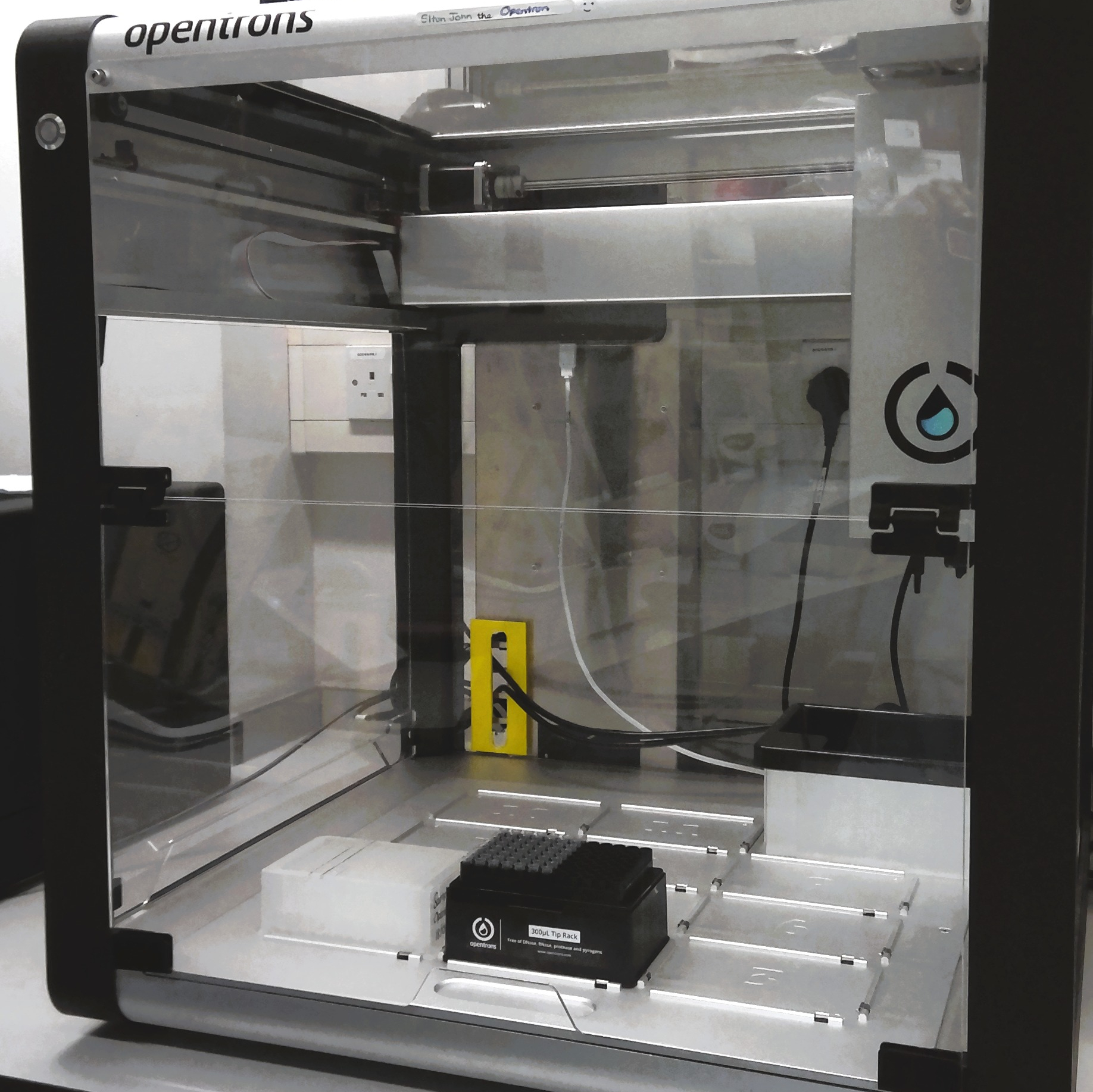
- The Opentrons® OT-2 requires a GEN1 8-channel 300 µL pipette in the right mount to run the pipette shearing protocol.
- The shearing parameters for the Opentrons® OT-2 are as follows:
| Parameters | Requirements | |
| DNA concentration (ng/µL) | 1–10 | |
| Total volume (µL) | 300 | |
| Pipette Speed (µL/s) | 1000 | |
| Volume pipetted (µL) | 200 | |
| Repetitions | 1200 |
- The Opentrons® OT-2 is able to shear one column of samples in a 2 mL 96-well deep-well KingFisher™ plate at a time, therefore it is recommended to process samples in multiples of 8.
Additional Notes:
- Example protocols for shearing 24 samples in three columns of a 2 mL 96-well deep-well KingFisher™ plate have been attached in the Materials section. These protocols can be directly imported to the Opentrons app for running on an Opentrons® OT-2, or can be imported to the Opentrons Protocol Designer for editing.
- The custom labware created for the 2 mL 96-well deep-well KingFisher™ plate has been attached in the Materials section.
Troubleshooting:
- There may be issues with connection where the robot cannot be found by the Opentrons app. If this occurs, check that the ‘on’ light on the OT-2 is solid blue – if it is flashing then the robot is still connecting. If the ‘on’ light is blue and the app still cannot find the robot, restart both the robot and app.
- If there are any issues with samples not being taken up by the pipettes during the run, pause the protocol and note the location of the sample. This sample will require transfer to a new well at the end of the protocol and re-shearing.
Materials
- EB buffer (Qiagen Cat. no. 19086)
Equipment:
- Pipettes for 0.5–1000 μL and filtered tips
- 200 μL wide-bore pipette tips
- Opentrons® OT-2 robot (Cat. no. 999-00111, 999-00002, 999-00006)
- Opentrons® 300 μL tips (Cat. no. 999-00009 and refills 999-00012)
- Thermo Fisher KingFisher™ 1 mL 96-well Deep-well plates (Thermo Fisher Cat. no. 95040450)
Opentrons pipette shearing protocols:
 Columns_1__3_Pipette_Shearing_for_PacBio.py21.6KB Columns_4__6_Pipette_Shearing_for_PacBio.py21.6KB Columns_7__9_Pipette_Shearing_for_PacBio.py21.6KB Columns_10__12_Pipette_Shearing_for_PacBio.py21.7KB
 Opentrons custom labware:
 thermofisher_96_wellplate_2000ul.json28.6KB
 Protocol PDF:  Sanger Tree of Life HMW DNA Fragmentation_ Opentrons® OT-2 for PacBio LI.pdf148.1KB
Sanger Tree of Life HMW DNA Fragmentation_ Opentrons® OT-2 for PacBio LI.pdf148.1KB Safety warnings
- Operators must wear a lab coat, powder-free nitrile gloves and safety specs to perform the laboratory procedures in this protocol.
- Waste needs to be collected in a suitable container (e.g. plastic screw-top jar or Biobin) and disposed of in accordance with local regulations.
- Do not open the door of the Opentrons® OT-2 whilst it is in operation.
Preparing DNA for fragmentation
For each sample, use a wide-bore pipette tip to transfer the volume required for a maximum of 3000 ng of DNA into a fresh well of a 2 mL 96-well deep-well KingFisher plate, up to the maximum volume of 300 µL.
Prior to transferring sample from its original storage tube, mix sample by pipetting carefully with wide-bore pipette tip.
To ensure that under-shearing does not occur due to more than 3000 ng being transferred, round down the volume required for 3000 ng. For example, if 24.8 µL is needed for 3000 ng, transfer 24 µL.
Transfer samples down each column of the 2 mL 96-well deep-well KingFisher plate, e.g., sample one in A1, then sample two in B1, sample three in C1, etc.
For each sample in the KingFisher plate, top-up to the required volume of 300 µL with buffer EB.
Label this plate containing the diluted DNA samples as the ‘Sample Plate’.
Running the Opentrons® OT-2
Switch on the Opentrons® OT-2.
On a laptop, navigate to the Opentrons® app on the desktop and open.
Using ‘Devices’, check that the Opentrons® OT-2 has connected to the app – this may take a few minutes after it has been switched on.
Using ‘Protocols’, select an appropriate shearing protocol based upon the number of samples you are shearing and their location in the KingFisher plate.
After selecting your protocol, choose ‘Start setup’:
For the ‘choose robot step’, select the OT-2.
Select ‘proceed to set-up’.
Protocol window will then open with set-up steps to confirm before protocol will be able to run:
Perform calibration and offset measurements as required.
Proceed to ‘Labware & Liquids’ for a map view of the OT-2 to show you where the Sample Plate and tip box should be loaded onto the deck – follow this guidance.
Load the Sample Plate into slot 1 on the OT-2 starting deck as directed in ‘Labware & Liquids’.
Load the tip box into slot 2 on the OT-2 starting deck as directed in ‘Labware & Liquids’.
Ensure tips are loaded so that the robot can take from the first row in the tip box.
Ensure that you remove the lid of the tip box before closing the door and starting the run.
Finally, check the bin in the OT-2 to ensure that it will not overflow during the protocol, emptying it if required.
Close the door of the OT-2 – the shearing protocol will not be able to start until the door is properly closed.
Click ‘Start run’ on the Opentrons® app to begin the protocol.
After starting the protocol, visually confirm the robot loads all tips onto the pipette and that all pipettes are drawing up liquid.
Each column in the KingFisher plate takes approximately 45 mins to be sheared. If multiple rows are being sheared, this shearing will occur sequentially.
Whilst the OT-2 does not require supervision throughout the run, if running multiple columns, it is good practice to check during the transition periods to ensure that tip disposal, the attachment of new tips and the commencement of shearing of the next rows occurs without issue.
Once the program is complete, remove the Sample Plate from the Opentrons® OT-2.
Switch off the Opentrons® OT-2 robot.
Proceed to the automated SPRI clean-up on the KingFisher Apex as detailed in the Sanger Tree of Life Fragmented DNA clean up: Automated SPRI protocol v2, or store samples at 4 °C.
Note: if storing samples in the fridge for SPRI at a later time, ensure that the plate is sealed properly to prevent evaporation of samples.
Protocol references
Fragmenting High Molecular Weight DNA for PacBio® Long-Read Sequencing Using Pipette Shearing - D. Howell, C. Bravo, A. Jung, E. Lee, K. Watson, Opentrons Labworks Inc & Psomagen. Fragmenting High Molecular Weight DNA PacBio Psomagen_app note.pdf