Sep 08, 2022
S-Trap™ plate digestion protocol (Protifi) of proteins for LC-MS / proteomics
- 1University of Manchester
- BioMS CRF, UoM



Protocol Citation: ronan.ocualain , Davidknight , Staceywarwood , Jamesallsey , Emmakeevill 2022. S-Trap™ plate digestion protocol (Protifi) of proteins for LC-MS / proteomics. protocols.io https://dx.doi.org/10.17504/protocols.io.kxygxzd2zv8j/v1
License: This is an open access protocol distributed under the terms of the Creative Commons Attribution License, which permits unrestricted use, distribution, and reproduction in any medium, provided the original author and source are credited
Protocol status: Working
We use this protocol and it's working
Created: July 20, 2022
Last Modified: September 08, 2022
Protocol Integer ID: 67156
Keywords: S-trap™ 96-well plate, Digestion, Elution, Digestion protocol, Eppendorf thermomixer, Mass spec analysis, proteomics, quartz, s-trapping, S-trap, Protifi, desalting, clean-up, LC-MS, off-line, offline, enzymatic digestion, automatable, proteomics this protocol, proteomic, proteins for lc, well plate protein clean, long protocol from protifi, protein, protifi, digestion, protocol detail, house bioms procedure
Abstract
This protocol details the in-house BioMS procedure of S-Trap™ 96-well plate protein clean-up and digestion.
It is adapted from the long protocol from Protifi (as on August 2022) - https://files.protifi.com/protocols/s-trap-96-well-plate-long-1-4.pdf
Attachments

iiaebptmp.docx
173KB
Guidelines
- You may purchase S-trap plate positions (or full plates) and other consumables directly from us at the BioMS core facility on PPMS - https://corefacilities.manchester.ac.uk/?BioMS).
- Allow 02:30:00 for this process.
- This plate based protocol is to be used for samples with a protein load between 50 µg to 250 µg of starting material.1
- You have cell or tissue lysates in 50 µL of S-Trap lysis buffer (5 % (v/v) SDS with 50 millimolar (mM) TEAB 7.5 ).2
- Protein lysates have been sheared of nucleic acid (e.g. from BioMS’s LE220+ AFA sonication system).3
- Protein lysates have been reduced and alkylated and clarified by centrifuging at 14000 x g for 00:10:00 (see the protocol "Reduction and alkylation of protein lysates for LC-MS (proteomics) using dithiothreitol (DTT) and iodoacetamide (IAM)" in this collection).4
- The protein concentration of a pool of the protein lysates has been quantified and samples prepared to be 100 ug of protein in 50ul of 5% SDS (see notes).
Notes:
- If you have less than 50 µg of protein - use the "S-Trap™ column digestion protocol (Protifi) of proteins for LC-MS / proteomics" in this collection. Speak with a member of BioMS if you are unsure which option to use.
- Alternatively, if your lysate volume is larger than 50 µL simply remove a 25 µL sample aliquot for processing.
- This step is essential as omitting it may clog the S-Trap column. If you do not have access to ultrasonication, see protocol from EMDmillipore for details.
- If it is thought that the insoluble pellet contains proteins of interest, then proceed with homogenising (with a pipette and tip) the insoluble pellet as much as possible with fresh 5% S-trap lysis buffer. A suspension of insoluble particles may be formed this way. Proceed with a separate S-trap column to process this additional sample.
Materials
Locate the following buffers and reagents:
| A | B | |
| Location | Buffer/reagent | |
| Bench | -- 12% phosphoric acid -- S-Trap binding buffer (90% aqueous methanol containing a final concentration of 100 mM TEAB, pH 7.1) -- 0.1% formic acid in water -- 0.1% formic acid in 30% acetonitrile -- MTBE / Methanol solution (10/3 (v/v)) | |
| Freezer 3 | Aliquots of trypsin (10 uL at 2ug.uL-1) |
Locate the following consumables:
- 2x S-Trap plates (one for the processing, and another to use as a balance in the centrifuge - the balance one will be next to the centrifuge you will be using). Please purchase the use of the S-trap plate in advance from BioMS core facility on PPMS - https://corefacilities.manchester.ac.uk/?BioMS).
- 2x fresh collection plates: one for sample flow-through and washes, use the other clean plate for elution and collection of peptides generated by the process.
- 1.5 mL (i), and 2 mL (ii) Eppendorf tubes
for
(i) diluting samples (if necessary), and for the digestion step.
and
(ii) collecting unbound material from the S-trapping process.
- You may need additional S-Trap binding buffer, there are aliquots of 5 mL of 100 millimolar (mM) TEAB, 7.1 stored in freezer 3, thaw and add 45 mL of methanol to make a final volume of 50 mL to use.
Identify the following equipment that you will use:
- one each of 10 µL or 20 µL , a 200 µL pipette, and a 1 mL pipette.
- A plate centrifuge such as a Thermo Megafuge 16 with plate rotor fitted. )
- A Vortex mixer (if diluting samples).
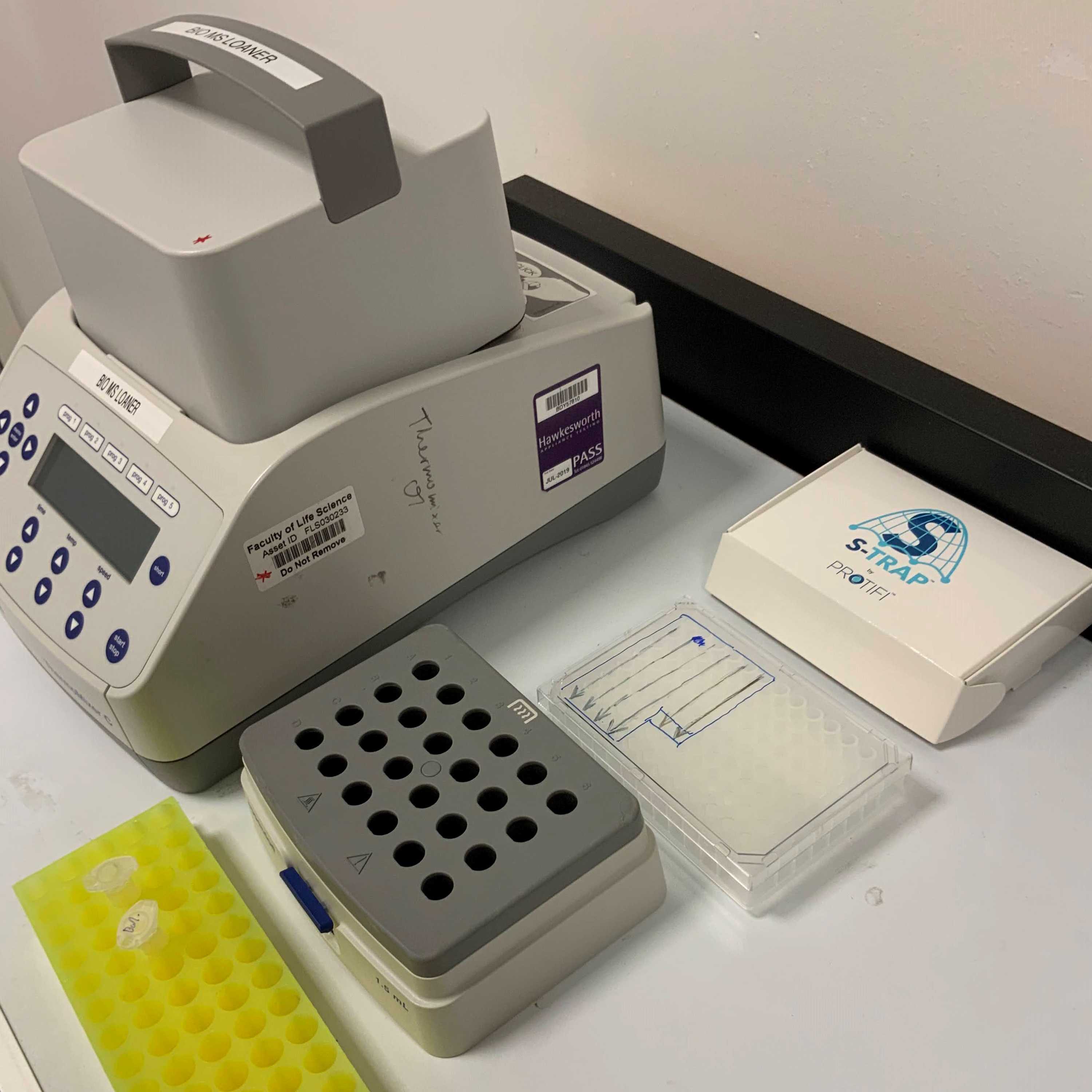
- Eppendorf Thermomixer.
- An Eppendorf Thermomixer with 1.5 mL thermoblock and set it to 47 °C, 01:00:00, and a speed of 0 rpm (i.e. no shaking).
Set the Eppendorf Thermomixer to 47 °C , 01:00:00 , with the PCR 96 thermoblock, and a speed of 0 RPM (i.e. no shaking).
Catalogue numbers:
ortho-Phosphoric acid 85%Merck MilliporeSigma (Sigma-Aldrich)Catalog #1005732500
Methanol Optima™ LC/MS Grade Fisher ChemicalFisher ScientificCatalog #A456-4
Pierce™ 0.1% Formic Acid (v/v) in Acetonitrile, LC-MS GradeThermo FisherCatalog #85174
Pierce™ 0.1% Formic Acid (v/v) in Water, LC-MS GradeThermo FisherCatalog #85170
tert-Butyl methyl ether 99%Alfa AesarCatalog #L14030
Trypsin TPCK TreatedWorthington Biochemical CorporationCatalog #LS003740
SDS sodium dodecyl sulfateCatalog #75746-250G
Triethylammonium bicarbonate (TEAB)Merck MilliporeSigma (Sigma-Aldrich)Catalog #T7408
Protifi S-trap 96-well plateCatalog #C02-96well-1
Safety warnings
Please refer to the copies of Risk Assessment Forms held in both B2071 and B2075 for hazards to health, and other identified hazards and risks, associated with the use of this protocol before starting.
Before start
Prepare your protein samples using the other protocols in this collection.
The following steps are optimised for volumes of 50 µL and 100 µL of protein.
For other volumes and amounts of protein, adjust accordingly, by dilution into S-trap lysis buffer. It is recommended that the final concentration of SDS be at least greater than 3 % (v/v) , and up to 15 % (v/v) , and a protein load between 50 µg to 250 µg for the process to work successfully.
Use the 1.5 mL adaptor for the Eppendorf Thermomixer, and set the thermomixer to 47 °C , 01:15:00 , and a speed of 0 rpm (i.e. no shaking).
Sample preparation
10m
To the 50 µL volume of sample in S-trap lysis buffer, add 5 µL of 12 % (v/v) aqueous phosphoric acid at 1:10 for a final concentration of 1.2 % (v/v) phosphoric acid and vortex mix.
Note
Notes:
1.To create a 50 µL sample with a concentration of 50 µg/µL protein,
You can estimate the amount of lysate required using the following calculation:
amount lysate (ul) = 50ul/calculated pooled lysate concentration(in ug/ul) and make up the volume to 50 µL with 1x SDS solubilization buffer,
e.g. if the pooled lysate was determined to have a concentration of 1.6 mg/mL then take 50/1.6 = 31 µL of each sample and add 19 µL of 1x SDS solubilization buffer.
If your samples are dilute, i.e. less than 0.5 µg/µL , it is be a good idea to concentrate your samples before proceeding with the S-trap plate process.
Methods to do this include the use of a speed-vac or lyophilisation.
Speak with a member of the BioMS team before doing so.
Note
This step is essential to completely denature proteins and trap them efficiently.
The pH will be ≤ 1.0 . If the sample pH is not ≤ 1.0 , add additional phosphoric acid to reach pH ≤ 1.0 .
A quick way to check the pH is to spot 2 µL of the acidified lysate on a strip of filter paper.
The final phosphoric acid concentration is different between S-Trap micros, and minis/midis.
Add 350 µL of S-Trap binding buffer to the acidified lysis buffer and mix.
Put the S-Trap plate on top of a clean 96 well plate, add the acidified methanolic SDS lysate into the plate.
Note
No plate pre-equilibration is necessary. Solution typically beings to drip through immediately.
Sample Trapping
30m
Locate an S-trap balance plate, with a receiver 96 well plate beneath. Centrifuge the plate at 1000 x g for 00:02:00 in the Thermo megafuge 16 centrifuge.
Note
2m
Repeat the previous two steps until there all sample has been applied to the S-Trap plate.
Note
Protein should be trapped within the protein-trapping matrix of the plate.
Sample Washing
30m
Wash captured protein with one wash of 200 µL of MTBE solution, simply add 200 µL of the MTBE solution to the column, and spin at 1000 x g for 00:02:00 .
Note
This will remove methanol insoluble biomolecules from the quartz filter.
2m
Following this, perform three washes of 200 µL of S-Trap binding buffer, again, add 200 µL of the S-trap binding buffer, and centrifuge at 1000 x g for 00:02:00 .
Note
Note: If you wish, you may transfer the flow through and washes back into an eppendorf sample tube after each centrifugation step, otherwise empty the collection tube so that the washes do not come in contact with the binding matrix. If discarding the washes then collect in a beaker and put in acetonitrile/solvent waste when finished.
Note
- Note: Depending on the number of protein samples you need to process, you may find that you need additional S-Trap binding buffer.
- If so, there are aliquots of 5 mL of 100 millimolar (mM) TEAB at 7.1 stored in 50 mL Falcon tubes in freezer 3.
- - take one out, thaw at Room temperature , and add 45 mL of methanol (located in fume hood) to make a final volume of 50 mL , mix, and use.
2m
Digest proteins
1h 15m
Move S-Trap digestion plate on top of a clean receiver plate.
Locate the trypsin aliquots. They are in the top shelf of freezer 3.
Note
Trypsin must be added to the protein at a ratio of 1:10 wt:wt (enzyme:protein).
The frozen aliquots are at a volume of 10 µL containing 20 µg of trypsin (concentration of 2 µg/µL 1).
Add 250 µL of digestion buffer to the aliquot. This gives a total volume of 260 µL , enough for 2 S-Trap digestions.
Add 125 µL of digestion buffer containing protease into the top of the wells.
Place cover over the stacked plates.
Incubate in the thermomixer for 01:15:00 at 47 °C for trypsin.
Note
Some dripping may occur during incubation; this is not of concern. REMEMBER - DO NOT SHAKE.
Note
1h 15m
OPTIONALSTEP: If you wish, you may also set up this digestion step overnight, with no impact on the S-trap process.
To do this, set the Thermomixer to 37 °C and incubate overnight, again with no shaking.
Elute peptides:
20m
Add 80 µL of digestion buffer to all wells of the S-Trap digestion plate.
Centrifuge the plate at 1000 x g for 00:02:00 or until all solution has passed through.
Note
Do not centrifuge the plate prior to addition of 80 μL of digestion buffer used in this first elution.
2m
Add 80 µL of 0.1% aqueous formic acid to all wells of the S-Trap digestion plate and spin through at 1000 x g for 00:02:00 .
2m
Further elute peptides with 55 µL of 30% aqueous acetonitrile containing 0.1% formic acid and spin through at 1000 x g for 00:02:00 .
2m
This elution assists in recovery of hydrophobic peptides.
Note
The final acetonitrile concentration will be around 5 % (v/v) .
Note
When you are ready, please dispose of any solvent waste in the non-chlorinated waste drum.
2m