Sep 06, 2022
S-Trap™ column digestion protocol (Protifi) of proteins for LC-MS / proteomics
- 1University of Manchester
- BioMS CRF, UoM



Protocol Citation: ronan.ocualain , Jamesallsey , Davidknight , Staceywarwood , Emmakeevill 2022. S-Trap™ column digestion protocol (Protifi) of proteins for LC-MS / proteomics. protocols.io https://dx.doi.org/10.17504/protocols.io.yxmvmn6q9g3p/v1
License: This is an open access protocol distributed under the terms of the Creative Commons Attribution License, which permits unrestricted use, distribution, and reproduction in any medium, provided the original author and source are credited
Protocol status: Working
We use this protocol and it's working
Created: July 20, 2022
Last Modified: September 06, 2022
Protocol Integer ID: 67160
Keywords: Digestion protocol, S-Trap column, Eppendorf thermomixer, Mass spec analysis, proteomics, quartz, s-trapping, S-trap, Protifi, digestion, desalting, clean-up, LC-MS, off-line, offline, enzymatic digestion, proteomics this protocol, proteomic, proteins for lc, conversion of protein, long protocol from protifi, protein, subsequent column digestion, using trypsin, protifi, protocol detail
Abstract
This protocol details the in-house BioMS procedure of S-Trap™ protein clean-up and subsequent column digestion/conversion of protein to peptide using trypsin.
It is adapted from the long protocol from Protifi (as on August 2022) - https://files.protifi.com/protocols/s-trap-micro-long-4-7.pdf
Attachments

iiaebptmp.docx
173KB
Guidelines
- You may purchase S-trap columns and other consumables directly from us at the BioMS core facility on PPMS - https://corefacilities.manchester.ac.uk/?BioMS).
- Allow 02:30:00 for this process
- This protocol is to be used for protein loads columns are best for loadings less than 100 µg of starting material (protein). 1
- You have cell or tissue lysates in 25 µL or 50 µL of S-Trap lysis buffer (5% SDS with 50 mM TEAB pH 7.5). If your lysate volume is lower than these two volumes, make up to either with 5% S-Trap lysis buffer (working concentration). 2
- SDS is essential for the S-trapping process and subsequent clean-up, it is important that samples contain close to 5 % (v/v) SDS. This can be achieved by dilution of the sample using the 10 % (v/v) stock of S-trap lysis buffer.
- Protein lysates have been sheared of nucleic acid (e.g. from BioMS’s Covaris LE220+ AFA sonication system). Alternatively, a nuclease such as Benzonase may be used.3
- Protein lysates have been reduced and alkylated 4 and clarified by centrifuging at 14000 x g for 00:10:00 (see reduction and alkylation protocol in this series).
- The protein concentration of a pool of the protein lysates has been quantified and samples prepared to be less than 4 µg/µL of protein (Use the Millipore Direct Detect with the 5% SDS calibration file to check).
- Please take care not to touch the S-trap matrix in the column with pipette tips during the process.
Notes:
- If you have more than 100 µg of protein - use the S-trap plate method "S-Trap™ 96-well plate digestion protocol" in this collection.
- Alternatively, if your lysate volume is larger than 50uL, simply remove a 25 µL sample aliquot for processing.
- This step is essential as omitting it may clog the S-Trap column. If you do not have access to ultrasonication, see protocol from EMDmillipore for details.
- If it is thought that the insoluble pellet contains proteins of interest, then proceed with homogenising (with a pipette and tip) the insoluble pellet as much as possible with fresh 5% S-trap lysis buffer. A suspension of insoluble particles may be formed this way. Proceed with a separate S-trap column to process this additional sample.
Materials
Locate the following buffers and reagents:
| A | B | |
| Location | Buffer/reagent | |
| Bench (orange tray) | -- 12% phosphoric acid -- S-Trap binding buffer (90% aqueous methanol containing a final concentration of 100 mM TEAB, pH 7.1) -- 0.1% formic acid in water -- 0.1% formic acid in 30% acetonitrile -- MTBE / Methanol solution (10/3 (v/v)) | |
| Freezer 3 | Aliquots of trypsin (10 uL at 2ug.uL-1) |
Locate the following consumables:
S-Trap columns for processing (C02-micro) - please purchase from in advance from BioMS core facility on PPMS - https://corefacilities.manchester.ac.uk/?BioMS).
1.5 mL (i), and 2 mL (ii) Eppendorf tubes
for
(i) diluting samples (if necessary), and for digestion step.
and
(ii) collecting unbound material from the S-trapping process.
Identify the following equipment that you will use:
- One each of 20 µL , 200 µL , and 1000 µL pipettes.
- Eppendorf centrifuge 5430R (or equivalent benchtop centrifuge that will centrifuge 2 mL Eppendorf tubes at 14000 x g ).
- Depending on the number of protein samples you need to process, you may find that you need additional S-Trap binding buffer, there are aliquots of 5 mL of 100 millimolar (mM) TEAB at 7.1 stored in 50 mL Falcon tubes in freezer 3. - take one, thaw at Room temperature , and add 45 mL of methanol (locate in fume hood) to make a final volume of 50 mL to use.
- A vortex mixer (if diluting samples)
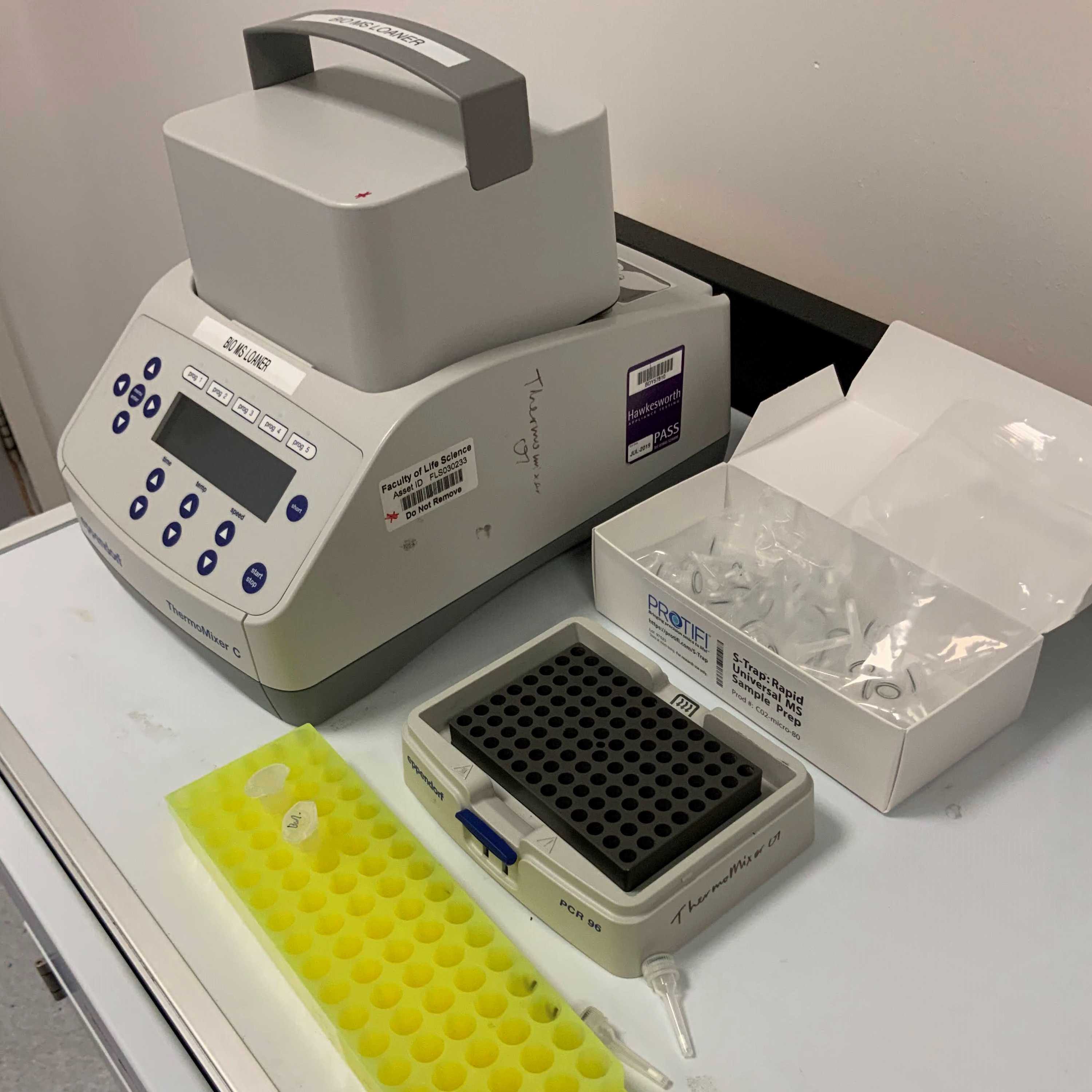
- An Eppendorf Thermomixer with 1.5 mL thermoblock and set it to 47 °C , 01:00:00 , and a speed of 0 rpm (i.e. no shaking).
Catalogue numbers:
ortho-Phosphoric acid 85%Merck MilliporeSigma (Sigma-Aldrich)Catalog #1005732500
Methanol Optima™ LC/MS Grade Fisher ChemicalFisher ScientificCatalog #A456-4
Pierce™ 0.1% Formic Acid (v/v) in Acetonitrile, LC-MS GradeThermo FisherCatalog #85174
Pierce™ 0.1% Formic Acid (v/v) in Water, LC-MS GradeThermo FisherCatalog #85170
tert-Butyl methyl ether 99%Alfa AesarCatalog #L14030
Trypsin TPCK TreatedWorthington Biochemical CorporationCatalog #LS003740
SDSMerck MilliporeSigma (Sigma-Aldrich)Catalog #75746
Triethylammonium bicarbonate (TEAB)Merck MilliporeSigma (Sigma-Aldrich)Catalog #T7408
S-Trap™ micro columns (≤ 100 μg)ProtifiCatalog #C02-micro (may be purchased in advance from BioMS core facility on PPMS - https://corefacilities.manchester.ac.uk/?BioMS).
Safety warnings
Please refer to the copies of Risk Assessment Forms held in both B2071 and B2075 for hazards to health, and other identified hazards and risks, associated with the use of this protocol before starting.
Before start
Locate the Eppendorf Thermomixer
Use the 1.5 mL adaptor for the Eppendorf Thermomixer, and set the thermomixer to 47 °C , 01:00:00 , and a speed of 0 rpm (i.e. no shaking).
Sample preparation
10m
To the reduced and alkylated sample of volume either of 25 µL or 50 µL , add a volume of 2.5 µL or 5.0 µL respectively of 12 % (v/v) aqueous phosphoric acid at a ratio of 1:10 for a final concentration of 1.2 % (v/v) phosphoric acid and vortex mix.
Note
Total volume is now either 27.5 µL or 55 µL .
Note
This step is essential to completely denature proteins and trap them efficiently.
The pH will be ≤ 1.0 . If the sample pH is not ≤ 1.0 , add additional phosphoric acid to reach pH ≤ 1.0 .
A quick way to check the pH is to spot 2 µL of the acidified lysate on a strip of filter paper.
The final phosphoric acid concentration is different between S-Trap micros, and minis/midis.
Add 165 µL or 330 µL of S-Trap binding buffer to the 27.5 µL or 55 µL volumes of acidified protein lysates respectively and mix.
Note
Total volume is now 192.5 µL for the 25 µL starting volume, or 385 µL for the 50 µL starting volumes.
Sample Trapping
30m
Place the S-Trap column on top of a 2 mL Eppendorf tube. This will collect the flow-through.
Add enough of the acidified methanolic lysate to the S-Trap column.
Note
Do not add more sample than will fit the narrow “stem” of the S-Trap column. If the volume to be loaded is larger than will fit in the stem, then proceed to centrifugation (next step).
Centrifuge the column/tube combination at 4000 rcf for 00:02:00 in the Eppendorf 5430R centrifuge.
Note
Protein should be trapped within the protein-trapping matrix of the column. It is important not to let the liquid that passes through the S-Trap to come in contact with the protein-trapping matrix of the column.
2m
Repeat the previous two steps if there is additional sample to be processed.
Note
Visually confirm all sample has passed through the column; if not, centrifuge again until all sample has passed through.
Sample Washing
30m
Wash captured protein with one wash of 150 µL of MTBE solution, simply add 150 µL of the MTBE solution to the column, and spin at 4000 x g for 00:02:00 . This will remove methanol-insoluble biomolecules from the quartz filter.
Note
For best results, rotate the S-Trap micro units (like a screw or knob) 180 degrees between the centrifugations of binding and wash steps. This is especially important when using a fixed-angle rotor because the spin column does not experience homogenous flow.
A mark on the outside edge with a "Sharpie" type marker during centrifugation makes it easy to track rotations.
2m
Following this, perform four washes of 150 µL of S-Trap binding buffer, again, add 150 µL of the S-trap binding buffer, and centrifuge at 4000 x g for 00:02:00 .
Note
Note: If you wish, you may transfer the flow through and washes back into an Eppendorf sample tube after each centrifugation step,
otherwise empty the collection tube so that the washes do not come in contact with the binding matrix of the S-trap column.
If discarding the washes then collect in a beaker and dispose in the acetonitrile/solvent waste when finished.
Note
- Note: Depending on the number of protein samples you need to process, you may find that you need additional S-Trap binding buffer.
- If so, there are aliquots of 5 mL of 100 millimolar (mM) TEAB at 7.1 stored in 50 mL Falcon tubes in freezer 3.
- - take one out, thaw at Room temperature , and add 45 mL of methanol (located in fume hood) to make a final volume of 50 mL , mix, transfer to the bin.
2m
Digestion
1h
Move S-Trap column to a clean digestion 1.5 mL Eppendorf tube.
Locate the trypsin aliquots. They are in the top shelf of freezer 3.
Note
Trypsin must be added to the protein at a ratio of 1:10 wt:wt (enzyme:protein).
The frozen aliquots are at a volume of 10 µL containing 20 µg of trypsin (concentration of 2 µg/µL ).
20 µL of digestion buffer is needed for each column.
If working from 50 µg of protein starting material, then add 75 µL of digestion buffer to the trypsin aliquot. This gives a total volume of 85 µL , enough for 4 S-Trap digestions.
Note
If your amount of protein starting material is 25 µg , make up the aliquot with 155 µL of digestion buffer, enough for 8 S-Trap column digestions.
Add 20 µL of digestion buffer containing protease at 1:10 wt:wt into the top of the micro column. Use a gel loading tip (blue box) for this step.
Note
IMPORTANT! – Ensure there is no air bubble between the digestion buffer and the column matrix. The S-Trap binding matrix is hydrophilic and will absorb the digestion buffer when incubating.
Correct loading of digestion buffer (no air bubble)
incorrect loading of digestion buffer (air bubble present in column)
Bubbles prevent the digestion buffer from entering the s-trap column matrix.
Cap the S-Trap column loosely to limit evaporative loss. A suggested way to do this is to close the cap until you feel resistance, then loosen one half-turn.
Incubate in the Eppendorf thermomixer for 01:00:00 at 47 °C for trypsin.
Note
Some dripping may occur during incubation; this is not of concern. REMEMBER - DO NOT SHAKE.
1h
If you wish, you may also set up this digestion step overnight, with no impact on the S-trap process. To do this, set the Thermomixer to 37 °C and incubate overnight, again with no shaking.
Elution of peptides
20m
Add 65 µL of digestion buffer to the S-Trap column. Centrifuge the column / tube at 4000 x g for 00:02:00 , and collect.
2m
Add 65 µL of 0.1% aqueous formic acid (FA) to the S-Trap column.
Centrifuge the column / tube at 4000 x g for 00:02:00 , and collect, this is now combined with the first elution through the centrifugation process.
2m
Add 30 µL of 30% aqueous acetonitrile containing 0.1% formic acid. Centrifuge the column / tube at 4000 x g for 00:02:00 , and collect.
2m
This elution assists in recovery of hydrophobic peptides. This is now combined with the the first and second elutions. The total volume will be approximately 200 µL .
Note
The final acetonitrile concentration will be around 5 % (v/v) .
Proceed to R3 desalting or store in a refrigerator.
Note
When you are ready, please dispose of any solvent waste in the non-chlorinated waste drum.