Nov 24, 2025
RNA extraction from Sterivex filters: An optimized protocol for metatranscriptomics in aquatic microbiomes
- Viviana Fonti1,
- Alberto Pallavicini2,
- Elisa Banchi1
- 1National Institute of Oceanography and Applied Geophysics - OGS;
- 2University of Trieste, Department of Life Sciences



Protocol Citation: Viviana Fonti, Alberto Pallavicini, Elisa Banchi 2025. RNA extraction from Sterivex filters: An optimized protocol for metatranscriptomics in aquatic microbiomes. protocols.io https://dx.doi.org/10.17504/protocols.io.6qpvrwz5olmk/v1
License: This is an open access protocol distributed under the terms of the Creative Commons Attribution License, which permits unrestricted use, distribution, and reproduction in any medium, provided the original author and source are credited
Protocol status: Working
We use this protocol and it's working
Created: November 11, 2025
Last Modified: November 24, 2025
Protocol Integer ID: 232034
Keywords: rna extraction from sterivex filter, rna extraction from aquatic environment, aquatic microbiomes untargeted sequencing of transcript, biased rna pool due to prolonged sampling procedure, aquatic microbiome, rna extraction protocol, gold standard for rna extraction, natural aquatic microbial community, collected rna sample, biased rna pool, rna extraction, rna sample, rna clean, rapid degradation of rna, rna concentration, rna degradation, mrna recovery for optimal capture, environmental microbial community, preventing rna loss, average rna concentration, sterivex filtration unit, protocol for metatranscriptomic, rna shield, sterivex filter, rna, metatranscriptomic, maximising mrna recovery, use of capsule filter system, preservative in the extraction procedure, preventing potential contamination, filtration, board filtration, capsule filter system, filtration time, prolonged sampling procedure, transcript diversity in the sample, transcript diversity, sample handling, rapid degradation, aquatic environment,
Funders Acknowledgements:
National Biodiversity Future Center - NBFC
Grant ID: F83B22000050001
Abstract
Untargeted sequencing of transcripts in a biological community (i.e. metatranscriptomics) is a powerful tool for obtaining extensive and detailed information about the functions that are active at the time of sampling (Moran 2009; Marshall et al., 2023).
However, when applying this approach to the study of natural aquatic microbial communities, major methodological challenges arise. These include: i) the risk of obtaining a biased RNA pool due to prolonged sampling procedures (such as filtration stress and endonuclease release) and ii) the rapid degradation of RNA during sample handling and processing. The use of capsule filter systems (such as the Merck-Millipore Sterivex cartridges) is recommended for rapid on-board filtration and for preventing potential contamination. Filtration time can be reduced by splitting volumes across multiple units, while ensuring that the representativeness of collected RNA samples is not compromised (Cohen et al., 2022). RNA degradation can be prevented by adding preservative solutions, followed by cold storage (4°C to -80°C; Berube et al., 2022).
Given the constraints on filtration time, it is crucial to employ an RNA extraction protocol that is compatible with the use of preservatives and yields mRNA of adequate quantity and quality to capture transcript diversity. Compared to conventional methods based on acid-phenol:chloroform extraction, commercial kits are preferred for their reliability and nucleic acid purity (Shaffer et al., 2021).
The RNeasy PowerWater Kit (Qiagen) is considered a gold standard for RNA extraction from environmental microbial communities as it offers reduced handling time and efficient removal of inhibitors. However, in our tests, a few modifications to the manufacturer’s protocol proved essential.
In particular, we observed that the DNA/RNA Shield, when extracted alone, yielded RNA concentrations comparable to those obtained from the corresponding filter, indicating the need to include the preservative in the extraction procedure.
Here, we propose simple modifications to the standard protocol aimed at overcoming the main problems commonly encountered in RNA extraction from aquatic environments, maximising mRNA recovery for optimal capture of transcript diversity in the sample. The DNA/RNA Shield (Zymo Research) is used both as a preservation agent and as a lysis buffer during bead beating. In this way, the cell fraction lost by detachment from the filter membrane is also recovered. Cool temperatures are maintained throughout the extraction procedure, preventing RNA losses due to endo- and exo-nuclease activation. An optimised elution and concentration using the RNA Clean & Concentrator Kit (Zymo Research) is also recommended.
With the present protocol, the filtration of 1.5–2.5 L of coastal marine water through two Sterivex filtration units yielded an average RNA concentration of 27.2 ± 11.5 ng/μl (measured with a Qubit Fluorometer, Thermo Fisher Scientific). Once sequenced for metatranscriptomics (paired-end 2×150 bp, Illumina NovaSeq X Plus) with a minimum throughput of 40M reads, the average per base sequence quality was 38.5 ± 1.5.
Guidelines
- The protocol was tested on seawater samples filtered through 0.22 µm Sterivex cartridges (Merck-Millipore) filled with approximately 1.8 mL of DNA/RNA Shield (Zymo Research), sealed with parafilm and stored at -80°C until extraction.
- As the DNA/RNA Shield (Zymo Research) is used here as a lysis buffer instead of the one provided with the RNeasy PowerWater Kit (Qiagen), some reagent volumes have been modified accordingly (see NOTES at steps 12 and 13). Therefore, ensure you have the appropriate amount of reagents before starting.
- The following instructions describe the processing of a single Sterivex cartridge per sample. However, we usually use two or more Sterivex cartridges per sample. In this case, pool multiple supernatants into the 15 mL Falcon-like tube from step 12, and adjust the volume of reagents at step 13 accordingly.
- To increase RNA extraction yields and maximize sample representativeness, we recommend cleaning and concentrating the RNA extracts even when good yields are obtained, following the steps below. In fact, even if the quantity of extracted RNA is above the minimum required for the library preparation kits (e.g. Zymo-Seq RiboFree Total RNA Library Kit, Illumina TruSeq Stranded Total RNA), note that the maximum sample volume required is low (8 and 10 µL, respectively).
Materials
Consumables
- DNA/RNA Shield (Zymo Research)
- RNeasy PowerWater Kit (Qiagen)
- RNA Clean & Concentrator Kit (Zymo Research)
- Qubit RNA HS assay (Thermo Fisher Scientific)
- Nitrile gloves
- Tweezers
- Sterile Blades
- Sterile petri dishes (90 mm)
- Pliers
- Micropipettes (1000 μL, 200 μL, 10 μL)
- Filter tips (1000 μL, 200 μL, 10 μL)
- 15 mL conical tubes, sterile and certified DNA, DNase, RNase and PCR-inhibitorfree
- β-Mercaptoethanol
- Absolute ethanol, molecular grade
- Non-enzymatic detergent specifically designed for removing contaminants such as RNases and nucleic acids for decontamination. Alternatively, a 1:10 dilution of commercial bleach
- Ice or refrigerated racks
Instruments
- Refrigerated microcentrifuge for 1.5 to 2 mL microtubes (set at +4°C 13,000 × g)
- Horizontal vortex equipped with a 5mL tube adapter
- Ice machine
- Fridge (4°C)
- Freezer (-20°C)
- Ultra Freezer (-80°C)
- Chemical fume hood
- Nanodrop Spectrophotometer (Thermo Fisher Scientific)
- Qubit Fluorometer (Thermo Fisher Scientific)
Safety warnings
- Wear gloves and a lab coat throughout the extraction procedure.
- Use a non-enzymatic detergent specifically designed to remove contaminants such as RNases and nucleic acids for decontamination. Alternatively, use a 1:10 dilution of commercial bleach.
- Is it recommended to use filtered pipette tips free from DNA, DNase, RNase and PCR-inhibiting substances.
- Work under a chemical fume hood as β-Mercaptoethanol is handled.
- Keep samples on ice throughout the extraction procedure.
- Conduct all centrifugation steps at +4°C.
Before start
- Set the centrifuge to +4°C.
- Decontaminate benches, tweezers, pliers, and any other tools.
- Remove the Sterivex cartridges from the freezer and allow them to thaw for 5- 10 min.
- Prepare a sufficient volume of DNase I working solution by mixing 5 µL of DNase I stock enzyme (provided with the Qiagen RNeasy PowerWater Kit) with 45 µL of DNase Digestion Solution for each sample.
RNA extraction using the RNeasy PowerWater Kit (Qiagen)
3h
Place the 5 mL PowerWater bead tubes on ice.
Ensure the DNA/RNA Shield is completely thawed. Hold the Sterivex cartridge with the vent end facing upward. Remove the parafilm (or any other material used to seal the vent). The Luer-lock inlet must remain sealed.
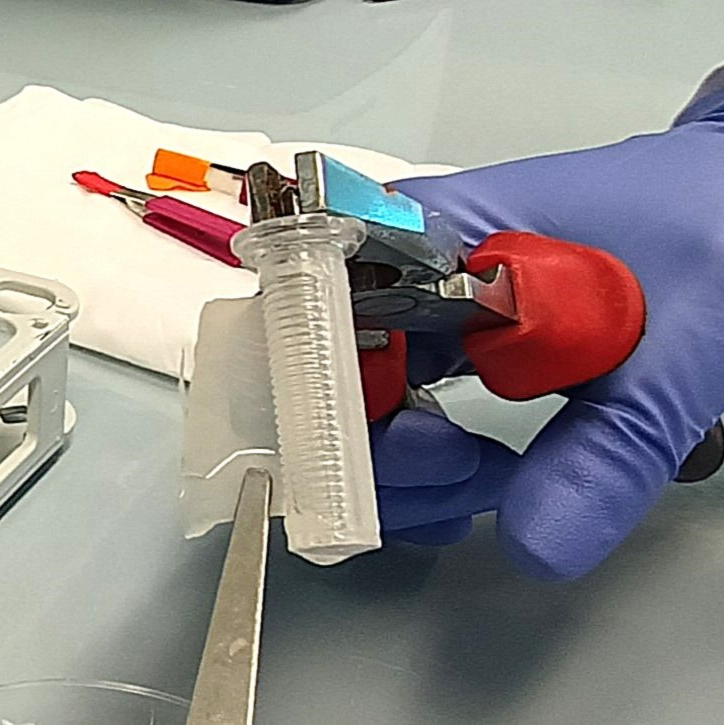
Use pliers to open the Sterivex cartridge: carefully press just beneath the sealed circumference near the vent end, rotating the cartridge to apply even pressure. Slowly rotate the cartridge until the inner cylinder pops loose.
Use pliers to lift the inner cylinder by the vent end and pour the DNA/RNA Shield into a 5 mL PowerWater bead tube, avoiding contamination by touch.
Using a sterile blade, locate the membrane seam (visible as a vertical plastic strip) and make two parallel cuts along each side. Cut along the horizontal edges to fully detach the filter membrane. Place a Petri dish beneath the Sterivex in order to collect and recover any leaking DNA/RNA Shield or filter pieces.
Carefully peel off the filter from the cylinder with the tweezers and place it in the same 5 mL PowerWater bead tube with the DNA/RNA Shield. If the filter breaks, ensure all pieces are collected.
Under the chemical fume hood, add 10 µL of β-Mercaptoethanol directly to the bead tube. Ensure that the screw cap is securely tightened.
Place the bead tubes horizontally to a Vortex adapter and vortex at maximum speed for 5 min.
Transfer all the supernatant to a clean 2 mL collection tube. Draw up the supernatant using a 1 mL pipette tip by placing it down into the beads. Expect to recover 1500–1700 µL of supernatant.
Centrifuge at 13,000 × g for 1 min. Avoiding the pellet, transfer the supernatant to a clean 2 mL collection tube.
Add 200 µL of Solution IRS and vortex briefly to mix. Incubate at 2–8°C for 5 min.
Centrifuge at 13,000 × g for 1 min. Note that the DNA/RNA Shield solution will prevent distinct pellet formation. Carefully collect the supernatant, avoiding any solid fragments or floating clumps.
NOTE: Transfer the supernatant to a clean 15 mL Falcon-like tube as the volume recovered is higher than
the standard procedure and would not fit.
Add 1300 µL of Solution PM3 and 1300 µL of Solution PM4. Vortex briefly to mix. NOTE: PM3 and PM4 volumes are doubled compared to the standard protocol.
Load 650 µL of supernatant onto an MB RNA Spin Column. Centrifuge at 13,000 × g for 1 min. Discard the flow-through and repeat until all the supernatant has been loaded.
Add 650 µL of Solution PM5. Centrifuge at 13,000 × g for 1 min. Discard the flow-through.
Centrifuge again at 13,000 × g for 1 min and place the MB RNA Spin Column into a clean 2 mL collection tube.
Add 50µL of DNase I Solution to the center of the column membrane and incubate at room temperature for 15 min.
Add 400 µL of Solution PM7 and centrifuge the column at 13,000 × g for 1 min.
Discard the flow-through. Add 650 µL of Solution PM5. Centrifuge at 13,000 × g for 1 min.
Discard the flow-through. Add 650 µL of Solution PM4. Centrifuge at 13,000 × g for 1 min.
Discard the flow-through and centrifuge again at 13,000 × g for 2 min.
Place the MB RNA Spin Column into a clean 2 mL collection tube.
Add 50 µL of RNase-free water to the center of the column membrane.
Wait 1 min and centrifuge at 13,000 × g for 1 min.
Reload the 50 µL of eluate to the center of the column membrane.
Wait 1 min and centrifuge at 13,000 × g for 1 min. Discard the MB RNA Spin Column.
Measure 1 µL of extracted RNA with a Nanodrop Spectrophotometer (Thermo Fisher Scientific).
RNA concentration using the RNA Clean & Concentrator Kit (Zymo Research)
30m
Add 2 volumes (100 µL) of RNA Binding Buffer to each sample and mix.
Add an equal volume (150 µL) of ethanol (95-100%) and mix.
Transfer the sample to the Zymo-Spin™ IC Column in a Collection Tube and centrifuge at 13,000 × g for 1 min. Discard the flow-through.
Add 400 µL RNA Prep Buffer to the column and centrifuge at 13,000 × g for 1 min. Discard the flow-through.
Add 700 µL RNA Wash Buffer to the column and centrifuge at 13,000 × g for 1 min. Discard the flow-through.
Add 400 µL RNA Wash Buffer to the column and centrifuge at 13,000 × g for 1 min. Ensure complete removal of the wash buffer. Carefully, transfer the column into an RNase-free tube.
Add 15 µL DNase/RNase-Free Water directly to the column matrix and centrifuge at 13,000 × g for 1 min.
Measure 1 µL of extracted RNA with a Nanodrop Spectrophotometer (Thermo Fisher Scientific).
Measure 2 µL of extracted RNA with a Qubit RNA HS assay (Thermo Fisher Scientific).
Store the samples at -80°C.
Protocol references
Berube, P., Gifford, S., Hurwitz, B., Jenkins, B., Marchetti, A., & Santoro, A. E. (2022). Roadmap Towards Communitywide Intercalibration and Standardization of Ocean Nucleic Acids ‘Omics Measurements: Ocean Nucleic Acids ‘Omics Intercalibration and Standardization Workshop University of North Carolina, Chapel Hill, NC, USA January 8-11, 2020.
Cohen, N. R., Alexander, H., Krinos, A. I., Hu, S. K., & Lampe, R. H. (2022). Marine microeukaryote metatranscriptomics: sample processing and bioinformatic workflow recommendations for ecological applications. Frontiers in Marine Science, 9, 867007.
Marshall, A. J., Phillips, L., Longmore, A., Hayden, H. L., Tang, C., Heidelberg, K. B., & Mele, P. (2023). Using metatranscriptomics to better understand the role of microbial nitrogen cycling in coastal sediment benthic flux denitrification efficiency. Environmental Microbiology Reports, 15(4), 308-323.
Moran, M. A. (2009). Metatranscriptomics: eavesdropping on complex microbial communities. Microbe, 4(7), 7.
Shaffer, J. P., Marotz, C., Belda-Ferre, P., Martino, C., Wandro, S., Estaki, M., ... & Knight, R. (2021). A comparison of DNA/RNA extraction protocols for high-throughput sequencing of microbial communities. Biotechniques, 70(3), 149-159.
Acknowledgements
This work is part of the project “National Biodiversity Future Center - NBFC” funded under the National Recovery and Resilience Plan (NRRP), Mission 4 Component 2 Investment 1.4 - Call for tender No. 3138 of 16 December 2021, rectified by Decree n.3175 of 18 December 2021 of Italian Ministry of University and Research funded by the European Union – NextGenerationEU; Project code CN_00000033, Concession Decree No. 1034 of 17 June 2022 adopted by the Italian Ministry of University and Research, CUP F83B22000050001.