May 12, 2026
Version 1
REFLEX on GEM-X v1 V.1
- Neel Kaul1,
- Saskia Ilcisin1,
- Matt Hart1,
- Zach Thomson1,
- Peter Skene1
- 1Allen Institute for Immunology



Protocol Citation: Neel Kaul, Saskia Ilcisin, Matt Hart, Zach Thomson, Peter Skene 2026. REFLEX on GEM-X v1. protocols.io https://dx.doi.org/10.17504/protocols.io.e6nvww797vmk/v1
Manuscript citation:
Hart, Matthew R., Zachary J. Thomson, Saransh N. Kaul, Saskia Ilcisin, Matthieu Landreau, Tyanna J. Stuckey, Peter J. Wittig, et al. 2025. “REFLEX, a Novel Immune Profiling Assay, Combining TCR Repertoire and Multiome at Massively Scalable Single-Cell Resolution to Catapult Exploration of T-Cell Derived Immunity.” bioRxivorg. bioRxiv. https://doi.org/10.1101/2025.10.24.684243.
License: This is an open access protocol distributed under the terms of the Creative Commons Attribution License, which permits unrestricted use, distribution, and reproduction in any medium, provided the original author and source are credited
Protocol status: Working
We use this protocol and it's working successfully
Created: April 06, 2026
Last Modified: May 12, 2026
Protocol Integer ID: 314562
Keywords: REFLEX, TCR, T cell, paired, alpha, beta, reverse transcription, FLEX, 10x, repertoire, SNP, targeted reverse transcription, multi-omic, reflex tcr on the 10x genomic, cell repertoire, 10x genomic, using cryopreserved human pbmc, reflex on gem, reflex tcr, protein level information through adt, cell resolution, beta tcr, cell, protein level information, tcr
Disclaimer
DISCLAIMER – FOR INFORMATIONAL PURPOSES ONLY; USE AT YOUR OWN RISK
The protocol content here is for informational purposes only and does not constitute legal, medical, clinical, or safety advice, or otherwise; content added to protocols.io is not peer reviewed and may not have undergone a formal approval of any kind. Information presented in this protocol should not substitute for independent professional judgment, advice, diagnosis, or treatment. Any action you take or refrain from taking using or relying upon the information presented here is strictly at your own risk. You agree that neither the Company nor any of the authors, contributors, administrators, or anyone else associated with protocols.io, can be held responsible for your use of the information contained in or linked to this protocol or any of our Sites/Apps and Services.
Abstract
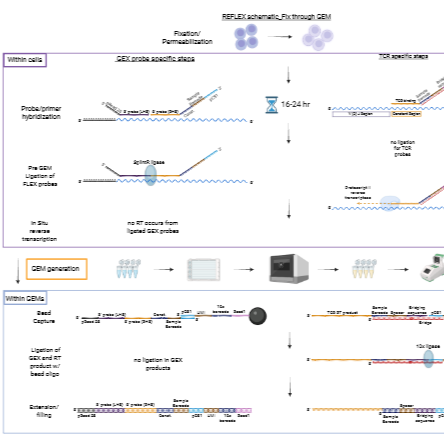
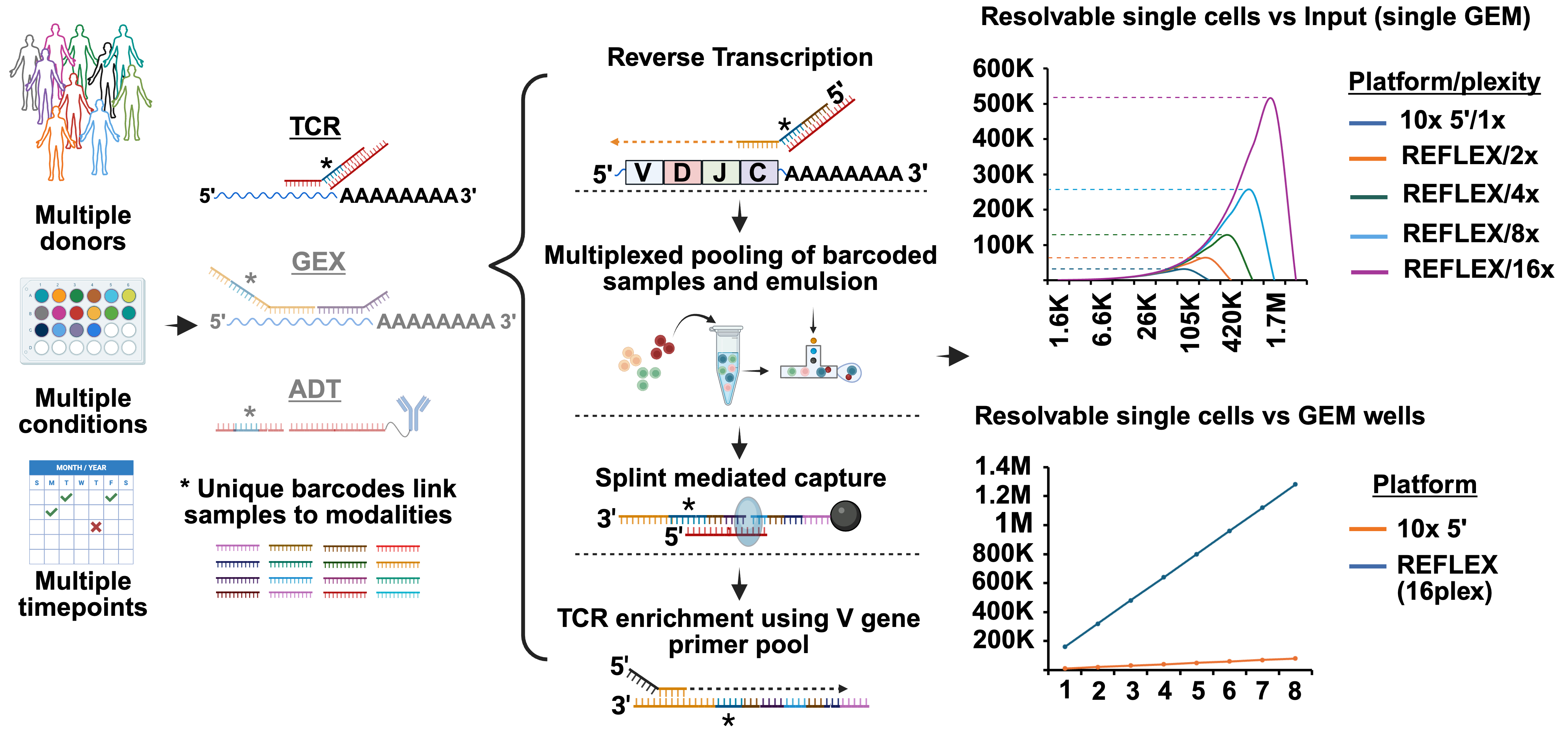
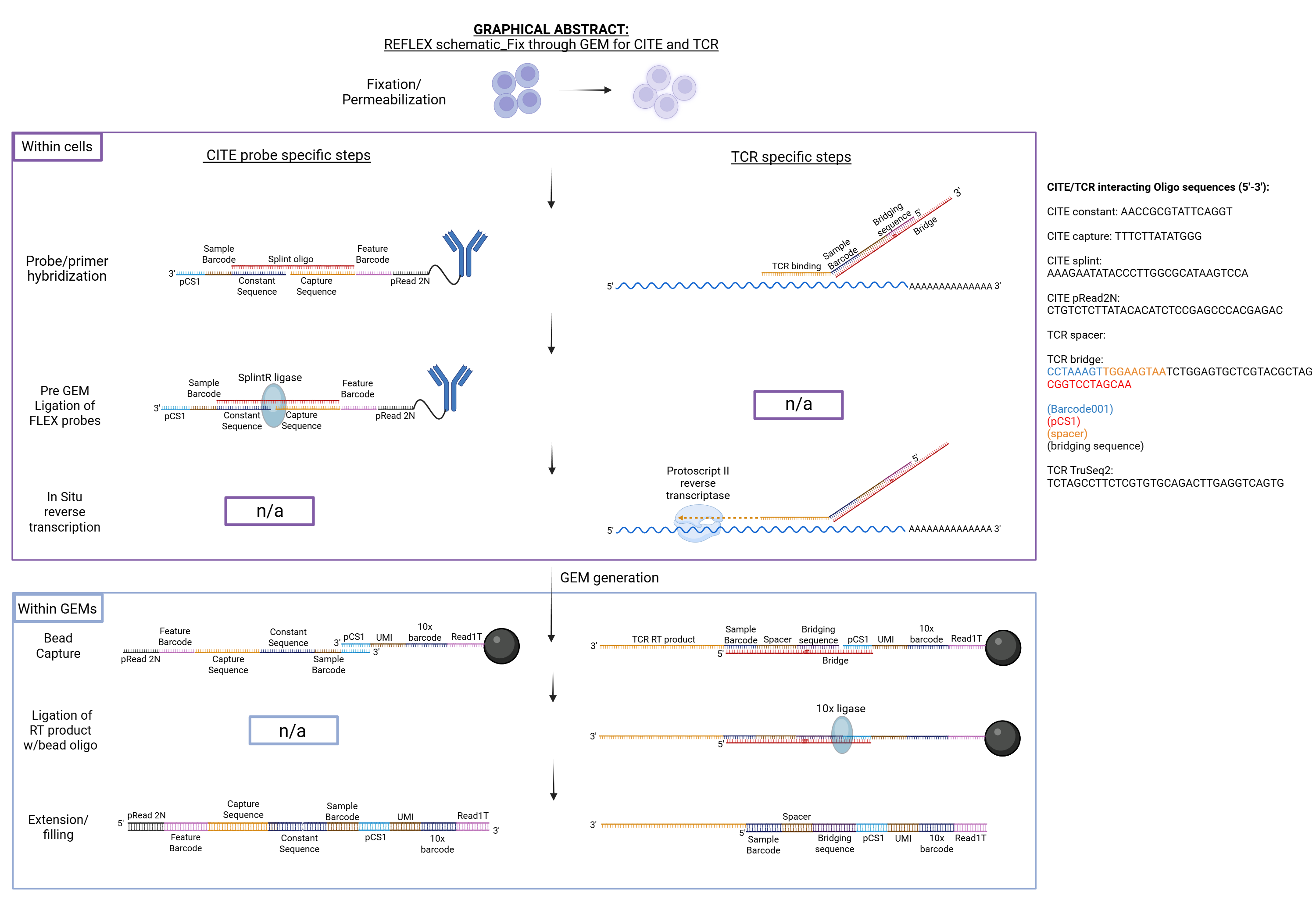
Profiling the vast diversity of the T-cell repertoire at single-cell resolution is challenging due to the scale and cost requirements involved. Current technologies capture TCR or perform single-cell sequencing at scale but struggle to combine both. The following protocol describes the steps taken to perform REFLEX TCR on the 10x Genomics, GEM-X v1 platform, using cryopreserved human PBMCs as a starting point. With it, one can expect to generate multi-omic profiling inclusive of FLEX transcriptome, paired alpha and beta TCR (paired efficiency varies with sample context), and protein level information through ADTs if desired.
Guidelines
In order to generate successful 10X Flex and REFLEX libraries:
- Use low-bind labware when dealing with cell samples
- Maintain a RNase-free environment when preparing master mixes, primer mixes, and handling sample pre-GEM generation.
- Cell recovery can be maximized by using a swinging bucket rotor during cell pelleting.
- Gently resuspend cell pellets using wide bore pipette tips.
- Leave no more than 10 uL of supernatant unless otherwise specified.
Materials
:
| Reagent | Supplier | Product Number | |
| Sodium chloride 5 M in aqueous solution, Biotechnology Grade, sterile, Size=500 mL | VWR | 97062-858 | |
| Invitrogen UltraPure 1 m Tris HCI Buffer, pH 7.5 | Thermo Scientific | 15567027 | |
| Water, HyClone‱ HyPure, Molecular Biology Grade, Size=500 mL | VWR | 82007-334 | |
| 10X TBS Buffer |
REFLEX:
NEXTGEM Compatible Reagents:
| A | B | C | |
| Reagent | Supplier | Product Number | |
| Water, HyClone‱ HyPure, Molecular Biology Grade, Size=500 mL | VWR | 82007-334 | |
| ViaStain PI Staining Solution | Nexcelom Biosciences | CS1-0109-5mL | |
| ViaStain AOPI Staining Solution | Nexcelom Biosciences | CS2-01065mL | |
| Cellaca MX High-throughput Automated Cell Counter | Nexcelom Biosciences | MX-112-0127 | |
| Chromium Next GEM Single Cell Fixed RNA Sample Preparation Kit (16 rxns) | 10X Genomics | PN-1000414 | |
| Chromium Next GEM Chip Q Single Cell Kit 48 rxns | 10X Genomics | PN-1000418 | |
| Single Cell Fixed RNA Human Transcriptome Probe Kit 64 rxns, Module 1 (BC001-BC008) | 10X Genomics | PN-1000456 | |
| Single Cell Fixed RNA Human Transcriptome Probe Kit 64 rxns, Module 2 (BC009-BC016) | 10X Genomics | PN-1000456 | |
| Fixed RNA Feature Barcode Multiplexing Kit 64 rxns, Module 1 (AB001-AB008) | 10X Genomics | PN-1000628 | |
| Fixed RNA Feature Barcode Multiplexing Kit 64 rxns, Module 2 (AB009-AB016) | 10X Genomics | PN-1000628 | |
| Single Cell Fixed RNA Human Transcriptome Probe Kit (16 rxns) | 10X Genomics | PN-1000547 | |
| Single Cell Fixed RNA Hybridization Kit (64 rxns) | 10X Genomics | PN-1000457 | |
| UltraPure Bovine Serum Albumin (BSA, 50 mg/ml) | Invitrogen | AM2616 | |
| Aim V‱ Medium, liquid (research grade), 1L | GIBCO | 12055083 | |
| Phosphate-Buffered Saline, 1X without Calcium and Magnesium | Corning | 21-040-CV | |
| Conc. Fix & Perm Buffer | 10X Genomics | PN-2000517 | |
| Formaldehyde (37% by Weight/ Molecular Biology) | Fisher BioReagents | BP531-25 | |
| Conc. Quenching buffer | 10X Genomics | PN-2000516 | |
| Hyb Buffer B (from PN-1000457) | 10X Genomics | PN-2000485 | |
| Enhancer | 10X Genomics | PN-2000482 | |
| Conc. Post-Hyb Buffer (from PN-100457) | 10X Genomics | PN-2000533 | |
| GEM Reagent Mix | 10X Genomics | PN-2000491 | |
| Reducing Agent B | 10X Genomics | PN-2000087 | |
| Adenosine-5 Triphosphate (ATP) - 5 ml | New England Biolabs (NEB) | P0756L | |
| SplintR‱ Ligase - 6250 units | New England Biolabs (NEB) | M0375L | |
| Invitrogen Ambion SUPERase·In RNase Inhibitor (20U/µL) | Invitrogen | AM2696 | |
| Recombinant Albumin, Molecular Biology Grade - 12 mg | New England Biolabs (NEB) | B9200S | |
| Thermo Scientific dNTP Mixes | Thermo Fisher Scientific | R0193 | |
| 10X DTT (100 uM) | New England Biolabs (NEB) | B1034A | |
| ProtoScript‱ II Reverse Transcriptase - 40000 units | New England Biolabs (NEB) | M0368X | |
| Pre-Separation Filters (30 µm) | Miltenyi Biotec | 130-041-407 | |
| GEM Enzyme Mix | 10X Genomics | PN-2000490 | |
| Glycerol for molecular biology, ≥99.0%, | Millipore Sigma | G5516-100ML | |
| NextGEM Chip Q | 10X Genomics | PN-2000518 | |
| Single Cell Fixed RNA Gel Bead Kit | 10X Genomics | PN-1000421 | |
| Single Cell TL v1 Gel Beads (4 rxns) | 10X Genomics | PN-2000538 | |
| Partitioning Oil | 10X Genomics | PN-2000190 | |
| Chip Gasket | 10X Genomics | PN-370017 | |
| Recovery Agent | 10X Genomics | PN-220016 | |
| Chromium X Controller | 10X Genomics | ||
| Thermalcycler | |||
| TCR Variable Pool Primers | IDT | ||
| Pre-Amp Primers B | 10X Genomics | PN-2000529 | |
| Pre-Amp Primers C | 10X Genomics | PN-2000953 | |
| Truseq1 (1 uM) | IDT | ||
| TruSeq2 (1 uM) | IDT | ||
| Amp Mix | 10X Genomics | PN-2000103 | |
| Buffer EB | Qiagen | 19086 | |
| 10% Tween 20, Nonionic Detergent | Bio-Rad | 1610781 | |
| Ethanol absolute ≥99.5% ACS (200 Proof), Size=500 mL | Fisher Scientific Acros Organics | AC615095000 | |
| Beckman Coulter SPRI SELECT REAGENT 60ML | Beckman Coulter | B23318 | |
| Kapa HiFi HotStart ReadyMix (2X)* (* Contains 2.5 mm MgCl2 at 1X) | Roche | 07958935001 | |
| Dual Index Kit TS Set A, 96 rxns | 10X Genomics | PN-1000251, PN-3000511 | |
| Dual Index TT Indices Set A | 10X Genomics | PN-1000215 | |
| Dual Index Kit TN Set A, 96 rxns | 10X Genomics | PN-1000250, PN-3000510 | |
| 10x Vortex Adapter | 10X Genomics | PN-330002 | |
| 10X Magnetic Separator | 10X Genomics | PN-230003 | |
| Chromium Next GEM Secondary Holder | 10X Genomics | PN-3000332 | |
| DNA LoBind Tubes 2.0 ml | Eppendorf | 022431048 | |
| Vortex Mixer | VWR | 10153-838 | |
| TapeStation Controller | |||
| High Sensitivity D1000 Ladder | Agilent Technologies | 5067-5587 | |
| High Sensitivity D1000 Sample Buffer Additional buffer for the High Sensitivity D1000 ScreenTape assay | Agilent Technologies | 5067-5603 | |
| High Sensitivity D1000 Screen tape | Agilent Technologies | 5067-5584 | |
| KAPA Library Quantification Kits, Complete kit (Bio-Rad‱) | Roche | 07960255001 | |
| TotalSeq‱-C Human TBNK Cocktail | BioLegend | 399903 | |
| TotalSeq‱-C Human Universal Cocktail, V1.0 | BioLegend | 399905 | |
| BioRad heat Sealer | |||
| BioRad CFX96 | |||
| NextSeq‱ 2000 P4 XLEAPSBS‱ Reagent Kit (300 Cycles) | Illumina | 20100992 | |
| RSB + Tween-20 | Illumina | ||
| Phix Control Kit V3 | Illumina | FC-110-3001 |
GEM-X v1 Compatible Reagents:
| Reagent | PN | |
| GEM-X Flex Sample Preparation v2 Kit | 1000781 | |
| GEM-X Flex Gene Expression Chip Kit | 1000791 | |
| GEM-X Flex Hyb and Wash Kit | 1000789 | |
| GEM-X Flex GEM and Library Kit | 1000782 | |
| GEM-X Flex Gel Bead Kit | 1000790 |
| DPBS (mL), 1X | 21-031-CM | |
| BSA (g) | A2934 |
| Nuclease-free Water | 82007-334/AM9937 | |
| Conc. Fix & Perm Buffer B | 2000516 | |
| 37% Formaldehyde, 10% methanol stabilized | BP531-25 | |
| Nuclease-free Water | 82007-334/AM9937 | |
| Conc. Quench Buffer B | 2001300 |
| Hyb Buffer B | 2001312 | |
| Enhancer | 2000482 |
| Conc. Post-hyb Buffer B | 2001308 | |
| Enhancer | 2000482 |
| GEM Reagent Mix | 2000491 | |
| Reducing Agent B | 2000087 | |
| GEM Enzyme Mix B | 2001302 |
| Amp Mix C | 2001311 |
Safety warnings
When handling PFA waste, please contact your local EHS department for how to properly discard into the correct waste streams.
RT Probe Hybridization
2h
A full list of REFLEX RT Probes can be found in Supplemental Tables 1-2 Supplemental Tables_REFLEX.pdf159.1KB
Supplemental Tables_REFLEX.pdf159.1KB RT probes were ordered from IDT and it is strongly recommended to order HPLC purified oligos due to the unstable nature of the 5phos during repeated freeze/thaws during .
Variable primer sets can be found in Supplemental Table 3. Variable primers can be ordered through IDT and can be ordered with standard desalting purification.
Make stock 10X TBS solution, keep at 4C. 10X TBS pH 7.4 can also be purchased from your trusted supplier.
| A | B | C | |
| 10X TBS Buffer | |||
| Reagent | Volume (uL) for 1mL final volume | Bulk Preparation for 5 mL | |
| NaCl 5M | 300 | 1500.000 | |
| Tris-HCl 1M pH 7.4 | 500 | 2500 | |
| MBGW | 200 | 1000 | |
5m
Assemble all lyophilized RT probes and bridging oligos. Centrifuge for a minimum of 1 min at a minimum of 15,000 x g. Resuspend in Molecular Grade Biology Water at 100 micromolar (µM) . While working, keep at 4 °C . Reconstituted oligos can be stored at -20 °C
1h
Mix bridging oligos and RT probes as follows. Each alpha and beta RT probe is annealed separately with its sample barcode matched bridging oligo, resulting in 2 reactions per barcode.
| A | B | C | |
| Bridge-RT Oligo Mix | |||
| Reagent | Volume (uL) / rxn | Scaled Down Rxn Volumes (uL) | |
| RT oligo (100 uM) | 45.00 | 15 | |
| Bdg oligo (100 uM) | 67.50 | 22.5 | |
| 10X TBS buffer | 15.00 | 5 | |
| MGBW | 22.50 | 7.5 | |
| Total Volume (µl) | 150.00 | 50 | |
10m
Pre-anneal each sample barcoded RT probe and matched bridge in a separate reaction by incubating at 95 °C for 00:02:00 , ramp down to 4 °C (0.2 °C /s).
20m
Combine sample barcode matched, bridged, TRAC and TRBC RT probes (30 micromolar (µM) each) together at a 1:1 volume for a final RT probe concentration of15 micromolar (µM) . For example, bridge annealed TRAC BC001 would be combined with bridge annealed TRBC BC001 at 1:1 volume.
5m
Aliquot combined constant probes into 5 µL reaction volumes. Each primer pool aliquot is single use and should not undergo more than 1 round of freeze/thaw after being stored at -20 °C
Additional freeze/thaws of the RT hybridization probes may negatively affect data quality.
20m
Variable Primer Pool Resuspension
2h 35m
Assemble all lyophilized variable primers. Centrifuge for a minimum of 1 min at a minimum of 15,000 x g. Resuspend in Molecular Grade Biology Water at 100 micromolar (µM)
1h
Combine 5 µL of each primer to generate a 1.35 micromolar (µM) per primer pool. For the TCR specific variable primer pool (n=74) this final volume should be 370 µL .
30m
Dilute the pool 1:1 by adding 370 µL of 1X TBS. Final volume will now be740 µL with per primer concentration of ~.67 micromolar (µM) .
5m
Store variable primer pools in aliquots of 30 µL each to be stored at -20 °C . These primers are less likely to be sensitive to freeze/thaw than the 5'Phos+Bridged RT primers, but may benefit from fewer freeze thaw episodes than would occur in a 740 µL volume.
30m
Prior to use, thaw at Room temperature (20C-25C) and vortex then centrifuge briefly.
30m
Sample Thaw
2h 2m
SET-UP
Cool centrifuge with swinging rotor buckets to 4 °C
Set water-bath to 37 °C and allow to come to temperature.
1h
Pre-warm 40 mL of AIM-V media for each cryopreserved (Cryostor) PBMC vial (up to 100M cells per tube) to 37 °C .
40m
Retrieve sample from liquid nitrogen tank. Thaw quickly in 37 °C water bath (~ 00:02:00 ) until ice has just barely melted.
2m
Working quickly, aspirate out 1 mL sample volume from cryovial. Add dropwise to 50mL conical containing pre-warmed 40 mL AIM-V. Gently swirl the AIM-V media while adding the cells.
5m
Using a p1000 pipet, take 1 mL of the warmed AIM-V, wash out the cryovial, and return to the 50mL AIM-V conical tube.
1m
Close cap and gently invert to mix x5.
1m
Place sample(s) in swinging rotor bucket and spin at 400 x g, 4°C, 00:05:00
Once completed, carefully remove the supernatant without disturbing the pelleted cells.
5m
Gently resuspend the cell pellet in1 mL cold PBS + 2% BSA solution.
1m
Add 24 mL s of PBS + 2% BSA. Gently mix the sample by closing the tube and inverting x5.
1m
Place sample(s) in swinging rotor bucket and spin at 400 x g, 4°C, 00:05:00 . Once completed, carefully remove the supernatant without disturbing pelleted cells.
5m
Gently resuspend the pellet per recommendations below.
If immediately continuing to live/dead counting or cell fixation:
Resuspend in 1 mL PBS.
PBS + 0.04% BSA can alternately be used if samples are to be left on ice prior to fixation.
1m
Cell Counting
5m
Count resuspended cells using cell counting methodology of choice.
5m
Counting fresh single cell/nuclei suspensions prior to fixation can be skipped if viability information is not needed and if the amount of cells/ nuclei do not overly exceed the upper limit recommendations going into fixation. If cell/nuclei number exceeds this recommendation, additional Fixation Buffer will be needed.
REFLEX GEM-X v1 Sample Fixation
30m
Set heat block or thermomixer to 25 °C (Room temperature ) for fixation reactions. Set heat block or thermomixer at 42 °C and 65 °C in advance for the Hyb Buffer B and Enhancer reagent thaw pre-emptively.
30m
Collect 10X Fixed RNA Sample Preparation Kits.
Thaw Additive C (PN-2001332), Conc. Fix and Perm Buffer (PN-2001301) and Conc. Quench Buffer B (PN-2001300) at room temperature. Vortex and briefly centrifuge prior to use, check for precipitation.
1m
NOTE: Make 10X Fix Buffer in chemical hood. Use Supremo SE gloves while handling PFA. Keep at RT.
5m
| A | B | C | |
| Fixation Buffer B | |||
| Reagent | Product Number | Vol (uL) / rxn | |
| Nuclease-free Water | 82007-334/AM9937 | 435.0 | |
| Conc. Fix & Perm Buffer B | 2000516 | 55.0 | |
| 37% Formaldehyde, 10% methanol stabilized | BP531-25 | 60.0 | |
| Total Volume (µl) | 550 | ||
Make Quenching Buffer and keep on On ice
| A | B | C | |
| Quenching Buffer B | |||
| Reagent | Product Number | Vol. (uL) / rxn | |
| Nuclease-free Water | 82007-334/AM9937 | 962.5 | |
| Conc. Quench Buffer B | 2001300 | 137.5 | |
| Total Volume (mL) | 1,100 | ||
5m
After sample thaw and count, centrifuge samples at 400 x g, 4°C, 00:05:00 to pellet cells. Carefully remove supernatant. If sample was previously resuspended in a protein-rich media (i.e. BSA/FBS), it is advisable to do an additional wash centrifugation in PBS prior to fixation.
5m
Carefully remove supernatant and then resuspend cell pellet in 0.5 mL of Fixation Buffer B mix with gentle pipetting. Incubate for01:00:00 atRoom temperature in a heat block.
1h
Following the 1 hour RT fixation, add 0.5 mL Additive C to each sample and pipette mix 5X.
Centrifuge sample at 850 x g, 20°C, 00:05:00 to pellet cells. Once complete, carefully remove supernatant.
5m
Resuspend cell pellet in 1 mL of chilled 4 °C Quenching buffer B, maintain on ice.
1m
Count fixed samples (27 uL PI dye + 27 uL cell suspension) on CellacaMx or cell counter of choice.
5m
Probe Hybridization
17h 18m
Thaw Hyb Buffer B at 42 °C . Briefly vortex and make sure there is no undissolved precipitate remaining.
Keep warm (do not place on ice). DO NOT keep the thawed buffer on ice, or the solution will precipitate.
Thaw Enhancer at65 °C for 00:10:00 . Briefly vortex and make sure there is no undissolved precipitate remaining. Keep warm (do not place on ice). DO NOT keep the thawed reagent on ice, or the solution will precipitate. Once thawed, Enhancer can be kept warm at 42 °C for up to 00:10:00 if a delay in processing is expected.
If not used within 00:10:00 and precipitation is observed, reheat at 65 °C to ensure enhancer is fully dissolved again before use.
30m
Set a thermomixer with heated lid to 42 °C or prepare a thermal cycler with the following incubation protocol and start the program:
Lid Temperature: 42 °C
Reaction Volume: 65 µL
Run time: Overnight (16:00:00 - 24:00:00 )
Pre-equilibrate: 42 °C , Run Time (Hold/ Infinity)
Probe Hybridization: 42 °C , Run Time (Hold/Infinity)
1m
Collect 10X WTA Probe Plate and thaw on ice. Ensure probes have fully thawed before usage. Vortex and centrifuge plate/tubes briefly prior to addition to sample.
30m
Prepare Hyb Mix at room temperature. Pipette mix 10x. Once Hyb mix has been made, leave at 42C for a minimum of 5 minutes before adding to sample.
| A | B | C | |
| Hybridization Mix | |||
| Reagent | Product Number | Vol. (uL) / rxn | |
| Hyb Buffer B | 2001312 | 42 | |
| Enhancer | 2000482 | 6 | |
| Total Volume (uL) | 48 | ||
5m
Aliquot appropriate number of quenched cells per single sample barcode into a strip tube or well of a semi-skirted PCR compatible plate (*see guideline below). Spin at 850 x g, 4°C, 00:05:00 and remove supernatant. Up to15 µL of remaining supernatant may be left behind to optimize cell recovery without significantly impacting assay performance.
*REFLEX has been validated from 350,000 down to 150,000 cells per sample barcoded hybridization reaction on the GEM-X v1 protocol.
5m
Add 10 µL of unique Human WTA probes (PN-2001259-2001274) to each sample. Only one WTA probe barcode is used per sample.
1m
Add 3.35 µL of pre-annealed/bridged REFLEX RT probe to each sample. Ensure barcoded RT probes match barcodes used for WTA probes by sample.
1m
Add 40 µL of pre-warmed Hyb Mix to each sample. Pipette Mix 10-15X.
5m
Ensure plate or strip tubes are completely sealed prior to loading on thermal cycler. Add semi-skirted plate or strip tube to a thermocycler for incubation at 42C for 16 to 24 hours. If using 1.5 mL microcentrifuge tube, a thermal cycler with a heated lid will be required for incubation.
16h
Post-Hybridization Washes and Sample Pooling
4h 0m 30s
Thaw Enhancer at 65 °C for 00:10:00 . Briefly vortex and make sure there is no undissolved precipitate remaining. Keep warm (do not place on ice). DO NOT keep the thawed reagent on ice, or the solution will precipitate. If not used within 10 minutes and precipitation is observed, reheat at 65 °C to ensure enhancer is fully dissolved again before use.
10m
Collect Conc. Post-Hyb Buffer B (PN-2001308) and thaw at RT. Once thawed, keep on ice.
10m
Pre-warm heat block to 42 °C .
10m
Prepare Post-Hyb Wash Buffer B:
| A | B | C | |
| Post Hyb Wash Buffer B | |||
| Reagent | Product Number | Vol (mL) / 16 rxns | |
| Nuclease-free Water | 82007-334/AM9937 | 13.86 | |
| Conc. Post-hyb Buffer B | 2001308 | 0.77 | |
| Enhancer | 2000482 | 0.77 | |
| Total Volume (mL) | 15.4 | ||
1m
Collect Hyb plate from thermal cycler, note total hybridization time. Sample must undergo hybridization for a minimum of 16 hours and a maximum of 24 hours.
Add 225 µL Post-Hyb Wash Buffer B to each sample and pipette mix 5X.
5m
Count samples (44 µL PI dye + 11 µL cells) on Cellaca, or cell counter of your choice. Recommend to use a dilution factor of 5 to minimize sample loss from cell counting.
5m
After counting each barcoded sample, pool samples at 100,000 cells per barcoded sample into a 15 mL conical centrifuge tube. Add525 µL Post-Hyb Wash Buffer B per barcoded sample to the pooled cells.
10m
Optional: Sample types prone to clumping can be filtered with a 30 μm filter (Sysmex CellTrics or Miltenyi Biotec Pre-Separation Filters) during pooling by adding the filter on top of the 5-ml or 15-ml tube. Using a P1000 pipet, pass cells through the filter directly into the conical tube containing Post-Hyb Wash Buffer B.
Invert tube 5X in order to mix.
30s
Spin samples at 850 x g, 00:05:00 at Room temperature .
5m
Remove the supernatant without disturbing the pellet.
30s
Resuspend the cell pellet in 1 mL Post-Hyb Wash Buffer B and transfer to a 1.5 mL LoBind microcentrifuge tube.
1m
Incubate at 42 °C for 00:10:00 in a thermomixer or heat block.
10m
Centrifuge samples at 850 x g, Room temperature, 00:05:00 .
5m
Remove the supernatant without disturbing the pellet.
30s
Resuspend cell pellet in 0.5 mL Post-Hyb Wash Buffer B. Pipette mix 5x.
30s
Incubate at 42 °C for 00:10:00 in a thermomixer or a heat block.
10m
Centrifuge samples at 850 x g, Room temperature, 00:05:00 .
5m
Remove the supernatant without disturbing the pellet.
30s
Resuspend cell pellet in 0.5 mL Post-Hyb Wash Buffer B. Pipette mix 5x.
30s
Incubate at 42 °C for 00:10:00 in a thermomixer or a heat block. During this incubation, prepare Post-Hyb Resuspension Buffer B. (see step 64)
10m
Centrifuge samples at 850 x g, Room temperature, 00:05:00 .
5m
Make Post-Hyb Resuspension Buffer B Mix:
| A | B | C | |
| Post-Hyb Resuspension Buffer B | |||
| Reagent | Product Number | Vol (μl) / Pool | |
| Nuclease-free Water | 82007-334/AM9937 | 1,567.5 | |
| Conc. Post-Hyb Buffer B | 2001308 | 82.5 | |
| Total Volume (μl) | 1,650.0 | ||
1m
Remove 500 µL supernatant from tube without disturbing pellet
30s
Resuspend pellet in 80 µL post-hyb resuspension buffer and transfer to a new "ligation & RT" plate. Rinse Post-Hyb wash tube/plate with 40 µL and combine with the current 80uL volume in the "ligation & RT" plate (~130 uL total volume, accounting for up to 10 uL unremoved supernatant)
1m
Centrifuge ligation plate at 850 x g, 4°C, 00:05:00
5m
Remove 115 µL supernatant (leaving ~15 µL behind)
30s
Add 35.83 µL Post Hyb Resuspension Buffer back for final volume of 50.83 µL . Sample should be left On ice until ligation.
30s
Prepare GEM Master Mix (GEM MM):
| A | B | |
| GEM Master Mix | ||
| Reagent | Vol (uL) for 1 rxn | |
| GEM Reagent Mix | 21 | |
| Reducing Agent B | 1.75 | |
| MBGW | 12.25 | |
| Total Volume (mL) | 35 | |
1m
Prepare Ligation Reaction Mix:
| A | B | |
| Ligation Reaction | ||
| Reagent | Volume (uL) for 1 rxn | |
| GEM MM | 33.33 | |
| ATP | 5 | |
| SplintR ligase | 7.5 | |
| Superase.In | 3.33 | |
| Cell suspension | 50.83 | |
| Total | 100 | |
| Sum | 100.00 | |
Add 49.2 µL of Ligation Master Mix to each well of pooled cells (50.83uL) in the ligation & RT plate for a final volume of 100uL. Mix 10-15X.
5m
Incubate on thermocycler at 25 °C for 01:00:00 . Heated lid should be set to 30C.
1h
Following completion of the ligation reaction, pellet the plate at 850 x g, 4°C, 00:05:00 .
5m
Remove ~85 µL supernatant (leaving 15 µL behind) and resuspend in 95 µL chilled post hyb resuspension buffer (total volume 110 µL ).
30s
Following plate wash, remove plate and pellet at 850 x g, 4°C, 00:05:00 .
5m
Remove 100 µL of supernatant, leaving pellet in 10 µL of Post Hyb Resuspension Buffer. Add 30 µL of Post-Hyb resuspension buffer for a total Cell Suspension volume of 40 µL .
30s
Prepare RT Reaction Mix:
| A | B | |
| RT Reaction Mix | ||
| Reagent | Volume (uL) | |
| GEM MM | 33.33333333 | |
| Recombinant Albumin (20 mg/ml) | 5 | |
| dNTPs | 5 | |
| Cell suspension | 40 | |
| DTT (100 uM) | 3.3 | |
| Superase.In | 3.333333333 | |
| ProtoScript II RT | 10.0 | |
| Total | 100 | |
| Sum | 100 | |
Add 60 µL of RT Reaction Mix to each pooled sample in the ligation & RT plate (40uL) for a final volume of 100uL. Pipette mix 10-15X to resuspend cell pellet.
5m
Incubate on thermocycler for 00:45:00 at 45 °C , set heated lid to 45 °C .
45m
GEM Preparation and Generation
3h 17m 5s
From the -80 °C , collect and thaw Single Cell TL v1 Gel Beads (PN-2000538) for 00:30:00 at RT.
30m
Following reverse transcription step, transfer the entire volume of sample pool to a 1.5 mL centrifuge tube. Add 890 µL Post-Hyb Resuspension Buffer to each pool.
*Note - if working with multiple sample pools, each pool requires a separate 1.5mL tube
30s
Centrifuge for 850 x g, 4°C, 00:05:00 .
5m
Remove supernatant and resuspend sample in 500 µL of Post-Hyb Resuspension Buffer.
30s
Using a p1000 pipet, gently pass each pool though 30 um filter (Miltenyi Biotec Pre-Separation Filters, Cat 130-041-407) into new lo-bind 1.5 mL tube according to 90.1 below.
1m
Hold the pipette tip at an angle and touch the filter membrane where the filter meets the wall. Slowly pipette through the filter. Tap gently or centrifuge briefly if liquid remains at the end of the filter. To maximize recovery, residual volume can be pipetted from underneath the filter.
Count pooled & filtered sample (12 µL PI dye + 12 µL cells) on Cellometer or cell counter of your choice. Record cell count.
5m
Collect GEM-X Flex Gene Expression Chip Kit (PN-1000791) and GEM-X chip holder.
Collect 50% glycerol (1:1 glycerol w/MBGW)
From the -20C, collect the following from GEM-X Flex GEM and Library Kit (PN-1000782)
Keep GEM Enzyme Mix B (PN-2001302) On ice .
Thaw GEM Reagent Mix (PN2000491) at RT. Vortex, verify no precipitate, centrifuge briefly. Keep on ice
5m
Assemble the chip and holder, taking care to avoid touching the gasket
1m
Keep the assembled unit with the attached gasket open until ready for and while dispensing reagents into the wells.
Make the GEM Master Mix on ice. Pipette mix 15x and centrifuge briefly.
5m
GEM Master Mix
| A | B | C | |
| GEM Master Mix | |||
| Reagent | Product Number | Vol (uL) / rxn | |
| GEM Reagent Mix | 2000491 | 19.9 | |
| Reducing Agent B | 2000087 | 1.6 | |
| GEM Enzyme Mix B | 2001302 | 11.8 | |
| Total Volume (uL) | 33.3 | ||
In a strip tube on ice, add volume of cell pool + Post Hyb-Resuspension Buffer for a total volume of 34.7 µL for each well to be loaded. Total cell concentration should equal up to 20,000 cells per probe barcode, not to exceed 320,000 cells total at 16 plex barcodes.
1m
Add 30.3 µL of prepared GEM Master Mix into each tube containing diluted sample and immediately proceed to the next step. (Total volume will be 65 µL )
1m
For any unused chip wells, add 50% glycerol with the following volumes:
| Row | Vol | |
| 1 | 60 μL | |
| 2 | 60 μL | |
| 3 | 250 μL |
1m
Load Row 1
Using the same pipette tip, pipette mix 10X-15X prior to dispensing 60 µL Master Mix + Cell Suspension into the bottom of each well without introducing bubbles.
30s
Load Row 2
Vortex Gel Beads for 00:00:30
30s
Quickly centrifuge the Gel Beads, ~ 5 seconds
5s
Puncture the foil seal of the Gel Bead tubes and slowly aspirate 60 µL Gel Beads.
30s
Dispense into the bottom center of each well in row labeled 2 without introducing bubbles.
30s
Wait 00:00:30 before continuing to the next step.
30s
Load Row 3
Dispense 250 µL Partitioning Oil B into the wells by pipetting two aliquots of 125 µL from a reagent reservoir.
30s
Close the lid and load the chip into the Chromium X controller and play. (~00:06:00 run time).
6m
During the GEM incubation, label a new half-skirt plate and place On ice .
During the GEM incubation, pre-heat a thermocycler with "Fixed_GEM" program.
5m
When the GEM run has completed, immediately remove the chip and fold the chip-holder lid back so the chip is sitting at a 45 degree angle
Inspect the wells, noting inconsistent volumes between wells as that may be a sign of a clog
Slowly aspirate 100 µL GEMs from the lowest points of the recovery wells in the top NO FILL row
Slowly dispense GEMs into the GEM plate on ice, keeping pipette tips against the side-walls of the plate
Load samples onto the pre-heated thermal cycler with the "Fixed_GEM" program. This is a safe stopping point and GEM samples can be left on thermal cycler at 4C overnight.
2h 5m
Excess cells from Hyb Pools or Hybed Samples can be stored at -80C for long term storage or future use:
Bring total volume to 500 uL using Post-Hyb Wash Buffer.
1m
Add 0.1X of warmed Enhancer (50 µL )
30s
Add 50% glycerol (final concentration is 10% glycerol) (12.5 µL )
30s
Store at -80 °C REFLEX Hyb Pools have been tested at -80 °C storage up to 3 months.
GEM Recovery and Pre-Amp
1h 15m
Thaw Pre-Amp Primers B at RT. Keep on ice once thawed.
Thaw TCR Variable Primer Mix (or equivalent) at RT. Keep on ice once thawed.
Thaw TruSeq-1 (1 micromolar (µM) ) at RT. Keep on ice once thawed.
Thaw Amp Mix C on ice.
Retrieve GEMs from thermocycler. Add125 µL of recovery agent to each sample.
Close tubes/seal plate. Invert to mix 10X. DO NOT PIPETTE TO MIX.
Wait 00:02:00 , a biphasic mixture should appear with the pink (recovery agent) on bottom and clear (aqueous layer) on top.
2m
Briefly spin down tube/plate. Remove 125 µL recovery agent from bottom of each well. Be careful not to aspirate out any of the aqueous phase. Around 65 µL of aqueous phase should remain in the tube/plate.
Make Pre-Amp mix as follows, keep on ice:
| A | B | |
| Pre Amplification Mix | ||
| 1 rxn | ||
| Recovered GEM | 65 | |
| Amp Mix C | 27 | |
| TCRV (0.5 uM per primer) | 3 | |
| PreAmp Primers B | 10 | |
| TruSeq 1(1 uM) | 1.5 | |
| Total w/o sample | 41.5 | |
| Total | 106.5 | |
5m
Incubate on thermalcycler as follows:
| A | B | |
| 98C/3 min | ||
| 98C/20s | 8 cycles | |
| 60C/30s | ||
| 72C/2 min | ||
| 72C/5 min | ||
| 4C/inf |
35m
Thaw Reducing Agent at Room temperature .
10m
Make Elution Solution 1 at Room temperature :
| A | B | |
| Elution Solution 1 | ||
| Reagent | Volume/rxn (uL) | |
| Buffer EB | 98.00 | |
| 10% Tween-20 | 1.00 | |
| Reducing Agent B | 1.00 | |
| Total Volume (µl) | 100.00 | |
1m
Prepare a 80% EtOH wash solution. Must be made fresh prior to usage:
| A | B | |
| 80% Ethanol | ||
| Reagent | Total Volume (mL) | |
| 200 Proof Ethanol | 320.00 | |
| MBGW | 80.00 | |
| Total Volume (µl) | 400.00 | |
1m
At the end of the thermalcycler program, spin down plate for 30 seconds.
30s
Transfer 90 µL of sample into a new 1.5ml Eppendorf tube. Be careful not to transfer any cell debris.
30s
Add 1.8X volume of SPRI beads (162 µL ) to each sample. Mix well. Incubate for 00:05:00 .
5m
Spin down. Set on magnet for 2-3 minutes or until the solution clears.
3m
Remove and discard 252 µL supernatant.
30s
Wash beads in 200 µL 80% EtOH. Wait 00:00:30 . Remove EtOH.
30s
Wash beads in 200 µL 80% EtOH. Wait 00:00:30 . Remove EtOH.
30s
Briefly spin down, return to magent, and remove any remaining EtOH with a p20.
1m
Elute beads in 102 µL Elution Solution 1. Wait00:01:00 .
1m
Mix to fully resuspend beads. Incubate for 00:05:00 .
5m
Spin down. Set on magnet for 2-3 minutes or until the solution clears.
3m
Transfer 100 µL to new wells/plate.
30s
Samples may be stored at 4 °C for up to 72 hours or at -20 °C for up to 4 weeks.
GEX Library Preparation
1h 11m
Thaw the Dual Index Plate TS Set A (PN-3000511) at RT. Set On ice once thawed.
10m
Place Amp Mix C (PN-2001311) On ice .
Make the Sample Index PCR Mix 0 °C .
| A | B | C | |
| Sample Index PCR Mix | |||
| Reagent | Product Number | Vol (uL) / rxn | |
| Amp Mix C | 2001311 | 50.00 | |
| Nuclease-free Water | 82007-334/AM9937 | 10.00 | |
| Total Volume (µl) | 60.00 | ||
1m
Transfer 20 µL of cleaned pre-amp sample product to a new plate or strip tube On ice .
30s
Add 60 µL Sample Index PCR mix to each sample On ice .
30s
Add 20 µL of an index from the Dual Index Plate TS Set A plate to each well.
30s
Seal. Cool. Invert or pipette 10X to mix. Briefly spin down.
30s
Transfer the sample to pre-warmed thermal cycler and run the following protocol:
40m
*Safe Stopping Point* - store 4 °C up to 72 hr.
Make fresh 80% EtOH if needed.
| A | B | |
| 80% Ethanol | ||
| Reagent | Total Vol (mL) | |
| 200 Proof Ethanol | 8.00 | |
| MBGW | 2.00 | |
| Total Volume (Ml) | 10.00 | |
1m
At the end of the thermalcycler program, spin down plate for 30 seconds.
30s
Add 100 µL SPRI beads (1.0X) to each sample. Pipette mix 15x with a pipette set to 180 µL .
Ensure SPRI beads are well mixed by vortexing before addition
30s
Incubate for 00:05:00 at Room temperature
5m
Spin down. Set on magnet (HIGH) for until the solution clears.
3m
Remove and discard ~200 µL supernatant.
30s
Wash beads in 200 µL 80% EtOH. Wait 00:00:30 . Remove EtOH.
30s
Wash beads in 200 µL 80% EtOH. Wait 00:00:30 . Remove EtOH.
30s
Briefly spin down, return to magnet, and remove any remaining EtOH
1m
Resuspend beads in 42 µL Qiagen Elution Buffer (EB).
30s
Mix to fully resuspend beads. Incubate for 00:02:00 .
2m
Spin down briefly. Set on magnet for until the solution clears.
2m
Transfer 40 µL to new wells/plate.
30s
Make a 1:50 dilution using 98 µL EB + 2 µL of library. Store GEX library and dilution long term at -20 °C or proceed to Sample QC.
30s
REFLEX Custom Library Preparation Step 1 (Re-Amp)
1h 38m
Thaw Kapa PCR Mix on ice.
Thaw TruSeq2 (10 micromolar (µM) ), TruSeq1 (10 micromolar (µM) ) atRoom temperature .
10m
Important : Per GEM well, each pre-amp product must be split into 4 separate reactions. Prepare re-amp mixture as follows, 4 per sample.
| A | B | |
| Re-Amplification Mix | ||
| 1 rxn | ||
| PreAmp product | 10 | |
| Molecular Grade Biology Water | 10 | |
| KAPA Mix | 20 | |
| TruSeq2 (10 uM) | 0.5 | |
1m
Incubate as follows:
| A | B | |
| 95C/3 min | ||
| 98C/20s | 5 cycles | |
| 62C/30s | ||
| 72C/1 min 30s | ||
| 72C/5 min | ||
| 4C/inf |
22m
Once sample has reached 4 °C , remove reactions from thermal cycler and spike in 0.5 µL of TruSeq1 into each reaction, mix via pipetting and briefly spin down.
5m
Place sample back on thermalcycler and incubate as follows:
| A | B | |
| 95C/3 min | ||
| 98C/20s | 8 cycles | |
| 62C/30s | ||
| 72C/1 min 30s | ||
| 72C/5 min | ||
| 4C/inf |
28m
Thaw Reducing Agent at RT.
10m
Make Elution Solution 1 at room temp:
| A | B | |
| Elution Solution 1 | ||
| Reagent | Volume/rxn (uL) | |
| Buffer EB | 98.00 | |
| 10% Tween-20 | 1.00 | |
| Reducing Agent B | 1.00 | |
| Total Volume (µl) | 100.00 | |
1m
Make fresh 80% EtOH if needed.
1m
At the end of the thermalcycler program, spin down plate for 30 seconds.
30s
Following the completion of the second PCR amplification, pool each reaction (4 per pool) into a single reaction. Total volume should equal approximately 164 uL per pool.
30s
Add 131.2 µL of SPRI beads (0.8X) to each sample. Mix well. Incubate for 00:05:00 .
5m
Spin down. Set on magnet for 2-3 minutes or until the solution clears.
3m
Remove and discard 295 µL supernatant.
30s
Wash beads in 200 µL 80% EtOH. Wait 30 seconds. Remove EtOH.
30s
Wash beads in 200 µL 80% EtOH. Wait 30 seconds. Remove EtOH.
30s
Briefly spin down, return to magnet, and remove any remaining EtOH with a p20.
30s
Elute beads in 52 µL Elution Solution 1. Wait 00:01:00 before mixing to fully resuspend beads. Then, incubate sample for 00:05:00 .
6m
Spin down. Set on magnet for 2-3 minutes or until the solution clears.
3m
Collect 50 µL of supernatant. Store 'ReAmp" Product long term at -20 °C or proceed to sample indexing PCR.
REFLEX Custom Library Preparation Step 2 (Sample Indexing)
1h 13m
Thaw the Dual Index Plate TT Set A at RT. Set on ice once thawed.
10m
Make the Sample Index PCR Mix on ice:
| A | B | |
| Sample Index PCR | ||
| Reagent | Vol (uL) for 1 rxn | |
| Kapa Mix | 50 | |
| MBGW | 10 | |
| ReAmp Product | 20 | |
| TT indexes | 20 | |
| Total Volume (mL) | 100 | |
5m
Seal. Cool. Invert or pipette 10-15X to mix. Briefly spin down.
Incubate as follows:
| A | B | |
| 98c/45s | ||
| 98c/20s | See table | |
| 54c/30s | ||
| 72c/1.5m | ||
| 72c/1min | ||
| 4c/inf |
| A | B | |
| # of barcoded samples in GEM pool | Cycle number to use | |
| 9-16 | 13 | |
| 0-8 | 15 |
Note, this will depend on the expected transcriptomic abundance of the target gene. This table was based off of the average expression of TCR alpha and beta transcripts in T cells derived from unstimmed PBMC samples.
38m
At the end of the thermal cycler program, spin down plate for 30 seconds.
30s
Add 70 µL SPRI beads (0.7X) to each sample. Mix well. Incubate for 5 minutes.
5m
Spin down. Set on magnet for 2-3 minutes or until the solution clears.
3m
Remove and discard 170 µL supernatant.
30s
Wash beads in 200 µL 80% EtOH. Wait 30 seconds. Remove EtOH.
30s
Wash beads in 200 µL 80% EtOH. Wait 30 seconds. Remove EtOH.
30s
Briefly spin down, return to magnet, and remove any remaining EtOH with a p20.
30s
Resuspend beads in 42 µL Qiagen Elution Buffer (EB).
30s
Mix to fully resuspend beads. Incubate for 5 minutes.
5m
Spin down. Set on magnet for 2-3 minutes or until the solution clears.
3m
Transfer 40 µL to new wells/plate.
30s
Make a 1:10 dilution by adding 4 µL of product + 36 uL of EB.
30s
Stock library and diluted sample can be stored at -20 °C long-term.
Sample QC
3h 10m
Final library dilutions (1:50 dilution GEX, 1:10 dilution TCR) can be analyzed on a TapeStation HS D1000 screen tape.
Expected library size:
- GEX Library: 260 BP
- REFLEX TCR Library: 460 bp
10m
Library quantification should be done with the KAPA DNA Quantification Kit using the average insert size determined by Agilent Bioanalyzer or Agilent TapeStation QC. Alternate methods to KAPA qPCR for final library quantification may result in under quantification, and consequently overloading.
Quantification of libraries prior to sequencing can be done using the KAPA Library Quantification Kit for Illumina Platforms (KR0405 – v11.20). Protocol can be found here: https://rochesequencingstore.com/wp-content/uploads/2017/10/KAPA-Library-Quantification-Kit.pdf
3h
Thaw KAPA Library Quantification Kit for Illumina Platforms.
Dilute 2 μl sample with deionized water to appropriate dilutions that fall within the linear detection range of the KAPA Library Quantification Kit for Illumina Platforms. (For more accurate quantification, make the dilution(s) in duplicate).
Make enough Quantification Master Mix for the DNA dilutions per sample and the DNA Standards (plus 10% excess) using the guidance for 1 reaction volume below.
Dispense 16 μl Quantification Master Mix for sample dilutions and DNA Standards into a 96 well PCR plate.
Add 4 μl sample dilutions and 4 μl DNA Standards to appropriate wells. Centrifuge briefly.
Incubate in a thermal cycler with the following protocol.
Follow the manufacturer’s recommendations for qPCR-based quantification. For library quantification for sequencer clustering, determine the concentration based on insert size derived from the Bioanalyzer/TapeStation trace.
Sequencing
3d
Once libraries are quantified and normalized, the libraries should be denatured and diluted as recommended for Illumina sequencing platforms. See Illumina documentation for denaturing and diluting libraries. See the 10x Genomics Support website for more information.
The following table provides library loading concentrations that are recommended as general guidelines based on internal testing. Libraries might need to be titrated for optimal performance.
These recommendations are based on qPCR quantification. Alternative quantification methods may affect optimal loading concentration.
GEM-X Flex – Gene Expression libraries may be pooled for sequencing, taking into account the differences in cell number and per-cell read depth requirements between each library. Samples utilizing the same sample index should not be pooled together or run on the same flow cell lane, as this would not enable correct sample demultiplexing. Sequencing of GEX libraries can be combined with sequencing of the TCR (Dual Index TT) libraries if done on a 300 cycle compatible kit.
Sequencing read lengths:
For combined TCR + GEX libraries, or TCR libraries alone: Read 1: 80 Index:10 Index:10 Read 2: 200 cycles.
If sequencing GEX libraries alone: R1: 28 I:10 I:10 R2: 90 cycles.
Recommended sequencing depth:
1. GEX: Minimum of 10,000 reads/cell targeted
2. TCR (TT-indexed libraries): Minimum of 5,000 reads/cell targeted
3d
Protocol references
Hart, Matthew R., Zachary J. Thomson, Saransh N. Kaul, Saskia Ilcisin, Matthieu Landreau, Tyanna J. Stuckey, Peter J. Wittig, et al. 2025. “REFLEX, a Novel Immune Profiling Assay, Combining TCR Repertoire and Multiome at Massively Scalable Single-Cell Resolution to Catapult Exploration of T-Cell Derived Immunity.” bioRxivorg. bioRxiv. https://doi.org/10.1101/2025.10.24.684243.
Boria I, Cotella D, Dianzani I, Santoro C, Sblattero D. Primer sets for cloning the human repertoire of T cell Receptor Variable regions. BMC Immunol. 2008 Aug 29;9:50. doi: 10.1186/1471-2172-9-50. PMID: 18759974; PMCID: PMC2551579.
Fahad AS, Chung CY, Lopez Acevedo SN, Boyle N, Madan B, Gutiérrez-González MF, Matus-Nicodemos R, Laflin AD, Ladi RR, Zhou J, Wolfe J, Llewellyn-Lacey S, Koup RA, Douek DC, Balfour HH Jr, Price DA, DeKosky BJ. Immortalization and functional screening of natively paired human T cell receptor repertoires. Protein Eng Des Sel. 2022 Feb 17;35:gzab034. doi: 10.1093/protein/gzab034. PMID: 35174859; PMCID: PMC9005053.
Tu AA, Gierahn TM, Monian B, Morgan DM, Mehta NK, Ruiter B, Shreffler WG, Shalek AK, Love JC. TCR sequencing paired with massively parallel 3' RNA-seq reveals clonotypic T cell signatures. Nat Immunol. 2019 Dec;20(12):1692-1699. doi: 10.1038/s41590-019-0544-5. Epub 2019 Nov 19. PMID: 31745340; PMCID: PMC7528220.
Genolet R, Bobisse S, Chiffelle J, Arnaud M, Petremand R, Queiroz L, Michel A, Reichenbach P, Cesbron J, Auger A, Baumgaertner P, Guillaume P, Schmidt J, Irving M, Kandalaft LE, Speiser DE, Coukos G, Harari A. TCR sequencing and cloning methods for repertoire analysis and isolation of tumor-reactive TCRs. Cell Rep Methods. 2023 Apr 24;3(4):100459. doi: 10.1016/j.crmeth.2023.100459. PMID: 37159666; PMCID: PMC10163020.
DEMONSTRATED PROTOCOL. n.d. “Fixation of Cells & Nuclei for Chromium Fixed RNA Profiling.” Accessed September 8, 2025. https://cdn.10xgenomics.com/image/upload/v1676674019/support-documents/CG000478_DemonstratedProtocol_Cell_NucleiFixation_Chromium_FixedRNA_Profiling_RevC.pdf.
“User Guide | CG000673 | Rev B Chromium Fixed RNA Profiling Reagent Kits for Multiplexed Samples with Feature Barcode Technology for Protein Using Barcode Oligo Capture.” n.d. https://cdn.10xgenomics.com/image/upload/v1722287838/support-documents/CG000673_ChromiumFixedRNAProfiling_MultiplexedSamples_ProteinExpression_BarcodeOligoCapture_UserGuide_Rev_B.pdf.
Genomics, 10x. n.d. “10X Genomics User Guide | CG000787 | Rev B GEM-X Flex Gene Expression Reagent Kits for Multiplexed Sample.” https://cdn.10xgenomics.com/image/upload/v1744998428/support-documents/CG000787_GEM-X_Flex_MultiplexedSamples_UserGuide_Rev_B.pdf.
Agilent. n.d. “High Sensitivity D1000 ScreenTape Assay for TapeStation Systems Quick Guide.” https://www.agilent.com/cs/library/usermanuals/public/HS-D1000_QuickGuide.pdf?srsltid=AfmBOoqM89J9QgqH7rWZkSwDeAlmNguJtKrwxiA0Eg4RfltfuicQdthk.
“Chromium GEM-X Single Cell 5’ v3 Gene Expression User Guide.” n.d. 10x Genomics. Accessed May 6, 2026. https://www.10xgenomics.com/support/universal-five-prime-gene-expression/documentation/steps/library-prep/chromium-gem-x-single-cell-5-v3-gene-expression-user-guide.