Jun 11, 2025
Quantitative Assessment of Hormogonia Induction in Nostoc punctiforme by a Fluorescent Reporter Strain (Neubauer et al. 2025)
- Anna Neubauer1,
- Macarena Iniesta-Pallarés2,
- Consolación lvarez2,
- Aurélien ailly1,
- Péter zövényi1,
- Vicente Mariscal2
- 1University of Zurich;
- 2Instituto de Bioquímica Vegetal y Fotosíntesis, Consejo Superior de Investigaciones Científicas and Universidad de Sevilla



Protocol Citation: Anna Neubauer, Macarena Iniesta-Pallarés, Consolación lvarez, Aurélien ailly, Péter zövényi, Vicente Mariscal 2025. Quantitative Assessment of Hormogonia Induction in Nostoc punctiforme by a Fluorescent Reporter Strain (Neubauer et al. 2025). protocols.io https://dx.doi.org/10.17504/protocols.io.n92ldr4n7g5b/v1
License: This is an open access protocol distributed under the terms of the Creative Commons Attribution License, which permits unrestricted use, distribution, and reproduction in any medium, provided the original author and source are credited
Protocol status: Working
We use this protocol and it's working
Created: March 01, 2025
Last Modified: June 11, 2025
Protocol Integer ID: 123635
Keywords: cyanobacteria, plant-cyanobacteria symbiosis, hormogonia, hormogonia inducing factor, fluorescence, Nostoc, hormogonia quantification, cyanobacterial hormogonia reporter strain, cyanobacteria interaction, cyanobacteria symbiosis, formation of motile cyanobacterial filament, throughput screening of the hormogonia, quantitative assessment of hormogonia induction, motile cyanobacterial filament, hormogonia induction in response, cyanobiont, quantifying hormogonia induction, hormogonia induction, initiation of symbiosis, genetic underpinnings of the symbiotic interaction, plant signal, symbiotic plant, reporter strain of nostoc punctiforme pcc, fluorescent reporter strain, host plant, hormogonia, symbiotic interaction, plant host, symbiosis, molecular mechanism, underpinning plant, abiotic stimuli, artificial nitrogen fertilizer, essential for colonization, plant
Abstract
While symbiotic plant-cyanobacteria interactions hold significant potential for revolutionizing agricultural practices by reducing the application of artificial nitrogen fertilizers, the genetic underpinnings of the symbiotic interaction between the plant host and the cyanobiont remain poorly understood. In particular, the molecular mechanisms through which host plants induce the formation of motile cyanobacterial filaments (hormogonia), essential for colonization and initiation of symbiosis, are not well characterized. In this protocol, we present a novel yet objective method for quantifying hormogonia induction. We have developed a reporter strain of Nostoc punctiforme PCC 73102 capable of quantifying hormogonia induction in response to diverse biotic and abiotic stimuli. Our innovative approach, using a cyanobacterial hormogonia reporter strain, allows high-throughput screening of the hormogonia-inducing effect of a wide array of environmental and plant signals. This method is expected to greatly advance our understanding of the genetic determinants underpinning plant-cyanobacteria symbioses.
Confocal images of the pilA reporter strain after exposure to Anthoceros exudates for 24 hours. Left panel: chlorophyll autofluorescence; Middle panel: GFP fluorescence; Right panel: left and middle panels merged. Scale bar: 5 μm.
Materials
Far red light
We applied three panels of a far-red LED module; 50-60 μmol m-2 s-1 (Green Power LED module HF far red, IONC 9290004645, Koninklijke Philips N.V., NL).
Induction by HIF
For an optimal hormogonium induction process, use Anthoceros agrestis exudate by collecting its BG110-MES medium after one month of HIF production. This HIF-containing medium can be used in a 1:1 volume ratio.
Cyanobacterial culture conditions
The laboratory model strain Nostoc punctiforme PCC 73102 (also known as ATCC 29133 and UCO 154) was obtained from the culture service of the Institute of Plant Biochemistry and Photosynthesis, Sevilla, Spain. It was routinely maintained in solid BG11 (Rippka et al., 1979) medium containing 1% weight/volume (w/v) Bacto Agar (Becton, Dickinson and Company, France). Solid cultures were kept on a shelf at 25°C under reduced illumination (20-25 μmol m-2 s-1) in a growth chamber.
Liquid cultures were prepared in BG11 from solid cultures and incubated at 20-25°C, with a continuous light exposure of 45-55 μmol m-2 s-1 on an orbital shaker (100-120 r.p.m.). Mutant strains derived from N. punctiforme were maintained under the same conditions, but growth media were supplemented with 25 μg/ml Neomycin to preserve the genetic modification.
Nostoc culture grown in BG11.
Plant culture
Thallus tissue of the hornwort Anthoceros agrestis Bonn isolate (Szövényi et al., 2015) was cultivated in liquid BCD medium (Cove et al., 1996) under the same conditions as described above. To induce the secretion of the hormogonia-inducing factor (HIF), 1 g (fresh weight) of thallus tissue was transferred to BG110 (BG11 without nitrogen, (Rippka et al., 1979)) and supplemented with 5 mM 4-Morpholineethanesulfonic acid (MES, Merck KGaA, Germany) to stabilize the pH at 7.4. The cultures were grown in 500 mL Erlenmeyer flasks containing 200 mL BG110 sealed with a sponge plug for one week.
Gunnera tinctoria plants were cultivated in a greenhouse in pots. Gunnera mucilage containing the HIF was obtained from the emerging leaves, using a sterile spoon.
Rice (Oryza sativa) and wheat (Triticum aestivum) plants were germinated axenically and grown hydroponically in BG11. To obtain HIF, they were maintained for 1 week in BG110 under illumination. This BG110 medium was used in the experiments to induce hormogonia.
Anthoceros agrestis liquid cultures.
Closer look at liquid culture of Anthoceros agrestis.
Before start
Nostoc & Plant Culture and Induction Methods
See Materials section.
Preculture
For the induction of hormogonia, liquid cultures of the cyanobacterial strains were prepared in BG11. Six days prior to hormogonia induction, the culture was transferred to antibiotic-free BG110 that was supplemented with 4 mM sucralose (Merck KGaA, Germany) to repress the formation of hormogonia (Splitt and Risser, 2016). Additionally, the culture was homogenized by passing through a needle (0.8 x 50 mm), and the density was adjusted to a chlorophyll a concentration of 0.5 µg/ml. The concentration of chlorophyll a was assessed by a 1:10 dilution of N. punctiforme in methanol (Mackinney, 1941).
Replicates
We recommend starting with 4 replicates for each treatment, using 250 mL Erlenmeyer flasks filled with 100 mL medium.
Controls
Hormogonia formation can be induced by exposing the reporter strains physical or chemical stimuli such as far red light or different plant exudates.
As controls, we recommend a negative control from cultures in BG110 without any additional treatment and a positive control which is either induced by far red light or by HIF from Anthoceros agrestis.
Nostoc pilA reporter strain after exposure to Anthoceros exudates. Single flask on the left: control culture (pilA strain grown without exposure to Anthoceros exudates); Four flasks on the right: pilA reporter strain exposed to Anthoceros exudates in four replicates.
Moreover, two more controls can be carried out: a wild type strain of N. punctiforme as well as a reporter sample that is kept in the hormogonia repressing medium (BG110 + 4 mM sucralose).
Wild type Nostoc after exposure to Anthoceros exudates. Flask on the left: Nostoc culture after exposure to Anthoceros exudates for 24h; Flask on the right: Control Nostoc culture (Nostoc grown with sucralose).
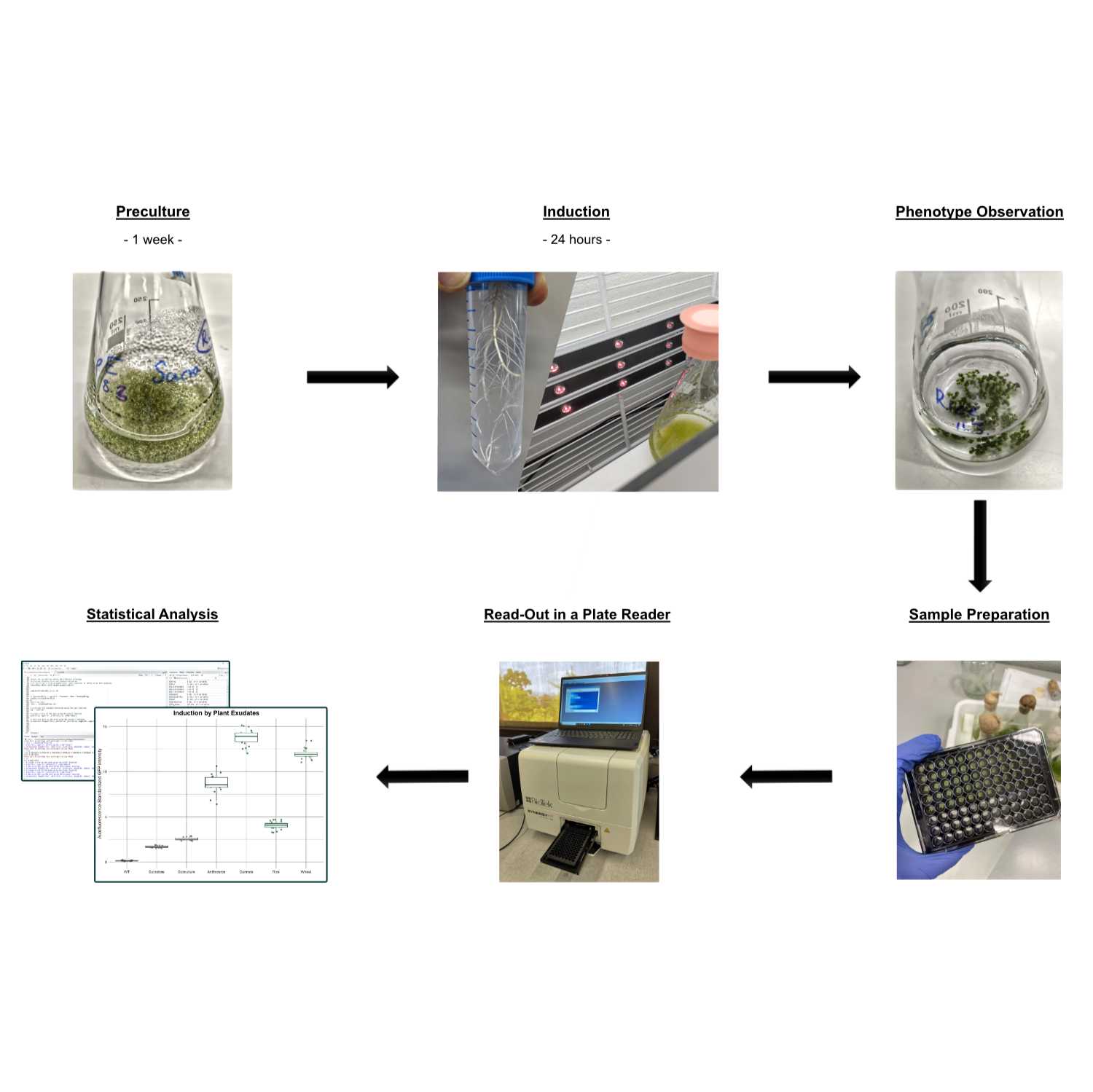
Overview of the Protocol Steps
Hormogonia Induction
Prior to hormogonia induction, wash the cultures twice with BG110: Centrifuge 100 mL of the Nostoc reporter culture at 3000 ×g for 5 min. Resuspend the culture in 100 mL of BG110.
Repeat centrifugation and resuspension. Centrifuge again and resuspend in the final volume of BG110 (and additional supplements).
Induce hormogonia formation by exposing the reporter strains to a physical or chemical stimulus such as far red light or different plant exudates.
Quantification of Hormogonia
Spin down the Nostoc reporter cultures and quickly homogenize 100 mL of each culture by passing through a needle (0.8 x 50 mm).
A blank sample with BG110 for the correction of autofluorescence and turbidity was used in each measurement (measurement was made in at least eight wells).
Add 200 μL aliquots of the samples into the wells of a black 96-well microplate (Nunc, Denmark).
We recommend to carry out at least 12 measurements (12 wells, technical replicates) for each biological replicate.
Measure GFP fluorescence, turbidity, and Chlorophyll a autofluorescence using a VARIOSKAN LUX microplate reader.
Turbidity was measured at 730 nm. Chlorophyll a autofluorescence and GFP were measured at 650-700 nm and 485-520 nm, after excitation at 650 nm and 485 nm, respectively.
VARIOSKAN LUX microplate reader and 96 well plates used.
Statistical Analysis
To test the effect of abiotic and biotic factors on GFP fluorescence, a one-way ANOVA in combination with the Tukey Honest post hoc test was used in R (Core, 2008).
Protocol references
Splitt, S. D., and Risser, D. D. (2016). The non-metabolizable sucrose analog sucralose is a potent inhibitor of hormogonium differentiation in the filamentous cyanobacterium Nostoc punctiforme. Arch. Microbiol. 198:137–47.
Rippka R, Deruelles J, Waterbury JB, Herdman M, Stanier RY (1979) Generic assignments, strain histories and properties of pure cultures of cyanobacteria. Microbiology 111:1–61
Szövényi, P., Frangedakis, E., Ricca, M., Quandt, D., Wicke, S., and Langdale, J. A. (2015). Establishment of Anthoceros agrestis as a model species for studying the biology of hornworts. BMC Plant Biol. 15:98.