Jul 18, 2025
Quantifying DNA Using the Qubit
- 1Saint Mary's University



External link: https://assets.thermofisher.com/TFS-Assets/LSG/manuals/MAN0017209_Qubit_4_Fluorometer_UG.pdf
Protocol Citation: Sonya N. Radvan, Tim Frasier 2025. Quantifying DNA Using the Qubit. protocols.io https://dx.doi.org/10.17504/protocols.io.8epv5k1knv1b/v1
License: This is an open access protocol distributed under the terms of the Creative Commons Attribution License, which permits unrestricted use, distribution, and reproduction in any medium, provided the original author and source are credited
Protocol status: Working
We use this protocol and it's working
Created: July 17, 2025
Last Modified: July 18, 2025
Protocol Integer ID: 222729
Keywords: DNA Quantification, Qubit, Fluorometry, qubit assay, dsdna hs assay, dsdna br assay, quantifying dna, dna broad range assay, dna high sensitivity assay, dsdna h, broad range assay, high sensitivity assay, dsdna br, quantification range, qubit, ranges of quantification, assay, stranded dna, detection molecule, dna, quantification, quantification of ngs library
Abstract
There are two Qubit assays that we will generally be using: (1) the dsDNA BR assay (double-stranded DNA broad range assay) for DNA that has just been extracted (quantification range is 4-4,000 ng); and (2) the dsDNA HS assay (double-stranded DNA high sensitivity assay) for quantification of NGS libraries and other similar applications (quantification range 0.1-120 ng). See image below for ranges of quantification associated with each assay.
The protocol is essentially the same regardless of which of the two assays you are using (dsDNA BR or dsDNA HS). Note that, in addition to getting readings of your samples, you also need to get readings for the two standards that come with the kit each time you use the machine. The kit also contains two solutions (in addition to the two standards): (1) the “Reagent” solution that contains the appropriate detection molecule(s), and (2) the “Buffer” solution, to which the detection molecules will be mixed, and then will be added to your samples. These two are mixed as a ‘cocktail’ prior to being added to each sample and the standards.
Guidelines
For both DNA kits, when a new kit is received the buffer and reagent should be aliquoted into smaller tubes (5-10 mL tubes for the buffer and 0.6 mL tubes for the reagent). One "working" aliquot of each should be stored at room temperature in the Qubit Supplies cupboard and all others should be stored in the refrigerator at 4°C or the freezer at -20°C. When the current working aliquot is used up, a new aliquot can be thawed and stored at room temperature for use. This is done to avoid freeze/thaw cycles for the reagent and to prolong the shelf life of both solutions as they are only shelf stable at room temperature for 6 months.
The reagent is light sensitive and should be stored in an amber bottle or small box to protect it.
DNA standards 1 & 2 should be stored in the refrigerator at 4°C.
Materials
| Reagent | Supplier | Catalogue # | |
| dsDNA BR assay (100) | ThermoFisher Scientific | Q32850 | |
| dsDNA BR assay (500) | ThermoFisher Scientific | Q32853 | |
| dsDNA HS assay (100) | ThermoFisher Scientific | Q32851 | |
| dsDNA HS assay (500) | ThermoFisher Scientific | Q32854 | |
| Qubit Assay Tubes | ThermoFisher Scientific | Q32856 |
Safety warnings
Please refer to the SDS for all solutions used. The solutions used for the Qubit contain DMSO and also have ingredients that are designed to bind to DNA, and therefore should be used with caution. Always wear appropriate PPE (lab coat and gloves) and use care while completing this protocol. Ensure all tubes and waste are disposed of properly.
Preparation
Conduct calculations. Calculate how much Reagent and Buffer you will need to make the "working solution". The final volume should be 200 µL per sample, and the ratio of Reagent to total volume should be 1:200 (i.e., 1 µL of Reagent and 199 µL of Buffer for each sample). An example calculation is below.
Suppose that we are quantifying 10 samples plus 2 standards. Note that we will include 1 extra to allow for pipetting error, for a total of 13 samples.
Reagent: Need 1 µL of Reagent per sample. 1 µL x 13 samples = 13 µL of Reagent
Buffer: Need 199 µL for example sample. 199 µL x 13 samples = 2587 µL of Buffer
A diagram displaying this process is below.
Prepare reagents & DNA. Take reagents out of the refrigerator to allow them to come to room temperature. Take the DNA out of the freezer and allow to thaw.
Prepare tubes. Take out the appropriate number of Qubit tubes (# of samples + 2 for the standards) and label the lids accordingly. Do not label the sides of the tubes, as this will interfere with the readings.
Aliquot the DNA. Mix each DNA sample well (including the two standard solutions), and then briefly spin down to get all liquid into the bottom of the tube. Aliquot the appropriate amount of DNA into the appropriate tubes (this will be 10 µL for the two standards, and 2 µL for each of your samples). Remaining DNA should be put back into the freezer, and the standard should be put back into the refrigerator.
Make the working solution. In a new tube, combine the Buffer and the Reagent in the amounts calculated in Step #1. Vortex briefly to mix.
Getting Readings
Aliquot the working solution. Aliquot the appropriate amount of the working solution into the Qubit tubes (which already contain the appropriate amount of DNA). This will be 190 µL for the two standards, and 198 µL for your samples. A diagram of this process is below
The standards require adding 10 µL of each standard to 190 µL of the working solution.
For most of our samples we can quantify 2 µL of each sample, and therefore add 198 µL of the working solution. However, you can add up to 20 µL of your samples, with the appropriate amount of working solution so that the final volume is 200 µL .
Vortex each tube for 3-5 seconds
Let tubes sit at room temperature for 2 minutes. Readings from the Qubit are highly sensitive to temperature. This is why it is imperative to allow all solutions to come to room temperature first. This is also why you should only read each sample once: obtaining the reading heats up the samples, and therefore concentrations can be off if they are read multiple times.
Get readings from the standards and samples.
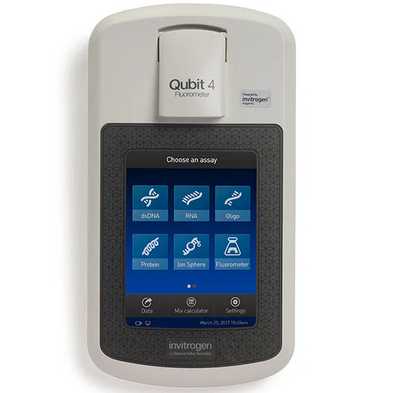
On the Home screen, select dsDNA, then select the appropriate assay (dsDNA Broad Range or dsDNA High Sensitivity). Select Read Standards.
Insert the tube containing Standard #1 into the sample chamber, close the lid, then touch Read Standard. When the reading is done, write the value in your lab book, then remove Standard #1
Insert the tube containing Standard #2 into the sample chamber, close the lid, then touch Read Standard. When the reading is done, write the value in your lab book, then remove Standard #2.
Interpret the standards. The screen will show the raw fluorescence values for the standards. We are looking to see that the reading for Standard #2 is at least ten times higher than that for Standard #1. If not, then there are problems and you should not continue with reading your samples, and should tell Tim.
Touch Read Samples.
On the assay screen, select the sample volume and units.
- Touch the + or - buttons on the wheel, or anywhere on the wheel itself, to select the sample volume added to the assay tube (1-20 µL ).
- From the Unit dropdown menu, select the units for the output sample concentration.
Insert a sample tube into the sample chamber, close the lid, then touch Read tube. When the reading is complete, write the concentration in your lab book, then remove the sample tube.
Repeat step 9.7 until all samples have been quantified.
If samples are over-range (too concentrated), create aliquots of a 10X serial dilution from your stock DNA until you bring it into range. You may need to make more working solution to read these. DO NOT ADD MORE TE TO DILUTE THE STOCK DNA ITSELF.
Dispose of samples. Sample tubes should not be thrown in the regular garbage after reading as they require special disposal conditions. Please dispose of all tubes in the ethidium bromide waste container.