Jun 29, 2026
Quantification of coumarins by UV-Vis
- 1College of Natural Sciences, Can Tho University



Protocol Citation: Cuong-Quoc NGUYEN 2026. Quantification of coumarins by UV-Vis. protocols.io https://dx.doi.org/10.17504/protocols.io.q26g7q833lwz/v1
License: This is an open access protocol distributed under the terms of the Creative Commons Attribution License, which permits unrestricted use, distribution, and reproduction in any medium, provided the original author and source are credited
Protocol status: Working
We use this protocol and it's working
Created: June 28, 2026
Last Modified: June 29, 2026
Protocol Integer ID: 319955
Keywords: coumarins, antioxidant, anti-inflammatory, anticancer, hepatoprotective, UV-Vis, Quantification, Detection, Food, step-by-step , quantification of coumarin, coumarin via uv, coumarin, vis spectroscopy, uv
Abstract
The analysis of coumarin via UV-Vis spectroscopy has garnered popularity due to its numerous advantages. Firstly, this technique is non-destructive, enabling the reuse of samples for further processing or analysis. Secondly, it allows for rapid measurements, facilitating seamless integration into various experimental protocols.
Materials
1. Prepare test sample: 0.5 g of powdered herbal material was extracted twice with 10 mL of 50% methanol at 50°C for 40 minutes. The extract was evaporated, and the residue was dissolved in 3 mL of methanol .
2. Prepare 0.02% coumarin standard (w/v): The coumarin standard was isolated as described in section 3.2 or purchased commercially (CAS 91-64-5). Coumarin was diluted to a stock concentration of 0.02% by dissolving 2.0 mg of the compound in 10 mL of methanol. Ensure the solution is well-mixed.
3. Prepare 7% (w/v) sodium carbonate solution: Dissolve the 7.0 g of sodium carbonate in a small amount of distilled water. Transfer the dissolved sodium carbonate into a 100 mL volumetric flask. Add distilled water to the flask until the total volume reaches 100 mL, which is well-mixed.
4. Prepare 0.05N sulfuric acid solution. Carefully measure approximately 1.39 mL of concentrated sulfuric acid using a pipette. Add the measured sulfuric acid to a 500 mL volumetric flask containing about 250 mL of distilled water. Mix the solution gently. Add distilled water to the flask until the total volume reaches 500 mL.
5. Prepare p-nitrobenzenediazonium chloride (1.5 mmols/L) solution. Dissolve the 0.284 g of p-nitrobenzenediazonium chloride in a small amount of distilled water. Transfer the dissolved p-nitrobenzenediazonium chloride into a 1000 mL volumetric flask. Add distilled water to the flask until the total volume reaches 1000 mL.
Prepare five 50-mL-volumetric flasks. Introduce the following volumes of 200 ppm coumarin standard solution into the flasks: 0.1 mL; 0.2 mL; 0.5 mL; 0.8 mL; 1.0 mL (use 20 µL for sample test)
Add 5 mL of 7% sodium carbonate solution to each flask.
Heat the solutions for 5 minutes at 85°C.
Allow the solutions to cool to ambient temperature.
Add 5 mL of 0.05 N sulfuric acid solution to each flask.
Add 5 mL of p-nitrobenzenediazonium chloride (1.5 mmols/L) to each flask, resulting in the formation of a red azo compound.
Bring each solution to the mark (50 mL) with distilled water.
Transfer the samples to cuvettes. Measure the absorbance of the resulting solutions at 520 nm by UV-VIS spectrophotometer.
UV-absorption spectrums of azo coumarin
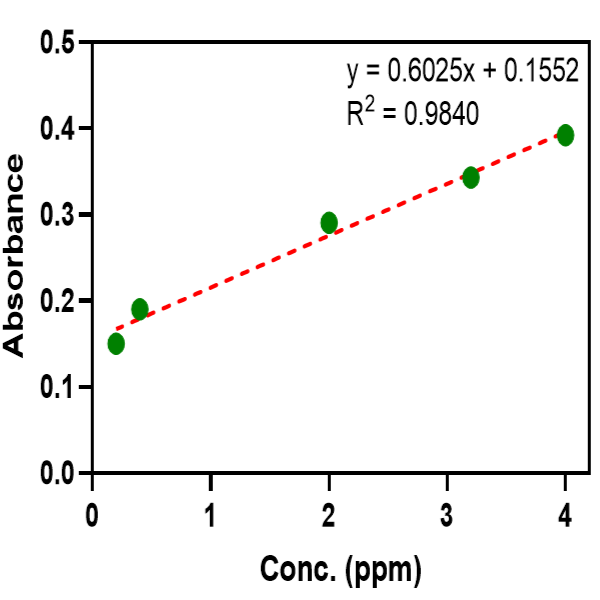
Construct a linear calibration curve y = ax+b from the measured absorbance values. The coumarin content, expressed in mg/100 g dry weight, is calculated using the formula: