Jun 24, 2025
PRP and Physiotherapy for Disc Herniation
- 1Department of Physiotherapy & Rehabilitation, Jashore University of Science & Technology



Protocol Citation: Rayhan Islam, K M Amran Hossain 2025. PRP and Physiotherapy for Disc Herniation. protocols.io https://dx.doi.org/10.17504/protocols.io.q26g79qm1vwz/v1
License: This is an open access protocol distributed under the terms of the Creative Commons Attribution License, which permits unrestricted use, distribution, and reproduction in any medium, provided the original author and source are credited
Protocol status: Working
We use this protocol and it's working
Created: June 24, 2025
Last Modified: June 24, 2025
Protocol Integer ID: 220807
Keywords: Lumbar Disc Herniation, Platelet-Rich Plasma, McKenzie Exercises, Musculoskeletal Ultrasound, Nerve Conduction Studies, Electromyography, Randomized Controlled Trial, Low Back Pain, Radiculopathy, Disc Morphology, Neurophysiology, Oswestry Disability Index, physiotherapy for disc herniation, s1 lumbar disc herniation, disc herniation, assessing pain, prp with mckenzie exercise, week mckenzie exercise program, physiotherapy, using musculoskeletal ultrasound, mckenzie exercise, pressure pain threshold, musculoskeletal ultrasound, exercise, effectiveness of ultrasound, treatment strategies for ldh, single prp injection, disability, electromyography, mckenzie exercise program, disability index
Abstract
This protocol outlines a randomized controlled trial (RCT) to evaluate the effectiveness of ultrasound-guided platelet-rich plasma (PRP) injections combined with McKenzie exercises compared to McKenzie exercises alone in 60 patients with L5/S1 lumbar disc herniation (LDH), assessing pain, disc morphology, neurophysiology, and disability over 6 months. The intervention involves a single PRP injection (2–3 ml autologous PRP) plus a 4-week McKenzie exercise program, with outcomes measured using musculoskeletal ultrasound (MSK-USG), nerve conduction studies (NCS), electromyography (EMG), Visual Analogue Scale (VAS), Pressure Pain Thresholds (PPTs), Straight Leg Raise (SLR) test, and Oswestry Disability Index (ODI). The study is expected to demonstrate that combining PRP with McKenzie exercises significantly improves disc morphology, neurophysiological recovery, pain, and disability compared to exercises alone. Results may inform evidence-based treatment strategies for LDH in resource-limited settings.

Image Attribution
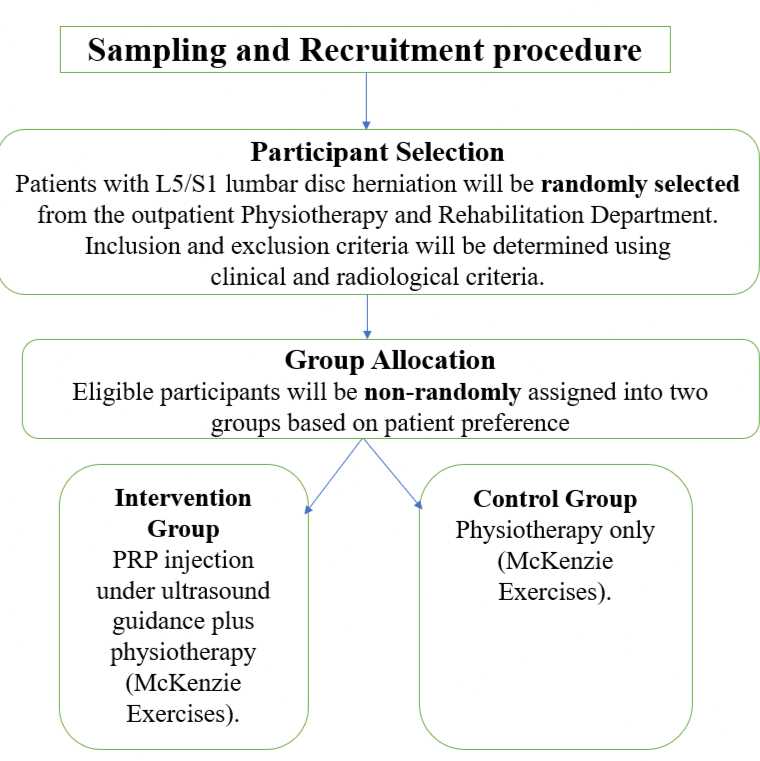
Image created by the authors (Rayhan Islam and K M Amran Hossain) for this study.
Guidelines
Guidelines for Protocol Execution
To ensure precise execution of the randomized controlled trial (RCT) evaluating ultrasound-guided platelet-rich plasma (PRP) injections combined with McKenzie exercises for L5/S1 lumbar disc herniation, the following guidelines must be followed:
- Study Oversight: Conduct the single-center RCT at Jashore University of Science and Technology, with randomization using a computer-generated sequence and allocation concealment via sealed envelopes.
- Blinding: Ensure outcome assessors are blinded to group allocation; participants and clinicians cannot be fully blinded due to PRP injection.
- Training: Require certified training for Orthopedic Spine Surgeons (PRP injections), Certified McKenzie Therapists (exercises), and assessors (MSK-USG, NCS, EMG).
- Participant Screening: Verify eligibility using NASS guidelines, including MRI-confirmed L5/S1 LDH, chronic symptoms (>6 weeks, VAS ≥3), and normal platelet count (150–400 × 10^9/L).
- Intervention Delivery:
- Control Group: Deliver 4-week McKenzie exercise program (12 clinic sessions, 5–7 minutes, 10 repetitions; home program 5–7 sessions daily).
- Experimental Group: Administer single ultrasound-guided PRP injection (4 ml, 3 ml PRP + 0.5 ml saline) plus identical McKenzie exercises.
- Outcome Assessments: Measure pain (VAS, PPTs), disc morphology (MSK-USG), neurophysiology (SLR, NCS, EMG), and disability (ODI) at baseline, 1, 3, and 6 months by blinded assessors.
- Data Management: Collect data using structured forms, store anonymized data in a password-protected database, and conduct weekly audits for accuracy.
Materials
1. PRP Injection
- Blood Collection: 26 ml syringes, CPDA tubes (24 ml, 6–8 per participant), 21-gauge butterfly needles, alcohol swabs, sterile gloves, tourniquets.
- PRP Preparation: Centrifuge (900–1000 g), 15 ml conical tubes, 5 ml pipettes, normal saline (10 ml vials).
- Injection: 22-gauge, 8-inch Quincke Chiba needles, 5 ml syringes, ultrasound gel, sterile drapes, povidone-iodine, adhesive bandages.
2. McKenzie Exercises
- Equipment: Treatment plinths, floor mats, pillows/bolsters.
- Instructional: Printed exercise guides (English/Bengali), home exercise diaries.
- Monitoring: Timer, attendance log sheets.
3. Outcome Assessments
- Pain: Visual Analog Scale (VAS) forms, pressure algometer.
- Disc Morphology: Musculoskeletal ultrasound, ultrasound gel, cleaning wipes.
- Neurophysiology: NCS/EMG system , surface electrodes, conductive gel, goniometer (for SLR test).
- Disability: Oswestry Disability Index (ODI) questionnaires (English/Bengali).
4. Data Management
- Forms: Data collection forms (VAS, PPTs, MSK-USG, NCS, EMG, SLR, ODI), adverse event forms.
- Storage: Computer with database software, external hard drive/secure cloud, secure filing cabinet.
5. Safety/Emergency
- Sharps container, first aid kit, resuscitation kit, hand sanitizers, disinfectants, emergency contact list.
6. Participant Materials
- Consent forms and study information sheets (English/Bengali).
Protocol references
- Daly, M. E. (2011). Determinants of platelet count in humans. Haematologica, 96(1), 10–13. https://doi.org/10.3324/haematol.2010.035287
- Dhurat, R., & Sukesh, M. (2014). Principles and methods of preparation of platelet-rich plasma: A review and author’s perspective. Journal of Cutaneous and Aesthetic Surgery, 7(4), 189–197. https://doi.org/10.4103/0974-2077.150734
- Dunsford, A., Kumar, S., & Clarke, S. (2011). Integrating evidence into practice: Use of McKenzie-based treatment for mechanical low back pain. Journal of Multidisciplinary Healthcare, 4, 393–402. https://doi.org/10.2147/JMDH.S24733
- Hirayama, J., Yamagata, M., Ogata, S., Shimizu, K., Ikeda, Y., & Takahashi, K. (2006). Relationship between low-back pain, muscle spasm and pressure pain thresholds in patients with lumbar disc herniation. European Spine Journal, 15(1), 41–47. https://doi.org/10.1007/s00586-004-0813-2
- Kilpikoski, S., Häkkinen, A. H., Repo, J. P., Kyrölä, K., Multanen, J., Kankaanpää, M., ... & Ylinen, J. (2024). The McKenzie Method versus guideline-based advice in the treatment of sciatica: 24-month outcomes of a randomised clinical trial. Clinical Rehabilitation, 38(1), 72–84. https://doi.org/10.1177/02692155231196393
- Li, W., Liu, Y., Zheng, C., Miao, J., Chen, H., Quan, H., ... & Zhang, K. (2018). Diagnosis of compressed nerve root in lumbar disc herniation patients by surface electromyography. Orthopaedic Surgery, 10(1), 47–55. https://doi.org/10.1111/os.12362
- Machado, E. S., Soares, F. P., Vianna de Abreu, E., de Souza, T. A. da C., Meves, R., Grohs, H., ... & Caldas, J. M. P. (2023). Systematic review of platelet-rich plasma for low back pain. Biomedicines, 11(9), 2404. https://doi.org/10.3390/biomedicines11092404
- McNally, D. S., Naish, C., & Halliwell, M. (2000). Intervertebral disc structure: Observation by a novel use of ultrasound imaging. Ultrasound in Medicine & Biology, 26(5), 751–758. https://doi.org/10.1016/S0301-5629(00)00209-X
- Robin McKenzie, S. M. (2003). The Lumbar Spine Mechanical Diagnosis & Therapy (2nd ed., Vol. 2). Spinal Publications New Zealand Ltd.
- Wongjarupong, A., Pairuchvej, S., Laohapornsvan, P., Kotheeranurak, V., Jitpakdee, K., Yeekian, C., & Chanplakorn, P. (2023). “Platelet-Rich Plasma” epidural injection an emerging strategy in lumbar disc herniation: A randomized controlled trial. BMC Musculoskeletal Disorders, 24(1), 335. https://doi.org/10.1186/s12891-023-06429-3
Acknowledgements
We express gratitude to the Department of Physiotherapy & Rehabilitation (PTR) at Jashore University of Science and Technology for partial funding and provision of facilities for this study. We also acknowledge the anticipated contributions of Certified McKenzie Therapists, Orthopedic Spine Surgeons, and the research team for their expertise in executing this future protocol.