Dec 16, 2025
Version 1
Protocol for the extraction of human auditory ossicles in bioarchaeology V.1
- Emy Gentile1,
- Giulia Riccomi1,2
- 1University of Pisa (Italy);
- 2Max Planck Institute of Geoanthropology (Germany)



External link: https://doi.org/10.1016/j.ijpp.2025.02.008
Protocol Citation: Emy Gentile, Giulia Riccomi 2025. Protocol for the extraction of human auditory ossicles in bioarchaeology. protocols.io https://dx.doi.org/10.17504/protocols.io.261ge1pnov47/v1
Manuscript citation:
Gentile E., Giuffra V., Campana S., Riccomi G. (2025). Ossicular chain changes revealed middle ear inflammation in medieval rural central Italy (Tuscany 10th-12th century). International Journal of Paleopathology, vol. 49, p. 58-68.
License: This is an open access protocol distributed under the terms of the Creative Commons Attribution License, which permits unrestricted use, distribution, and reproduction in any medium, provided the original author and source are credited
Protocol status: Working
We use this protocol and it's working
Created: December 16, 2025
Last Modified: December 16, 2025
Protocol Integer ID: 235106
Keywords: Temporal bone, middle ear, palaeopathology, archaeology, preservation, human auditory ossicles in bioarchaeology, storing auditory ossicle, human auditory ossicle, auditory ossicle, archaeological human skeletal remain, bioarchaeology, protocol for the extraction, cranial structure, surrounding cranial structure, documenting, extraction, stape, ensuring proper contextual documentation, proper contextual documentation, malleus
Disclaimer
This is an open access protocol distributed under the terms of the Creative Commons Attribution
License, which permits unrestricted use, distribution, and reproduction in any medium, provided the original author
and source are credited.
Abstract
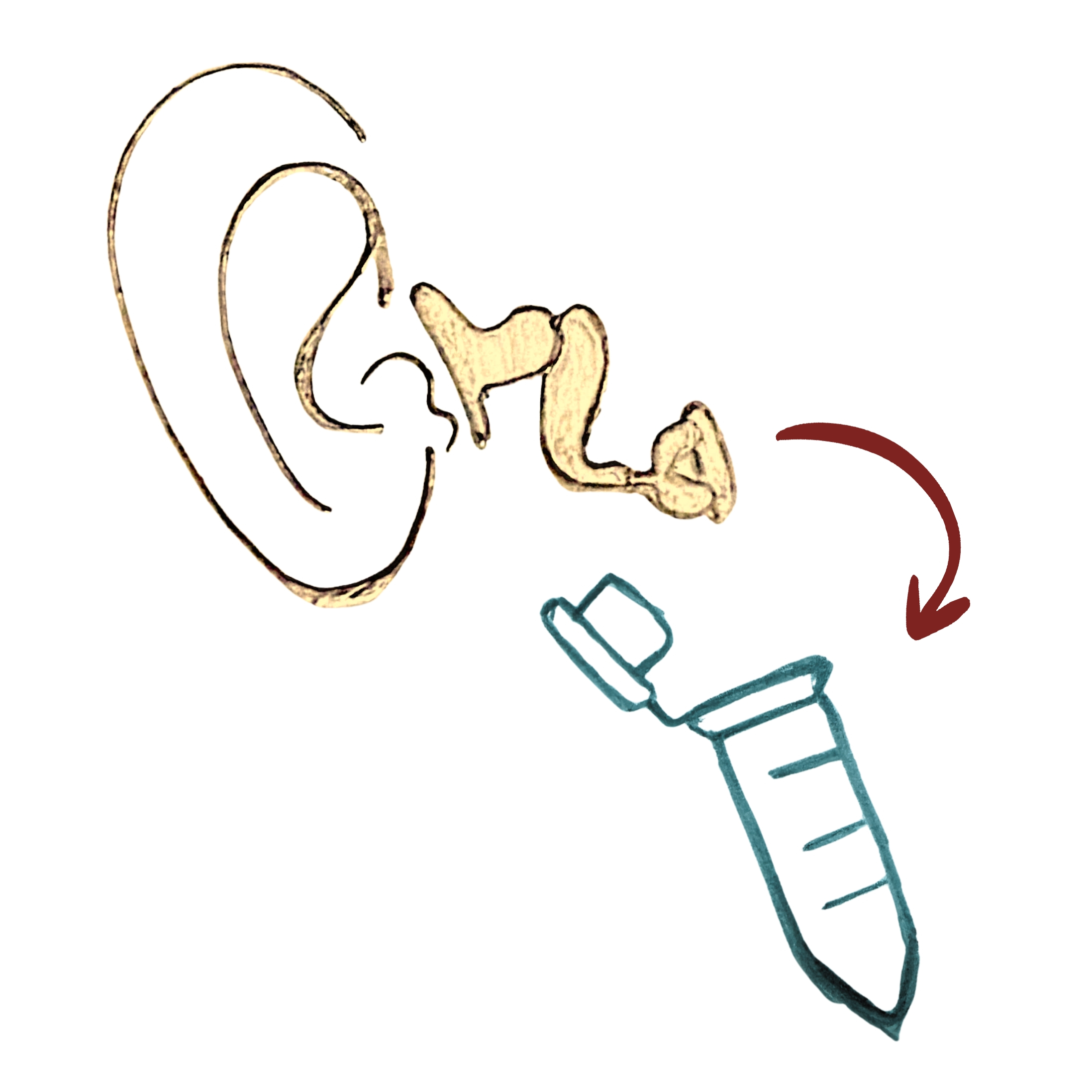
This protocol describes standardised procedures for locating, extracting, documenting, and storing auditory ossicles (malleus, incus, and stapes) from archaeological human skeletal remains while minimising damage to the surrounding cranial structures and ensuring proper contextual documentation.
Image Attribution
Protocol image by Giulia Riccomi
Protocol figures by Emy Gentile
Guidelines
Perform this protocol only in a laboratory setting with dedicated space and equipment suitable for handling human osteoarchaeological remains.
Materials
REQUIRED EQUIPMENT (Figure 1)
- Nitrile gloves
- Soft bristle toothbrush
- Paintbrush
- Dental probes (Right-Angle Dental Probe; Shepherd’s Hook Explorer)
- Water container
- Distilled water
- Directed light source
- Padded micro-containers (e.g., microtube)
- Labels and fine tip markers
- Photography equipment (camera, scale bar)
Figure 1. Equipment for the extraction of auditory ossicles.
Safety warnings
- Work on a padded, stable surface to avoid loss or breakage of bone elements and use a direct light source.
- Wear nitrile gloves and use metal tools strictly for the extraction procedure (step 1).
Ethics statement
Archaeological human skeletal remains shown in figures 2-10 derived from a medieval cemetery of Pieve di Pava (Siena, Italy), and are hosted at the Division of Paleopathology directed by Prof. Valentina Giuffra at the University of Pisa (Italy).
Permission to access, study and sampling the osteoarcheological skeletal assemblage from Pieve di Pava was granted by the director of the excavations, Prof. Stefano Campana, University of Siena (Italy).
Before start
PRE-EXTRACTION PROCEDURES
Documentation and Assessment
- Record contextual data: context/skeleton ID number.
- Assess preservation: note completeness of the temporal bones, potential taphonomic damage, and sediment compaction.
- Photograph the cranium/skull and both the right and left temporal bone.
- Determine the appropriate approach based on bone condition (e.g., intact or fragmented temporal bone).
EXTRACTION PROCEDURE
ACCESSING THE MIDDLE EAR
Place the temporal bone (or the cranium) with the external acoustic meatus facing upward (Figure 2).
Figure 2. Accessing the middle ear procedure: Step 1.1. Face the external acoustic
meatus upward.
Use distilled water and a soft bristle toothbrush or a paintbrush to remove the sediment around the external acoustic meatus (Figure 3).
Figure 3. Accessing the middle ear procedure: Step 1.2. Remove the sediment around the external acoustic meatus with a wet soft bristle toothbrush or a paintbrush.
If the meatus is filled with compact sediment, moisten the sediment with a wet soft bristle toothbrush or a paintbrush and remove sediment incrementally using the right-angle dental probe; repeat this procedure multiple times until the sediment is completely removed (Figure 4).
Figure 4. Accessing the middle ear procedure: Step 1.3. Moisten the sediment and remove it using the right-angle dental probe.
NOTE: Proceed with caution when removing the sediment using the probe as the ossicles are often embedded into the sediment (Figure 5).
Figure 5. Incus (whitesquare) embedded into the sediment.
RECOGNISING THE OSSICLES
- Malleus: it appears as hammer-shaped, with an oval-shaped head, a long, thin handle (manubrium), and two processes (anterior and lateral); typically found near the medial side of the tympanic membrane area.
- Incus: it resembles an anvil shape, with a cubical body and a short and a long process; often lies posteromedial relative to the malleus.
- Stapes: the smallest and most fragile ossicle; it is shaped like a horse stirrup, with a head, two arched crura (anterior and posterior), and a footplate; it is situated near the oval window.
EXTRACTION TECHNIQUES OF THE OSSICLES
Once the ossicles become visible, use minimal force to extract them individually with the probe (Right-Angle or Shepherd’s Hook Explorer). Before the extraction procedure of the ossicles, consider carefully the anatomical regions of the temporal bone where the ossicles may be situated (Figure 6).
Figure 6. Anatomical regions of the right temporal bone (medial view) where the ossicles may be situated; A) mesotympanum; B) epitympanum and antrum (*); C) oval window.
Follow the steps below based on the ossicle’s position:
Most often the ossicles are embedded in the sediment within the mesotympanum (Figure 6A; Figure 7); visualise the ossicle, lift gently with the probe (Right-Angle) and extract it from the meatus.
Figure 7. Malleus (white square) embedded in the sediment within the mesotympanum (lateral view).
Occasionally, ossicles may become entrapped within the epitympanum (Figure 6B; Figure 8); in such cases the recommended procedure is:
- Clear the surrounding sediment first.
- Gently use the probe (Shepherd’s Hook Explorer) to extract the ossicle from the epitympanic cavity through the meatus.
Figure 8. Incus (white square) entrapped within the epitympanum (lateral view).
If the tegmen tympani is damaged, examine the antrum from a superior view as the ossicles may be entrapped within (Figure 6B; Figure 9).
Figure 9. Incus (white rectangle) entrapped within the antrum (superior view).
NOTE: Proceed with caution when clearing the area around the oval window as the stapes is usually heavily embedded in the sediment situated there (Figure 6C; Figure 10).
Figure 10. Stapes (white square) situated near the oval window (inferior view).
POST-EXTRACTION PROCEDURES
CLEANING
Do not clean ossicles beyond what is minimally necessary; remove the sediment with a dry paintbrush.
For biomolecular analysis (e.g., aDNA), avoid excessive handling of the ossicles.
DOCUMENTATION
Photograph each ossicle with a scale and context/skeleton ID number.
Record recognisable anatomical and palaeopathological features (on this please see Gentile et al. 2025, https://doi.10.1016/j.ijpp.2025.02.008).
Document any taphonomic alterations (e.g., mineralisation).
STORAGE
Place the ossicles in a padded micro-container (e.g., microtube).
Ensure clear labelling on the micro-container with a fine-tip marker, precisely stating the context/skeleton ID number, the specific type of ossicle and the corresponding side (left or right).
Store micro-containers within the cranium/skull bag or in a dedicated sample box.