Sep 30, 2025
Protocol Bait-lamina strips / preparation of 100 g substrate (dry mass)
- Simone Cesarz1,
- Anja Zeuner1
- 1German Centre for Integrative Biodiversity Research (iDiv) Halle-Jena-Leipzig



Protocol Citation: Simone Cesarz, Anja Zeuner 2025. Protocol Bait-lamina strips / preparation of 100 g substrate (dry mass). protocols.io https://dx.doi.org/10.17504/protocols.io.8epv5kb25v1b/v1
License: This is an open access protocol distributed under the terms of the Creative Commons Attribution License, which permits unrestricted use, distribution, and reproduction in any medium, provided the original author and source are credited
Protocol status: Working
We use this protocol and it's working
Created: September 26, 2025
Last Modified: September 30, 2025
Protocol Integer ID: 228305
Keywords: ecosystem functioning, bait-lamina test, belowground activity, bait lamina strip, standardized bait mixture, situ indicator of soil invertebrate feeding activity, soil invertebrate feeding activity, lamina strip, contrast between bait, feeding activity of soil, faunal feeding activity, bait, strip, plastic strip, applicable in soil ecology, feeding activity, substrate, earthworm, macrofauna such as enchytraeid, lamina method, protocol bait, cellulose powder, soil, soil during scoring, soil ecology, quantitative measure of soil, soil depth, mimics natural soil organic matter, natural soil
Abstract
Bait lamina strips are a standardized tool to assess the feeding activity of soil invertebrates in situ. The method uses PVC or plastic strips, typically 16 cm long, 6 mm wide, and 1 mm thick, that contain a series of evenly spaced holes (usually 16–20) along their length. These holes are filled with a standardized bait mixture that mimics natural soil organic matter, often composed of cellulose powder, bran, and activated carbon.
For deployment, the strips are inserted vertically into the soil, exposing the bait-filled holes at varying depths. The strips are left in the field for a defined incubation period (e.g., 2–4 weeks to several months), during which soil invertebrates (mainly meso- and macrofauna such as enchytraeids, earthworms, collembolans, and isopods) may feed on the bait. After retrieval, the strips are carefully cleaned, and each hole is inspected under a stereomicroscope. Feeding activity is scored as “empty” (1) if the bait is consumed or “intact” (0) if not.
The proportion of holes consumed provides a quantitative measure of soil faunal feeding activity, which can be compared across soil depths, seasons, habitats, and land-use types. Bait lamina strips are inexpensive, easy to standardize, and widely applicable in soil ecology, environmental monitoring, and land-use impact studies.
In a nutshell, the bait-lamina method provides a rapid, in situ indicator of soil invertebrate feeding activity and related biological functions. It is widely used to compare activity across land uses, regions, and seasons (Kratz, 1998). Adding an organic textile dye to the substrate can improve contrast between bait and soil during scoring (Eisenhauer et al., 2014).
Attachments
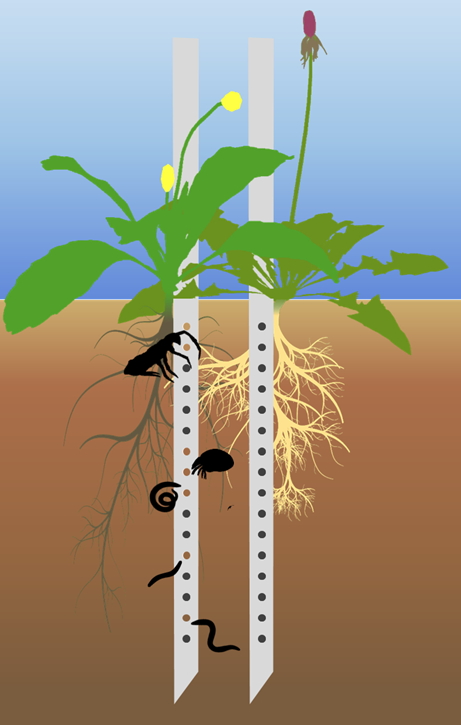
Image Attribution
Holes of PVC strips are filled with a cellulose-based substrate that is consumed by soil detritivores. Counting
the number of holes after ~3 weeks allows us to assess soil-fauna activity
Materials
- 70 g cellulose, microcrystalline
- 27 g wheat bran
- 3 g charcoal
- Deionized water
- Beaker
- Spatula
- Paper tissue
- Milling device
- Templates = empty bait-lamina strips
- Drying oven
Procedure
Wheat bran and cellulose must be finely ground before further processing and sieved through 500 µm (activated carbon is not ground and sieved). For grinding, do not fill the capsules of the ball mill more than 2/3. Use dry materials. Grind cellulose for 10 minutes at f = 10/s. Grind wheat bran 5 minutes at f = 30/s.
Mix the components and then grind the finished mixture again in the ball mill for 5 minutes at f = 30 / s. The substrate can be stored dry in a sealed vessel.
For use, place a small portion of the substrate in a beaker and add just enough distilled water until the powder sticks together. Too much water in the mixture results in greater volume loss during drying, and the substrate falls out of the holes. If it is too dry/crumbly, it falls out immediately.
Two templates are placed on paper towels and the substrate is inserted into the holes with the spatula on both sides. The supernatants can be brushed off with a finger or a spatula.
Thereafter, the strips are dried for 1 h at 40 °C in the drying cabinet.
Because the mixture contracts on drying, reaping and drying must be repeated twice to fill even small cracks. It is recommended to add the substrate for the second and third time with a little more water.
In the field, insert strips tip-first vertically into the soil so that the strip is buried to ~1 cm above the top hole. Leave undisturbed for 2–3 weeks.
Evaluation
Remove strips individually and score immediately. Inspect each hole once against backlight and once in reflected light on both sides. If you are unsure whether the material is bait or soil, gently remove it (e.g., with a pencil) and rub a small amount between gloved fingertips or on a clean, smooth surface (e.g., weighing paper or a glass plate). A uniform, deep-black, smoothly smearing residue indicates bait; a grainy, color-heterogeneous residue indicates soil.
Use the following ordinal scale: 0 = no feeding marks, 0.5 = partially eaten, 1 = hole completely consumed
Protocol references
von Törne E (1990) Assessing feeding activities of soil-living animals. I. Bait-lamina-tests. Pedobiologia 34: 89–101. Kratz, W. The bait-lamina test. Environ. Sci. 26 Pollut. Res. 5, 94–96 (1998). https://doi.org/10.1007/BF02986394
Eisenhauer, N., Wirsch, C., Cesarz, S., Craven, D., Dietrich, P., Friese, J., Helm, J., Hines, J., Schellenberg, M., Scherreiks, P., Schwarz, B., Uhe, C., Wagner, K., 26 Steinauer, K. (2014). Organic textile dye improves the visual assessment of the bait-lamina test. Applied Soil Ecology, 82, 78–81. https://doi.org/10.1016/j.apsoil.2014.05.008
Thakur MP, Reich PB, Hobbie SE, Stefanski A, Rich R, Rice KE, Eddy WC, Eisenhauer N (2018) Reduced feeding activity of soil detritivores under warmer and drier conditions. Nature Climate Change 8: 75–78. https://doi.org/10.1038/s41558-017-0032-6
Sünnemann N, Siebert J, Reitz T, Schädler M, Yin R, Eisenhauer N (2021) Combined effects of land-use type and climate change on soil microbial activity and invertebrate decomposer activity. Agriculture, Ecosystems 26 Environment 318: 107490.
Siebert J, Sünnemann N, Hautier Y, Risch AC, Bakker JD, Biederman L, Blumenthal DM, Borer ET, Bugalho MN, Broadbent AAD, Caldeira MC, Cleland E, Davies KF, Eskelinen A, Hagenah N, Knops JMH, MacDougall AS, McCulley RL, Moore JL, Power SA, Price JN, Seabloom EW, Standish R, Stevens CJ, Zimmermann S, Eisenhauer N (2023) Drivers of soil microbial and detritivore activity across global grasslands. Communications Biology 6: 1220. https://doi.org/10.1038/s42003-023-05607-2
Bonato Asato AE, Ebeling A, Wirth C, Eisenhauer N, Hines J (2025) Positive plant diversity effects on soil detritivore feeding activity and stability increase with ecosystem age. Soil Biology and Biochemistry 200: 109637. https://doi.org/10.1016/j.soilbio.2024.109637