Jun 06, 2025
Producing Plant-Based Leather from Coffee Grounds and Yerba Mate remains (Eco-friendly alternative to leather)
- Joseph shenekji1,2,
- kamar shayah1,
- Miray Mobayed1,
- Marie-Nour Noubarian1,
- Alaa Alabd1,
- Luna Mannaa1
- 1department of biotechnology engineering, faculty of technical engineering, university of Aleppo;
- 2Coordinator of Biotechnologysy.org
- Joseph shenekji: PhD in Biotechnology Engineering - [email protected];
- kamar shayah: PhD in Biotechnology Engineering
- Miray Mobayed: Graduation student
- Marie-Nour Noubarian: Graduation student
- Alaa Alabd: Graduation student
- Luna Mannaa: Graduation student
- Reclone.org (The Reagent Collaboration Network)Tech. support email: [email protected]



Protocol Citation: Joseph shenekji, kamar shayah, Miray Mobayed, Marie-Nour Noubarian, Alaa Alabd, Luna Mannaa 2025. Producing Plant-Based Leather from Coffee Grounds and Yerba Mate remains (Eco-friendly alternative to leather). protocols.io https://dx.doi.org/10.17504/protocols.io.rm7vzqz7xvx1/v1
License: This is an open access protocol distributed under the terms of the Creative Commons Attribution License, which permits unrestricted use, distribution, and reproduction in any medium, provided the original author and source are credited
Protocol status: Working
We use this protocol and it's working
Created: June 06, 2025
Last Modified: June 06, 2025
Protocol Integer ID: 219726
Keywords: plant-base leather, vegan leather, coffee grounds, yerba mate, eco-friendly , leather alternative, leather from coffee ground, friendly alternative to leather, traditional leather, based leather, gelling properties of sodium alginate, formation of the biopolymer matrix, leather, biopolymer matrix, using coffee ground, gelling property, sodium alginate, coffee ground, applications in textile, textile, primary biomass
Abstract
This protocol outlines a method for producing plant-based leather using coffee grounds or yerba mate remains as primary biomass, combined with sodium alginate and other reagents. The process leverages the gelling properties of sodium alginate in the presence of calcium chloride to form a flexible, leather-like material. The protocol details the preparation, mixing, and curing steps, with an emphasis on the molecular mechanisms driving the formation of the biopolymer matrix. This eco-friendly approach repurposes household daily waste into a sustainable alternative to traditional leather, with applications in textiles and material science.
Materials
For Coffee-Based Leather
· Sodium alginate: 8 g
· Coffee grounds (dried, finely ground): 8 g
· Olive oil (lampante olive oil or pomace olive oil): 8 g
· Glycerin: 20 g
· Distilled water: 132 ml
· Calcium chloride (CaCl₂, anhydrous): 7 g
For Yerba Mate-Based Leather
· Sodium alginate: 8 g
· Yerba mate (dried, finely ground): 8 g
· Olive oil: 8 g
· Glycerin: 20 g
· Distilled water: 132 ml
· Calcium chloride (CaCl₂, anhydrous): 7 g
Equipment
· Analytical balance (0.01 g precision)
· Glass beakers (250 mL, 2 units)
· Magnetic stirrer with hotplate
· Spatula or stirring rod
· Flat, smooth, non-porous surface (e.g., glass or silicone mold)
· Spray bottle (for CaCl₂ solution)
· Drying oven (optional, set to 40°C)
· pH meter (optional, for quality control)
Introduction
This protocol transforms household coffee grounds (Coffea spp.) and yerba mate (Ilex paraguariensis) into plant-based leather, mitigating traditional leather’s environmental impact (15,000 L water/kg). Globally, 10.5M metric tons of coffee (2020) produce ~5.25M tons of grounds; households generate 2–4 kg yearly. In Argentina, 90% of households consume 5.9 kg mate/person, yielding 16.5–18.9 kg waste/household. Syria imports 26,000 tons (2023), producing 2.8–6.4 kg/household. Using sodium alginate cross-linking, this biodegradable leather reduces landfill methane (1.5–2.0 tons CO₂/ton) and taps the $73.4B vegan leather market (2023), fostering sustainable economies.
Objectives
· To repurpose coffee grounds and yerba mate into a sustainable leather alternative.
· To elucidate the molecular interactions driving biopolymer formation.
· To provide a reproducible protocol for laboratory and industrial applications.
Protocol of making plant-based leather
3d 0h 20m
Step 1: Preparation of Dry Components
Weigh 8 g of sodium alginate and 8 g of dried coffee grounds (or dried remains of yerba mate) using an analytical balance. Combine in a 250 mL beaker.
weighing dry components, dried remains of yerba mate, sodium alginate, dried coffee grounds
Molecular Mechanism: Sodium alginate, a linear copolymer of β-D-mannuronic acid (M) and α-L-guluronic acid (G) residues, provides a scaffold for the biopolymer matrix. Coffee grounds and yerba mate contribute lignocellulosic fibers (cellulose, hemicellulose, and lignin), which enhance tensile strength and texture. The dry mixing ensures uniform distribution of the biomass within the alginate matrix, preventing clumping during hydration.
The lignocellulosic components in coffee grounds (approximately 40–50% cellulose) and yerba mate (similar composition) act as fillers, increasing the mechanical strength of the final material. Sodium alginate’s anionic carboxyl groups are critical for subsequent cross-linking with calcium ions.
Step 2: Preparation of Liquid Components
In a separate 250 mL beaker, combine 132 g distilled water, 20 g glycerin, and 8 g olive oil. Stir using a magnetic stirrer at300 rpm for00:05:00 to form a homogeneous mixture.
mixing olive oil with water and glycerin
Molecular Mechanism: Glycerin acts as a plasticizer, reducing intermolecular forces within the alginate matrix to enhance flexibility. Olive oil, rich in triglycerides (e.g., oleic acid), serves as a hydrophobic agent, improving water resistance and adding suppleness to the material. Water hydrates the alginate, enabling dissolution and gel formation.
Glycerin’s hydroxyl groups form hydrogen bonds with alginate’s carboxyl and hydroxyl groups, reducing brittleness. Olive oil’s non-polar nature minimizes water penetration, enhancing the material’s durability in humid conditions.
Step 3: Combining Dry and Liquid Components
Gradually add the liquid mixture to the dry mixture while stirring continuously for 00:10:00 to achieve a uniform, viscous paste.
mixing liquid and dry components
Molecular Mechanism: Hydration of sodium alginate results in the dissociation of Na⁺ ions, exposing negatively charged carboxyl groups. The lignocellulosic fibers from coffee grounds or yerba mate become embedded in this viscous matrix, forming a composite material.
The viscosity of the mixture (typically 1000–5000 cP, depending on shear rate) ensures proper dispersion of fibers. Overmixing should be avoided to prevent air bubble incorporation, which could weaken the material.
10m
Step 4: Forming the Leather Sheet
Spread the mixture evenly onto a smooth, non-porous surface (e.g., glass or silicone mold) to a thickness of 2–3 mm using a spatula, cover it with a plastic bag and roll it to have a consistent appearance.
forming leather sheet of coffee grounds, and yerba mate remains
Molecular Mechanism: The uniform spreading ensures consistent cross-linking in the subsequent step. The lignocellulosic fibers align randomly within the alginate matrix, contributing to isotropic mechanical properties.
The thickness of 2–3 mm is optimal for balancing flexibility and strength. Thinner layers may be too fragile, while thicker layers may require extended drying times.
Step 5: Cross-Linking with Calcium Chloride
Dissolve7 g of calcium chloride in 50 mL of distilled water to prepare a 14% (w/v) solution. Spray the solution evenly over the spread mixture using a spray bottle. Allow it to sit for 00:10:00 .
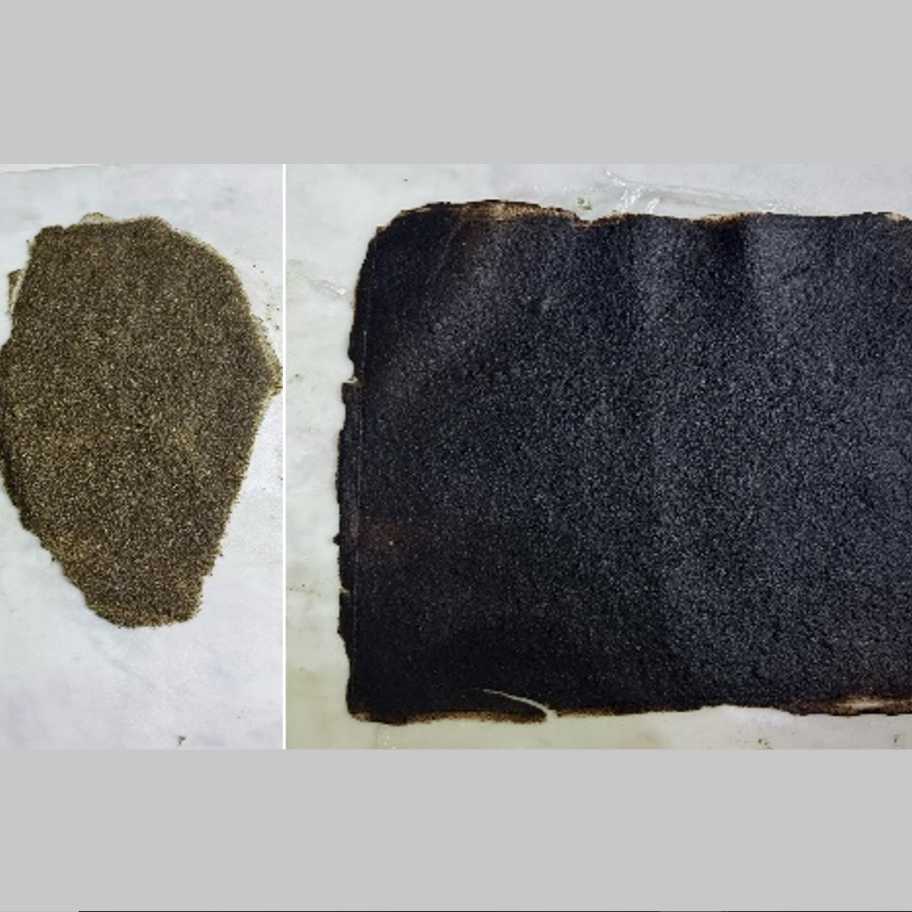
after spraying the leather on both sided with cacl2 it will give this appearance
Molecular Mechanism: Calcium ions (Ca²⁺) interact with the guluronic acid (G) blocks of sodium alginate, forming an “egg-box” structure through ionic cross-linking. This creates a stable, three-dimensional hydrogel network that traps the lignocellulosic fibers.
The “egg-box” model involves Ca²⁺ ions coordinating with oxygen atoms in the carboxyl and hydroxyl groups of adjacent G blocks, forming a rigid gel (Draget et al., 2006). The 14% CaCl₂ concentration ensures rapid gelation without excessive ion residue, which could affect texture.
10m
Step 6: Washing Excess Calcium Chloride
Rinse the gelled material with distilled water to remove excess calcium chloride. Gently pat dry with a lint-free cloth.
Molecular Mechanism: Excess Ca²⁺ ions not incorporated into the alginate matrix are removed to prevent surface crystallization, which could compromise flexibility. The rinsing step also removes unbound sodium ions and residual coffee or yerba mate particles.
Over-rinsing should be avoided to prevent leaching of glycerin, which could weaken the material’s flexibility. The pH of the rinse water should be neutral (pH 6.5–7.5) to avoid disrupting the alginate matrix.
Step 7: Drying the Material
Allow the material to air-dry at room temperature (20–25°C) for 72:00:00 or use a drying oven at 40°C for 24 hours.
final appearance of plant-based leather from coffee grounds and yerba mate remains.
Molecular Mechanism: Evaporation of water during drying consolidates the alginate matrix, reducing pore size and increasing density. The glycerin retains residual moisture, preventing excessive brittleness.
Drying at higher temperatures (>50°C) may cause cracking due to rapid water loss. The lignocellulosic fibers contribute to dimensional stability during drying, minimizing shrinkage.
3d
Expected Results
The resulting material is a flexible, leather-like sheet with a thickness of 1–2 mm (post-drying), exhibiting a slightly textured surface due to the embedded coffee grounds or yerba mate. The material is biodegradable, relatively water-resistant (you can add a layer of hydrophobic spray), and mechanically robust, with potential applications in sustainable fashion and upholstery.
Protocol references
Draget, K. I., Smidsrød, O., & Skjåk-Bræk, G. (2006). Alginates from Algae. In Polysaccharides and Polyamides in the Food Industry (pp. 1–30). Wiley-VCH.
Lee, K. Y., & Mooney, D. J. (2012). Alginate: Properties and biomedical applications. Progress in Polymer Science, 37(1), 106–126.
Ballesteros, L. F., Teixeira, J. A., & Mussatto, S. I. (2014). Chemical, functional, and structural properties of spent coffee grounds and coffee silverskin. Food and Bioprocess Technology, 7(12), 3493–3503.
Sánchez, M. L., & Laca, A. (2020). Yerba mate as a source of biopolymers for sustainable material development. Industrial Crops and Products, 155, 112791.
NextMSC. (2025). Vegan Leather Market. https://www.nextmsc.com/report/vegan-leather-market