Jun 27, 2025
Version 2
Potato Leafroll Virus Purification for Aphid Feeding V.2
- 1Cornell University Plant Pathology and Plant-Microbe Biology;
- 2USDA-ARS Emerging Pests and Pathogens Research Unit
- Vector Biology protocols


Protocol Citation: Michael West-Ortiz, Michelle Heck 2025. Potato Leafroll Virus Purification for Aphid Feeding. protocols.io https://dx.doi.org/10.17504/protocols.io.eq2lyqo7rvx9/v2Version created by Michael West-Ortiz
License: This is an open access protocol distributed under the terms of the Creative Commons Attribution License, which permits unrestricted use, distribution, and reproduction in any medium, provided the original author and source are credited
Protocol status: Working
We use this protocol and it's working
Created: June 26, 2025
Last Modified: June 27, 2025
Protocol Integer ID: 221122
Keywords: Polerovirus purification, PLRV, aphid feeding, artificial diets, potato leafroll virus purification for aphid feeding method, potato leafroll virus purification, potato leafroll virus, aphid feeding method, purified virus, testing aphid acquisition, aphid acquisition, polerovirus, plrv
Funders Acknowledgements:
NSF GRFP Fellowship
Grant ID: DGE-2139899
Abstract
Methods for the partial and complete purification of a Polerovirus, potato leafroll virus (PLRV), and its confirmation via DAS-ELISA and RT-PCR are discussed. Methods for testing aphid acquisition of purified virus using artificial diets are included.
Guidelines
* Use freshly picked plant tissue or tissue stored at -80°C for no longer than 2 weeks.
** Do all steps on ice or at 4°C.
***Ultracentrifuge bottles always need to have 80% or more of their volume filled
Materials
Virus: Potato leafroll virus (PLRV) [Polerovirus]
Host plant: Hairy Nightshade (Solanum sarrachoides)
Date of PLRV agroinfiltration: 01/16/2025
Tissue Harvested: 02/10/2025
Protocol started: 02/10/2025
Grams used: 43 g
Buffers:
0.1 M Citrate buffer (pH 6.5, lower it using NaH2PO4):
-29.41 g of Na3C6H5O7-2H2O for 1L will be 0.1M
-900 mL distilled or distilled autoclaved (if available) water
-Adjust pH to 6.5 using 0.5 M NaH2PO4, then complete volume up to 1000 mL
0.5 M NaH2PO4 (it takes almost 50 mL to take 1L of citrate buffer to pH 6.5)
0.1 M Phosphate buffer (pH 7.0) – maintain at 4°C
Safety warnings
Training in the handling of liquid nitrogen, hazardous chemicals, and the correct usage of an ultracentrifuge are required before starting this protocol
PLRV purification -day 1
Obtain 2 liters of Liquid Nitrogen.
Weigh the collected PLRV-symptomatic leaves.
Place a 2000ml beaker with a stir bar in a chemical fume hood. Use a thin secondary container with ice to keep the beaker cold while stirring.
Add liquid nitrogen to a medium-sized mortar and pestle to start cooling it before you add the leaves.
Crush the leaves into a fine powder while consistently adding liquid nitrogen to prevent moisture and degradation.
Add the fine powder to a 2000ml beaker in the chemical fume hood containing 5 mL per gram of tissue of 0.1 M citrate buffer, pH 6.5, 0.5% beta-mercaptoethanol (BME, added the same day of use). Stir in the fume hood for 2-3 hours with food wrap or parafilm cover.
Place a clean beaker in the fume hood on ice and filter homogenate through 4 layers of cheesecloth.
Add 0.6 volumes of 2:1 chloroform:isoamyl alcohol (IAA) and stir FAST for 2-3 hours with food wrap or parafilm cover. This needs to mix well.
Pour into 250 mL JA14 rotor centrifuge bottles and centrifuge for 10 min at 8,000 rpm at 4°C.
Remember to balance a pair of bottles so that they do not weigh with a difference over 1 g.
Recover aqueous supernatant using a pipettor into a graduated cylinder to measure volume. I recovered 180ml. Then transfer to a beaker in the cold room. Add 0.2M of NaCl slowly but stir as fast as needed to pour into solution. Then slowly sprinkle -to prevent clumping- PEG 8,000 to 8%. Stir as fast as needed to pour into solution but then turn stirring speed down and leave it barely stirring for 2-3 hours.
Pour into 250 mL JA14 rotor centrifuge bottles and centrifuge for 20 min at 8,000 rpm at 4°C.
Remember to balance pair of bottles so that they do not weigh with a difference over 1 g.
Carefully decant supernatant (virus is in the pellet due to the PEG and NaCl). Using long forceps, wipe out the bottles with kimwipe but do not touch the pellet. Resuspend virus pellet in 1/10th of the original volume from step 6 using 0.1M phosphate buffer.
In the cold room: Use a glass tissue grinder to break the pellet, then add a stir bar and leave stirring overnight to resuspend the virus (Overnight resuspension is a must). Cover with food wrap.
PLRV purification -day 2
Combine all liquids in 50 mL conical tubes sitting in an ice bed.
To the empty bottles, add ~3 mL to wash, and add this to the 50mL conical tube(s).
Centrifuge 10 min at 5,000 rpm in JA-20 rotor.
Discard pellets, and transfer supernatant to Ti50.2 bottles containing 5 mL of 30% sucrose (prepared using 0.1 M phosphate buffer). 19 mL of supernatant will fit into each tube containing the sucrose cushion pad. Use a pipettor set up in ‘low’ and ‘droplet’ modes and use a 5 mL pipette (greater than this volume will not work) to carefully layer the virus suspension into the sucrose cushion pad without breaking the interface. Lay the tube sideways while loading to increase the surface of the top layer.
Complete the volume using phosphate buffer if 80% of tube is not filled.
Remember to balance a pair of tubes so that they do not weigh with a difference over 0.1 g. Centrifuge 2 h at 44,000 rpm in Ti50.2 rotor at 4°C.
Discard supernatant, wipe tubes with long forceps and kimwipe, and cover pellets with 0.5 mL of 0.1 M phosphate buffer (300ul added today, 200ul to wash the tube the next morning). We want to keep volume to a minimum. Break pellets using a glass tissue grinder. Stir overnight in the cold room (Overnight resuspension is a must).
Complete PLRV purification
This is partially purified virus, which could be enough for artificial diets. However, to feed aphids on this occasion I completed the full purification.
PLRV purification -day 2
At the end of this second day, be sure sucrose gradients are made and sit overnight in the cold room (if performing full virus purification). All sucrose solutions are prepared in 0.1 M phosphate buffer, pH 7) in SW41 tubes as follows:
Use a pipettor set up in ‘low’ and ‘droplet’ modes, and use a 5 mL pipette (greater than this volume will not work) to layer each sucrose solution carefully.
Add 3 mL of 40% sucrose, 3 mL of 30% sucrose, 3 mL of 20% sucrose, and 1.5 mL of 10% sucrose buffered in 0.1M phosphate buffer. Lean the tube sideways while loading and load onto tube wall. Place sucrose gradient tubes in the cold room overnight.
PLRV purification -day 3
Transfer virus suspension to corex tubes inside rubber tube sheaths, and centrifuge at 7,000 rpm for 5 min in a JA-20 rotor. Transfer supernatant to a clean corex tube.
Carefully layer 0.5 mL of the virus suspension (2 ml max, keep volume to a minimum) onto the top of gradient in SW41 tubes. Lean the tube sideways while loading and load onto tube wall.
Centrifuge for 2 h 15 min at 30,000 rpm in SW41 rotor (No brake on centrifuge, this adds 1 ½ hours). Add all tubes to the swing bucket even if not using all. Check swing bucket in the ultracentrifuge.
Recover the major light-scattering band(s) using a 20-gauge needle syringe and bring to 80% of tube volume with 0.1 M phosphate buffer, pH 7.
If no light-scattering band(s) are observed, fractionation must be used to obtain the single virus peak fractions. Have 8-16 2 ml tubes ready. Using a 20-gauge needle syringe, stab the underside of the SW-41 plastic tube and collect 8-16 fractions. Confirm which fraction(s) has the virus by using the Qubit protein assay.
Combine positive fractions in thick-walled Ti70 centrifuge tubes, then bring to 80% volume with 0.1M phosphate buffer. Centrifuge for 90 min at 40,000 rpm in Ti70 rotor at 4°C.
Remember to balance a pair of tubes so that they do not weigh with a difference over 0.1 g.
After spin, be sure to circle area where pellet is on the tube.
Carefully decant supernatant and wipe out tubes with Kim wipe and long forceps without touching the pellet.
Resuspend in 200 uL of 0.1 M phosphate buffer, pH 7.0. Do not disrupt the pellet. Incubate tubes in the cold room overnight.
PLRV purification -day 4
Then, break pellets using a glass tissue grinder and wash the tissue grinder with 50-100 ul. Leave this overnight.
PLRV purification -day 5
Pipette the virus suspension to mix well, then transfer virus suspension to ‘Protein lo-bind’ tubes.
Prepare a 1:5 dilution and a 1:10 dilution. Measure the protein concentration using Qubit.
Using a nanodrop (Custom > UV-vis), measure the absorbance at 260, 280 and 320 nm and calculate virus concentration of diluted virus preparations.
When determining virus concentration, make a dilution of the virus 1:10 or 1:5 and save this dilution with the stock.
Virus concentration (mg/mL) = ((Abs260nm – Abs 320 nm) x dilution factor) / 8.0
Store purified virus in -80°C freezer.
DAS-ELISA for PLRV
To confirm the PLRV purification, 100ul of purified virus suspension at 20ng/ul was used and incubated overnight on plates coated with the PLRV antibody. ELISA Reagent Set for Potato leafroll virus (PLRV) Agdia -SRA 30002- was used.
Aphid Feeding (5 days)
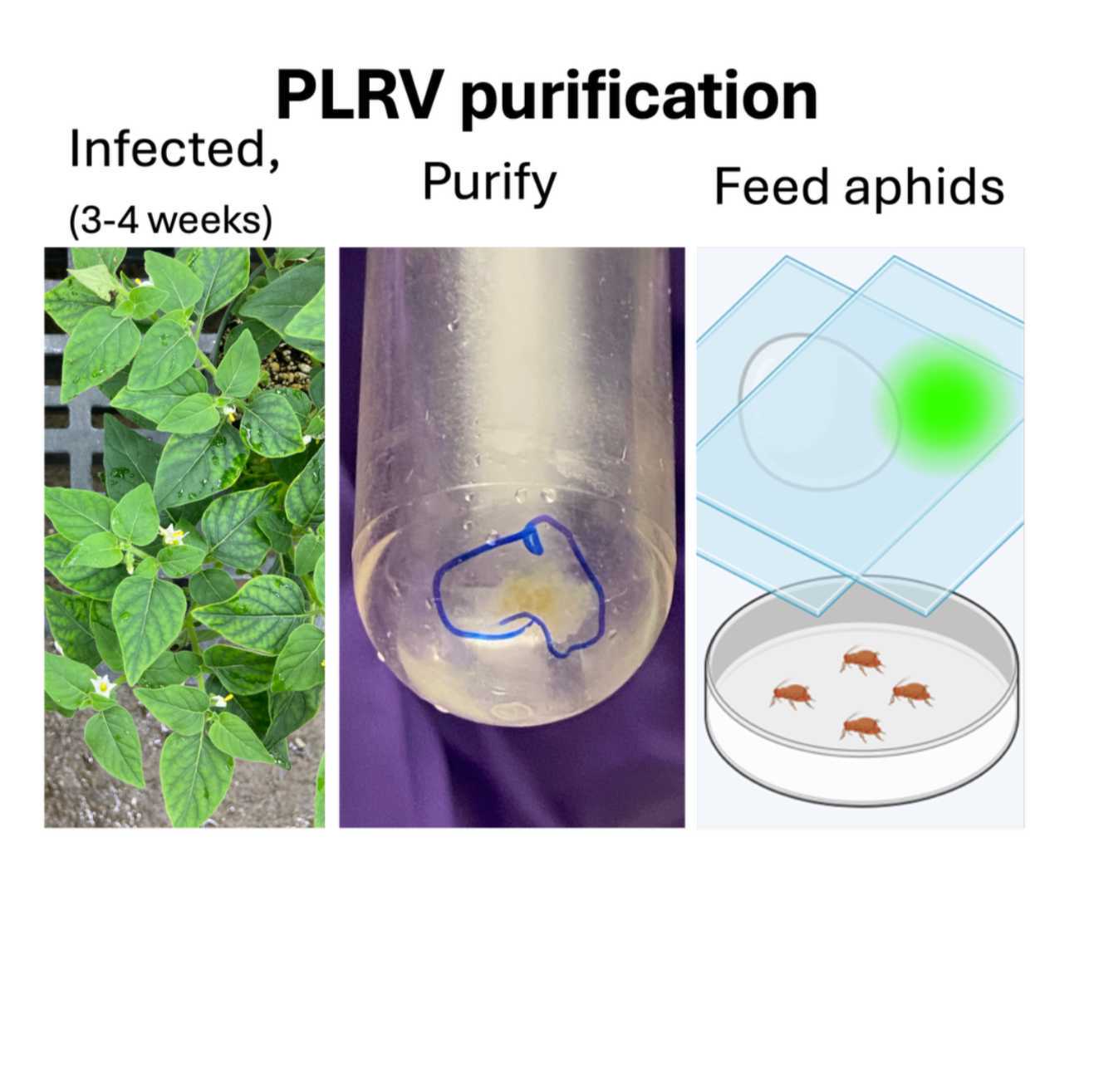
To confirm aphid acquisition of purified PLRV, the virus suspension was normalized to 108 ng/ul with 30% sucrose and placed between two stretched parafilm layers and of a Petri dish.
Make a small hole on a Petri dish where aphids can fit through.
Stretch a parafilm layer to cover a Petri dish before placing the virus suspension on top.
Seal the virus suspension by stretching another parafilm layer on top.
Insert the aphids through the hole and seal the hole with a parafilm layer to avoid escape.
Paint the outside of the parafilm with a green highlighter to encourage aphid feeding.
Feed aphids for three days.
Move aphids to a 30% sucrose diet for two days for gut clearing.
A RT-PCR was done on single aphids to confirm PLRV acquisition.
Protocol references
adapted from Mike Mayo's BYDV protocol.