Jul 31, 2025
Poa annua seed predation cards for summer measurements in Belgian winter cereals
- 1PEPA lab: Plant Ecology, ecoPhysiology and sustainable Agriculture, Earth & Life Institute, UCLouvain, Louvain-la-Neuve, Belgium
- Ecosystem Services indicators



Protocol Citation: Lola Leveau 2025. Poa annua seed predation cards for summer measurements in Belgian winter cereals. protocols.io https://dx.doi.org/10.17504/protocols.io.eq2ly4n7qlx9/v1
License: This is an open access protocol distributed under the terms of the Creative Commons Attribution License, which permits unrestricted use, distribution, and reproduction in any medium, provided the original author and source are credited
Protocol status: Working
We use this protocol and it's working
Created: July 29, 2025
Last Modified: July 31, 2025
Protocol Integer ID: 223623
Keywords: Weed seed, predation card, predator, vertebrate, invertebrate, poa annua, winter cereal, seed predation cards for summer measurement, comparative study of weed seed predation methodology, weed seed predation methodology, seed predation rate, weed seed predation card method, seed predation card, term predation rate of poa, seed predator, seeds by granivore, belgian winter cereals the protocol, term predation rate, seed, number of seed, biological regulation in agroecosystem, hectare winter cereal plot, glued seed, agroecosystem, belgian winter cereal, assessment of biotic pressure, biotic pressure, livestock, granivore, harm to livestock, poa
Abstract
The protocol empirically quantifies the short-term predation rate of Poa annua seeds by granivores in a one-hectare winter cereal plot. Seed predation cards - rigid supports with glued seeds - are placed directly on the soil surface for one week in late June or early July. After retrieval, the number of seeds missing from each card, assumed to have been consumed by seed predators, is used to calculate a seed predation rate.
The protocol is adapted from the weed seed predation card method developed in the French CASIMIR project, which aimed to simplify the assessment of biotic pressures and biological regulation in agroecosystems (Cellier et al., 2017). It also draws on the comparative study of weed seed predation methodologies by Saska et al. (2014). In addition to these references, the protocol was specifically designed to avoid risks associated with non-decomposable waste or harm to livestock: all materials are free of plastic or metal components.
Materials
General materials: tools
- Heavy-duty scissors, to cut in sandpaper
- Hole punch
- Cylindrical glass jar
- Fine sieve or sugar shaker, for applying dry soil dust on the cards
- Kraft paper to protect the workspace during spray adhesive application
- Disposable gloves for spray adhesive handling
- GPS device for precise field positioning
- Broom handle or other long wooden stick, to aid in locating predation cards in the field
General materials: consumables
- Repositionable spray adhesive (e.g. 3M "Spray Mount")
- Fluorescent spray paint
- Dry soil dust, for example dust residues from soil grinding from other experiments
- Pen and notebook, to write results in the field at the end of the experiment
Material per experimental plot, to make and install 10 predation cards
- 100 seeds of Poa annua, dried for 5 minutes at 100°C to avoid germination in the field
- 10 squares of 5 x 5 cm of coarse-grit sandpaper (grit 180)
- 20 wooden skewers
- 2 polystyrene strips of ~6 x 30 cm
- 20 sewing pins
Safety warnings
Securing the workspace
If possible, card preparation is carried out under a fume hood to protect people from contact with the spray adhesive. As the spray adhesive releases particles that may settle throughout the workspace, all interior surfaces of the hood, including the ceiling, should be covered with kraft paper to facilitate cleaning.
It is recommended to wear disposable gloves during spray adhesive application to avoid skin contact.
Before start
Experimental plot
This experiment is designed for a plot of one hectare within an arable field with winter cereal.
Experimental season
Predation cards are placed in the field as late as possible in the crop cycle, ideally aligning with the natural seed dispersal period of weed species that would have germinated during crop sowing. In practice, for winter wheat, cards are placed in late June or early July. Mid-July is avoided to prevent overlap with potential harvest operations.
Cards remain in the field for approximately one week. This duration may be adjusted based on weather conditions to avoid two extremes: (1) no seeds removed at all, or (2) complete removal of all seeds. Monitoring a subsample of plots during the experiment is recommended to track seed removal rates and fine-tune the exposure period accordingly.
Weed species choice
Poa annua was selected as the tested weed species based on the empirical evaluation by Saska et al. (2014), which demonstrated that:
- Its elongated seeds adhere effectively to glue surfaces, unlike more spherical seeds such as Stellaria media.
- Its seeds are consumed by both vertebrate and invertebrate granivores, unlike smaller seeds such as Capsella bursa-pastoris, which are primarily predated by invertebrates.
As a result, the outcomes of this protocol reflect the cumulative seed predation pressure exerted by a granivore community including both vertebrates and invertebrates.
Preparation of predation cards (for one plot)
Spray the upper half of each wooden skewer with fluorescent paint, then let it dry. This enhances visibility and facilitates retrieval of the predation cards in the field.
Cut ten square cards (5 x 5 cm) from coarse-grit sandpaper using scissors. Punch holes in two opposite corners of each square using a hole punch.
Spray the cards evenly with repositionable adhesive, inside the fume hood.
Application of adhesive spray on the cards. The workspace (a fume hood) is covered with kraft paper, and the experimenter wears gloves to avoid contact with the glue.
Deposit ten Poa annua seeds on each card, spacing them as evenly as possible. Gently press the seeds onto the adhesive using a flat-sided glass jar to ensure good contact.
Placement of weed seeds on the card, with a light pressure from a cylindrical glass jar to ensure contact with the glue.
Lightly dust the cards with fine dry soil using a sieve or sugar shaker. Then lift each card vertically and tap it gently against the work surface to remove excess soil. This step prevents predators from getting stuck in the adhesive and makes the card color more similar to the soil.
Addition of soil dust on the cards.
To facilitate storage and transportation to the crop field, group the cards in two sets of five and pin them onto polystyrene strips. Each card is fixed by inserting sewing pins through the pre-punched holes.
Method of storage of the predation cards.
Installation of the predation cards in the field
The predation cards are installed in two lines of five cards each, along two tractor tracks, positioned approximately at the first and second thirds of the plot width, respectively. These positions can be determined in advance on a map to facilitate field installation.
Placement of the ten predation cards in two lines, each aligned with a tractor track, within a one-hectare square plot.
If no tractor tracks are visible, for example in some organic crops, the lines are still placed at the first and second third of the plot width, between two rows of cereals.
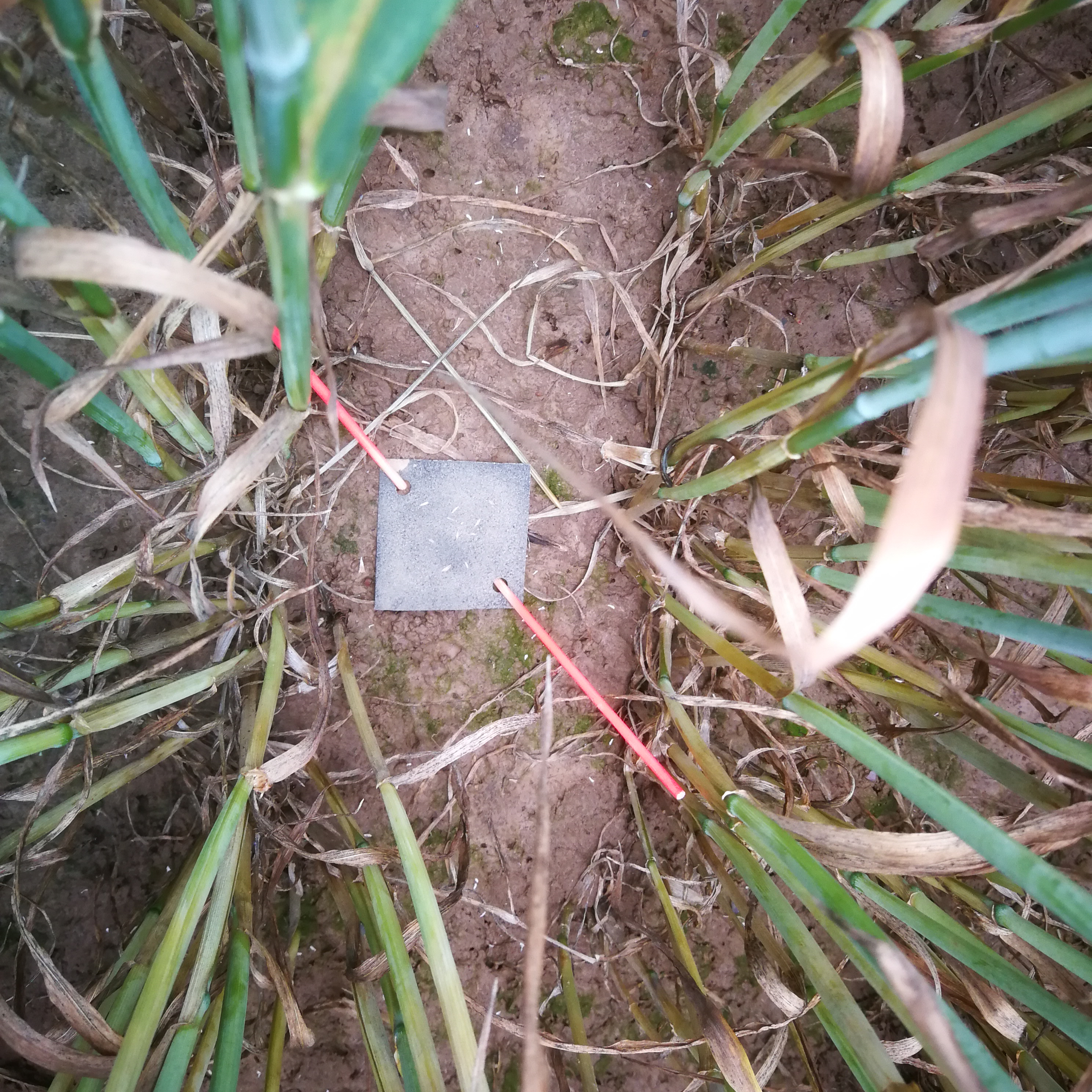
In the plot, go to the beginning of the first line, staying on tractor tracks. Place the first predation card approximately 50 cm away from the tractor track, perpendicularly, between two cereal rows. Secure it with two wooden skewers inserted diagonally through the punched holes in the card, like tent pegs.
Installation of a predation card in the plot.
Record the position of the first card of this line in the GPS as “P1”.
Return to the tractor track and walk forward 20 steps. Place the next card as described in step 8. Repeat this process three more times to install five cards along the track.
Move to the second placement zone (line) and repeat steps 8 to 10, using “P2” for the first card position in the GPS.
Retrieval of the predation cards from the plot
Navigate to the first GPS-marked location (“P1”) by following the tractor tracks.
Use the broom handle, held horizontally at cereal ear height, to gently sweep the cereal crop and reveal the soil surface without damaging the plants. This fastens the finding of the first predation cards around the GPS mark, which is not always precise.
Locate and retrieve the first predation card. Record in a notebook the number of seeds remaining on the card.
Proceed forward four times, taking 20 steps each time along the tractor track, and repeat the retrieval and recording process (steps 13 and 14) for cards 2, 3, 4 and 5.
Move to the second GPS-marked location (“P2”) and repeat steps 13 through 15 to retrieve and record data for cards 6, 7, 8, 9 and 10.
Calculation of Weed Seed Predation Rate
For each experimental plot, the weed seed predation rate [seeds predated/day] is calculated as the mean number of seeds removed from the ten predation cards, divided by the number of days the cards were left in the field.
Where i is the identifier of the predation card in the plot.
Protocol references
Cellier, V., J.N., A., Cordeau, S., Fontaine, L., Froger, M., Gardarin, A., P., G., Lavigne, C., Petit, S., A., R., Sarthou, J.-P., & M., V.-M. (2017). Développements méthodologiques pour une CAractérisation SIMplifiée des pressIons biotiques et des Régulations biologiques-CASIMIR. Innovations Agronomiques, 59, 41–54.
Saska, P., Koprdová, S., Martinková, Z., & Honěk, A. (2014). Comparing methods of weed seed exposure to predators. Annals of Applied Biology, 164(2), 301–312. https://doi.org/10.1111/aab.12102
Acknowledgements
We would like to thank Cellier et al. (2017) and Saska et al. (2014) for their articles, that we used to design the protocol.
We also thank Christelle Buyens, Thomas Dagbert and Pierre Van Thorre, the PEPA laboratory technicians who helped us apply this protocol, as well as the 20 Belgian farmers who provided access to 60 crop fields to test this protocol between 2020 and 2023.