Aug 16, 2025
Platelet Rich Plasma with Strengthening Exercise versus Physiotherapy for Knee Osteoarthritis
- Sree Pallob1,
- Md. Zahid Hossain1
- 1Jashore University of science and technology



Protocol Citation: Sree Pallob, Md. Zahid Hossain 2025. Platelet Rich Plasma with Strengthening Exercise versus Physiotherapy for Knee Osteoarthritis . protocols.io https://dx.doi.org/10.17504/protocols.io.rm7vz9xb2gx1/v1
License: This is an open access protocol distributed under the terms of the Creative Commons Attribution License, which permits unrestricted use, distribution, and reproduction in any medium, provided the original author and source are credited
Protocol status: Working
We use this protocol and it's working
Created: August 15, 2025
Last Modified: August 16, 2025
Protocol Integer ID: 224774
Keywords: Platelet-rich plasma, Strengthening exercise, Knee osteoarthritis, Conventional Physiotherapy , physiotherapy for knee osteoarthritis, exercises versus conventional physiotherapy, exercise versus physiotherapy, strengthening exercise program, outcomes for knee osteoarthritis patient, strengthening exercise, knee osteoarthritis patient, conventional physiotherapy program, patients with knee osteoarthritis, knee osteoarthritis, exercise program, conventional physiotherapy, based rehabilitation strategy, rehabilitation strategy, physiotherapy, muscle strength, platelet rich plasma, greater reductions in pain, prp injection
Abstract
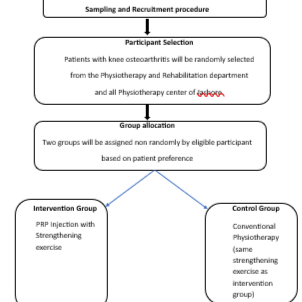
This protocol describes a randomized controlled trial to compare the effectiveness of platelet-rich plasma (PRP) injections combined with strengthening exercises versus conventional physiotherapy in patients with knee osteoarthritis (Kellgren–Lawrence grade I–III). Sixty participants aged 40–70 years will be randomly assigned to receive either three PRP injections spaced 10 days apart followed by a structured strengthening exercise program, or a conventional physiotherapy program, over an 8-week intervention period with follow-up at 6 months.
The study is expected to show that PRP with strengthening exercises provides greater reductions in pain and improvements in physical function, range of motion, muscle strength, and mobility compared to conventional physiotherapy. Findings may inform evidence-based rehabilitation strategies and improve outcomes for knee osteoarthritis patients in clinical practice.

Guidelines
Guidelines for Protocol Execution
- Setting & Oversight: Single-center RCT at JUST, randomization via computer-generated sequence, allocation concealed in sealed envelopes.
- Blinding: Outcome assessors blinded; full blinding of participants/clinicians not possible due to PRP injections.
- Training: PRP by trained orthopedic specialists; exercises by certified physiotherapists; assessors trained in NPRS, WOMAC, Goniometer, 30s-STS, TUG.
- Screening: Include age 40–70, KL grade I–III knee OA, symptoms >3 months (NPRS ≥3). Exclude infection, coagulopathy, uncontrolled diabetes, recent injections/surgery.
- Interventions:
- Control: 8-week conventional physiotherapy, 3×/week (50 min).
- Experimental: Three PRP injections (4-5 ml PRP , 10 days apart) + strengthening exercise program.
- Assessments: Baseline, 8 weeks, 6 months – NPRS, WOMAC, ROM, 30s-STS, TUG by blinded assessors.
- Data Management: CRFs, secure password-protected database, weekly quality audits.
Materials
Materials
1. PRP Injection
- Blood collection: 30 ml syringes, CPDA/PT tubes, 21G butterfly needles, alcohol swabs, gloves, tourniquets
- PRP preparation: Centrifuge, 10 ml tubes.
- Injection: 10 ml syringes, povidone-iodine, bandages
2. Strengthening Exercises
- Equipment: Plinths/chairs, resistance bands, dumbbells (1–3 kg), mats, pillows/bolsters
- Instructional: Printed guides, home exercise diaries
- Monitoring: Timer, attendance logs
3. Outcome Assessments
- Pain: NPRS
- Function & mobility: WOMAC, Goniometer, 30s-STS, TUG
4. Data Management
- Forms: Data collection forms (NPRS, WOMAC, Goniometer, 30s-STS, TUG), adverse event forms.
Storage: Computer with database software, external hard drive/secure cloud, secure filing cabinet.
5. Safety & Emergency
- Sharps container, first aid kit, resuscitation kit, disinfectants, emergency contacts
6. Participant Materials
- Consent forms and study information sheets (English/Bengali)
Protocol references
1. Bricca A, Juhl CB, Steultjens M, et al. Impact of exercise on articular cartilage in people at risk of, or with established, knee osteoarthritis: a systematic review of randomized controlled trials. Br J Sports Med. 2019;53(15):940–947. doi: 10.1136/bjsports-2017-098661.
2. Raeissadat SA, Ghazi Hosseini P,Bahrami MH, Salman Roghani R, Fathi M, Gharooee Ahangar A, Darvish M. The comparison effects of intra-articular injection of Platelet Rich Plasma (PRP), Plasma Rich in Growth Factor (PRGF), Hyaluronic Acid (HA), and ozone in knee osteoarthritis; a one year randomized clinical trial. BMC Musculoskelet Disord.2021 Feb 3;22(1):134. doi: 10.1186/s12891-021-04017-x.
3. 1.Sadeghi, A., Rostami, M., Khanlari, Z., Zeraatchi, A., Jalili, N., Karimi Moghaddam, A., Karimi Moghaddam, Z., Fallah, R., & Sangtarash, F. (2023). Effectiveness of muscle strengthening exercises on the clinical outcomes of patients with knee osteoarthritis: A randomized four-arm controlled trial. Caspian journal of internal medicine, 14(3), 433–442.
4. Sadeghi A, Rostami M, Khanlari Z, Zeraatchi A, Jalili N, Karimi Moghaddam A, Karimi Moghaddam Z, Fallah R, Sangtarash F. Effectiveness of muscle strengthening exercises on the clinical outcomes of patients with knee osteoarthritis: A randomized four-arm controlled trial. Caspian J Intern Med. 2023 Summer;14(3):433-442. doi: 10.22088/cjim.14.3.433.
5. Cui A, Li H, Wang D, Zhong J, Chen Y, Lu H. Global, regional prevalence, incidence and risk factors of knee osteoarthritis in population-based studies. EClinicalMedicine. 2020 Nov 26;29-30:100587. doi: 10.1016/j.eclinm.2020.100587.
6. Conaghan PG, Cohen SB, Berenbaum F, Lufkin J, Johnson JR, Bodick N. Brief Report: A Phase IIb Trial of a Novel Extended-Release Microsphere Formulation of Triamcinolone Acetonide for Intraarticular Injection in Knee Osteoarthritis. Arthritis Rheumatol. 2018 Feb;70(2):204-211. doi: 10.1002/art.40364.
7. O'Connell, B., Wragg, N. M., & Wilson, S. L. (2019). The use of PRP injections in the management of knee osteoarthritis. Cell and tissue research, 376(2), 143–152. https://doi.org/10.1007/s00441-019-02996-x
8. Zhao, J., Huang, H., Liang, G., Zeng, L. F., Yang, W., & Liu, J. (2020). Effects and safety of the combination of platelet-rich plasma (PRP) and hyaluronic acid (HA) in the treatment of knee osteoarthritis: a systematic review and meta-analysis. BMC musculoskeletal disorders, 21(1), 224. https://doi.org/10.1186/s12891-020-03262-w
9. Zhang, Y., & Jordan, J. M. (2010). Epidemiology of osteoarthritis. Clinics in geriatric medicine, 26(3), 355–369. https://doi.org/10.1016/j.cger.2010.03.001
10. Farrar, J. T., Young Jr, J. P., LaMoreaux, L., Werth, J. L., & Poole, R. M. (2001). Clinical importance of changes in chronic pain intensity measured on an 11-point numerical pain rating scale. Pain, 94(2), 149-158.
Acknowledgements
Acknowledgements
We express our gratitude to the Department of Physiotherapy & Rehabilitation (PTR) at Jashore University of Science and Technology for partial funding and providing facilities for this study. We also acknowledge the anticipated contributions of the orthopedic specialists, certified physiotherapists, and the research team for their expertise in implementing this protocol.