Apr 20, 2026
PIA-PINK Immunoassay for poly-histidine tagged proteins
- Katja Werner1
- 1PiNa-Tec Katja Werner
- Katja Werner: Founder
- PiNa-Tec Katja Werner



Protocol Citation: Katja Werner 2026. PIA-PINK Immunoassay for poly-histidine tagged proteins. protocols.io https://dx.doi.org/10.17504/protocols.io.81wgbjen3vpk/v1
License: This is an open access protocol distributed under the terms of the Creative Commons Attribution License, which permits unrestricted use, distribution, and reproduction in any medium, provided the original author and source are credited
Protocol status: Working
We use this protocol and it's working
Created: April 19, 2026
Last Modified: April 20, 2026
Protocol Integer ID: 315309
Keywords: immunoassay, western blot, dot blot, ELISA, protein-protein interaction, antibody, polyhistidine protein, pink immunoassay, high precision of this immunoassay, based immunoassay, tagged protein, histidine, next steps in purification, purification, time immunoassay
Abstract
This real-time immunoassay uses PIA-PINK-His to visually and quantitatively detect polyhistidine proteins.
This particle-based immunoassay streamlines the process by eliminating many steps required by outdated protocols.
The rapid results and high precision of this immunoassay allow researchers to base their next steps in purification or extraction on robust data analysis and make informed decisions.
Image Attribution
Created in Microsoft PowerPoint
Materials
Any immunoassay membrane, like cellulose nitrate or PVDF
PIA-PINK-His COMFORT PiNa-Tec.
incubation tray
lab shaker
Troubleshooting
Problem
no signal on positie control
Solution
Incrase/elongate wahing seps to remove unbound target protein before adding the staining solution
Dilute the sample
Preparation
Transfer protein samle onto an immunoassay membrane
The assay is suitable for
* Western Blots,
* Dot Blots or Slot Blots and
* Protein-protein interaction assays (similar to membrane based ELISA)
Take the PIA-PINK-Kit out of the fridge and allow it to equiibrate to room-temperature
PIA-PINK Immunoassay
Blocking of remaining binding sites as well as washing out access protein
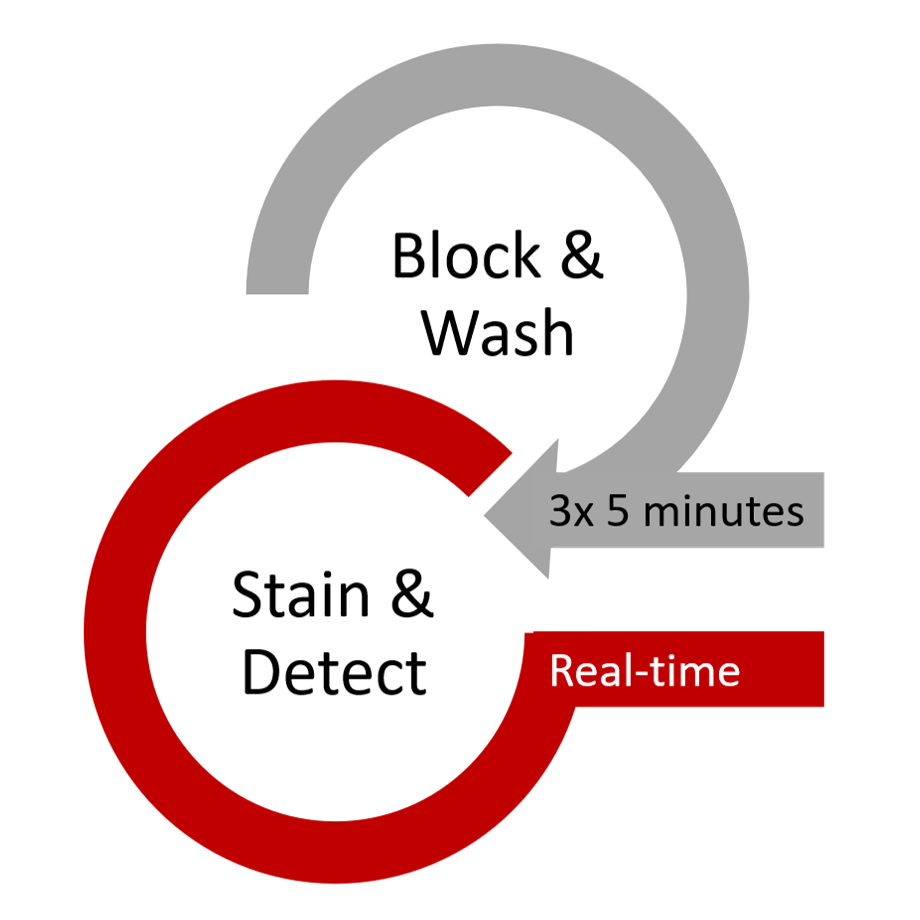
Place the membrane into a clean tray of suitable size, cover it with PIA-PINK-BLOCK solution and shake it strongly for 5 Minutes. Exchange blocking solution twice.
Imunostaining
Discard the solution from the last blocking/washing step and cover the membrane with PIA-PINK-HIS staining solution instead. Shake the membrane until the positive control sample shows sufficiently strong pink-red signal.
Binding of the Nanogold labelled antibody to the target antigen is visible and quantitative. The accumulation of the immunobound nanogold increases until all accessible binding sites are found.
The signal intensity is dependent on the target amount, the result is quantitative and can be analysed with any image quantification software.
You can stop and continue the staining process any time by removing the membrane out of the staining solution. If you wat to take pictures, best practice is to dry the membrane, as this enhances the signal to noise ration of the signal.
You can store the membrane in you lab book and fix it with clear tape, if you want to.