Jul 25, 2025
Phytochemical Screening
- Brian Andrich Pollo1,
- Paolo Robert Bueno2,1,
- Gracia Fe Budoy Yu1
- 1Department of Biochemistry and Molecular Biology, College of Medicine, University of the Philippines Manila;
- 2Department of Pharmaceutical Sciences, College of Pharmacy, University of the Philippines Manila



Protocol Citation: Brian Andrich Pollo, Paolo Robert Bueno, Gracia Fe Budoy Yu 2025. Phytochemical Screening. protocols.io https://dx.doi.org/10.17504/protocols.io.bp2l6zb85gqe/v1
Manuscript citation:
License: This is an open access protocol distributed under the terms of the Creative Commons Attribution License, which permits unrestricted use, distribution, and reproduction in any medium, provided the original author and source are credited
Protocol status: Working
We use this protocol and it's working
Created: July 24, 2025
Last Modified: August 10, 2025
Protocol Integer ID: 223148
Keywords: Phytochemical analysis, Secondary metabolites, Plant extracts, Alkaloids, Screening assays, phytochemical screening phytochemical screening, detection of bioactive compound, primary metabolite detection, bioactive compound, flavonoid, phytochemical class, anthraquinone glycosides via bornträger, targeted phytochemical class, medicinal plant, anthraquinone glycoside, secondary metabolite, phytopharmaceutical research in natural medicine discovery, compounds such as phenol, cyanogenic glycoside, alkaloid, tannin, natural medicine discovery, department of biochemistry, phytopharmaceutical research, picrate assay, assays for protein, natural product research, color reaction, derived compound, assay, coumarin, sodium picrate assay, multiple biosynthetic pathway, carbohydrate, biochemistry
Funders Acknowledgements:
DOST-PCHRD
Grant ID: IDC211
Abstract
Phytochemical screening is a foundational approach in natural product research, enabling the detection of bioactive compounds in medicinal plants. This protocol outlines a systematic qualitative analysis conducted by the Department of Biochemistry and Molecular Biology, College of Medicine, University of the Philippines Manila. Tests were performed to identify both primary and secondary metabolites, using classical and modified methods based on color reactions and precipitate formation.
Primary metabolite detection included assays for proteins (Ninhydrin, Biuret, and Xanthoproteic tests) and carbohydrates (Benedict’s, Fehling’s, Molisch’s, and Seliwanoff’s tests), confirming presence through colorimetric changes. Secondary metabolites were examined through multiple biosynthetic pathways. The acetate pathway was assessed for anthraquinone glycosides via Bornträger and Shouteten reactions. Shikimate pathway-derived compounds such as phenols, tannins, flavonoids, and coumarins were confirmed using ferric chloride, lead acetate, gelatin precipitation, and Shinoda tests. Terpenes and steroids were detected through Salkowski and Liebermann-Burchard tests, aligned with the mevalonate pathway.
Alkaloids were identified using five classical reagents (Mayer’s, Wagner’s, Dragendorff’s, etc.), while cyanogenic glycosides were confirmed through sodium picrate assays. Saponins and cardiac glycosides were verified using frothing and Keller-Killiani tests, respectively. Results were interpreted based on color development or precipitate formation, confirming the presence of targeted phytochemical classes.
This protocol provides a robust, reproducible framework for plant extract analysis, supporting future pharmacognostic, pharmacologic, or phytopharmaceutical research in natural medicine discovery.
Attachments

1. Proteins and amino acids
Use albumin as positive control.
Ninhydrin test: To 0.5 mL of the sample, add 1-2 drops of 0.25% (w/v) Ninhydrin reagent. Mix and heat to boiling for 1-2 minutes. (+) Development of purple-blue or blue color (Oser, 1966, p. 181; Cabatit, 1988, p. 142; Bettelheim and Landesberg, 2000, p. 456) or deep violet / Ruhemann’s purple (Wade, 1991, p. 111).
Biuret test: To 0.5 mL of the sample, add 0.5 mL of 10% NaOH. Add 0.5% CuSO4 dropwise. (+) Development of blue color (Oser, 1966, p. 179), pink color (Oser, 1966, p. 179), purplish violet or pinkish-violet color (Oser, 1966, p. 179; Abaya, et al, 1980, p. 55), rose pink to violet to purple color (Cabatit, 1988, p. 142; Bettelheim and Landesberg, 2000, p. 455). Formation of copper-potassium-biuret compound (cupripotassium biuret or biuret potassium cupric hydroxide) from compounds containing 2 carbamyl (-CONH2) groups joined either directly together or through a single atom (e.g., nitrogen).
Xanthoproteic test: To 0.5 mL of the sample, add 0.25 mL of concentrated nitric acid. Heat carefully under the hood and observe whether the nitration of the benzene ring of tyrosine and/or tryptophan occurs.
2. Carbohydrates
Use 10% glucose as positive control for Fehling’s test and Molisch’s test. Use 10% fructose as positive control for Seliwanoff’s test.
Benedict’s test for reducing substances: To 0.5 mL of sample, add 0.5 mL of Benedict’s reagent. Heat (boiling water bath, 2 min). (+) brick red precipitate (but color may range from green, yellow, orange to brick red). Cu2O formation under basic conditions via the reduction of Cu2+ to Cu^+^ and oxidation of reducing substances (e.g., reducing sugars).
Fehling’s test for reducing substances: Boil (in a boiling water bath) 1 mL of sample with 1 mL each of Fehling’s solutions A and B. (+) brick red precipitate (but color may range from green, yellow, orange to brick red). Cu2O formation under basic conditions via the reduction of Cu2+ to Cu^+^ and oxidation of reducing substances (e.g., reducing sugars).
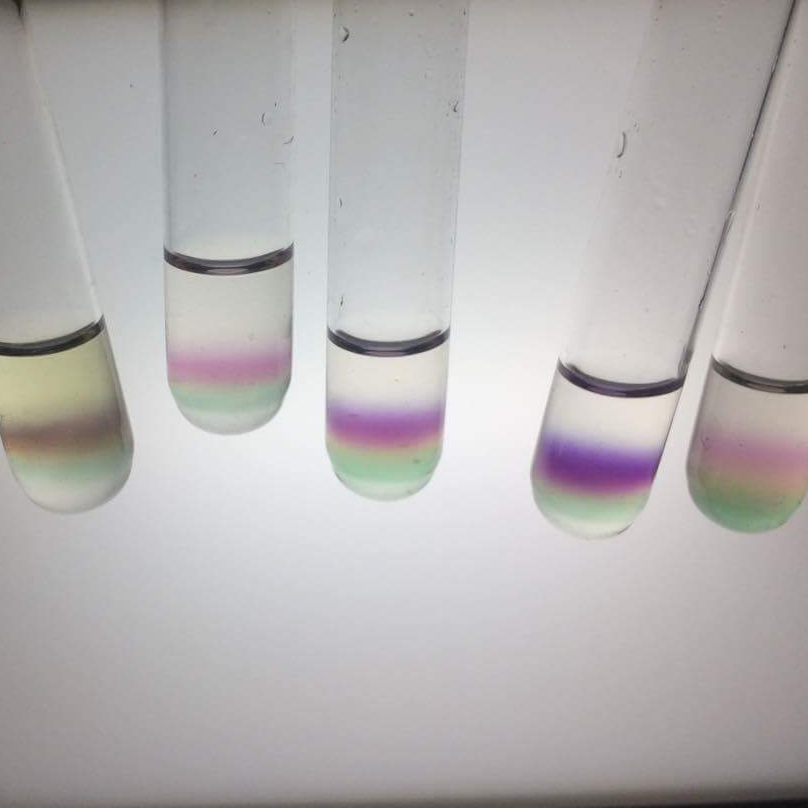
Molisch’s test for carbohydrates: To 2 mL of sample, add 1 mL 1% α-naphthol 95% ethanol. Add concentrated H2SO4, slow down the sides of the tube. (+) Purple ring at the junction of two liquids (Nucum and Santiago, 2005, p. 36). Violet ring at the junction of two liquids (Cabatit, 1988, p. 65).
Seliwanoff’s test for ketoses: To 1 mL of sample previously diluted with an equal amount of distilled water, add a crystal of resorcinol. Add 1 mL conc. HCl then heat on a boiling water bath for 1 minute. Continue heating and observe the color change at one minute intervals for 4 minutes. (+) bright cherry red coloration (Nucum and Santiago, 2005, p. 36; Cabatit, 1988, p. 88). The furfural derivative further undergoes condensation with resorcinol.
3. Anthraquinone glycosides
Use rutin hydrate as positive control.
Hydrochloric acid test: To 1mL of sample, add few drops of 2% HCl. (+) red precipitate. Precipitation of anthraquinones.
Bornträger test (Free anthraquinone test): To 2mL of sample, add 3mL each of chloroform and ammonia TS (10%). (+) formation of rose-pink to cherry red color. Extraction of anthraquinones with chloroform, and subsequent washing of the aqueous layer with ammonia. (Evans, 2009)
Modified Bornträger test: Evaporate 5mL of sample to dryness in water bath. Add a mixture of 10mL 5% FeCl3 and 5mL conc. HCl. Heat (water bath, 10min). Filter, then shake the filtrate with 10mL chloroform and 5mL ammonia TS (10%). (+) formation of rose-pink to cherry red color. Oxidative hydrolysis to release anthraquinones. Extraction of anthraquinones with chloroform. (Evans, 2009)
Shouteten reaction: To about 1g of concentrated sample, add 20mL boiling water and shake. Cool and add 1g talc. Add 0.25g borax, then heat. Dilute 2mL of the heated solution with water to make 20mL. View under long wavelength (365nm) UV light. (+) yellowish green which fluoresce. Strong greenish fluorescence is exhibited in the presence of borax by anthranols, which are readily formed from anthrones by isomerism. (Evans, 2009)
4. Plant Acids
Use 2% HCl as positive control.
To 1mL of sample, add 1mL NaHCO3 solution. (+) Dense stable froth. | Neutralization to release CO2.
5. Phenols
Use gallic acid as positive control.
Ferric chloride test: To 1mL of sample, add few drops of 5% FeCl3 solution. (+) Formation of bluish-black or green color. | Complex formation.
Lead acetate test: To 1mL of sample, add 3mL 10% Pb(CH3COO)2 solution. (+) Bulk white precipitate. | Formation of insoluble lead salts.
6. Quinones
Sulfuric acid test: To 1mL of sample, add 1mL conc. H2SO4. (+) Formation of red color.
7. Tannins and phenolic glycosides
Use catechin as positive control.
Ferric chloride test: To 1mL of sample, add 0.25mL of 5% FeCl3. (+) Formation of blue (hydrolysable tannins) or green (condensed tannins) color. | Complex formation of Fe3+ with phenolic moieties.
Gelatin test: To 1mL of sample, add 1% gelatin solution containing 10% NaCl. (+) jelly precipitate. | Gelatin precipitates under the cross-linking action of tannins.
8. Coumarins
Alkaline reagent test: To 1mL of sample, add 1mL 10% NaOH. (+) formation of yellow color.
9. Flavonoids
Use quercetin as positive control.
Alkaline reagent test: To 1mL of sample, add few drops of 20% NaOH. Then, add few drops of dil. HCl. (+) Formation of intense yellow color upon addition of base, and turns colorless upon addition of acid. | pH-dependent color changes.
Shinoda test for flavones and flavonols: To 1mL of sample, add few Mg turnings and few drops of conc. HCl. (+) Formation of pink, scarlet, crimson red, or, occasionally, green to blue color. | Reduction of the flavonoid to an anthocyanidin, with the metal acting as electron donor and the acidic condition to provide a supply of protons.
Lead acetate test: To 1mL of sample, add few drops of Pb(CH3COO)2 solution. (+) white to yellow precipitate. | Precipitation as lead salts.
Alkaline reagent test for cyanins: To 1mL of sample, add 0.5mL 2M NaOH. Heat (5min, 100°C). (+) formation of bluish green color (anthocyanin) or formation of yellow color (betacyanin). | pH-dependent color changes of cyanins.
10. Terpenes and terpenoids
Copper acetate test for diterpenes: To 1mL of sample, add 3-4 drops Cu(CH3COO)2 solution. (+) formation of emerald green color.
Salkowski’s test for triterpenes: To 1mL of sample, add 2mL chloroform and few drops of concentrated H2SO4. Shake and let stand. (+) formation of golden yellow color. | Oxidation to yield a colored derivative.
Salkowski’s test for terpenoids: To 1mL of sample, add 2mL chloroform. Then, add 3mL of concentrated H2SO4 slowly, down the sides of the tube. (+) formation of reddish brown coloration at the interphase. | Oxidation to yield a colored derivative.
11. Steroids and phytosterols
Liebermann-Burchard test for unsaturated sterols (acetic anhydride-sulfuric acid test): To 1 mL of sample, add a few drops of acetic anhydride. Then, add 1 drop conc. H2SO4. (+) Reddish brown ring at the junction, which may turn into green, blue, or purple. Red to blue to bluish green color. Lilac color gradually turning to blue and then finally to emerald green color (Nucum and Santiago, 2005, p. 55; Cabatit, 1988, p. 118). Pink color then to lilac and finally to deep green (Bettelheim and Landesberg, 2000, p. 429).
12. Saponins and sapogenins
Use saponin standard (from quillaja bark) as positive control.
Froth test for saponins: Dilute 2.5mL sample to 10mL with distilled water. Shake vigorously (2min). (+) Honeycomb froth 3cm stable for at least 30 min. | Reduction of surface tension as a consequence of the amphiphilic nature of saponins.
Cholesterol crystallization test for saponins and sapogenins: To 5mL of sample, add few drops of saturated alcoholic solution of cholesterol (+) crystal formation.
13. Cardiac glycosides
Use rutin hydrate as positive control.
Salkowski’s test (Sulfuric acid test): To the concentrated sample, add 0.5mL each of chloroform and H2SO4. (+) chloroform layer: bluish red to cherry red and purple solution; acid layer: green fluorescence (Cabatit, 1988, p. 105). Oxidation yields a red-colored derivative (λmax 560nm). (Evans, 2009)
Baljet test: Combine 1mL each of 1% picric acid in ethanol and NaOH TS. Add a small amount of evaporated sample. (+) formation of yellow to orange color. The butenolide moiety forms a red color (λmax 495nm) with alkaline sodium picrate reagent. (Evans, 2009)
Legal test: Dissolve a small amount of the solid sample in 2-3 drops pyridine. Add 1 drop 0.5% recently prepared sodium nitroprusside. Then add 4 drops 0.2N NaOH. (+) formation of red color. The butenolide moiety forms a red color (λmax ~470nm) with sodium dinitroprusside. (Evans, 2009)
Keller-Killiani test: To 1mL of sample, add 3mL ferric chloride reagent, and shake. Then, add 1mL H2SO4 slowly, down the sides of the tube. (+) formation of a reddish-brown layer at the junction of the two liquids and the upper layer slowly becomes bluish-green, darkening with standing (Evans, 2009). Specific for deoxysugars (e.g., digitoxose). The sugar dissolves in acetic acid with a trace of FeCl3, and transferred at the surface of H2SO4. (Evans, 2009)
14. Alkaloids
Use reserpine as positive control.
To about 4mL of sample, add sufficient 1% HCl until acid to litmus. Divide this into 4, and add the following reagents along the sides of the tube:
Mayer’s test: Mayer’s reagent (mercuric-potassium iodide TS). (+) white or creamy precipitate.
Valser’s test: Valser’s reagent (mercuric iodide TS). (+) white precipitate.
Wagner’s test: Wagner’s reagent (iodine in potassium iodide TS). (+) reddish brown precipitate.
Hager’s test: Hager’s reagent (saturated solution of picric acid in water). (+) yellow precipitate.
Dragendorff’s test: Dragendorff’s reagent (bismuth potassium iodide TS). (+) orange-red to red precipitate.
15. Cyanogenic glycosides
Grignard’s test (Sodium picrate test): Moisten a strip of filter paper with 10% aqueous picric acid, drain then dip into 10% Na2CO3, then drain again. Trap this strip with a cork in a 10-mL test tube containing a small amount of the sample. (+) brown-red coloration in the filter paper.
Protocol references
BETTELHEIM, F.A. and LANDESBERG, K.M., 2000. Laboratory Experiments for Introduction to General, Organic and Biochemistry. 4th ed. Harcourt College Publication, 429-436.
CABATIT, B.E., 1988. Biochemistry. 12th ed. Manila, UST Press, 103-105 and 118.
DEWICK, P.M., 2009. Medicinal Natural Products: A Biosynthetic Approach, 3rd ed. USA: John Wiley and Sons.
EVANS, W.C., 2002. Trease and Evans’ Pharmacognosy. 15th edition. London: W.B. Saunders, 223, 336, 354, 388
MERCK & COMPANY INCORPORATED. 2001. The Merck Index. [CD-ROM]. 13th edition. New Jersey, USA: Whitehouse station.
NUCUM, Z.T. and SANTIAGO, L.E.A., 2005. Laboratory Manual for Biochemistry. Manila, Quezon City: C&E Publishing, Inc. 53-55.
OSER, B.L., 1966. Hawk’s Physiological Chemistry. New York: McGraw-Hill Book Company, 119-120, 122 and 125.
PAVIA, D.L., 1976. Introduction to Organic Laboratory Techniques. Philadelphia: W.B. Saunders Company, 115.
PRASAD, M.P., SHEKHAR, S. & AMIT, B., 2012. Phytochemical Analysis and Antioxidant potential of Piper species and its Molecular Characterization by RAPD Markers, International Journal of Fundamental & Applied Sciences, vol.I, no.4, pp. 71-74.
SVEHLA, G., PhD. 1996. Vogel’s Qualitative Inorganic Analysis. 7th edition. England: Longman Group Limited, 85, 164
TYLER, V.E., BRADY, L.R., and ROBBERS, J.E., 1988. Pharmacognosy. 9th edition. Philadelphia: Lea & Febiger, 187.