May 22, 2026
Phenotyping mice for Prox1-eGFP transgene expression
- Sylvia Masala1,
- Amy Rivers1,
- Simon Cleary1
- 1King's College London



Protocol Citation: Sylvia Masala, Amy Rivers, Simon Cleary 2026. Phenotyping mice for Prox1-eGFP transgene expression. protocols.io https://dx.doi.org/10.17504/protocols.io.dm6gp74m8gzp/v1
License: This is an open access protocol distributed under the terms of the Creative Commons Attribution License, which permits unrestricted use, distribution, and reproduction in any medium, provided the original author and source are credited
Protocol status: Working
This protocol works well and is currently used at King's College London and by other groups at UCSF.
Created: May 22, 2026
Last Modified: May 22, 2026
Protocol Integer ID: 317761
Keywords: phenotyping, GFP, nightsea, flashlight, torch, fluorescent reporter mouse line, genotype as fluorescent protein expression, egfp transgene expression, phenotyping mice, fluorescent protein expression, egfp line, modified mice, genotyping after use, determining genotype, based genotyping, phenotyping protocol enable, mice, using polymerase chain reaction, vascular structures in the eye
Funders Acknowledgements:
Academy of Medical Sciences Springboard grant
Grant ID: SBF0010\1170
Abstract
Genetically modified mice typically require genotyping using polymerase chain reaction (PCR)-based methods. In some fluorescent reporter mouse lines, for example the Prox1-eGFP line (1), PCR-based methods are not essential for determining genotype as fluorescent protein expression can be visually assessed. The following phenotyping protocol enables rapid, inexpensive and restraint-free testing for Prox1-eGFP transgene expression (2,3). Similar approaches can be used to test for inheritance of other modified alleles that label vascular structures in the eyes (4). Alongside speed and environmental sustainability advantages, a one-time flashlight system purchase becomes more cost efficient than PCR-based genotyping after use for phenotyping approximately 50 mice.
Guidelines
- Only briefly shine the flashlight directly at the eyes of mice. Prolonged, direct exposure to the flashlight beam can activate the pupillary light reflex, potentially causing Prox1-eGFP mice to falsely test negative for transgene expression.
- If there is uncertainty about the phenotype of a mouse, leave the mouse being tested in a dark place, assess signal from known wild-type and Prox1-eGFP controls, then retest.
- This method is only suitable for distinguishing wild-type mice from carriers of fluorescent alleles. For discrimination of heterozygous versus homozygous expression of modified alleles, PCR-based testing or more quantitative phenotyping approaches are required (4).
Materials
- Xite fluorescence flashlight system, royal blue with green-only bandpass filter glasses (Nightsea, Cat# XITE-RB-GO).
- Spare clean cage.
- Known Prox1-eGFP carrier and wild-type control for validation (recommended).
Steps
Dim lights as much as possible in testing area and prepare items needed
(Figure 1).
Figure 1. Set up of flashlight, glasses, and
clean mouse cage.
Put on filter glasses and remove cap from flashlight.
Place mouse to be tested in clean cage.
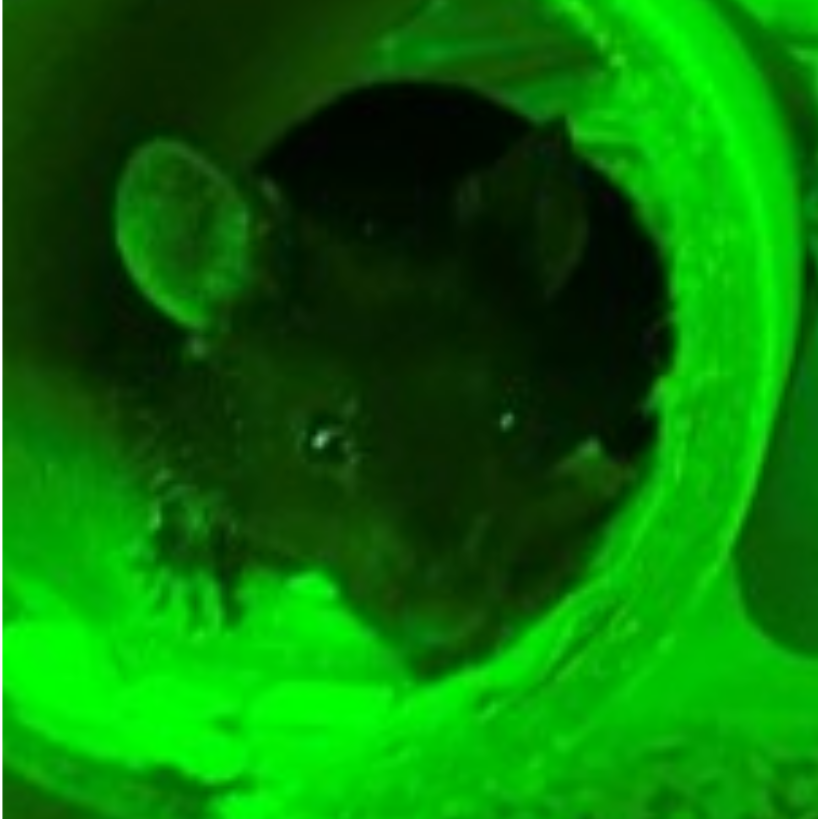
Turn on flashlight and scan from side to side, looking for bright points of light coming from eyes as the flashlight beam hits the eyes of the mouse being tested
(Figure 2).
Figure 2. Example images of a wild-type mouse and
heterozygous carriers of the Prox1- eGFP transgene. Note: fluorescent signal appears stronger by eye.
Guidelines and warnings
Only briefly shine the flashlight directly at the eyes of mice. Prolonged, direct exposure to the flashlight beam can activate the pupillary light reflex, potentially causing Prox1-eGFP mice to falsely test negative for transgene expression.
If there is uncertainty about the phenotype of a mouse, leave the mouse being tested in a dark place, assess signal from known wild-type and Prox1-eGFP controls, then retest.
This method is only suitable for distinguishing wild-type mice from carriers of fluorescent alleles. For discrimination of heterozygous versus homozygous expression of modified alleles, PCR-based testing or more quantitative phenotyping approaches are required.
Protocol references
1. Choi I, Chung HK, Ramu S, Lee HN, Kim KE, Lee S, et al. Visualization of lymphatic vessels by Prox1-promoter directed GFP reporter in a bacterial artificial chromosome-based transgenic mouse. Blood. 2011 Jan 6;117(1):362–5. doi:10.1182/blood-2010-07-298562
2. Baluk P, Naikawadi RP, Kim S, Rodriguez F, Choi D, Hong YK, et al. Lymphatic Proliferation Ameliorates Pulmonary Fibrosis after Lung Injury. The American Journal of Pathology. 2020 Dec;190(12):2355–75. doi:10.1016/j.ajpath.2020.08.018
3. Cleary SJ, Qiu L, Seo Y, Baluk P, Liu D, Serwas NK, et al. Intravital imaging of pulmonary lymphatics in inflammation and metastatic cancer. J Exp Med. 2025 May 5;222(5):e20241359. doi:10.1084/jem.20241359
4. Cornett JC, Landrette SF, Xu T. Characterization of Fluorescent Eye Markers for Mammalian Transgenic Studies. Götz J, editor. PLoS ONE. 2011 Dec 28;6(12):e29486. doi:10.1371/journal.pone.0029486