1Simpson Querrey Institute for Epigenetics, Department of Medicine/Biochemistry and Molecular Genetics, Feinberg School of Medicine, Northwestern University, Chicago, IL 60611, USA;
2Simpson Querrey Institute for Epigenetics, Department of Biochemistry and Molecular Genetics, Feinberg School of Medicine, Northwestern University, Chicago, IL 60611, USA
Aoi Y, Shah AP, Ganesan S, Soliman SHA, Cho BK, Goo YA, Kelleher NL, Shilatifard A (2022). SPT6 functions in transcriptional pause/release via PAF1C recruitment.
Aoi Y, Takahashi YH, Shah AP, Iwanaszko M, Rendleman EJ, Khan NH, Cho BK, Goo YA, Ganesan S, Kelleher NL, Shilatifard A (2021). SPT5 stabilization of promoter-proximal RNA polymerase II.
License: This is an open access protocol distributed under the terms of the Creative Commons Attribution License, which permits unrestricted use, distribution, and reproduction in any medium, provided the original author and source are credited
Protocol status: Working
We use this protocol and it's working
Created: August 08, 2025
Last Modified: August 11, 2025
Protocol Integer ID: 224290
Keywords: nuclei, mammalian, cell culture, immunoprecipitation, IP, chromatin, RNA Polymerase II, Pol II, proteomics, purification, transcription, elongation, purification, benzonase, CTD, PEACh, SPT5, SPT6, NELF, ARMC5, RPB1, biochemistry, antibody, magnetic bead, sucrose cushion, RNAPII, mass spectrometry, IP-MS, PAF1, transcription elongation factor, vivo functions of transcription elongation factor, chromatin solubilization via enzymatic digestion, purifying elongation complex with associated factor, factors from native chromatin, rna polymerase ii elongation complex, following chromatin solubilization, purifying elongation complex, native chromatin, chromatin, proteomic analysis, quality nuclei from mammalian cell culture, rna polymerase ii, nucleic acid, interacting protein, enzymatic digestion, purification, protocol for purification, mammalian cell culture, nuclei
Funders Acknowledgements:
National Cancer Institute
Grant ID: R35-CA197569
Abstract
Here we provide a protocol for purification of RNA Polymerase II elongation complex with associated factors from native chromatin. To isolate high-quality nuclei from mammalian cell culture, adherent cells are lysed directly on a cell culture plate and nuclei are separated from cytoplasmic and other fractions by centrifugation and sucrose cushion. Nuclei can be stored in a freezer. Following chromatin solubilization via enzymatic digestion of nucleic acids, RNA Polymerase II and interacting proteins are enriched using antibody-conjugated magnetic beads. An elution fraction can be used for western blot and proteomic analysis. This method is particularly useful when combined with rapid depletion systems (e.g. auxin-inducible degron/AID, dTAG, PROTAC) to study in vivo functions of transcription elongation factors, including SPT5, SPT6, PAF1, and NELF.
Guidelines
The brief workflow of this protocol:
Day1: Nuclei isolation (2h)
Day2: Purification (~6h)
- Chromatin digestion (2.5h)
- Immunoprecipitation (1.5h)
- Wash and elution (1.5h)
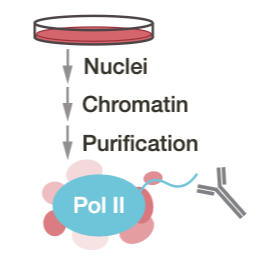
PEACh workflow: A schematic of the workflow of PEACh experiment. Cells (e.g. SPT5-AID) are treated with auxin for rapid depletion of AID-tagged proteins (this rapid depletion step using AID, dTAG, PROTAC, or other systems is optional, but highly recommended.). Nuclei are isolated and can be stored at –80°C.
A chromatin fraction that contains RNA Polymerase II (Pol II) elongation complex is generally insoluble. To solubilize chromatin, benzonase nuclease is used to digest nucleic acid (DNA and RNA). The solubilized chromatin fraction is then used for immunoprecipitation to purify Pol II elongation complex with associated elongation factors. The elution fraction can be used for the subsequent mass spectrometric analysis.
Experimental design:
Cells:
The use of a rapid depletion system is highly recommended: Auxin-inducible degron (AID), dTAG, PROTAC, or other systems can be used to rapidly and specifically degrade a protein of interest within a few hours inside the cells. A minimum of two conditions (e.g. with and without depletion) with four biological replicates are generally required to obtain high-quality and reproducible proteomic data.
Proteomics:
The strategy of proteomic analysis can vary depending on proteomics cores. In our cases at IDeA National Resource for Quantitative Proteomics, briefly, enriched proteins are reduced, alkylated, and digested using filter-aided sample preparation. Peptides are then analyzed on Orbitrap Exploris with data-independent acquisition (DIA). Please see our recent paper for the detailed protocol regarding our proteomic analysis.
Sodium dodecyl sulfate (SDS) and Protease/Phosphatase inhibitors are toxic and they may cause skin/eye damage. Care should be taken when handling these reagents.
Before start
Cell culture: Prepare cells in a 15-cm plate at 80-90% confluency.
Buffers:
For Day1:
- Keep PBS in a cold room.
- Cool a centrifuge with swing buckets for 50-ml tubes to 4°C.
- Prepare buffers ~2h before starting nuclei isolation: Dissolve inhibitor tablets completely on nutator in cold room. Add DTT to the buffers. Keep working solutions on ice.
For Day2:
- Cool a centrifuge with a fixed-angle rotor for 1.5-ml tubes to 4°C.
- Preparation of inhibitor-containing chromatin digestion buffer:
a. Per 10 ml Chromatin digestion buffer,
b. Add 1 Protease inhibitor mini tablet EDTA-free (Thermo, Cat# A32955, 4°C)
c. Add 1 Phosphatase inhibitor mini tablet EDTA-free (Thermo, Cat# A32957, 4°C)
d. Incubate on nutator at 4°C for around 30 min until tablets get completely dissolved.
e. Thaw an aliquot of 1 M DTT (stock at −20°C) and add 5 μl 1 M DTT to Chromatin digestion buffer + inhibitors. Keep on ice.
- Preparation of Benzonase-containing chromatin digestion buffer:
a. Per 1 ml Chromatin digestion buffer + inhibitors + DTT,
b. Add 4 μl 250 U/μl Benzonase (Sigma, Cat# E1014-25kU, −20°C). Adjust the volume as needed.
c. Invert 5 times to mix. Keep on ice.
Note
Once cells are lysed, samples need to be chilled On ice or at 4 °C to minimize protein degradation during sample preparation.
Day1: Nuclei isolation (2h)
Move cell culture (15-cm plates) to a cold room.
Pour off media, then add 10 mL ice-cold PBS.
Note
Complete this step for all plates before starting the next step.
Wash with 10 mL ice-cold PBS again.
After the 2nd wash, tilt plates, then carefully discard the supernatant by aspirating with 10-ml pipette.
Add 7 mL Lysis buffer per plate.
Note
Complete this step for all plates before starting the next step.
Scrape and transfer cells to a 50-ml tube.
Add 2 mL lysis buffer to the plate. Collect and pool lysates. Total lysate = 9 mL
00:05:00 IncubationOn ice
800 x g, 4°C, 00:05:00 , Swinging bucket
Discard the supernatant by aspirating.
Note
Do not disturb the pellets.
Add 5 mL lysis buffer. Carefully resuspend the pellet with a wide-bore P1000 tip.
Layer nuclei suspension over 25 mL Sucrose Cusion in a 50-ml tube.
Note
Pipette slowly to add cushion under the nuclei suspension.
800 x g, 4°C, 00:20:00 , swinging bucket.
Note
If a large number of nuclei keep floating after the centrifuge, repeat this step.
Discard the supernatant.
Note
White debris may be floating in the cushion. Make sure to aspirate them.
Add 500 µL freeze buffer to the nuclei pellet. Carefully resuspend the pellet with a wide-bore P1000 tip. Transfer nuclei to a 1.5-ml Protein LoBind tube.
Snap freeze in liquid nitrogen.
Note
PAUSE POINT: Store the nuclei at -80 °C.
Day2: Chromatin digestion (2.5h)
See the "Before start" section above. Prepare the buffers and cool the centrifuge.
Thaw frozen nuclei on ice (~20 million nuclei/sample). On ice
500 x g, 4°C, 00:05:00
Discard the supernatant using pipette gently.
Resuspend in 1 mL ice-cold Benzonase-containing Chromatin digestion buffer.
Note
Use a wide-bore tip to pipet gently.
Incubate at 4 °C for 02:00:00 with rotation.
Note
During this incubation step, start beads-Ab preparation (see the section below). Also, heat and stir 6x SDS loading buffer at 80°C to dissolve SDS precipitates completely.
Add2 µL 0.5 M EDTA. Invert to mix.
Note
EDTA concentration can be increased up to 5 mM to inhibit metalloproteases. Note that >1 mM EDTA will also inhibit benzonase.
20000 x g, 4°C, 00:05:00.
Collect the supernatant in a new 1.5-ml Protein LoBind tube and keep on ice. On ice Also, keep the insoluble pellet on ice.
Note
Skip step 26 and go to step 27 when opting out the optional recovery from pellet.
(Optional recovery from pellet)
Resuspend the pellet in100 µL high-salt Chromatin digestion buffer + inhibitors + DTTthat contains 500 mM NaCl and 3 mM EDTA.
(Optional recovery from pellet)
Incubate at 4 °C for 00:30:00 with rotation
(Optional recovery from pellet)
Mix with 900 µL Chromatin digestion buffer + inhibitors + DTT that contains 3 mM EDTA to lower the salt concentration.
(Optional recovery from pellet)
Centrifuge 20000 x g, 4°C, 00:10:00. Mix the supernatant with the first soluble fraction and keep on iceOn ice . Also, keep the insoluble pellet on ice.
Take 25 μl sample from the soluble fraction as an input fraction. Keep on ice. On ice
For WB: Add equal volume (25 μl) of 2x SDS loading buffer to input soluble sample.
For WB: Resuspend insoluble pellets in 50 μl 2x SDS loading buffer.
For WB: Boil at 95 °C for 00:03:00. Then 20000 x g, Room temperature, 00:01:00. Store at -20 °C.
(Optional DNA analysis): Take another 25 μl input sample from the soluble fraction. Store at −20°C until needed.
(Optional DNA analysis): When analyzing DNA fragment size, add 1.25 µL 20 mg/ml Proteinase K to 25 μl input sample then mix well.
(Optional DNA analysis): Incubate at 55 °C for 02:00:00.
(Optional DNA analysis): Add 5.25 µL 6x loading buffer, purple. Analyze the DNA fragment size on 1.5% agarose gel with Gel Red.
Beads-Ab preparation (~30min)
Transfer 50 µL Dynabeads-Protein G to a 1.5-ml Protein LoBind tube.
Note
The volume is per sample; adjust the buffer volume as needed. Beads for up to 10 samples can be collected in a single tube as a bulk.
Place on a magnetic stand. Discard the supernatant, then resuspend in 1 mL Chromatin digestion buffer (no DTT, no inhibitors, no benzonase). 00:01:00 incubation Then place on a magnetic stand and discard the supernatant.
Resuspend beads in 100 µL Chromatin digestion buffer (no DTT, no inhibitors, no benzonase).
Note
The volume is per sample; adjust the buffer volume as needed.
The volume is per sample; adjust the antibody volume as needed.
Incubate at Room temperature for 00:30:00 with rotation.
Wash beads twice with 1 mL Chromatin digestion buffer (no DTT, no inhibitors, no benzonase) .
Resuspend in 50 µL Chromatin digestion buffer (no DTT, no inhibitors, no benzonase).
Note
The volume is per sample; adjust the buffer volume as needed.
Place on ice until use. On ice
Immunoprecipitation (1.5h)
Complete beads-Ab preparation (see the section above).
Add 50 µL Ab-conjugated beads to each 1 ml soluble chromatin fraction.
Note
When the optional recovery from pellet is performed, add 50 µL Ab-conjugated beads to 2 ml pooled soluble chromatin fraction in a 5-ml Protein LoBind tube.
Incubate at 4 °C for 01:30:00 with rotation.
Wash and Elution (1.5h)
Wash buffer preparation: Transfer 25 mL Chromatin digestion buffer (no DTT, no inhibitors, no benzonase) to a 50-ml tube and add 12.5 μl 1 M DTT. Invert to mix, then keep on ice. On ice
Freshly prepare 100 mM ammonium bicarbonate: Dissolve 316 mg ammonium bicarbonate in 40 mL H2O. Keep on ice. On ice
Place the sample tubes on a magnetic stand.
[Optional] Transfer 50 μl supernatant to a new 1.5-ml tube as a flow-through fraction.
Discard the supernatant and resuspend beads in 1 mL ice-cold chromatin digestion buffer (+DTT). Incubate at 4 °C for 00:01:00 with rotation. Place tubes on a magnet stand, then discard the supernatant.
Note
Do not let the beads dry out during wash steps.
Repeat wash 3 more times.
[Recommended for mass spectrometry] Wash beads with 1 mL freshly prepared, ice-cold 100 mM ammonium bicarbonate.
Note
This wash step will get rid of the detergent from the samples.
[Recommended for mass spectrometry] Repeat wash again with 100 mM ammonium bicarbonate for a total of two washes.
At the last wash, transfer the samples to a new 1.5 ml Protein LoBind tube.
After the last rotation for washing, briefly spin down then place samples on a magnet stand and bring to the bench at Room temperature.
Discard the supernatant carefully. Remove the remaining supernatant using P-10 tip from the bottom of the tube.
Note
Do not let the beads dry out during wash steps.
Resuspend beads in 60 µL Mild Elution buffer at Room temperature.
Note
The majority of co-immunoprecipitated proteins are eluted in this buffer. However, the beads partially retain the antibodies and its antigen (RPB1). This helps reduce the amount of co-eluted antibody.
Incubate at Room temperature for 00:15:00 with 1,100 rpm on a ThermoMixer.
Note
Make sure to use Protein LoBind tubes and close the lid tightly to avoid leaking. Alternatively, incubate the samples on the bench and flick the tube to mix every 5 minutes.
Briefly spin down, then place on a magnetic stand. Transfer 60 µL supernatant to a new 1.5-ml Protein LoBind tube.
Repeat elution from the beads then pool the two elution fractions. Briefly vortex to mix a pooled sample and spin down. Total elution volume = 120 µL.
Prepare two aliquots of 45 µL elution fraction in new 1.5-ml Protein LoBind tubes. Snap freeze in liquid nitrogen and store the samples at -80 °C. These samples are ready for sending to a proteomics core for analysis using mass spectrometry.
For WB/Gel analysis: Prepare 5x SDS loading buffer (+b-ME): Add 100 µL 2-Mercaptoethanol to 900 µL 6x SDS loading buffer. Mix by inverting tubes and spin down.
For WB/Gel analysis: Mix 30 µL elution fraction with 7.5 µL 5x SDS loading buffer.
For WB/Gel analysis: Resuspend the remaining bead in 50 µL 2x SDS loading buffer.
For WB/Gel analysis: [Optional] Add equal volume of 2x SDS loading buffer to the flow-through fration.
For WB/Gel analysis: Boil at 95 °C for 00:03:00. Then 20000 x g, Room temperature, 00:01:00. Store at -20 °C.
For WB/Gel analysis: Test each fraction for western blotting and Oriole gel staining analysis to validate purification. When thawing samples for WB/gel analysis, Boil at 95 °C for 00:03:00. Then 20000 x g, Room temperature, 00:01:00.
Citations
Aoi Y, Iravani L, Mroczek IC, Gold S, Howard BC, Shilatifard A. SPT5 regulates RNA polymerase II stability via Cullin 3-ARMC5 recognition.
Aoi Y, Shah AP, Ganesan S, Soliman SHA, Cho BK, Goo YA, Kelleher NL, Shilatifard A. SPT6 functions in transcriptional pause/release via PAF1C recruitment.
Aoi Y, Takahashi YH, Shah AP, Iwanaszko M, Rendleman EJ, Khan NH, Cho BK, Goo YA, Ganesan S, Kelleher NL, Shilatifard A. SPT5 stabilization of promoter-proximal RNA polymerase II.
We thank the Shilatifard Lab members for contributing to development and improvement of the protocol, I. C. Mroczek for critical reading, and S. G. Mackintosh for proteomic sample preparation advice.