Nov 23, 2023
PCR Amplification of Clock and Adcyap1 genes with EmeraldAmp® GT PCR Master Mix in Avian species for polymorphism elucidation
- Louis-Stéphane Le Clercq1,2,
- Desiré ee Dalton3,
- Antoinette Kotzé1,2,
- Paul Grobler1
- 1University of the Free State;
- 2South African National Biodiversity Institute;
- 3Teesside University
- Biological clock measures the association between the circadian and epigenetic clock as predictors of migration and ageTech. support email: [email protected]



Protocol Citation: Louis-Stéphane Le Clercq, Desiré ee Dalton, Antoinette Kotzé, Paul Grobler 2023. PCR Amplification of Clock and Adcyap1 genes with EmeraldAmp® GT PCR Master Mix in Avian species for polymorphism elucidation. protocols.io https://dx.doi.org/10.17504/protocols.io.6qpvrdwk3gmk/v1
Manuscript citation:
Le Clercq, L.S., 2023. Biological clock measures: Assessing the association between the circadian and epigenetic clock as predictors of migration phenology and biological aging in wildlife (Doctoral thesis, University of the Free State).
License: This is an open access protocol distributed under the terms of the Creative Commons Attribution License, which permits unrestricted use, distribution, and reproduction in any medium, provided the original author and source are credited
Protocol status: Working
We use this protocol and it's working
Created: June 19, 2021
Last Modified: November 23, 2023
Protocol Integer ID: 50910
Keywords: Emerald Amp, Clock genes, Avian, PCR, Clock, Adcyap, Kingfisher, Cuckoo, relevant gene sequences for chicken, adcyap1 gene regions in avian species, pcr amplification of clock, polymorphism elucidation this pcr protocol, individual clock gene sequence, avian species, several other available avian species, pcr amplification, pcr protocol, following pcr, pcr, sanger sequencing, same primer, polymorphism elucidation, common variations in primer region, relevant gene sequence, chicken, primer, adcyap1 gene, adcyap1 gene region, primer region, gene, polymorphism, woodlands kingfisher, avian species for polymorphism elucidation
Funders Acknowledgements:
National Research Foundation (RSA)
Grant ID: 112062
Abstract
This PCR protocol is used to amplify Clock and Adcyap1 gene regions in avian species which have previously shown polymorphisms, such as poly-Q runs, that correlated to migration phenology. It was tested and optimized in Woodlands kingfisher (Halcyon senegalensis) and Diederik cuckoos (Chrysococcyx caprius). The primers were designed based on those previously used by Johnson et al. (2007) and Steinmeyer et al. (2009) by comparing the relevant gene sequences for chickens (Galus galus) with several other available avian species to select primers that would account for the most common variations in primer regions, enabling more universal amplification. Individual clock gene sequences were retrieved from Genbank and aligned in BioEdit 7.2. Primers were then selected based on the annotated regions. The assay was designed using 25 μL (half) reactions of EmeraldAmp® GT PCR Master Mix, which is premixed with loading buffer for easy gel loading following PCR and does not require a long initial denaturation step (thereby shortening the run time). Gel electrophoresis was able to confirm successful amplification of a product ±280 bp long in both species. The same primers were subsequently used for sanger sequencing. A BLAST search of the resulting sequences confirmed the identity of the amplified regions.
![Icon for Clock_anot_Primers+Product [BioEdit].bio](https://www.protocols.io/img/new-extensions/bio.svg)

Image Attribution
https://www.takara-bio.com/
Guidelines
- A PCR worksheet template is included for download to automatically calculate volumes.
- Check DNA template quantity and purity prior to use in PCR.
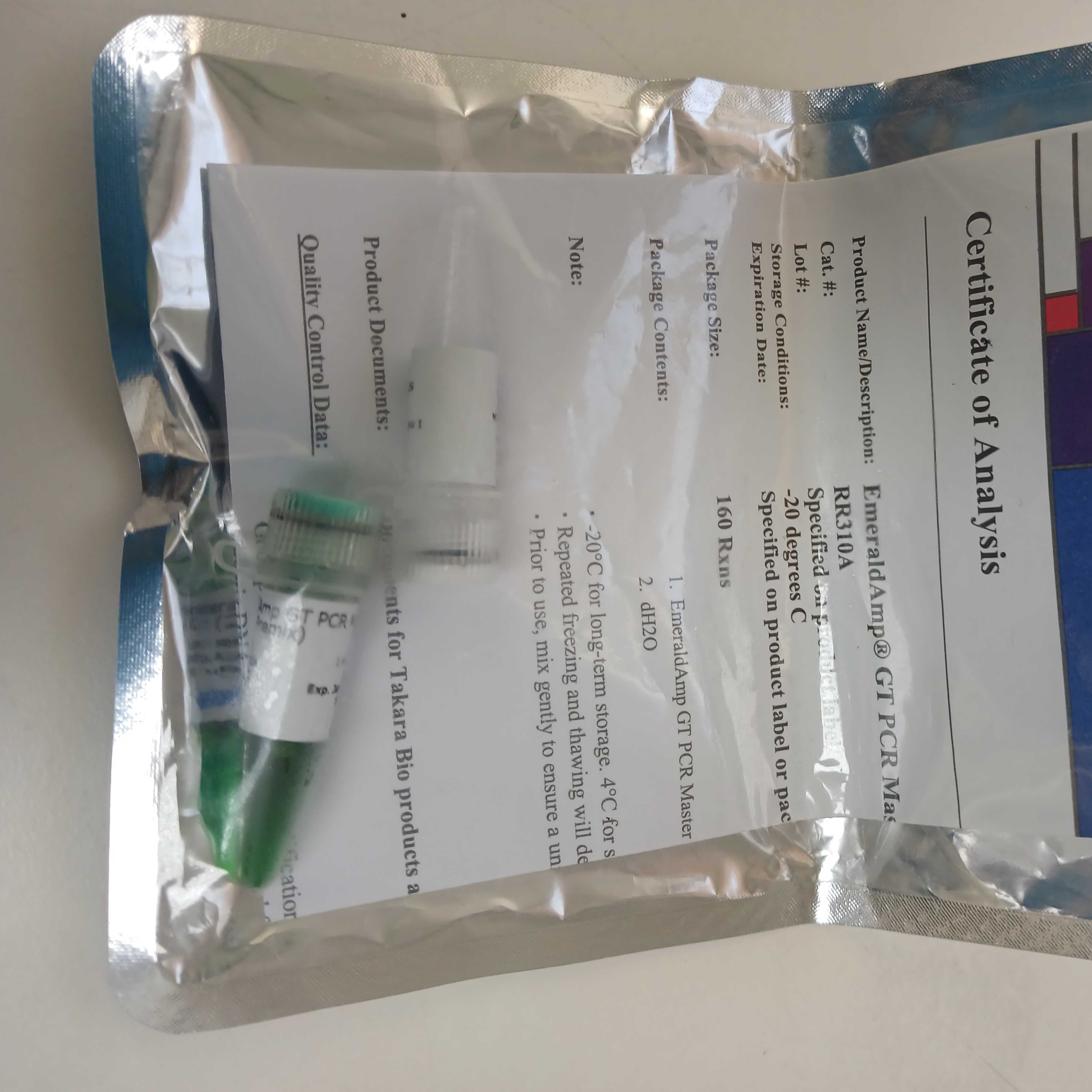
- EmeraldAmp® GT PCR Master MixTakara Bio Inc.Catalog #RR310A allows for direct gel loading.
- Equipment used are interchangeable with industry equivalents.
- Experiments performed at Room temperature is always at 21 °C .
- Treated PCR products may be stored at -20 °C until required for sequencing.
- Briefly vortex reagents and mixes as needed.
Materials
Reagents:
- EmeraldAmp® GT PCR Master MixTakara Bio Inc.Catalog #RR310A
- Primers: (Inqaba Biotec. Industries; Annotated "BioEdit" alignment files are included)
| A | B | C | D | E | F | |
| Adcyap F | GATGTGAGTAACCAGCCACT | Adcyap1 | Gene ID: 408251 | 20 | 61.3 | |
| Adcyap R | ATAACACAGGAGCGGTGA | Adcyap1 | Gene ID: 408251 | 18 | 59.7 | |
| Clock F1 | TGGAGCAGTAATGGTACCAAGTA | clock | Gene ID: 373991 | 23 | 62.9 | |
| Clock F2 | TGGAGCGGTAATGGTACCAAGTA | clock | Gene ID: 373991 | 23 | 65.0 | |
| Clock R1 | TCAGCTGCGACTGAGCTGG | clock | Gene ID: 373991 | 19 | 66.0 | |
| Clock R2 | TCAGCTGTGGCTGAGCTGG | clock | Gene ID: 373991 | 19 | 66.1 |
Summary of primer details for the assay including the primer name, sequence, gene, gene ID, length and Tm
- UltraPure™ TBE Buffer 10XThermo Fisher ScientificCatalog #15581044
- SeaKem® LE AgaroseLonzaCatalog #50004
- SYBR SAFE DNA stainInvitrogen - Thermo FisherCatalog #S33102
- Quick-Load 100 bp DNA Ladder - 375 gel lanesNew England BiolabsCatalog #N0467L
- ExoSAP-IT™ PCR Product Cleanup ReagentThermo Fisher Scientific AustraliaCatalog #78201.1.ML
Equipment:
Equipment
SimpliAmp Thermal Cycler
NAME
PCR
TYPE
Applied Biosystems
BRAND
A24811
SKU
LINK
Any standard PCR thermocycler will suffice
SPECIFICATIONS
Equipment
Gel Doc XR+ Gel Documentation System
NAME
Gel Documentation System
TYPE
Bio-rad Laboratories
BRAND
1708195
SKU
LINK
Equipment
PowerPac Basic Power Supply
NAME
Power Supply
TYPE
Bio-Rad Scientific
BRAND
1645050
SKU
LINK
Samples:
- BioSample information information has been deposited to the BioProject (PRJNA737185) linked to this protocol.
Protocol materials
EmeraldAmp® GT PCR Master MixTakara Bio Inc.Catalog #RR310A
ExoSAP-IT™ PCR Product Cleanup ReagentThermo Fisher Scientific AustraliaCatalog #78201.1.ML
SeaKem® LE AgaroseLonzaCatalog #50004
SYBR SAFE DNA stainInvitrogen - Thermo FisherCatalog #S33102
Quick-Load 100 bp DNA Ladder - 375 gel lanesNew England BiolabsCatalog #N0467L
UltraPure™ TBE Buffer 10XThermo Fisher ScientificCatalog #15581044
UltraPure™ TBE Buffer, 10XThermo FisherCatalog #15581044
Safety warnings
- Set up master mixes in a "DNA-free" room and laminar flow cabinet.
- Add DNA to reaction tubes in a "DNA-loading" laminar flow cabinet.
- Always dispose of biohazardous waste appropriately in accordance to lab regulations.
- Always wear gloves and a lab coat.
- Never directly look at the UV lamps.
Ethics statement
Protocol approval for the present study was obtained from the protocol committee of the Department of Genetics, University of the Free State (approval number: Res18/2020). Ethics approvals were obtained from the University of the Free State (approval number: UFS-AED2020/0015/1709) as well as the South African National Biodiversity Institute (approval number: SANBI/RES/P2020/30). Appropriate research permits were also obtained from South African regulatory authorities including the Department of Agriculture, Land Reform, and Rural Development (Section 20 permit: 12/11/1/1/18(1824JD)).
Before start
- Thaw reagents On ice .
- Wipe workspace with 10 % volume Bleach, followed by 70 % volume Ethanol, and ddH2O before (and after).
- UV the relevant laminar flow cabinets.
Master Mix set-up
Prepare Master Mix and Samples* for PCR.
*Sample information has been deposited to BioSample and associated to the BioProject (PRJNA737185) which used this protocol.
(An experiment template is included in excel format.)
Set up the following Master Mix with EmeraldAmp® GT PCR Master MixTakara Bio Inc.Catalog #RR310A for a 25 µL reaction in a DNA-free lab and laminar flow cabinet.
| A | B | C | D | |
| EmeraldAmp® GT PCR Master Mix | X2 | X1 | 12.5 | |
| Forward primer | 10 µM | 0.2 µM | 0.5 | |
| Reverse primer | 10 µM | 0.2 µM | 0.5 | |
| Nuclease free water | - | - | 9.5 |
Summary of components to add to Master Mix with the original and final concentrations as well as the relative volume in μL
EmeraldAmp GT MM
Working solutions of forward (Clk F1) and reverse (Clk R1) primers.
30m
- Add 23 µL Master Mix to 2 µL DNA template * in individual thin-walled PCR tubes in a DNA-loading laminar flow cabinet.
PCR reactions prepared to run thermal cycles.
*DNA isolated from avian blood samples may be highly concentrated, ensure that it is still less that 500 ng of DNA per reaction.
20m
Thermal cycling
10s
Program and run the following thermal cycling profile on a thermal cycler, e.g.
Equipment
SimpliAmp Thermal Cycler
NAME
PCR
TYPE
Applied Biosystems
BRAND
A24811
SKU
LINK
Any standard PCR thermocycler will suffice
SPECIFICATIONS
- 40 Cycles of:
- Denaturation at 98 °C for 00:00:10
- Annealing at 60 °C for 00:00:30
- Elongation at 72 °C for 00:01:00
- Infinite hold at 4 °C until ready for next steps.
Example of PCR run lasting approximately 1h30.
2h
Electrophoresis
Confirm success of amplification by TAE/TBE electrophoresis.
Prepare a 2 % (v/v) gel with SeaKem® LE AgaroseLonzaCatalog #50004 and UltraPure™ TBE Buffer, 10XThermo FisherCatalog #15581044 , pre-stained with SYBR SAFE DNA stainInvitrogen - Thermo FisherCatalog #S33102 using a casting tray and comb with sufficient wells.
Resolution capacity of different concentrations of gels.
| A | B | |
| 0.3 | 5 to 60 kbp | |
| 0.6 | 1 to 20 kbp | |
| 0.7 | 0.8 to 10 kbp | |
| 0.9 | 0.5 to 7 kbp | |
| 1.2 | 0.4 to 6 kbp | |
| 1.5 | 0.2 to 3 kbp | |
| 2.0 | 0.1 to 2 kbp |
Concentration (%) of agarose gels and their efficient range of separation in kilo base pairs.
Amount of agarose required for a small (50 mL) and large (100 mL) gel.
| 0.3 | 150mg | 300mg | |
| 0.6 | 300mg | 600mg | |
| 0.7 | 350mg | 700mg | |
| 0.9 | 450mg | 900mg | |
| 1.2 | 600mg | 1.2g | |
| 1.5 | 750mg | 1.5g | |
| 2.0 | 1g | 2g |
Concentration (%) of gels and their required amount of agarose.
*Note:SYBR SAFE DNA stainInvitrogen - Thermo FisherCatalog #S33102 is usually added at a concentration of 1 µL Stock per 10 mL TBE
SYBR Safe
45m
Load 4 µL of PCR product to the gel alongside a molecular weight marker, e.g. Quick-Load 100 bp DNA Ladder - 375 gel lanesNew England BiolabsCatalog #N0467L , and run at 60 Volt for 00:30:00 . Possible settings for the
Equipment
PowerPac Basic Power Supply
NAME
Power Supply
TYPE
Bio-Rad Scientific
BRAND
1645050
SKU
LINK
are:
| A | B | |
| < 1kbp | 5 V/cm | |
| 1-12 kbp | 4-10 V/cm | |
| >12 kbp | 1-2 V/cm |
Ideal voltages for resolving different size fragments.
40m
Visualize and capture gel on an appropriate imager and paired software, e.g.
Equipment
Gel Doc XR+ Gel Documentation System
NAME
Gel Documentation System
TYPE
Bio-rad Laboratories
BRAND
1708195
SKU
LINK
Expected result
Gel image of molecular marker and clock gene amplicons for Diederik cuckoo:
Positive amplification of clock genes viewed on a 1.5% TAE-Agarose gel.
15m
Amplicon purification
30m
Purify the positive amplicons with ExoSAP-IT™ PCR Product Cleanup ReagentThermo Fisher Scientific AustraliaCatalog #78201.1.ML prior to sequencing.
1h
Mix 5 µL PCR product with 2 µL Exo-SAP IT reagent for a total volume of 7 µL .
30m
Incubate at 37 °C for 00:15:00 to degrade PCR primers and short products.
15m
Incubate at 80 °C for 00:15:00 to inactivate the ExoSAP-IT™ PCR Product Cleanup ReagentThermo Fisher Scientific AustraliaCatalog #78201.1.ML .
Exo-SAP digestion and inactivation cycles.
15m
The PCR product is now ready for use in DNA sequencing*, SNP analyses, or other primer-extension applications.
*See Clock genes sequencing protocol (https://protocols.io/view/abi-sanger-sequencing-of-avian-clock-genes-to-eluc-bvydn7s6)
Protocol references
Johnsen, A., Fidler, A.E., Kuhn, S., Carter, K.L., Hoffmann, A., Barr, I.R., Biard, C., Charmantier, A., Eens, M., Korsten, P. and Siitari, H., 2007. Avian Clock gene polymorphism: evidence for a latitudinal cline in allele frequencies. Molecular Ecology, 16(22), pp.4867-4880.
Steinmeyer, C., Mueller, J.C. and Kempenaers, B., 2009. Search for informative polymorphisms in candidate genes: clock genes and circadian behaviour in blue tits. Genetica, 136, pp.109-117.