Mar 06, 2024
Version 2
Pathogen-Oriented Low-cost Assembly & Re-sequencing (POLAR): A highly sensitive and high-throughput SARS-CoV-2 diagnostic based on whole genome sequencing V.2
Version 1 is forked from nCoV-2019 sequencing protocol (single sample)
Peer-reviewed method
- Per Adastra1,2,3,
- Neva C. Durand1,2,3,4,
- Namita Mitra1,2,3,
- Saul Godinez1,2,3,
- Ragini Mahajan1,3,5,
- Alyssa Blackburn1,2,3,
- Zane Colaric1,2,3,
- Joshua W. M. Theisen1,3,
- David Weisz1,2,3,
- Olga Dudchenko1,2,3,
- Andreas Gnirke1,4,
- Suhas S.P. Rao1,2,3,6,
- Parwinder Kaur7,
- Erez Lieberman Aiden1,2,3,8,
- Aviva Presser Aiden1,2,9,10
- 1The Center for Genome Architecture, Baylor College of Medicine, Houston, TX 77030, USA;
- 2Department of Molecular and Human Genetics, Baylor College of Medicine, Houston, TX;
- 3Center for Theoretical Biological Physics, Rice University, Houston, TX 77030, USA;
- 4Broad Institute of MIT and Harvard, Cambridge, MA 02139, USA;
- 5B9Department of Biosciences, Rice University, Houston, TX 77030, USA;
- 6Department of Structural Biology, Stanford University School of Medicine, Stanford, CA 94305, USA;
- 7UWA School of Agriculture and Environment, The University of Western Australia, 35 Stirling Highway, Crawley, WA 6009, Australia;
- 8Departments of Computer Science and Computational and Applied Mathematics, Rice University, Houston, TX 77030, USA;
- 9Department of Bioengineering, Rice University, Houston, TX, USA;
- 10Department of Pediatrics, Stanford University School of Medicine, Stanford, CA 94305, USA
- Erez Lieberman Aiden: Co-corresponding authors;
- Aviva Presser Aiden: Co-corresponding authors;
- Coronavirus Method Development Community
- PLOS ONE Lab Protocols



Protocol Citation: Per Adastra, Neva C. Durand, Namita Mitra, Saul Godinez, Ragini Mahajan, Alyssa Blackburn, Zane Colaric, Joshua W. M. Theisen, David Weisz, Olga Dudchenko, Andreas Gnirke, Suhas S.P. Rao, Parwinder Kaur, Erez Lieberman Aiden, Aviva Presser Aiden 2024. Pathogen-Oriented Low-cost Assembly & Re-sequencing (POLAR): A highly sensitive and high-throughput SARS-CoV-2 diagnostic based on whole genome sequencing. protocols.io https://dx.doi.org/10.17504/protocols.io.3byl47xx8lo5/v2Version created by Per A. Adastra
License: This is an open access protocol distributed under the terms of the Creative Commons Attribution License, which permits unrestricted use, distribution, and reproduction in any medium, provided the original author and source are credited
Protocol status: Working
We use this protocol and it's working
Created: January 22, 2024
Last Modified: March 06, 2024
Protocol Integer ID: 93920
Keywords: de novo genome assembly, dna sequencing, read dna sequencing, sequencing, targeting particular viral loci, particular viral loci, genome, whole genome, throughput sar, pathogen, computational pipeline, sar, entire sar, read dna, throughput method for diagnosis
Abstract
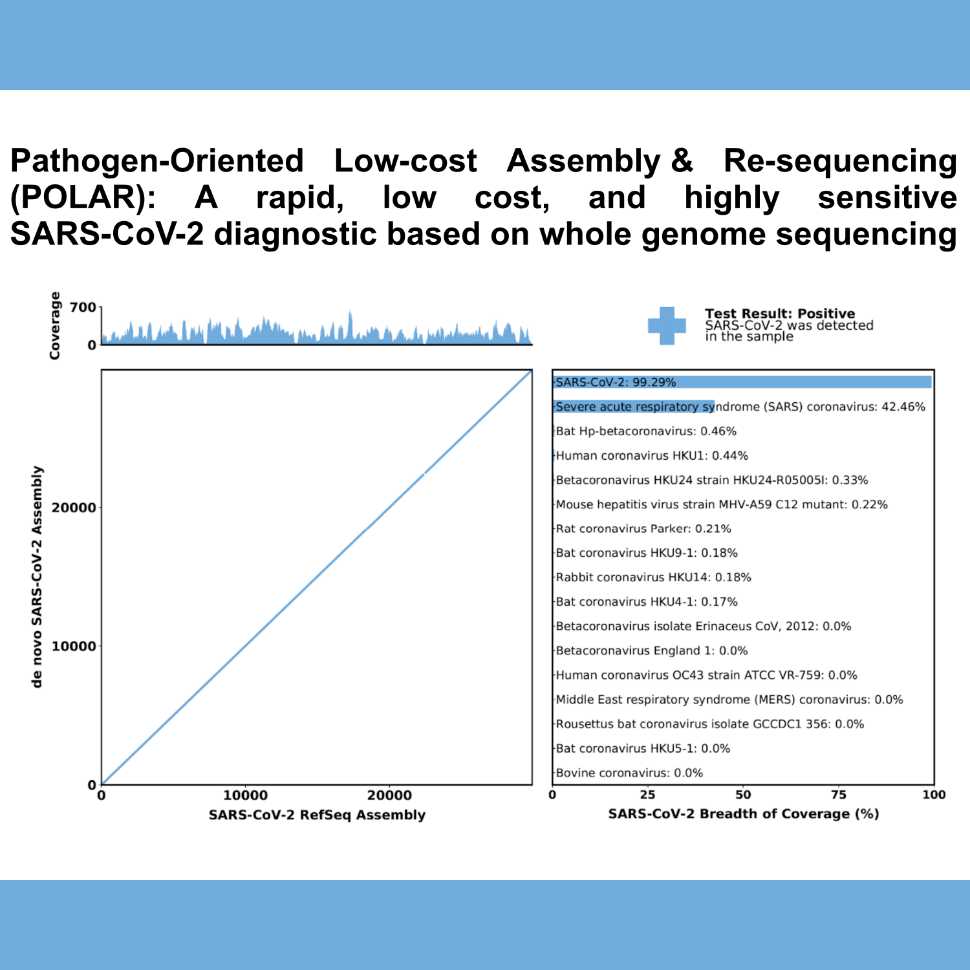
Here, we introduce a low-cost, high-throughput method for diagnosis of SARS-CoV-2 infection, dubbed Pathogen- Oriented Low-Cost Assembly & Re-Sequencing (POLAR), that enhances sensitivity by aiming to amplify the entire SARS-CoV-2 genome rather than targeting particular viral loci, as in typical RT- PCR assays. To achieve this goal, we combine a SARS-CoV-2 enrichment method developed by the ARTIC Network (https://artic.network/) with short-read DNA sequencing and de novo genome assembly. For details on our computational pipeline for automated data processing, including documentation and test set, please visit our Githuh at https://github.com/aidenlab/Polar.
The last step in this version contains a supplemental video with extra context and tips, as part of the protocols.io Spotlight series, featuring conversations with protocol authors.
Guidelines
SARS-CoV-2 Specific Primer Set
The ARTIC Network designed and tested1 the primer set used in this protocol and must be custom ordered prior to experiments. Details on their primer set can be found on their Github page https://github.com/artic-network/artic-ncov2019.
The World Health Organization: Dos and Don’ts for Molecular Testing
Molecular detection methods have the ability to produce a large volume of nucleic acid through the amplification of trace quantities found in samples. While this is beneficial for enabling sensitive detection, it also introduces the possibility of contamination through the spreading of amplicon aerosols in the laboratory environment. When conducting experiments, measures can be undertaken to avoid the contamination of reagents, laboratory equipment, and bench space, as such contamination may generate false-positive (or false-negative) results.
To help reduce the likelihood of contamination, Good Laboratory Practice should be exercised at all times. Specifically, precautions should be taken regarding the following points:
Handling reagents
- Briefly centrifuge reagent tubes before opening to avoid the generation of aerosols.
- Aliquot reagents to avoid multiple freeze-thaw and the contamination of master stocks.
- Clearly label and date all reagent and reaction tubes and maintain logs of reagent lot and batch numbers used in all experiments.
- Pipette all reagents and samples using filter tips. Prior to purchase, it is advisable to confirm with the manufacturer that the filter tips fit the brand of the pipette to be used.
Organization of workspace and equipment
The workspace should be organized to ensure that the flow of work occurs in one direction, from clean areas (pre-PCR) to dirty areas (post-PCR). The following general precautions will help to reduce the chance of contamination.
Have separate designated rooms, or at minimum physically separate areas, for:
- master mix preparation,
- nucleic acid extraction and DNA template addition
In some settings, having 4 separate rooms is difficult. A possible but less desirable option is to do the master mix preparation in a containment area, e.g. a laminar flow cabinet. In the case of nested PCR amplification, the preparation of the master mix for the second round reaction should be prepared in the ‘clean’ area for master mix preparation, but the inoculation with the primary PCR product should be done in the amplification room, and if possible in a dedicated containment area (e.g. a laminar flow cabinet).
Each room/area needs a separate set of clearly labeled pipettes, filter tips, tube racks, vortexes, centrifuges (if relevant), pens, generic lab reagents, lab coats, and boxes of gloves that will remain at their respective workstations.
Hands must be washed and gloves and lab coats changed when moving between the designated areas. Reagents and equipment should not be moved from a dirty area to a clean area. Should an extreme case arise where a reagent or piece of equipment needs to be moved backward, it must first be decontaminated with 10% sodium hypochlorite, followed by a wipe down with sterile water
Ideally, staff should abide by the unidirectional workflow ethos and not go from dirty areas (post-PCR) back to clean areas (pre-PCR) on the same day. However, there may be occasions when this is unavoidable. When such occasion arises, personnel must take care to thoroughly wash hands, change gloves, use the designated lab coat and not introduce any equipment they will want to take out of the room again, such as lab books. Such control measures should be emphasized in staff training on molecular methods.
After use, bench spaces should be cleaned with 10% sodium hypochlorite (followed by sterile water to remove residual bleach), 70% ethanol, or a validated commercially available DNA-destroying decontaminant. Ideally, ultra-violet (UV) lamps should be fitted to enable decontamination by irradiation. However, the use of UV lamps should be restricted to closed working areas, e.g. safety cabinets, in order to limit the laboratory staff’s UV exposure. Please abide by manufacturer instructions for UV lamp care, ventilation, and cleaning in order to ensure that lamps remain effective.
If manufacturer instructions permit it, pipettes should be routinely sterilized by autoclave. If pipettes cannot be autoclaved, it should suffice to clean them with 10% sodium hypochlorite (followed by a thorough wipe down with sterile water) or with a commercial DNA-destroying decontaminant followed by UV exposure.
All equipment needs to be calibrated regularly according to the manufacturer-recommended schedule. A designated person should be in charge of ensuring that the calibration schedule is adhered to, detailed logs are maintained, and service labels are clearly displayed on equipment.
Use and cleaning advice for the designated molecular space
- Pre-PCR: Reagent aliquoting / mastermix preparation
This should be the cleanest of all spaces used for the preparation of molecular experiments and should ideally be a designated laminar flow cabinet equipped with a UV light.
Samples, extracted nucleic acid, and amplified PCR products must not be handled in this area.
Amplification reagents should be kept in a freezer (or refrigerator, as per manufacturer recommendations) in the same designated space, ideally next to the laminar flow cabinet or pre-PCR area.
Gloves should be changed each time upon entering the pre-PCR area or laminar flow cabinet.
The pre-PCR area or laminar flow cabinet should be cleaned before and after use as follows: Wipe down all items in the cabinet, e.g. pipettes, tip boxes, vortex, centrifuge, tube racks, pens, etc. with 70% ethanol or a commercial DNA-destroying decontaminant, and allow to dry. In the case of a closed working area, e.g. a laminar flow cabinet, expose the hood to UV light for 30 minutes.
- Pre-PCR: Nucleic acid extraction/template addition
Nucleic acid must be extracted and handled in a second designated area, using a separate set of pipettes, filter tips, tube racks, fresh gloves, lab coats, and other equipment.
This area is also for the addition of template, controls, and trendlines to the master mix tubes or plates. To avoid contamination of the extracted nucleic acid samples that are being analyzed, it is recommended to change gloves prior to handling positive controls or standards and to use a separate set of pipettes.
PCR reagents and amplified products must not be pipetted in this area.
Samples should be stored in designated fridges or freezers in the same area.
The sample workspace should be cleaned in the same way as the master mix space.
- Post-PCR: Amplification and handling of the amplified product
This designated space is for post-amplification processes and should be physically separate from the pre-PCR areas. It usually contains thermocyclers and real-time platforms, and ideally should have a laminar flow cabinet for adding the round 1 PCR product to the round 2 reaction, if nested PCR is being performed.
PCR reagents and extracted nucleic acid must not be handled in this area since the risk of contamination are high.
This area should have a separate set of gloves, lab coats, plate and tube racks, pipettes, filter tips, bins, and other equipment.
Tubes must be centrifuged before opening.
The sample workspace should be cleaned in the same way as the master mix space.
Materials
MATERIALS
Q5 Hot Start High-Fidelity DNA Polymerase - 100 unitsNew England BiolabsCatalog #M0493S
Deoxynucleotide Solution Set - 25 umol of eachNew England BiolabsCatalog #N0446S
Random hexamersThermo Fisher ScientificCatalog #N8080127
Nextera XT DNA Sample Preparation Kit, 96 samplesIllumina, Inc.Catalog #FC-131-1096
Qubit dsDNA HS (High sensitivity) AssaysThermo Fisher ScientificCatalog #Q32851
SuperScript™ IV Reverse TranscriptaseThermo Fisher ScientificCatalog #18090050
RNaseOUT™ Recombinant Ribonuclease InhibitorThermo FisherCatalog #10777019
SuperPlate PCR Plate, 96-well, semi-skirtedThermo FisherCatalog #AB2400
100mM DTTThermo Fisher ScientificCatalog #18090050
SuperScript™ IV Reverse Buffer (5X)Thermo Fisher ScientificCatalog #18090050
Q5 Reaction Buffer (5X)New England BiolabsCatalog #M0493S
sparQ PureMag BeadsQuantabioCatalog #95196-060
Nuclease-Free WaterQiagenCatalog #129115
Quick-RNA Viral 96 KitZymo ResearchCatalog #R1041
Agencourt SPRIPlate 96R Ring Super Magnet PlateBeckman CoulterCatalog #A32782
Zymo-Spin I-96 PlateZymo ResearchCatalog #C2004
Nextera XT Index Kit v2 Set A (96 Indexes 384 Samples)Illumina, Inc.Catalog #FC-131-2001
10mM Tris-HCl (pH 8.0)
NextSeq500 v2.5 Mid-Output KitIllumina, Inc.Catalog #20024904
IDT primers Custom ordered from IDT created by ARTIC Network v3IDTCatalog #Custom picked from ARTIC
0.1 N NaOH
100% EthanolMerck MilliporeSigma (Sigma-Aldrich)Catalog #E7023
RNA extraction
41m
Collect 96 patient samples and record sample data. Add 200 µL of the samples into each well of the Zymo-Spin™ I-96 plate. Keep plate On ice while preparing reagents in Step 2.
5m
Prepare the following reagents before starting viral RNA extraction:
1. Add beta-mercaptoethanol (user supplied) to the Viral RNA Buffer to a final dilution of 0.5 % volume i.e., 500 µL per 100 ml.
2. Add 192 mL of 100% ethanol (or 204 mL of 95% ethanol) to the 48 mL Viral Wash Buffer concentrate.
2m
Add 400 µL of Viral RNA Buffer to each sample well. Mix well by pipetting.
2m
Mount the Zymo-Spin™ I-96 plate on a Collection Plate and centrifuge at 3000 x g -5000 x g for 00:05:00 . Discard the flow-through from the collection plate.
7m
Add 500 µL Viral Wash Buffer to each well and centrifuge at 3000 x g -5000 x g for 00:05:00 . Discard the flowthrough from the collection plate. Repeat this step.
12m
Add 500 µL ethanol (95-100%) to each well and centrifuge at 3000 x g - 5000 x g for 00:05:00 .
6m
To elute RNA, mount a new 96-well plate between the Zymo-Spin™ I-96 plate and an empty Collection Plate. Add 15 µL DNase/RNase-Free Water directly to the column matrix of the Zymo-Spin™ I-96 plate wells and centrifuge at 3000 x g - 5000 x g for 00:05:00 . The eluted RNA extract will be collected in the middle 96-well plate.
7m
cDNA preparation
1h 8m
Make a mastermix of the dNTPs and Random Hexamers for 96 samples (account for pipette error), pipette to mix and add 1 µL from mastermix to each well in a 96-well plate.
To each well, add 5.5 µL of RNA extract eluted in Step 7.
5m
Set-up and run the following program on a thermal cycler to incubate reaction:
6m
Make a mastermix of the following components for 96 samples (account for pipette error) and mix by pipetting.
Add 3.5 µL of mastermix to each well with the annealed template RNA from Step 9.
5m
Set-up and run the following program on a thermal cycler to incubate reaction:
1h
Multiplex PCR
8m
The following steps are performed in plates prepared according to the schematic below:
Two 96-well plates are prepared for PCR such that each contains a mastermix with the corresponding primer pool and cDNA from each biological sample.
Make a Pool #1 and Pool #2 master mix with the following reagents for 96 samples (account for pipette error) and mix by pipetting. In two 96-well plates, labeled Pool #1 or Pool #2, aliquot 22.5 µL of the corresponding Pool master mix into each well.
10m
Add 2.5 µL of cDNA of each biological sample from from Step 11 to both Pool #1 and Pool #2 96-well plates.
2m
Set-up and run the following program on a thermal cycler to incubate reaction
5m 45s
Post PCR Clean-up
15m
Add an equal volume (1:1) of sparQ PureMag beads to each sample well in plates Pool #1 and Pool #2 and mix gently by either flicking or pipetting. For example, add 50 µL sparQ PureMag beads to a 50 µL reaction. Then pulse centrifuge to collect all liquid at the bottom of the tube.
1m
Incubate for 00:05:00 at room temperature.
5m
Place the plates on the Agencourt SPRIPlate Super Magnet Plate and incubate for 00:02:00 or until the beads have pelleted and the supernatant is completely clear. Then, while avoiding the bead pellet, carefully remove the clear supernatant.
Equipment
SPRIPlate 96R Ring Super Magnet Plate
NAME
96-well Magnet Plate
TYPE
Agencourt
BRAND
A32782
SKU
LINK
3m
Keeping on magnetic plate, add 200 µL of Room temperature 80 % volume (freshly made) ethanol to the side of the well opposite to the pellet and let sit for 00:00:30 .
2m
Avoid disturbing the bead pellet, carefully remove and discard ethanol. Wait for 00:00:10 then remove any remaining ethanol.
50s
and repeat ethanol wash.
2m
Add 20 µL of 10 millimolar (mM) Tris-HCl (Ph 8.0) and pipette to mix well. Incubate for 00:02:00 at 37 °C .
3m
Separate beads on the Agencourt SPRIPlate Super Magnet Plate for 00:02:00 or until the beads have pelleted.
3m
Transfer supernatant from each biological sample in the two plates (Pool #1 and Pool #2) and combine into a single well per sample in a new 96-well plate.
2m 30s
Quantification of DNA concentration using a Qubit® High Sensitivity Kit:
1h
Quantify the DNA concentration using the Qubit® High Sensitivity DNA kit from 1 µL of each product using Steps 26-35.
Set up the required number of 0.5-mL tubes for standards and samples and label lids accordingly.
7m
Prepare a working solution by diluting the Qubit® dsDNA HS Reagent 1:200 in Qubit® dsDNA HS Buffer. For example, add 199 µL of buffer and 1 µL of dye per sample to a tube and vortex.
1m
Add 190 µL of Qubit® working solution and 10 µL of the standard to each of the standards tubes and vortex.
1m
For each sample, add 199 µL of Qubit® working solution and 1 µL of the sample in each 0.5-mL sample tube and vortex.
10m
Allow all tubes to incubate at room temperature for 00:02:00
2m
On the Home screen of the Qubit® 3.0 Fluorometer, press DNA, select dsDNA High Sensitivity, and press Read Standards to proceed.
2s
Insert the tube containing Standard #1 into the sample chamber, close the lid, then press Read standard. When the reading is complete (~00:00:03 ), remove Standard #1.
3s
Repeat Step 32 with Standard #2.
3s
To quantify samples, Press Run samples and select the sample volume (1 µL ) and units.
3s
Repeat Step 34 for all samples.
6m
Nextera Library Preparation
17m
Make a master mix of the Tagment mix and Tagment Buffer for 96 samples (account for pipette error) and pipette to mix well. Aliquot 6 µL of the master mix into each well of a new 96-well plate and add 4 µL of 1ng Amplicon DNA.
4m
Incubate at 55 °C for00:05:00 , then lower to 10 °C . Once at 10°C, immediately add 2.5 µL of Neutralizing Tagment Buffer to stop the reaction. Mix by pipetting up and down.
5m
Incubate at Room temperature for 00:05:00 . Centrifuge at 280 x g for 00:01:00 .
Make a mastermix of the Nextera PCR Master Mix and Index Primers 1 and 2 for 96 samples (account for pipette error) and mix by pipetting. Aliquot 12.5 µL of this mastermix into each well of a new 96-well plate and add 12.5 µL of tagmented amplicon DNA from Step 35.
1m
Set-up and run the following program on a thermal cycler to incubate reaction:
9m 20s
Final Library Cleanup
27m
After PCR, bring up sample volume in each well to 50 µL with nuclease free water.
Add a 1:1.8 ratio of sparQ PureMag beads to each well and mix gently pipetting. For example, add 90 µL sparQ PureMag beads to a 50 µL reaction.
30s
Incubate for 00:05:00 at room temperature.
5m
Place the plate on the Agencourt SPRIPlate Super Magnet Plate and incubate for 00:02:00 or until the beads have pelleted and the supernatant is completely clear. Then, while avoiding the bead pellet, carefully remove the clear supernatant.
2m
While keeping on magnetic plate, add 200 µL of Room temperature 80 % volume (fresh made) ethanol to the side of the well opposite of the pellet and let sit for 00:00:30 .
1m
Avoid disturbing the bead pellet, carefully remove and discard ethanol. Wait for 00:00:10 then remove any remaining ethanol.
20s
Add 100 µL of 10 millimolar (mM) Tris-HCl (pH 8.0) , vortex, and pulse centrifuge to collect all liquid at the bottom of the tube. Incubate for 00:02:00 at 37 °C .
2m
Separate beads on the Agencourt SPRIPlate Super Magnet Plate and transfer 100 µL of supernatant to a new plate for a second round of cleanup.
Add an equal volume (1:1) of sparQ PureMag beads to each well and mix gently by pipetting. For example add 100 µL sparQ PureMag beads to a 100 µL reaction.
30s
Incubate for 00:05:00 at room temperature.
5m
Separate beads on the Agencourt SPRIPlate Super Magnet Plate and incubate for 00:02:00 or until the beads have pelleted and the supernatant is completely clear. Then, while avoiding the bead pellet, carefully remove the clear supernatant.
2m
While keeping on magnetic plate, add 200 µL of Room temperature 80 % volume (fresh made) ethanol to the side of the well opposite of the pellet and let sit for 00:00:30 .
1m
Avoid disturbing the bead pellet, carefully remove and discard ethanol. Wait for 00:00:10 then remove any remaining ethanol.
10s
and repeat ethanol wash.
1m 30s
Add 20 µL of 10 millimolar (mM) Tris-HCl (Ph 8.0) and mix well by pipetting. Incubate for 00:02:00 at 37 °C
2m
Place the plate on the Agencourt SPRIPlate Super Magnet Plate and incubate for 00:02:00 or until the beads have pelleted and the supernatant is completely clear. Then, while avoiding the bead pellet, transfer the 20 µL final library to a new plate for subsequent steps and storage.
2m
Library Normalization
30m
Transfer 10 µL supernatant from each well of the PCR plate to the corresponding well of a new midi plate.
Combine the following volumes in a 15 mL conical tube to prepare the LN master mix. Multiply each volume by the number of samples being processed: 23 µL of LNA1 and 4 µL of LNA2.
Pipette 10 times to mix and pour the LN master mix into a trough.
Use a p200 multichannel pipette to transfer 22.5 µL LN master mix to each sample well.
Seal the plate, and then use a plate shaker at 1800 rpm for 00:30:00
Place on the magnetic stand and wait until the liquid is clear (~2 minutes). Without disturbing the beads, discard all the supernatant.
Wash two times as follows:
Add 22.5 µL LNW1 to each well. Seal the plate, and then use a plate shaker at 1800 rpm for00:05:00 . Separate on a magnetic plate and wait until the liquid is clear (~2 minutes). Without disturbing the beads, remove and discard all supernatant.
Add 15 µL 0.1 N NaOH to each well. Seal the plate, and then use a plate shaker at 1800 rpm for 00:05:00
Add 15 µL LNS1 to each well of a new 96-well PCR plate labeled SGP.
After the 00:05:00 elution completes, make sure that all samples in the midi plate are resuspended. If they are not, resuspend as follows:
Pipette 10 times to mix or lightly tap the sample plate on the bench. Seal the plate, and then use a plate shaker at 1800 rpm for 00:05:00 . Place on a magnet rack and transfer 15 µL supernatant from each well of the midi plate to thecorresponding well of the SGP plate.
Seal the plate, and then centrifuge at 1000 x g for00:01:00 .
Place on a magnetic stand and wait until the liquid is clear ~ 00:02:00 .
Transfer 15 µL supernatant from each well of the midi plate to the corresponding well of the SGP plate.
Seal the sample plate, and then centrifuge at1000 x g for 00:01:00 .
Loading the NextSeq550 sequencer
1h 20m
Remove a “Mid-Output Kit" reagent cartridge from -20°C freezer storage.
Place the cartridge right-side-up in a secondary container and fill the container with water at room temperature, but do not fully submerge the cartridge. Thaw cartridge in this water bath for about 01:00:00 .
When the reagent cartridge has been thawing for 00:30:00 , remove a "Mid-Output Kit" flow cell from the 4°C refrigerator but do not open the foil package. Place the flow cell on the bench for 00:30:00 to warm up to Room temperature
After the reagent cartridge is fully thawed, take it out of the water bath, tap on the bench to dislodge excess water, and dry with wipes.
Invert the cartridge to mix the reagents and make sure that the sequencing reagents in positions 29-32 are completely thawed. Then tap on the bench again to reduce air bubbles.
Remove the flow cell from its packaging and gently clean with a 70% ethanol wipe. Dry the glass with another wipe.
Inspect the flow cell to confirm: ports are free of obstructions, port gaskets are sealed and white plastic posts are visible, all 4 white retention clips are snapped over the edge of the black carrier plate and all 4 metal spring clips are laying flat against the black carrier plate.
Preheat an incubator to 98 °C
Remove a tube of Hybridization Buffer (HT1) from the -20°C freezer and thaw at Room temperature . When thawed, place on ice.
In a fresh 1.5ml tube, combine an aliquot from each library pool such that the total volume is 5 µL . For a Mid-Output kit, expect to obtain 150M reads in total.
Add 995 µL of ice-cold Hybridization Buffer (HT1). Vortex briefly and centrifuge at 300 x g for 00:01:00 .
Transfer 750 µL of diluted library to a new tube and add 750 µL of ice-cold Hybridization Buffer (HT1).
Vortex briefly and centrifuge at 300 x g for 00:01:00 .
Place the tube on the 98 °C heated incubator for 00:02:00 and immediately cool on ice. Leave on ice for 00:05:00
In a fresh 1.5ml tube, combine 1203 µL of ice-cold Hybridization Buffer (HT1) and 97 µL diluted library for a final concentration of 1.5 picomolar (pM) . Invert to mix and pulse centrifuge. Place on ice until ready to load onto the reagent cartridge.
Part 3: Load the Sequencer
Using a clean P1000 tip, poke a hole in the foil seal covering position 10 on the reagent cartridge (labeled “Load Library Here”). Avoid breaking any of the other seals on the cartridge:
Finalized libraries are loaded in hole 10 of reagent cartridge.
Add the entire 1.3ml of the 1.5 picomolar (pM) library dilution into this reservoir.
The reagent cartridge, flow cell, and buffer pack are now ready to be loaded onto the NextSeq500 for sequencing.
Spotlight video