Jul 30, 2024
Oxford Nanopore Technologies (ONT) library preparation and sequencing of DNA prepared using droplet Multiple Displacement Amplification (dMDA)
- Nadine Holmes1,
- Ester Kalef-Ezra2,3,
- Christos Proukakis2,3
- 1DeepSeq, School of Life Sciences, University of Nottingham, Nottingham, UK;
- 2Department of Clinical and Movement Neurosciences, Queen Square Institute of Neurology, University College London, London, UK;
- 3Aligning Science Across Parkinson’s (ASAP) Collaborative Research Network, Chevy Chase, MD, 20815
- Nadine Holmes: Nadine Holmes: [email protected];
- Ester Kalef-Ezra: Ester Kalef-Ezra: [email protected];
- Christos Proukakis: Christos Proukakis: [email protected]
- University College London


Protocol Citation: Nadine Holmes, Ester Kalef-Ezra, Christos Proukakis 2024. Oxford Nanopore Technologies (ONT) library preparation and sequencing of DNA prepared using droplet Multiple Displacement Amplification (dMDA). protocols.io https://dx.doi.org/10.17504/protocols.io.q26g71x2qgwz/v1
License: This is an open access protocol distributed under the terms of the Creative Commons Attribution License, which permits unrestricted use, distribution, and reproduction in any medium, provided the original author and source are credited
Protocol status: Working
We use this protocol and it's working
Created: July 04, 2024
Last Modified: July 30, 2024
Protocol Integer ID: 103055
Keywords: ASAPCRN, sequencing of dna, oxford nanopore technology, debranching of dna, nanopore, protocol for genomic dna, genomic dna, dna, using droplet mda, sequencing, sequencing step, droplet multiple displacement amplification, droplet mda, using droplet multiple displacement amplification, single nuclei
Funders Acknowledgements:
This research was funded in whole by Aligning Science Across Parkinson’s [Grant ID: 000430] through the Michael J. Fox Foundation for Parkinson’s Research (MJFF).
Grant ID: Grant ID: 000430
Disclaimer
DISCLAIMER – FOR INFORMATIONAL PURPOSES ONLY; USE AT YOUR OWN RISK
The protocol content here is for informational purposes only and does not constitute legal, medical, clinical, or safety advice, or otherwise; content added to protocols.io is not peer reviewed and may not have undergone a formal approval of any kind. Information presented in this protocol should not substitute for independent professional judgment, advice, diagnosis, or treatment. Any action you take or refrain from taking using or relying upon the information presented here is strictly at your own risk. You agree that neither the Company nor any of the authors, contributors, administrators, or anyone else associated with protocols.io, can be held responsible for your use of the information contained in or linked to this protocol or any of our Sites/Apps and Services.
Abstract
Debranching of DNA generated by Multiple Displacement Amplification (MDA) is an essential step prior to nanopore sequencing. This protocol describes an optimised T7-based debranching protocol for genomic DNA amplified from single nuclei using droplet MDA (dMDA) obtained according to Kalef-Ezra et al 2023 (https://www.protocols.io/view/manual-isolation-of-nuclei-from-human-brain-using-kxygxzjjov8j/v1). Subsequent library preparation and sequencing steps are also outlined here.
Materials
| A | B | C | D | E | |
| Item | Supplier | Catalogue Number | Preparation prior to use | Storage | |
| Nuclease-free water | Sigma Aldrich | W4502 | Aliquot | RT | |
| T7 Endonuclease I (10U/ul) | NEB | M0302S | Place on ice | -20 °C | |
| 10X NEBuffer 2 | NEB | M0302S | Thaw on ice | -20 °C | |
| AMPure XP Beads | Beckman Coulter | A63882 | Equilibrate at RT for 30 min | 4 °C | |
| 1 M Tris-HCl pH 8 | Thermo Scientific | J22638-AE | RT | ||
| 0.5 M EDTA pH 8, nuclease-free | Thermo Fisher Scientific | AM9260G | RT | ||
| 5M NaCl | Thermo Fisher Scientific | AM9759 | RT | ||
| PEG 8000 (40% w/v) | Sigma Aldrich | P1458 | 4 °C | ||
| TE Buffer pH 8, 2 um filtered | Invitrogen | AM9858 | RT | ||
| Native Barcoding Kit 96 V14 | ONT | SQK-NBD114.96 | See before starting notes | -20 °C | |
| NEBNext Ultra II End repair/dA-tailing Module | NEB | E7546 | Thaw on ice | -20 °C | |
| NEBNext FFPE Repair Mix | NEB | M6630 | Thaw on ice | -20 °C | |
| NEB Blunt/TA Ligase Master Mix | NEB | M0367 | Thaw on ice | -20 °C | |
| NEBNext Quick Ligation Module | NEB | E6056 | Thaw on ice | -20 °C | |
| Qubit Assay Tubes | ThermoFisher | Q32856 | RT | ||
| Qubit 1X dsDNA HS Assay Kit | ThermoFisher | Q33231 | Equilibrate at RT for 30 min | 4 °C | |
| Genomic DNA ScreenTape Assay (optional) | Agilent | 5067-5365; 5067-5366 | Equilibrate at RT for 30 min | 4 °C | |
| TapeStation strips and caps (optional) | Agilent | 401428; 401425 | RT | ||
| TapeStation Loading tips (optional) | Agilent | 5067-5598 | RT | ||
| PromethION R10.4.1M flow cell | ONT | FLO-PRO114M | Equilibrate at RT for 20 min | 4 °C | |
| Flow Cell Wash Kit | ONT | EXP-WSH004 or EXP-WSH004-XL | -20 °C |
General consumables:
- Gloves
- Pipettes: P10, P20, P200 and P1000 (any brand)
- Pipette filter tips: 10 ul, 200 ul and 100 ul (any brand)
- 0.2 ml thin-walled PCR tubes
- 1.5 ml Eppendorf LoBind tubes
- 2 ml Eppendorf LoBind tubes
- 80 % Ethanol, prepared with nuclease-free water
- 70 % Ethanol, prepared with nuclease-free water
Equipment:
- HulaMixer (ThermoFisher) or rotating tube mixer
- Magnetic rack for 0.2 ml PCR tubes
- Magnetic stand for 1.5 ml Eppendorf tubes, e.g. DynaMag-2 Magnet (ThermoFisher; 12321D)
- Microfuge
- Thermal cycler
- Ice bucket and ice
- Benchtop Cooler Rack for holding 1.5-2 ml tubes, with -20 °C temperature range
- Vortex mixer
- Qubit fluorometer (or equivalent)
- Agilent TapeStation (optional)
- Vortex mixer IKA MS3 with 96-well sample plate adapter (optional)
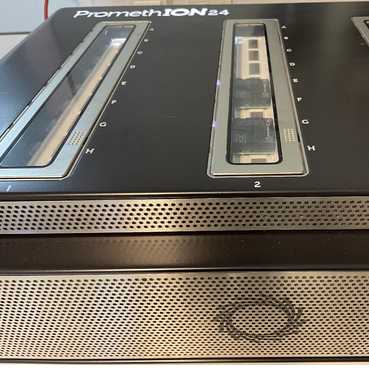
- PromethION sequencer (ONT)
- Heat block or thermomixer, set to 37 °C
Equipment
Magnet
NAME
DynaMag™-2 Magnet
TYPE
Thermo Fisher
BRAND
12321D
SKU
LINK
Nuclease-free WaterMerck MilliporeSigma (Sigma-Aldrich)Catalog #W4502-1L
T7 Endonuclease I - 250 unitsNew England BiolabsCatalog #M0302S
AMPure XP BeadsBeckman CoulterCatalog #A63882
Tris-HCl pH 8.0Thermo ScientificCatalog #J22638-AE
EDTA (0.5 M, pH 8.0, nuclease-free)Thermo Fisher ScientificCatalog #AM9260G
5M NaCl solutionThermo Fisher ScientificCatalog #AM9759
40% Polyethylene Glycol MW 8000Merck MilliporeSigma (Sigma-Aldrich)Catalog #P1458
TE, pH 8.0, RNase-freeThermo FisherCatalog #AM9858
Native barcoding kit (96)Oxford Nanopore TechnologiesCatalog #SQK-NBD114.96
NEBNext® Ultra™ II End Repair/dA-Tailing ModuleNew England BiolabsCatalog #E7546
NEBNext FFPE Repair MixNew England BiolabsCatalog #M6630
NEB Blunt/TA Ligase Master Mix Catalog #M0367
NEBNext Quick Ligation ModuleNew England BiolabsCatalog #E6056S
Qubit assay tubesThermo Fisher ScientificCatalog #Q32856
Genomic DNA ScreenTapeAgilent TechnologiesCatalog #5067-5365
Optical tube strips (8x Strip)Agilent TechnologiesCatalog #401428 Genomic DNA ReagentsAgilent TechnologiesCatalog #5067-5366 Qubit™ 1X dsDNA HS Assay KitThermo FisherCatalog #Q33231
Optical tube strip caps (8x strip)Agilent TechnologiesCatalog #401425 TapeStation Loading tipsAgilent TechnologiesCatalog #5067-5598
PromethION R10.4.1M flow cellOxford Nanopore TechnologiesCatalog #FLO-PRO114M
ONT Flow Cell Wash KitOxford Nanopore TechnologiesCatalog #EXP-WSH004
Flow Cell Wash KitOxford Nanopore TechnologiesCatalog #EXP-WSH004-XL
Before start
Section 1: DNA QC
Before starting:
- Pre-warm Qubit 1X dsDNA HS reagent to room temp for 00:30:00 prior to using.
- Pre-warm Genomic ScreenTape assay reagents to room temp for 00:30:00 prior to using.
Section 2: T7 debranching
Before starting:
- Thaw 10x NEBuffer 2 On ice , vortex and keep On ice until needed.
- Pre-warm AMPure XP beads at room temperature for 00:30:00 and vortex to thoroughly mix immediately prior to use.
- Prepare custom AMPure buffer as follows, by adding the following and pipette mixing:
| A | B | |
| Reagent | Volume (ul) | |
| 1 M Tris-HCl pH 8 | 20 | |
| 0.5 M EDTA pH 8 | 4 | |
| 5 M NaCl | 640 | |
| PEG 8000 (40% w/v) | 550 | |
| Nuclease-free water | 778 |
Section 3: Library preparation
Before starting:
- Thaw all buffers On ice , vortex to mix and ensure there is no precipitate. If precipitate is visible, vortex until it has fully mixed into solution. Keep on ice until needed. Briefly spin tubes in microfuge before opening.
- Keep enzymes and Native Adapter (NA) at -20 °C until needed. Just before use, transfer enzymes to Benchtop Cooler. Mix enzymes by very gently flicking the tubes, spin tubes briefly in microfuge and keep in Benchtop Cooler.
- Pre-warm AMPure XP beads at room temperature for 00:30:00 and vortex immediately prior to using.
- Thaw NBD114.96 barcode plate (or NDB114.24 barcode tubes) at room temperature. Centrifuge plate or tubes before opening and prepare 1.25 ul aliquots of individual barcodes in 0.2 ml PCR tubes and keep on ice.
- Thaw NEB Blunt/TA Ligase Master Mix on ice, mix by inversion and keep On ice .
- Thaw Short Fragment Buffer (SFB) at room temperature, vortex, and centrifuge briefly before using.
Section 4: Flow cell loading
Before starting:
- Thaw Flow Cell Tether (FCT), Flow Cell Flush (FCF), Sequencing Buffer (SB) and Library Solution (LIS) at Room temperature . Mix by vortex and centrifuge briefly before use.
Remove PromethION flow cell from 4 °C and equilibrate to Room temperature for 00:20:00 before loading.
Section 1: DNA QC
Measure the concentration of each dMDA sample using the Qubit Fluorometer. Mix 1 µL of DNA with 199 µL of 1X dsDNA HS reagent, in a 0.5 ml Qubit tube. Vortex for 00:00:10 , spin briefly in a microfuge and incubate at Room temperature for 00:02:00 and measure concentration.
2m 10s
(Optional) Assess the DNA integrity and fragment-length profile of each sample using the Agilent TapeStation and Genomic ScreenTape Assay. Use 1 µL of DNA, at a concentration of 10-100 ng/µL for TapeStation analysis.
Section 2: T7 debranching
1h 2m
Aliquot 500 ng of each dMDA sample into a 0.2 ml thin-walled PCR tube and make the volume up to 26 µL with nuclease-free water.
Prepare the following reaction:
| A | B | |
| Reagent | Volume (uL) | |
| Nuclease-free water | 26-x | |
| Template DNA | x | |
| 10x NEBuffer 2 | 3 | |
| T7 endonulcease I (10 U/uL) | 1 | |
| Total volume | 30 |
Incubate reactions in a thermal cycler at 37 °C for 01:00:00
1h
Prepare custom SPRI beads, by replacing the buffer of AMPure XP beads with custom AMPure XP buffer (according to the ONT protocol: Ligation sequencing gDNA – whole genome amplification (SQK-LSK110) Version: WAL_9115_v110_revH_10Nov2020).
Mix AMPure XP beads by vortexing thoroughly and transfer two 1 ml aliquots into two 1.5 ml Eppendorf LoBind tubes.
Place tubes in a magnetic rack for 00:02:00 , to pellet the beads and then remove the supernatant.
2m
Remove the tubes from the magnet and resuspend the beads by adding 1 mL of nuclease-free water and vortexing, then return the tubes to the magnet rack.
Repeat the above wash step, for a total of 2 washes.
Briefly centrifuge the tubes, return to the magnet, and use a P20 pipette to remove any remaining water.
Resuspend and pool the two pellets in 200 µL of custom AMPure buffer, then transfer the resuspended beads to the 2 ml tube containing the remaining custom AMPure buffer.
Vortex thoroughly and make sure beads are thoroughly mixed again just before use.
Adjust debranching reactions to 50 µL using TE buffer (pH 8), add 35 µL of custom SPRI beads and incubate on a Hula-Mixer at 9 rpm, 00:20:00 .
20m
Pellet beads on a magnetic rack for 00:02:00 , or until beads are completely separated from solution and remove the supernatant.
2m
Leave tubes on the magnet and wash the pellet by carefully adding 200 µL of 70 % ethanol. Do not disturb the bead pellet and remove ethanol after 00:00:30 .
30s
Repeat the above wash step, for a total of two washes.
Briefly centrifuge the samples, return to the magnet, and use a P20 pipette to remove any remaining ethanol.
Air-dry pellet for up to 00:02:00 .
2m
To elute DNA from the beads, resuspend the pellet by adding 20 µL of nuclease-free water and flicking the tubes to thoroughly resuspend the beads.
Briefly spin the tubes in a microfuge for 1-2 s.
Incubate in a thermal cycler at 50 °C for 00:01:00 .
1m
Incubate at Room temperature for 00:09:00 .
9m
Pellet beads on a magnetic rack for 00:02:00 .
2m
Transfer the supernatant, containing eluted DNA, to a new 0.2 ml thin-walled PCR tube.
Quantify 1 µL of eluted DNA by Qubit.
Section 3: Library Preparation
56m 30s
The following library preparation steps follow the protocol Ligation sequencing gDNA – Native Barcoding Kit 24 V14; Version: NBE_9169_v114_revQ_15Sep2022, with some modifications. For each sample, use all recovered debranched dMDA DNA from step 18.
End-prep:
Prepare the following reaction for each sample, in a 0.2 ml thin-walled PCR tube:
| A | B | |
| Reagent | Volume (uL) | |
| Nuclease-free water | 5 | |
| Debranched dMDA sample | 19 | |
| NEBNext FFPE DNA Repair Buffer | 1.75 | |
| Ultra II End-prep Reaction Buffer | 1.75 | |
| Ultra II End-prep Enzyme Mix | 1.5 | |
| NEBNext FFPE DNA Repair Mix | 1 | |
| Total volume | 30 |
Mix samples by pipetting and briefly centrifuge.
Incubate reactions in a thermal cycler at 20 °C for 00:30:00 , then 65 °C for 00:05:00 .
35m
Mix AMPure XP beads by vortexing and add 60 µL to each reaction.
Mix the AMPure beads with the reaction solution by thoroughly flicking and inverting the tubes.
Incubate at Room temperature for 00:05:00 .
5m
Briefly centrifuge the tubes then place on a magnetic rack for ~ 00:02:00 , or until the beads have completely pelleted.
2m
Remove the supernatant.
Leave tubes on the magnet and wash the pellet by carefully adding 200 µL of 80 % ethanol. Do not disturb the bead pellet and remove ethanol after 00:00:30 .
30s
Repeat the above wash step, for a total of two washes.
Briefly centrifuge the samples, return to the magnet, and use a P20 pipette to remove any remaining ethanol.
Air-dry pellet for up to 00:02:00 .
2m
To elute DNA from the beads, remove tubes from the magnetic rack and resuspend the pellets by adding 23 µL of nuclease-free water and flicking the tubes to thoroughly resuspend the beads. Briefly spin the tubes in a microfuge for 1-2 s and incubate in a thermal cycler at 37 °C for 00:10:00 .
10m
Pellet beads on a magnetic rack for 00:02:00 and then transfer 22.5 µL of supernatant, containing eluted DNA, to a new 0.2 ml thin-walled PCR tube.
2m
Barcode Adapter Ligation:
Prepare the following barcode adapter ligations at Room temperature
| A | B | |
| Reagent | Volume (uL) | |
| End-prepped DNA | 22.5 | |
| Native Barcode (NB01-24) | 2.5 | |
| Blunt/TA Ligase Master Mix | 25 | |
| Total volume | 50 |
Gently pipette mix to thoroughly mix reactions and briefly centrifuge.
Incubate at Room temperature for 00:30:00 .
30m
Mix AMPure XP beads by vortexing and add 100 µL to each reaction.
Mix the AMPure beads with the reaction solution by thoroughly flicking and inverting the tubes and incubate at Room temperature for 00:05:00 .
5m
Briefly centrifuge the tubes then place on a magnetic rack for ~ 00:02:00 , or until the beads have completely pelleted.
2m
Remove the supernatant.
Leave tubes on the magnet and wash the pellet by carefully adding 200 µL of 80 % ethanol. Do not disturb the bead pellet and remove ethanol after 00:00:30 .
30s
Repeat the above wash step, for a total of two washes.
Briefly centrifuge the samples, return to the magnet, and use a P20 pipette to remove any remaining ethanol.
Air-dry pellet for up to 00:02:00 .
2m
To elute DNA from the beads, remove tubes from the magnetic rack and resuspend the pellets by adding 16 µL of nuclease-free water and flicking the tubes to thoroughly resuspend the beads. Briefly spin the tubes in a microfuge for 1-2 s and incubate in a thermal cycler at 37 °C for 00:10:00 .
10m
Pellet beads on a magnetic rack for 00:02:00 and then transfer the supernatant, containing eluted DNA, to a new 0.2 ml thin-walled PCR tube.
2m
Quantify 1 µL of eluted DNA by Qubit.
Sequencing Adapter Ligation:
Combine barcoded samples in equal amounts, in a 1.5 ml LoBind tube, and use the pooled sample to prepare the below reaction. Add reagents in the listed order:
| A | B | |
| Reagent | Volume (uL) | |
| Barcoded sample pool | 30 | |
| Native Adapter | 5 | |
| NEBNext Quick Ligation Reaction Buffer (5x) | 10 | |
| Quick T4 DNA Ligase | 5 | |
| Total volume | 50 |
Incubate ligation reaction at Room temperature for 00:30:00 .
30m
Add 100 µL of resuspended AMPure beads and incubate on a HulaMixer for 00:10:00 at 9 rpm .
10m
Briefly centrifuge the tube then place on a magnetic rack for ~ 00:02:00 , or until the beads have completely pelleted.
2m
Remove the supernatant.
Remove tube from the magnetic stand and wash the beads by adding 125 µL of Short Fragment Buffer (SF) and thoroughly resuspend beads by flicking the tube.
Return tube to the magnetic stand and pellet beads for ~ 00:02:00 .
2m
Repeat the above wash steps, for a total of two washes.
Briefly centrifuge the samples, return to the magnet, and use a P20 pipette to remove any remaining SFB.
Air-dry pellet for up to 00:00:30 .
30s
To elute DNA from the beads, remove the tube from the magnetic rack and resuspend the pellet by adding 25 µL of Elution Buffer (EB) and flicking the tube to thoroughly resuspend the beads.
Briefly spin the tube in a microfuge for 1-2 s and incubate in a heat block or water bath at 37 °C for 00:10:00 .
10m
Pellet beads on a magnetic rack for 00:02:00 and then transfer the supernatant, containing eluted DNA, to a new 1.5 ml LoBind tube.
2m
Quantify 1 µL of eluted DNA by Qubit.
Section 4: Flow cell loading
3d
Prepare and load PromethION flow cell according to the protocol: Ligation sequencing gDNA – Native Barcoding Kit 24 V14; Version: NBE_9169_v114_revQ_15Sep2022.
Start run in MinKNOW using default parameters for the NBD114.24 or NBD114.96 library prep kit.
Monitor number of available pores during the run and perform nuclease flush and reloads as needed, using the Flow Cell Wash Kit (EXP-WSH004 or EXP-WSH004-XL) and the protocol: Flow Cell Wash Kit (EXP-WSH004 or EXP-WSH004-XL) Version: WFC_9120_v1_revQ_08Dec2020. A 72:00:00 run will normally require 1-2 flush and reloads to maximise the output of the flow cell.
3d
Protocol references
Ester Kalef-Ezra, Diego Perez-Rodriguez, Christos Proukakis 2023. Manual isolation of nuclei from human brain using CellRaft device and single nucleus Whole Genome Amplification. protocols.iohttps://dx.doi.org/10.17504/protocols.io.kxygxzjjov8j/v1