Aug 16, 2025
Neural stretching and Distalo -proximal release for chronic neck pain
- Manisha kumari Ray1,
- Sharmila Jahan2
- 1Department of physiotherapy and Rehabilitation ,Jashore University of science and Technology;
- 2Jashore University of science and technology
- Manisha kumari Ray: Manisha kumari Ray;



Protocol Citation: Manisha kumari Ray, Sharmila Jahan 2025. Neural stretching and Distalo -proximal release for chronic neck pain. protocols.io https://dx.doi.org/10.17504/protocols.io.36wgqp3j3vk5/v1
License: This is an open access protocol distributed under the terms of the Creative Commons Attribution License, which permits unrestricted use, distribution, and reproduction in any medium, provided the original author and source are credited
Protocol status: Working
We use this protocol and it's working
Created: August 16, 2025
Last Modified: August 16, 2025
Protocol Integer ID: 224766
Keywords: Neck pain, Neural stretching , Distalo- proximal release technique , Manipulation therapy , Functional outcomes , release for chronic neck pain, effectiveness of neural stretching, chronic neck pain, neural stretching, conventional physiotherapy, physiotherapy, session treatment time, pain
Abstract
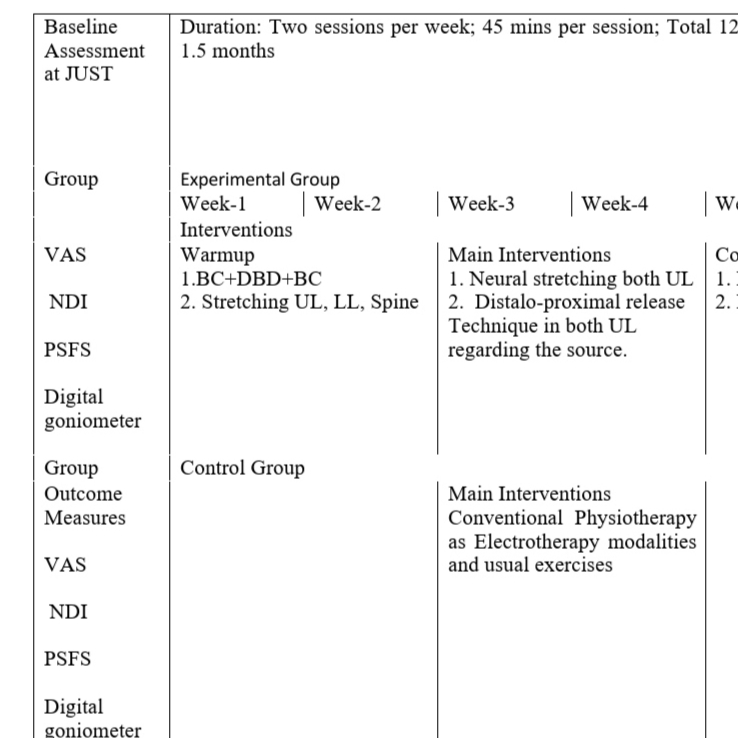
This is a randomized controlled trial that evaluates the Effectiveness of neural stretching and distalo -proximal release for chronic neck pain with referred symptoms. Participants are assigned to two groups: the experimental group will receive neural stretching and distalo -proximal release, and the control group will receive conventional physiotherapy. Both groups will undergo 6 weeks of intervention, and each session treatment time will be 40 minutes.

Guidelines
re-Start Preparation
- Participant Screening:
- Confirm diagnosis of chronic neck pain with referred symptoms
- Exclude participants with recent trauma, fractures, systemic illness, or neurological deficits.
- Informed Consent:
- Provide participants with study details, procedures, benefits, and possible risks in their native language.
- Obtain signed informed consent prior to starting interventions.
- Baseline Assessment:
- Conduct all pre-intervention outcome measures (VAS, NDI, PSFS, goniometric ROM).
- Record demographic and clinical history.
Safety Guidelines
- During Exercise:
- Monitor for signs of discomfort, dizziness, numbness, or unusual pain.
- Discontinue the intervention if symptoms worsen.
- Therapist Positioning:
- Maintain correct body mechanics to avoid therapist strain.
- Neural Stretching:
- Perform within the pain-free range; avoid over-tensioning nerves.
- Electrotherapy (TENS):
- Do not apply over pacemakers, open wounds, or areas with impaired sensation.
Materials
- Assessment Tools
- Visual Analogue Scale (VAS) – for pain intensity measurement
- Patient-Specific Functional Scale (PSFS) – for functional ability assessment
- Digital Goniometer – for cervical range of motion (ROM) measurement
- Data collection sheets and case report forms
- Intervention Materials
- Treatment plinth or adjustable physiotherapy bed
- Towels and pillows for patient positioning and comfort
- Stopwatch or timer (for exercise timing and rest intervals)
- Electrotherapy Equipment (for control group)
- Transcutaneous Electrical Nerve Stimulation (TENS) unit or Interferential Therapy (IFT) machine
- Electrodes and electrode gel/pads
- Power supply and extension cords (if needed)
- For Neural Stretching & Distalo-Proximal Release Technique (experimental group)
- Lubricant or massage cream (if required for manual release)
- Gloves (if indicated for hygiene)
- Documentation & Administrative Items
- Consent forms and participant information sheets
- Randomization envelopes or software (for group allocation)
- Secure file storage (physical cabinet or encrypted digital storage)
- Hygiene & Safety
Hand sanitizer and disinfectant wipes
Safety warnings
- Avoid intervention in cases of:
- Acute cervical injury or instability
- Active infection or inflammation
- Malignancy in the treatment area
- Ensure equipment (goniometer, TENS machine) is calibrated and checked before each use.
- Maintain session records for all participants.
Ethics statement
The study will be conducted in accordance with the Declaration of Helsinki and local institutional ethical guidelines.
Ethical approval has been obtained from the Institutional Review Board (IRB) of Jashore University of Science and Technology.
All data will be kept confidential and used solely for research purposes.
Participants have the right to withdraw from the study at any stage without penalty.
Neural stretching and Distalo -proximal release for neck pain
Protocol references
1. lanchard, C., et al. (2020). “Effectiveness of neural mobilization for neck pain: A systematic review.” Journal of Bodywork and Movement Therapies, 24(1), 10–19. https://doi.org/10.1016/j.jbmt.2019.08.003
2.Maitland, G. D., Hengeveld, E., Banks, K., & English, K. (2005). Maitland’s Vertebral Manipulation: Management of Neuromusculoskeletal Disorders. Elsevier.
3.Cleland, J. A., et al. (2007). “Manual physical therapy for neck pain: A systematic review.” Journal of Orthopaedic & Sports Physical Therapy, 37(7), 312–321. https://doi.org/10.2519/jospt.2007.2342
4. Stratford, P., Gill, C., Westaway, M., & Binkley, J. (1995). “Assessing disability and change on individual patients: A report of a patient-specific measure.” Physiotherapy Canada, 47(4), 258–263.
5. Huskisson, E. C. (1974). “Measurement of pain.” Lancet, 2(7889), 1127–1131. https://doi.org/10.1016/S0140-6736(74)90884-8
· Iqbal
6.ZA, Rajan R, Khan SA, Alghadir AH. Effect of deep cervical flexor muscles
training using pressure biofeedback on pain and disability of school teachers
with neck pain. J Phys Ther Sci. 2013;25:657–61. doi:
10.1589/jpts.25.657. [DOI] [PMC
free article] [PubMed] [Google Scholar]
7.CA, Marco AP, Plewa MC, Buderer N, Bowles J, Lee J. The verbal numeric pain
scale: effects of patient education on self-reports of pain. Acad Emerg Med.
2006;13:853–9. doi: 10.1197/j.aem.2006.04.020. [DOI] [PubMed] [Google Scholar]
·
8.TT, Lam TH, Hedley AJ. Correlation among physical impairments, pain,
disability, and patient satisfaction in patients with chronic neck pain. Arch
Phys Med Rehabil. 2005;86:534–40. doi: 10.1016/j.apmr.2004.02.030. [DOI] [PubMed] [Google Scholar]
·
9.N, Funprom K. Effect of carrying style on posture score in adolescents with
musculoskeletal pain. Chiang Mai Univ J Nat Sci. 2019;18:553–61. doi:
10.12982/CMUJNS.2019.0036. [DOI] [Google Scholar]
·
10 .Kaya D, Toprak Çelenay Ş. Effectiveness of relaxation training in addition to
stabilization exercises in chronic neck pain: a randomized clinical trial. Turk
J Physiother Rehabil. 2019;30:145–53. doi: 10.21653/tjpr.665131. [DOI] [Google Scholar]
Acknowledgements
The authors express sincere gratitude to all participants, colleagues, and faculty members who contributed their time, expertise, and support to this study. Special thanks to the Department of Physiotherapy and Rehabilitation, Jashore University of Science and Technology, for providing the necessary facilities and guidance .The partial funding will be provided by the Department of Physiotherapy and Rehabilitation, JUST ,Bangladesh was approved by the institutional Review Board (IRB)of the Department of Physiotherapy and Rehabilitation at Department of Physiotherapy and Rehabilitation, JUST ,Bangladesh ,JUST -7408