Oct 01, 2025
Mouse Breeding Recommendations
- Thom Saunders1,2,
- Wanda Filipiak1,2,
- Kay Oravecz-Wilson1,2,
- leoje 1,2,
- Sivakumar Jeyarajan1,2,
- Honglai Zhang1,2,
- Eden A. Dulka1,2,
- Zachary T. Freeman1,2
- 1University of Michigan;
- 2University of Michigan Transgenic Animal Model Core
- Thom Saunders: Orcid ID 0000-0003-2015-101X;
- Sivakumar Jeyarajan: Orcid ID 0000-0001-6614-5489
- Eden A. Dulka: Orcid ID 0000-0002-7724-8923
- Zachary T. Freeman: Orcid ID: 0000-0003-1291-382X
- Transgenic Animal Model Core



Protocol Citation: Thom Saunders, Wanda Filipiak, Kay Oravecz-Wilson, leoje , Sivakumar Jeyarajan, Honglai Zhang, Eden A. Dulka, Zachary T. Freeman 2025. Mouse Breeding Recommendations. protocols.io https://dx.doi.org/10.17504/protocols.io.261gek2njg47/v1
License: This is an open access protocol distributed under the terms of the Creative Commons Attribution License, which permits unrestricted use, distribution, and reproduction in any medium, provided the original author and source are credited
Protocol status: Working
We use this protocol and it's working
Created: September 25, 2025
Last Modified: October 01, 2025
Protocol Integer ID: 228206
Keywords: mice, mouse, breeding, C57BL/6, C57BL/6J, B6, genotype, ear punch, tail tip, pedigree, mouse diet, mouse breeding, mouse weaning, mouse mating, breeding transgenic mice, transgenic mice, transgenic mouse, mouse mutant, engineered mice, mutant mice, breeding mice, mouse breeding recommendation, genetic engineering technology, excellent overview of these genetic engineering technology, mouse colony, gene trap technology, nucleases such as crispr, chemical mutagenesi, mutation, crispr, gene, random transgene integration, rat
Abstract
We hope that this information will be useful to researchers who are breeding mice and/or breeding transgenic mice. For purposes of convenience the term “transgenic mouse” is applied equally to mutant mice derived from any of diverse mechanisms including: 1) random transgene integrations, 2) gene targeted mice produced with ES cells, 3) mice genetically modified with nucleases such as CRISPR, TALENs, or ZFNs, or 4) mouse mutants generated with gene trap technology. An excellent overview of these genetic engineering technologies is provided by Clark et al. 2020. Other areas of interest include mutations that occur spontaneously in mouse colonies (for example Lehoczky et al. 2013), mutations induced by chemical mutagenesis (Kile et al. 2003), radiation induced mutations (Hagiwara et al. 2000). This protocol includes a brief bibliography with references to genetically engineered mice and methodology for generating genetically engineered mice and rats. The suggestions that follow are based on our experience. They are open to modification and should not be construed as a comprehensive set of rules.
Image Attribution
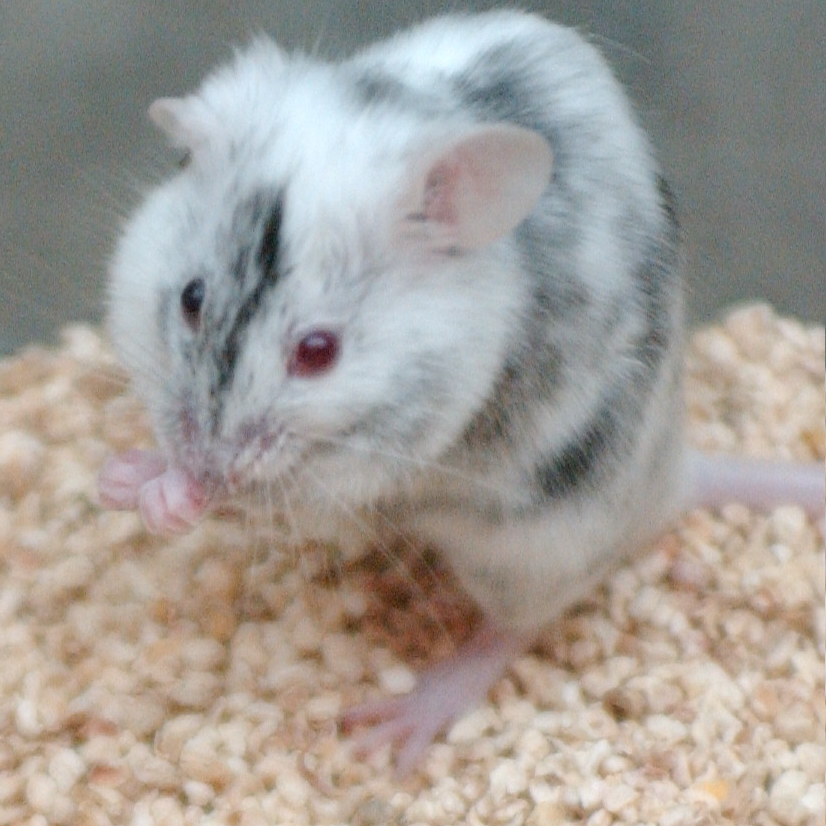
Mouse photograph provided by Thomas Saunders.
Typical ES cell-mouse chimera. A subclone of the Bruce4 ES cell line (Hughes et al. 2007) was used to target a critical gene. The black pigmented ES cells were microinjected into white (albino) B6(Cg)-Tyrc-2J/J (C57BL/6) mice (Le Fur et al. 1996). The resulting animal shows both black fur derived from ES cells and white fur derived from the albino embryo. Note the red left eye derived from albino embryo cells and the black right eye derived from black ES cells.
Safety warnings
All activities involving animals require approval by an IACUC or other relevant regulatory body prior to executing this protocol.
Breeding Guidelines for Established Mouse Lines
Keep accurate breeding records. Make a pedigree for every breeding pair. Every mouse in a colony can be traced back to the first mouse to make its entrance into the colony.
Genotype every transgenic mouse in the colony. Especially mice provided by colleagues or reputable vendors. Trust but verify. Genotyping assays are typically performed by PCR. The first time an assay is established the PCR product should be sequence to verify that is correct. See “Genotyping Mice by PCR and Copy Number Standards” in protocols.io.
Mate mice when they are sexually mature (6 to 8 weeks old).
We recommend all of the animals in your breeding cages, both males and females, be on LabDiet 5008 or LabDiet 5K52 equivalent diet, or other high quality rodent diet containing 6.0-6.5% crude fat.
Expect litters within a month of mating since female mice go into estrus every 3 or 4 days and the gestation time of mice is 19-21 days. If no litters are produced after one month you should replace the mice with a new breeding pair(s).
Anticipate adverse phenotypes from transgenic mice. It is possible that transgene expression cause infertility (Huttner et al. 1993). It is possible that gene knockouts will cause infertility that can only be overcome by in vitro fertilization (Wellik et al. 2002). Spontaneous mutations can lead to pituitary insufficiency that can be treated with hormone replacement therapy (Bartke. 1964).
Reasons to use C57BL/6J mice for breeding.
C57BL/6J is a standard inbred strain, commonly used in transgenic breeding.
The mouse reference genome is derived from C57BL/6J mice (Mouse Genome Sequencing Consortium, 2002).
Mate 6 - 8 week-old mice for best reproductive performance.
Replace males when they are 1 year or 6 months for inbred strains.
Replace females after 6 litters or when they are 6 months old.
Mate a male with 2 females to get 2 litters in close succession.
Mice usually mate again on the day the female gives birth, resulting in a second litter 3 weeks after the first.
To rapidly produce animals, rotate 2 females through a male's cage every 1- 2 weeks.
House pregnant females 1 or 2 per cage to prevent crowded cages.
Common problems and solutions,
Female may not care for first litter. Add proven breeder female to cage as helper and try again.
Female doesn't care for any litter. Often seen with 129 or Castaneus females kept on bedding which precludes the construction elaborate "subterranean" nests. Mating cages should include nesting material at all times.
Female may cannibalize litter. Ensure female has adequate diet. See suggestions above. Avoid “high” fat diet (>7%) as females will become infertile.
Male may cannibalize litter. Remove male from mating cage before female gives birth.
Fighting mice.
Separate the fighting mice, house them 1 per cage if necessary.
Females do not typically fight.
Males may fight in the following circumstances:
Male is placed in a cage containing other male(s).
Male is separated at weaning and then reunited with male littermates.
Male is weaned into a cage that contains males from another litter.
Males are aggressive and may begin to fight for no apparent reason
Adult male attacks immature female when female is placed in male's cage.
Schedule for ear tagging, tail biopsies, weaning, and mating:Untitled section
Record births on the cage card and the pedigree.
Ear tag the pups when they are two weeks old.
Collect tail tip biopsies or ear punches as you apply ear tags.
Isolate DNA and determine genotypes before pups are 21 days old.
Record genotypes in the pedigree.
Wean pups when they are 21 days old.
Remove the pups from their mothers into clean cages.
Discard un-needed non-transgenic pups.
House males and females separately to avoid unwanted pregnancies.
When mice are 6 weeks old they may be mated (see 1. above).
Vital statistics of the House Mouse, Mus Musculus.Untitled section
Genome
Number of chromosomes: 40.
Diploid DNA content about 6 pg per cell.
2.77 X10E9 bp per haploid genome (Liu et al. 2024).
Estimated number of genes: 24,268 (Mouse Genome Informatics, Baldarelli et al. 2024).
45% of the mouse genome is made up of repetitive DNA elements (Liao et al. 2022).
Reproductive Biology.
Gestation time 19 - 21 days, varies by strain.
Approximate weight at birth 1g.
Age at weaning 3 weeks.
Weaning weight 8 - 12g.
Age at sexual maturity 6 - 8 weeks.
Adult weight 30 - 40g (male > female).
Useful breeding life of females 6 - 8 months.
Useful breeding life of males 18 - 24 months.
Average litter size 6 – 8.
Total number of litters per breeding female 4 – 8.
Lifespan in laboratory 1.5 - 2.5 years.
Parameters such as gestation time, weight, lifespan, etc., vary between the different inbred strains.
Litter size depends on the number of eggs liberated at ovulation, the male's sperm count, and the rate of prenatal mortality. These may vary with age of mice, parity, and environmental conditions (e.g. diet, stress, presence of strange male) and with strain (reflecting genetic factors such as efficiency of placentation). Prenatal mortality in inbred strains can be around 10-20%.
Vital Statistics adapted from Manipulating the Mouse Embryo: A Laboratory Manual, by B. Hogan, R. Beddington, F. Constantini, and E. Lacey. 1994. Cold Spring Harbor Laboratory.
Bibliography for Additional Information on Mouse Breeding
The second edition of Biology of the Laboratory Mouse, by The Staff of the Roscoe B. Jackson Memorial Laboratory. 1966. Published by Blakiston Division of McGraw-Hill.
Handbook of Genetically Standardized JAX Mice. 1997. Section 10 on breeding genetically engineered mice. The Jackson Laboratory. (out of print, check book resellers or the Jackson Laboratory).
References
Mouse Genome Sequencing Consortium; Waterston RH, Lindblad-Toh K, Birney E, Rogers J, Abril JF, Agarwal P, Agarwala R, Ainscough R, Alexandersson M, An P, Antonarakis SE, Attwood J, Baertsch R, Bailey J, Barlow K, Beck S, Berry E, Birren B, Bloom T, Bork, Botcherby M, Bray N, Brent MR, Brown DG, Brown SD, Bult C, Burton J, Butler J, Campbell RD, Carninci P, Cawley S, Chiaromonte F, Chinwalla AT, Church DM, Clamp M, Clee C, Collins FS, Cook LL, Copley RR, Coulson A, Couronne O, Cuff J, Curwen V, Cutts T, Daly M, David R, Davies J, Delehaunty KD, Deri J, Dermitzakis ET, Dewey C, Dickens NJ, Diekhans M, Dodge S, Dubchak I, Dunn DM, Eddy SR, Elnitski L, Emes RD, Eswara P, Eyras E, Felsenfeld A, Fewell GA, Flicek P, Foley K, Frankel WN, Fulton LA, Fulton RS, Furey TS, Gage D, Gibbs RA, Glusman G, Gnerre S, Goldman N, Goodstadt L, Grafham D, Graves TA, Green ED, Gregory S, Guigó R, Guyer M, Hardison RC, Haussler D, Hayashizaki Y, Hillier LW, Hinrichs A, Hlavina W, Holzer T, Hsu F, Hua A, Hubbard T, Hunt A, Jackson I, Jaffe DB, Johnson LS, Jones M, Jones TA, Joy A, Kamal M, Karlsson EK, Karolchik D, Kasprzyk A, Kawai J, Keibler E, Kells C, Kent WJ, Kirby A, Kolbe DL, Korf I, Kucherlapati RS, Kulbokas EJ, Kulp D, Landers T, Leger JP, Leonard S, Letunic I, Levine R, Li J, Li M, Lloyd C, Lucas S, Ma B, Maglott DR, Mardis ER, Matthews L, Mauceli E, Mayer JH, McCarthy M, McCombie WR, McLaren S, McLay K, McPherson JD, Meldrim J, Meredith B, Mesirov JP, Miller W, Miner TL, Mongin E, Montgomery KT, Morgan M, Mott R, Mullikin JC, Muzny DM, Nash WE, Nelson JO, Nhan MN, Nicol R, Ning Z, Nusbaum C, O'Connor MJ, Okazaki Y, Oliver K, Overton-Larty E, Pachter L, Parra G, Pepin KH, Peterson J, Pevzner P, Plumb R, Pohl CS, Poliakov A, Ponce TC, Ponting CP, Potter S, Quail M, Reymond A, Roe BA, Roskin KM, Rubin EM, Rust AG, Santos R, Sapojnikov V, Schultz B, Schultz J, Schwartz MS, Schwartz S, Scott C, Seaman S, Searle S, Sharpe T, Sheridan A, Shownkeen R, Sims S, Singer JB, Slater G, Smit A, Smith DR, Spencer B, Stabenau A, Stange-Thomann N, Sugnet C, Suyama M, Tesler G, Thompson J, Torrents D, Trevaskis D, Tromp J, Ucla C, Ureta-Vidal A, Vinson JP, Von Niederhausern AC, Wade CM, Wall M, Weber RJ, Weiss RB, Wendl MC, West AP, Wetterstrand K, Wheeler R, Whelan S, Wierzbowski J, Willey D, Williams S, Wilson RK, Winter E, Worley KC, Wyman D, Yang S, Yang S-P, Zdobnov EM, Zody MC, Lander ES. 2002. Initial sequencing and comparative analysis of the mouse genome. Nature. 420:520-62.