Sep 18, 2025
Mouse and Rat Embryo Freezing and Recovery by Vitrification
- Thom Saunders1,2,
- Zachary T. Freeman1,2,
- Carlisle P. Landel3
- 1University of Michigan Transgenic Animal Model Core;
- 2The University of Michigan;
- 3Consulting Embryologist
- Thom Saunders: Orcid ID: 0000-0003-2015-101X;
- Zachary T. Freeman: Orcid ID: 0000-0003-1291-382X;
- Transgenic Animal Model Core



External link: https://michmed.org/z45g9
Protocol Citation: Thom Saunders, Zachary T. Freeman, Carlisle P. Landel 2025. Mouse and Rat Embryo Freezing and Recovery by Vitrification. protocols.io https://dx.doi.org/10.17504/protocols.io.bp2l6z7z5gqe/v1
License: This is an open access protocol distributed under the terms of the Creative Commons Attribution License, which permits unrestricted use, distribution, and reproduction in any medium, provided the original author and source are credited
Protocol status: Working
We use this protocol and it's working
Created: September 15, 2025
Last Modified: September 18, 2025
Protocol Integer ID: 227348
Keywords: Mouse, embryo, vitrification, cryopreservation, transgenic mice, genetic quality control , reanimation , embryo thawing, embryo transfer, blastocyst fertilized egg, cryopreserved embryos in the management, cryopreserved embryo, rat embryo freezing, cryopreservation of mouse line, laboratory cryogenic vials of embryo, thawing embryo, mice in quarantine, shipping embryo, mice in the vivarium, embryos in place, live mice, mouse colony, cryogenic vial, embryos in several location, cohorts of mice, large number of embryo, large number of mice, mice, aged mice, standardized mice, engineered mouse line, breeding cage, efficient mouse line management, mouse lines from environmental disaster, detailed vitrification protocol, reduction in animal use, mouse line, breeding pair, quarantine, mouse, accidental genetic contamination, jackson laboratory handbook on genetically, genetically, recovery by vitrification, cryo, biosecurity, animal use
Abstract
We provide a detailed vitrification protocol for freezing and thawing embryos that can contribute to efficient mouse line management. Cryopreservation of mouse lines is essential for the efficient management of mouse lines. When mouse lines are placed in a cryo-archive it is no longer necessary to maintain breeding pairs or mice in the vivarium, thus contributing to a reduction in animal use. When a mouse line is shared with another laboratory cryogenic vials of embryos can be shipped to a receiving institution where they can be recovered as live mice. Shipping embryos in place of live mice circumvents the need to establish mice in quarantine before they are mated to produce cohorts of mice for research. A large number of mice can be produced for a cohort of similarly aged mice for a research project by transferring a large number of embryos on the same day. This approach can accelerate research and prevent the need to set up breeding cages. Placing cryopreserved embryos in several locations can protect mouse lines from environmental disasters that can affect vivariums. Cryopreserved embryos can protect against viral or bacterial pathogen contamination; against accidental genetic contamination, against phenotypic drift in due to backcrossing complex genetic makeups into defined genetic backgrounds. For a description of the role of cryopreserved embryos in the management of mouse colonies see Chapter 8 of The Jackson Laboratory Handbook on Genetically Standardized Mice. In summary, cryo-archives provide biosecurity for valuable genetically engineered mouse lines and facilitate the sharing of irreplaceable research resources.
Image Attribution
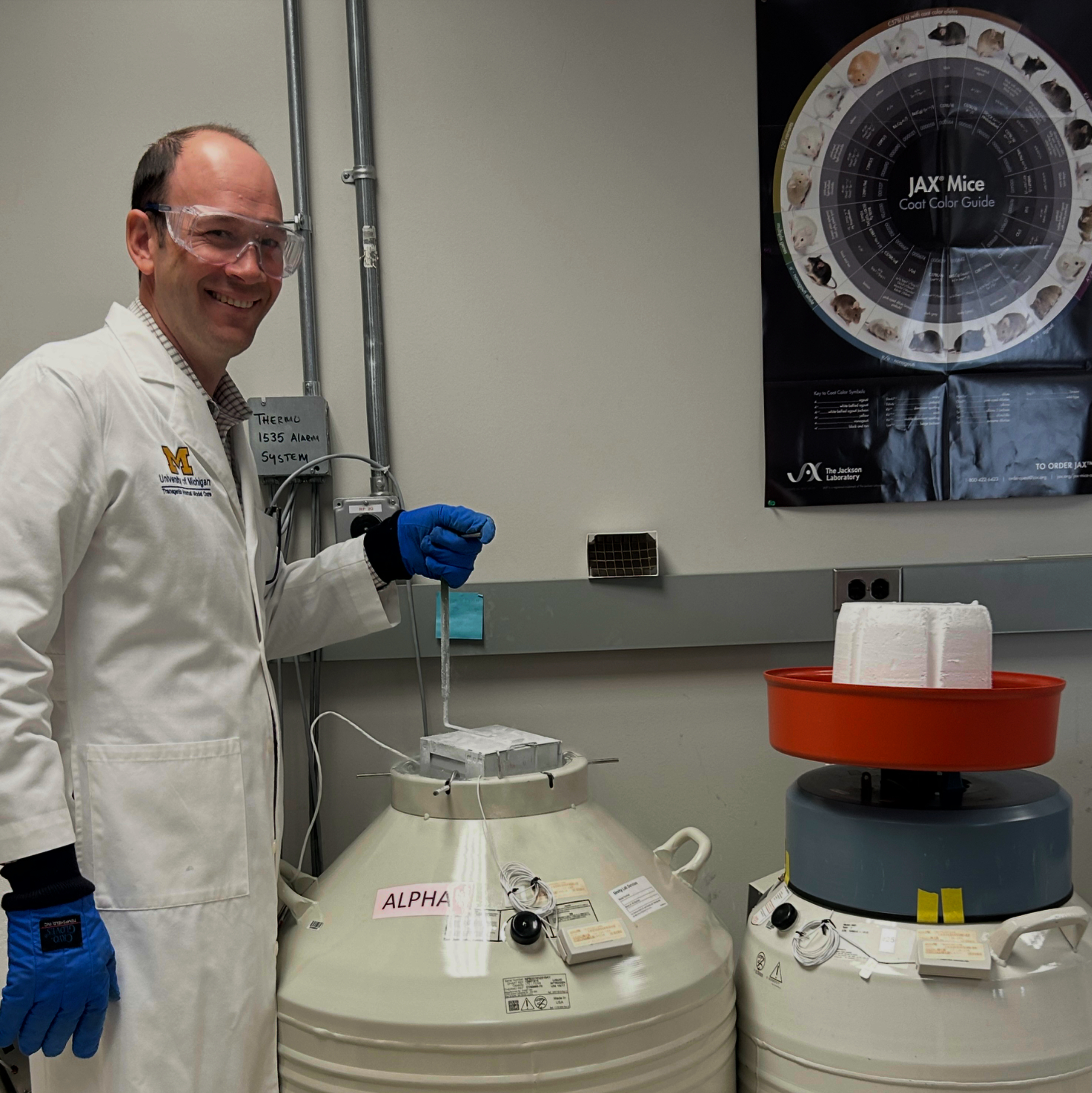
Dr. Zach Freeman demonstrates correct storage of vitrified mouse embryos. Photographer: Thomas Saunders.
Safety warnings
All activities involving animals require approval by an IACUC or other relevant regulatory body prior to executing this protocol.
Ethics statement
All animal activities described were reviewed and approved by the University of Michigan IACUC.
List of Materials
| A | B | |
| Reagent | Source | |
| 37°C, 5% CO2 humidified incubator. | ||
| 2-cell or 8-cell mouse embryos in culture medium in incubator. | ||
| Stereomicroscope. | ||
| Cryogenic Vial Box for cryogenic vial storage. | ||
| Liquid nitrogen storage Dewar for cryogenic vial storage. | ||
| Liquid nitrogen in a low pressure liquid nitrogen cylinder. | ||
| Styrofoam Vitrification boxes, 7 inches deep. | us.ivfstore.com | |
| Cryo-Babies tube Labels. | Research Products International | |
| *EmbryoMax Modified M2 with BSA and Phenol Red. | SigmaAldrich | |
| *EmbryoMax KSOM. | SigmaAldrich | |
| Embryo tested mineral oil. | SigmaAldrich | |
| DMSO, cell culture grade. | SigmaAldrich | |
| Propylene glycol. | SigmaAldrich | |
| Acetamide. | SigmaAldrich | |
| Sucrose. | SigmaAldrich | |
| Cryogenic Gloves. | Fisher Scientific | |
| General-Purpose 12" Extra-Long Forceps. | Fisher Scientific | |
| 60 mm petri dishes, Corning Falcon 353004. | Fisher Scientific | |
| 1 ml V-bottom cryogenic tubes. NUNC 366656. | Fisher Scientific | |
| 20, 200 and 1000 ml micropipettors and tips. | Fisher Scientific | |
| Gel-loading micropipette tips. | Fisher Scientific | |
| Ice bucket with ice or Labtop Cooler | Fisher Scientific |
*Depending on the manufacturer of mouse medium it may be necessary to supplement base media with antibiotics and/or bovine serum albumin. Add 100X penicillin/streptomycin (Fisher Scientific Cat. No. 15070-063) if needed. Add BSA to 4 mg/ml (SigmaAldrich Cat. no. A7979) if needed. The original formulations of M2 and M16 mouse media can be found in Behringer et al. 2014.
Prepare Solutions.
Prepare Solution A.
| A | B | |
| Item | Volume | |
| Modified M2 | 2.3 ml | |
| DMSO | 3.1 ml | |
| Propylene Glycol | 4.5 ml | |
| Total Volume | 10 ml |
Measure propylene glycol first and then add M2 and DMSO to propylene glycol. Note that DMSO and propylene glycol are viscous and need to be pipetted carefully for accurate volumes. Use Fresh.
Use Fresh. Prepare Solution B.
| A | B | |
| Item | Mass/Volume | |
| Acetamide | 1.18 mg | |
| Modified M2 | 10.0 ml |
Dissolve acetamide in M2.Use Fresh.
Prepare DAP213 Solution.
Prepare 1 M DMSO Solution.
| A | B | |
| Item | Volume | |
| DMSO | 2.0 ml | |
| Modified M2 | 23.0 ml | |
| Final volume | 25.0 ml |
Mix together, prepare 1.0 ml aliquots and store at -80°C.
Prepare Osmotic Buffer solution, 0.25 M Sucrose.
| A | B | |
| Item | Mass/Volume | |
| Sucrose | 1.7 g | |
| Modified M2 | 20.0 ml |
Dissolve sucrose in M2, prepare 1.0 ml aliquots and store at -80°C.
Procedure. Vitrification.
Fill two vitrification boxes with five inches of liquid nitrogen.
Chill long forceps tips by placing them into a box of liquid nitrogen.
Load ice bucket with ice or prepare 0°C block cooler.
Place DAP123 (2 M DMSO, 1 M acetamide, 3 M propylene glycol) aliquot on ice or in cooler.
Print or write on Cryo baby labels and apply to cryogenic tubes.
Place tubes on ice.
Place 100 µl drops of 1 M DMSO on lid of 60 mm petri dish at room temperature. Cover with bottom of dish.
Place mouse embryos into one drop of 1 M DMSO. Transfer a minimal volume of media with the embryos.
Divide the embryos among the DMSO drops so that each drop contains the numbers of embryos to be vitrified in one cryogenic vial.
Use a gel loading tip fitted to a 20 µl pipettor set to 5 µl. Pick up a group of embryos (up to 50 embryos) in 5 µl and place into a cryogenic vial.
Place the vial on ice or in the 0°C block for a minimum time of five minutes.
Add 45 µl of DAP123 to each cryogenic vial. Incubate on ice at 0°C for at least five minutes.
Use forceps to plunge each vial directly into liquid nitrogen in the first vitrification box until they are frozen ((liquid nitrogen stops boiling).
After all vials are frozen place them into a vial box that has been pre-cooled in the second vitrification box of liquid nitrogen. Record the coordinates of the vials in the vial box. Record the location of the box in the liquid nitrogen storage Dewar. Update the vial inventory system with the new information.
Procedure. Vitrified embryo recovery.Untitled section
Place four 100 µl drops of KSOM medium into the bottom of a 60 mm dish, cover with embryo tested mineral oil, add the dish lid and equilibrate in the incubator overnight or for at least an hour before thawing the embryos.
Prewarm an aliquot of 0.25 M sucrose to 37°C.
Remove the cryogenic vial from liquid nitrogen storage.
Open the cap of the vial and quickly empty out any liquid nitrogen before it can revert to gas and cause the vial to explode with concomitant sample loss.
Let the vial stand at room temperature for 30 seconds.
Add 0.9 ml of warm 0.25 M sucrose to the vial. Thaw the sample by gently pipetting the mixture until the sample is thawed.
Pipette the thawed embryos into the lid of 60 mm petri dish.
Rinse the cryogenic vial with 100 µl of 0.25 M sucrose and add it to the drop in the petri dish.
Cover the petri dish lid with the bottom of the dish and incubate at room temperature for 10 minutes.
Transfer the embryos into the first drop of equilibrated KSOM and then wash them through the other three drops to remove residual cryoprotective chemicals and sucrose.
Return dish to incubator.
Embryos now can be transferred to pseudopregnant female mice or cultured further to the blastocyst stage for downstream procedures such as embryonic stem cell derivation or microinjection with embryonic stem cells.
References
Behringer R, Gertsenstein M, Nagy, KV. Nagy A. 2014. Manipulating the Mouse Embryo: A Laboratory Manual, Fourth Edition. Cold Spring Harbor Laboratory Press, Cold Spring Harbor, NY.
The Jackson Laboratory Handbook on Genetically Standardized Mice. 2020. The Jackson Laboratory, Bar Harbor, ME
Landel CP. 2005. Archiving mouse strains by cryopreservation.
Lab Anim (NY). 34:50-57.
doi: 10.1038/laban0405-50.
Landel CP. 2010. Cryopreservation of mouse gametes and embryos.
Methods Enzymol. 476:85-105.
doi: 10.1016/S0076-6879(10)76006-7.