Jan 14, 2026
MODIFICATION OF THE INVERTED SCREEN TEST BY USING A CLOSED BOX
- Sergio Lopez de Davalillo Rodriguez1,
- Montserrat Arrasate1,2,
- Francisco José Álvarez Díaz3,4
- 1Molecular Brainlab, Biobizkaia Health Research Institute;
- 2Ikerbasque Research Associate Professor;
- 3Cruces University Hospital, Osakidetza, Basque Service of Health;
- 4Mental Health Network Group, Biobizkaia Health Research Institute



Protocol Citation: Sergio Lopez de Davalillo Rodriguez, Montserrat Arrasate, Francisco José Álvarez Díaz 2026. MODIFICATION OF THE INVERTED SCREEN TEST BY USING A CLOSED BOX. protocols.io https://dx.doi.org/10.17504/protocols.io.x54v954yql3e/v1
License: This is an open access protocol distributed under the terms of the Creative Commons Attribution License, which permits unrestricted use, distribution, and reproduction in any medium, provided the original author and source are credited
Protocol status: Working
We use this protocol and it's working
Created: November 06, 2025
Last Modified: January 14, 2026
Protocol Integer ID: 231670
Keywords: animal training, fatigue, devices, neuromuscular disorder, modification of the inverted screen test, inverted screen test measure, inverted screen test, screen test measures overall muscle strength, closed box the inverted screen test, laboratory animal technician, neuromuscular changes in animal model, measure of motor function, neuromuscular change, inverted position, such as parkinson, fatigue of rodent, overall muscle strength, laboratory, motor function, animal during the trial, amyotrophic lateral sclerosis, parkinson, multiple sclerosis, test
Funders Acknowledgements:
Plan Estatal de Investigación Científica y Técnica y de Innovación 2021-2023, Agencia Estatal de Investigación
Grant ID: PID2023-151717OB-I00 MCIU/AEI/10.13039/501100011033
Ikerbasque-The Basque Foundation for Science
Grant ID: .
Occident Foundation
Grant ID: .
BBK Foundation
Grant ID: .
DalecandELA Association
Grant ID: .
Disclaimer
DISCLAIMER – FOR INFORMATIONAL PURPOSES ONLY; USE AT YOUR OWN RISK
The protocol content here is for informational purposes only and does not constitute legal, medical, clinical, or safety advice, or otherwise; content added to protocols.io is not peer reviewed and may not have undergone a formal approval of any kind. Information presented in this protocol should not substitute for independent professional judgment, advice, diagnosis, or treatment. Any action you take or refrain from taking using or relying upon the information presented here is strictly at your own risk. You agree that neither the Company nor any of the authors, contributors, administrators, or anyone else associated with protocols.io, can be held responsible for your use of the information contained in or linked to this protocol or any of our Sites/Apps and Services.
Abstract
The inverted screen test is frequently used to evaluate neuromuscular changes in animal models of different diseases, such as Parkinson's disease, Amyotrophic Lateral Sclerosis, Huntington's disease, Nieman-Pick disease, Gaucher, Pompe, mucopolysaccharidosis, Multiple Sclerosis, etc...
The inverted screen test measures overall muscle strength, coordination, and fatigue of rodents by measuring how long they can hold on to a wire mesh grate in an inverted position. This rapid and cost-effective method provides a validated measure of motor function.
Variability in the execution of the steps of the original protocol by each laboratory animal technician (LAT) however, may alter results. In addition, proximity of LAT staff to the animal during the trial, as well as the inadequacy of the required materials, can also contribute to alter the results.
Image Attribution
Copyright F.J. Alvarez
Guidelines
It is recommended to review the following guidelines:
- Guidelines for the Accommodation and Care of Animals Used for Experimental and Other Scientific
Purposes, accessed at https://eur-lex.europa.eu/LexUriServ/LexUriServ.do?uri=OJ:L:2007:197:0001:0089:EN:PDF
- PREPARE, accessed at https://norecopa.no/prepare/12-housing-and-husbandry/12a/general-principles/
- Guide for the Care and Use of Laboratory Animals, accessed at https://olaw.nih.gov/policies-laws/guide-care-use-lab-animals
Materials
The original protocol describing the inverted screen test [1] states that the mesh must allow mice to move easily and freely across it. This means the spacing between the bars should be close enough to allow free and easy movement of the mice. Additionally, the width of the bars should be thin enough to allow full grip with their small claws. According to the original description [1], the grid should be a square of wire mesh with a side of 43 cm with openings forming small squares with a side of 10 to 12 mm. The mesh wire should be 1 mm thick1 mm , and the screen should have a 4 cm barrier along all sides to prevent the mouse from climbing over and escaping.
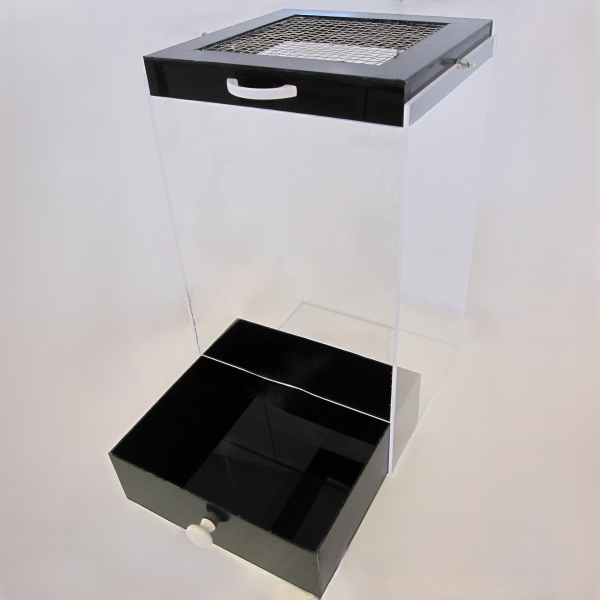
1. Trial box. A closed-trail box was designed for the inverted screen test with three main elements: a cover with grid and barrier, a holding support and a recovery drawer (Figure 1).
Figure 1. General view of the trial box for the inverted screen test. c: cover with the grille and climbing barriers; s: cover holding support; d: closed recovery drawer.
1.1 The designed box maintains the main characteristics of the original screen [1]. The cover measures 30 x 30 cm, and consists of a screen and its mounting frame. The grid frame has a 4 cm high vertical enclosure on all four sides to prevent the mouse from climbing to the opposite side of the grid (Figure 2A). The lid includes a frontal manipulation handle and two lateral axes. Both lateral axes allow a 180-degree rotation to invert the holding (upright) and test surfaces on negative geotaxis (Figure 2B). The grating consists of a 1mm diameter stainless steel square mesh with 10 mm mesh spacing (Figure 2C).
Figure 2. Cover with grid and enclosure. a: axes of rotation; mh: manipulation handle. (A) Start position of the cover with deep beadings up. (B) Lid rotation. Arrow indicates the cover turn according to the rotation axis. (C) Inverted position of the lid and enlarged detail of the wire mesh. The wire mesh has a square size of 10mm and a thread thickness of 1mm.
1.2 The holding body functions as a support for the cover, allowing a smooth and uniform rotation using locking pivots, and maintaining a constant height of 50 cm. This design allows the experimenter to stay away from the animal and the testing area during the procedure (Figure 3). The body of the box is transparent, so the animal can be continuously observed while ensuring it cannot escape.
Figure 3. Lid support during trial for the animal in negative (inverted) geotaxis. The lid remains at a 50-cm height (h) avoiding variability due to LAT handling.
1.3 The closed drawer delimits a closed space 10 cm high in which the shock-absorber material is located (bed, mattress, polyspan, etc.). It can be easily removed from the holding body using a steel knob (Figure 4).
Figure 4. Recovery drawer for placing the shock-absorbing material to avoid fall injuries at animals. It has a knob (k) to open and close the drawer. The closed position drawer prevents the animal from escaping after falling.
The trial box is made of methacrylate with the exception of the screen, handle, knob and axes which are made of stainless steel facilitating easy cleaning and disinfection. 100 €
2. Chronometer.
3. 70% ethanol solution and towels.
4. GoPro camera (for record).
5. Bedding material as a fall cushion.
Troubleshooting
Problem
Mouse falls quickly from the grate.
Solution
1. In a normal situation, mice will resist for shorter periods in successive tests due to fatigue. Allow to rest the animal beetwen different trials.
2. The bars of the grid are too thick. Use adequate grid with a thicker less than 1 mm.
Problem
Motivation and anxiety of the animals can influence the results during runs and trials.
Solution
Repeat the test after 1 hour.
Safety warnings
The use of animals in biomedical research is regulated to varying degrees in different countries. Some countries have very lax regulations, while in the EU it is strictly regulated and monitored. There is undeniably a strong ethical debate surrounding the necessity of animal experimentation. Proponents argue that it has driven significant advances in medicine and other fields, while opponents raise concerns about animal cruelty and question its efficacy and reliability. Therefore, the use of this type of protocol must be framed within the strictest moral, scientific, and legal controls. Please use and disseminate this protocol responsibly.
Ethics statement
The experimental protocol satisfies European and Spanish regulations for the protection of experimental animals (86/609/EEC and RD 53/2013). The study protocol was evaluated by the Animal Welfare Body from the Biobizkaia Health Research Institute and was performed in its experimental laboratories (permit no. OEBA-2024-006; OEBA-2024-007).
All experimental procedures were designed and conducted by personnel qualified in Laboratory Animal Science,
following the Federation of European Laboratory Animal Science Associations (FELASA) recommendations on categories B and C for Laboratory Animal Technician (LAT). Also, all experimental procedures on animal welfare were conducted in compliance with FELASA recommendations.
Before start
GENERAL OBSERVATIONS WHEN CONDUCTING BEHAVIORAL TESTS
It is essential to maintain consistent and controlled conditions to ensure reliable and valid results when conducting behavioral tests on rodents. Some important steps are:
Environment: The environmental room must be strictly controlled, in order to reduce the noise levels, fluctuations of room temperature, poor or excessive lighting, and undesired odors. When multiple technicians are present in the room, verbal communication should be avoided, and movements should be gentle to prevent startling the mice.
Homogenous sample: The mice in the experimental and control groups must be matched in terms of age, sex, body weight, and motor function status. Mice with abnormalities should be excluded to avoid confounding factors.
Genetics: The genetic background of rodents plays a crucial role in behavioral testing. Strain-specific behavioral phenotypes can significantly influence the results; therefore, it is important to ensure that same genetic background in all animals. This is a hot topic in disease or mutant models such as those used in multiple sclerosis research, where genetic variability can introduce unwanted biases.
Housing: The environment, including the number of cage mates, ambient enrichment, and lighting schedules, can greatly influence behavior. These factors should be consistent across all experimental groups to avoid variability that negatively affect the behavioral test results.
Order assignment: Often experimental design involves a behavioral test battery. The order in which these tests are accomplished is of utmost importance. Certain tests can affect the results of subsequent assessments, so careful planning and resting periods between tests should be planned.
Resting and recovery: Animals should rest adequately between tests to partially regain strength and mitigate weariness of previous tasks. The breaks helps to obtain more accurate measurements of their performance.
Cleaning and deodorizing: Apparatus should be thoroughly cleaned after each trial with a 70% ethanol solution to remove any excrement or olfactory cues that could influence the behavior of animals.
Acclimation: Mice should be acclimated to the test room before the start of the trials to reduce fear and anxiety, which improves assessments and reduces variability.
Blind data analysis: Whenever possible, data analysis should be performed with blinded technicians or researchers at the animal assignment groups to reduce experimenter bias.
Standardized protocols: While standard operating procedure (SOP) are essential, some flexibility is needed to adapt to specific laboratory conditions and available equipment. Any SOP modification should be documented and validated to maintain the integrity of the study. Protocols should be optimized, standardized, and strictly controlled to improve the reliability and reproducibility of the findings.
Preparing the trial box
1m
A shock-absorbing bedding material is placed in the recovery drawer to prevent injuries at the animals when they fall.
Closed drawer with shock-absorbing material.
1m
Animal assignment
5m 35s
Mice are randomly allocated for evaluation with their order recorded in the laboratory notebook.
The recording of the animal's data must be meticulous.
5m
The mouse is placed at the center of the top of the grid (side with the barrier), holding onto the wire.
Placement of the mouse in the center of the lid (start position).
30s
A gentle shake is applied to the mouse to encourage it to hold onto the grate.
5s
Inverted trial
3m 2s
The grid is rotated 180 degrees in about 2 seconds, so that the mouse is hanging in an inverted position. During the turn, the mouse's head should be below its body.
Turning the lid with the animal clinging to the grate.
2s
The cover is maintained with the hanging mice on the inverted surface (negative geotaxis) at a height of 50 cm.
Animal in negative (inverted) geotaxis during a trial.
3m
The time elapsed from turning the grid until the animal falls is measured and recorded.
Animal falls to the shock-absorver materials.
Recovery and animal rest
1m
If the mouse lasts longer than the time limit established, remove it from the grate, stop the chronometer, and record this time.
Stop the chronometer and recover the animal.
1m
Trial evaluation
10m
The mouse is allow to repeat 3 times (runs) the test (trial). Each trial is repeated twice, allowing to replenish itself by wandering around the cage with the blanket for approximately 1 minute.
Mouse is resting in the drawer beetwen runs.
10m
Recovery the mouse
1m 30s
Open the drawer and recover the mouse.
Extraction of the animal from the closed drawer.
30s
Leave the animal to rest in its cage.
To avoid altering animal behavior, the original box where each animal was allocated shoul be used.
1m
Trial evaluation
10m
A new test with a new animal should not start until the 3 runs of the previous one have been completed. Scores for each trial can be recorded as the average of the 3 runs or as independent values showing all runs. Also, it can be registered the best one only.
Table to quantify the run score.
Preparing box for next trial
30s
Before starting the following test with another animal, the cover and the screen should be cleaned with 70% ethanol solution.
The portable lid is cleaned and deodorized with 70% ethanol solution between trials.
30s
Protocol references
1. Kondziela, W. Eine neue method zur messung der muskularen relaxation bei weissen mausen. Arch Int Pharmacodyn 1964;152: 277-84.
2. Deacon RM. Measuring the strength of mice. J Vis Exp 2013; 76:e2610.
3. Sampson T, Krout IN, White A. 2024. Wire hang assessment. Protocols.io https://dx.doi.org/10.17504/protocols.io.3byl4qy9zvo5/v1, Reviewed: Jan 13, 2024.
4. Kamal OMF, Ojeda DD, Selma B, Benito MS, de la Fuente S, García M, Larriba T, Sancho F, Matias JA, Matias J, Gómez U. Technical assessment of motor and behavioral tests in rodent models of multiple sclerosis. J Integr Neurosci 2025, 24:26429