Nov 20, 2024
Minibulk v2 (modified Prime-seq)
Forked from prime-seq
- Daniel V Brown1
- 1Walter and Eliza Hall Institute


Protocol Citation: Daniel V Brown 2024. Minibulk v2 (modified Prime-seq). protocols.io https://dx.doi.org/10.17504/protocols.io.kxygx34qog8j/v1
Manuscript citation:
This protocol is a fork of Prime-Seq:
Janjic, A., Wange, L.E., Bagnoli, J.W. et al. Prime-seq, efficient and powerful bulk RNA sequencing. Genome Biol 23, 88 (2022). https://doi.org/10.1186/s13059-022-02660-8
License: This is an open access protocol distributed under the terms of the Creative Commons Attribution License, which permits unrestricted use, distribution, and reproduction in any medium, provided the original author and source are credited
Protocol status: Working
We use this protocol and it's working
Created: December 20, 2023
Last Modified: November 20, 2024
Protocol Integer ID: 92532
Keywords: bulk RNA sequencing, RNA-seq, transcriptomics, SCRB-seq, barcoding bulk rna, standard bulk rna, bulk rna, genomics facility amendments from prime, 10x genomics indexing primer, compatibility with 10x genomics indexing primer, rna, reverse transcription of prime, genomics facility amendment, rnase inhibitor, sequencing, cell rna, 10x genomics chemistry, reverse transcription, efficient library generation by early barcoding, minibulk v2, seq, efficient library generation, full length cdna amplification
Abstract
Cost-efficient library generation by early barcoding has been central in propelling single-cell RNA sequencing. Here, we optimize and validate prime-seq, an early barcoding bulk RNA-seq method. We show that it performs equivalently to TruSeq, a standard bulk RNA-seq method, but is fourfold more cost-efficient due to almost 50-fold cheaper library costs. We conclude that prime-seq is currently one of the best options to set up an early barcoding bulk RNA-seq protocol from which many labs would profit.
WEHI advanced Genomics facility amendments from Prime-seq:
The plasticware has been changed from 96w plates to 384w and volumes have been reduced 1/4. The reverse transcription of Prime-Seq does not use RNase inhibitors, which I have included.
The primers used for full length cDNA amplification have been taken from 10x Genomics chemistry. This adds compatibility with ONT sequencing (FLT-Seq) developed by Jafar and compatibility with 10x Genomics indexing primers set TT.
Guidelines
- All reagents and plastic-ware can be found in the 'Materials' section.
- Use only RNase free supplies and clean all surfaces and tools with RNase Away prior to working
- Make sure all steps involving cell lysate and RNA before reverse transcription are carried out swiftly and on ice.
- All primer sequences are listed below:
| A | B | C | D | E | F | |
| Oligo | Vendor | Purification | Working Conc. | Sequence | Notes | |
| MB2_KF_DS RT primer | IDT | Standard Desalting | 100 µM | ACACGACGCTCTTCCGATCTNNNNNNNNYRNNNYRNNN[10nt_BC]TTTTTTTTTTTTTTTTTTTTTTTTTTTTTTVN | ||
| Biotin RAP-TSO | Sigma | RNase-Free HPLC | 100 µM | /5Biosg/AAGCAGTGGTATCAACGCAGAGTACrGrGrG | Biotin reduces concatemers | |
| RAP_PCR-1_Fwd | IDT | Standard Desalting | 10 µM | CTACACGACGCTCTTCCGAT*C*T | PCR1 primer | |
| 10uM RAP-FL_Rev | IDT | Standard Desalting | 10 µM | AAGCAGTGGTATCAACGCAG*A*G | PCR1 primer | |
| tenX_adaptTop | IDT | Standard Desalting | 1.5 µM | 5Phos/GATCGGAAGAGCACACGTCTGAACTCCAGTCAC | Orded as pre-duplexed DNA | |
| tenX_adaptBot | IDT | Standard Desalting | 1.5 µM | GCTCTTCCGATC*T | Orded as pre-duplexed DNA |
Specific barcoded oligodT (MB2_Kx_DS_RT primer):
Base design is based off Karst et al., https://doi.org/10.1038/s41592-020-01041-y
- MB2 = protocol
- KF = Karst design forward UMI = NNNNNNNNYRNNNYRNNN
- KR = Karst design reverse UMI = NNNNNNNNRYNNNRYNNN
- Forward and reverse designs to improve complexity in Illumina sequencing
- DS = David Squire designed the well barcodes and thermodynamic properties
- RT = reverse transcription
 mb_v2_384w_v1.xlsx
 Materials
MATERIALS
DNase I Reaction Buffer - 6.0 mlNew England BiolabsCatalog #B0303S
DNase I (RNase-free) - 1,000 unitsNew England BiolabsCatalog #M0303S
SPRIselect reagent kitBeckman CoulterCatalog #B23317
Deoxynucleotide Solution Mix - 40 umol of eachNew England BiolabsCatalog #N0447L
Exonuclease I (E.coli) - 3,000 unitsNew England BiolabsCatalog #M0293S
5 M Sodium chloride (NaCl)Merck MilliporeSigma (Sigma-Aldrich)Catalog #S5150-1L
Maxima H Minus Reverse Transcriptase (200 U/uL)Thermo Fisher ScientificCatalog #EP0752
SUPERaseIN RNase InhibitorThermo Fisher ScientificCatalog #AM2696
NEBNext Ultra II FS DNA Library Prep with Sample Purification Beads - 24 rxnsNew England BiolabsCatalog #E6177S
EDTAMerck MilliporeSigma (Sigma-Aldrich)Catalog #E7889
Ethanol absoluteCarl RothCatalog #9065.4
KAPA HiFi 2x RMKapa BiosystemsCatalog #KR0370
UltraPure DNase/RNase Free Distilled WaterCatalog #10977-049
Buffer EBQiagenCatalog #19086
Trizma hydrochloride solutionMerck MilliporeSigma (Sigma-Aldrich)Catalog #T2694
Aluminium seals for cold storageCatalog #391-1275
PCR SealsThermo ScientificCatalog #AB0558
Dual Index Kit TT Set A10x GenomicsCatalog #1000215
Protocol materials
Dual Index Kit TT Set A10x GenomicsCatalog #1000215
DNase I Reaction Buffer - 6.0 mlNew England BiolabsCatalog #B0303S
Trizma hydrochloride solutionMerck MilliporeSigma (Sigma-Aldrich)Catalog #T2694
SPRIselect reagent kitBeckman CoulterCatalog #B23317
Deoxynucleotide Solution Mix - 40 umol of eachNew England BiolabsCatalog #N0447L
DNase I (RNase-free) - 1,000 unitsNew England BiolabsCatalog #M0303S
Buffer EBQiagenCatalog #19086
PCR SealsThermo ScientificCatalog #AB0558
5 M Sodium chloride (NaCl)Merck MilliporeSigma (Sigma-Aldrich)Catalog #S5150-1L
KAPA HiFi 2x RMKapa BiosystemsCatalog #KR0370
Exonuclease I (E.coli) - 3,000 unitsNew England BiolabsCatalog #M0293S
SUPERaseIN RNase InhibitorThermo Fisher ScientificCatalog #AM2696
EDTAMerck MilliporeSigma (Sigma-Aldrich)Catalog #E7889
Ethanol absoluteCarl RothCatalog #9065.4
UltraPure DNase/RNase Free Distilled WaterCatalog #10977-049
Aluminium seals for cold storageCatalog #391-1275
Maxima H Minus Reverse Transcriptase (200 U/uL)Thermo Fisher ScientificCatalog #EP0752
NEBNext Ultra II FS DNA Library Prep with Sample Purification Beads - 24 rxnsNew England BiolabsCatalog #E6177S
Troubleshooting
Safety warnings
Please follow all Manufacturer safety warnings and recommendations.
Keep a separation of pre and post PCR steps
Before start
Wipe bench surfaces with PCR clean wipes and keep working environment clean.
Preparation
12m
Clean all surfaces and pipettes with PCR clean wipes
5m
Turn on a lab oven to 50 °C and another to 65 °C
Thaw frozen buffers and primers on ice
10m
Prepare fresh 80% EtOH
2m
Prepare 900 µL diluted AMPure RNA XP beads: 1:4 in SPRI buffer per tube
225 µL RNA beads to 675 µL SPRI buffer
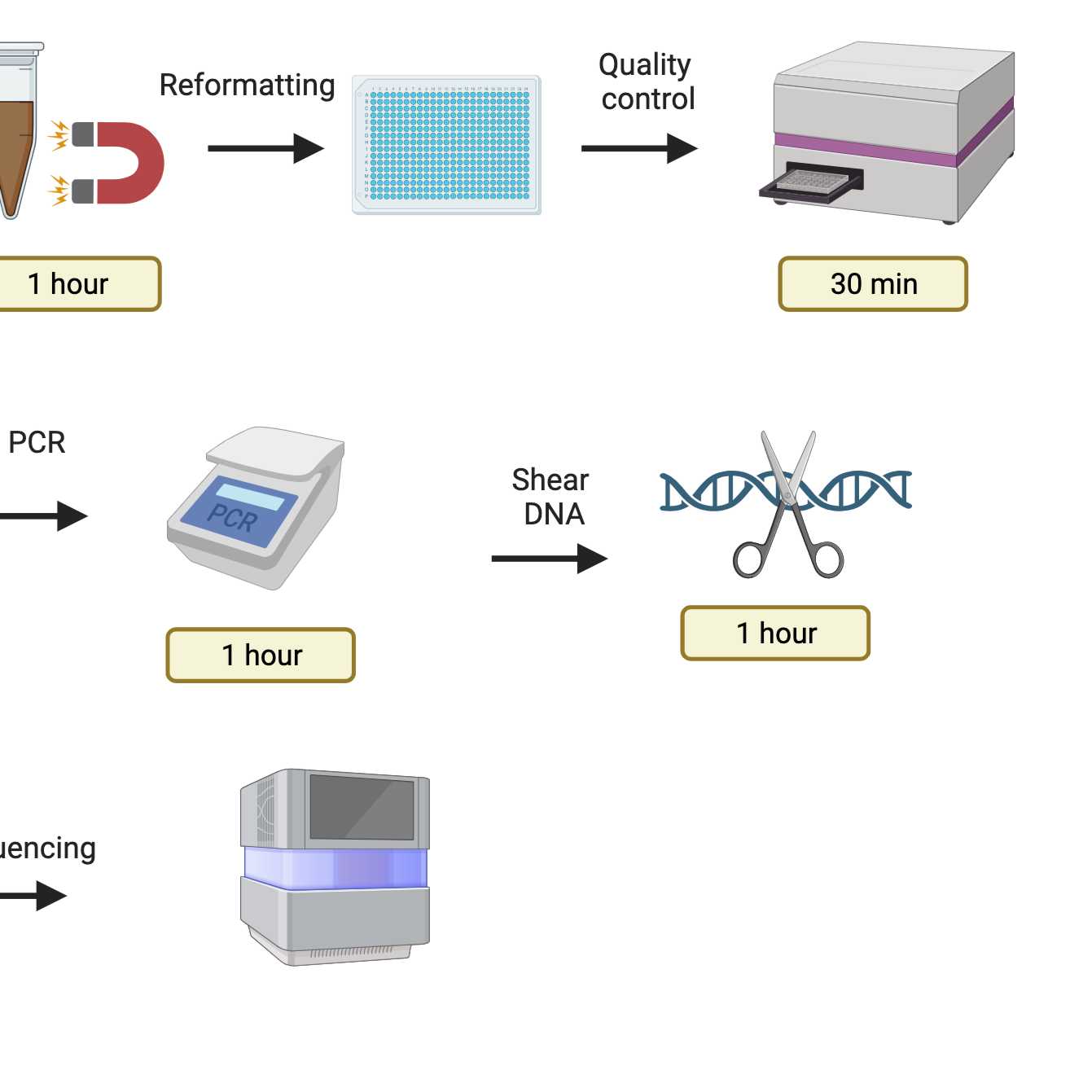
Input to minibulk v2 is extracted RNA or sorted cells.
It is essential, however, that the samples either have the same input or that they are normalized after the RNA is extracted, otherwise sequencing depth per sample will be impacted.
Extracted RNA76 steps
Follow this case if you are testing samples that have already been RNA extracted, were DNase treated, and have been normalized to the same input. The step here will guide you in preparing RNA-seq libraries and sequencing.
Example: 1 ng of total RNA from a cell line
Sample Preparation
Normalize the samples so they are all the same concentration.
Note
Minimum: 100 pg
Maximum: 4 ng
Transfer 1.2 µL of the normalized RNA to a new plate. Return the unnormalized RNA to the freezer.
You may store the sample plates at -80 °C at this point
Reverse Transcription
30m
Prepare Reverse Transcription Mix
Store on ice until use
| A | B | C | D | |
| Reagent | Well uL | 384w plate + 20% | Conc | |
| UltraPure Water | 0.5625 | 285.1 | ||
| Maxima RT Buffer (5x) | 0.5 | 253.4 | 1x | |
| 100mM dNTPs | 0.0125 | 6.3 | 500nM | |
| 100uM Biotin RAP-TSO | 0.025 | 12.7 | 1uM | |
| SuperaseIN | 0.125 | 63.4 | 1U | |
| Maxima H Minus RT | 0.075 | 38.0 | 1U | |
| Total (incl RNA) | 2.5 | 1267.2 |
Remove 384w plates from -80C freezer, thaw on ice and quick spin
Incubate 65 °C for 00:05:00
After this step increase the oven to 80 °C for later use
Add 1.3 µL Reverse Transcription Mix to each well with the FlexDrop
Incubate for 01:00:00 at 50 °C
1h
Incubate for 00:10:00 at 80 °C
10m
cDNA Pooling & Purification
40m
Pool all wells of each plate by inversion into a SBS reservoir using a centrifuge 400 x g, 4°C, 00:02:00
collect into a 5mL LoBind tube.
Measure the approximate volume in each cDNA pooled tube by measuring by pipette
Should be less than 870 µL
Perform 1x SPRI ratio cleanup with SPRI beads diluted 1:4 in SPRI buffer
Incubate for 00:05:00 at Room temperature to allow binding of the cDNA onto beads
Wash with 2 mL of 80% EtOH while the tube is on the magnet. Discard the supernatant
Note
Volume of EtOH should be adjusted depending on the number of samples. More samples will require more EtOH to cover the beads completely.
Repeat wash step once more
Remove tubes from magnet and quick spin in centrifuge.
Use a large centrifuge for 5mL tubes if necessary
Air dry beads for 00:02:00
Note
Daniel prefers 2 minutes to 5 minutes to reduce risk of overdrying. It is important to regularly check the beads and avoid over-drying.
2m
Elute the beads in 45 µL of UltraPure Water
Incubate for 00:05:00 at RT off the magnet
Incubate for 00:02:00 on the magnet and transfer 43 µL to a new PCR tube or plate
Exonuclease I Treatment
Add 2 µL of ExoI Buffer (10x) and 1 µL of Exonuclease I. Incubate as follows:
| A | B | C | |
| Step | Temp | Time | |
| Digest | 37 | 20 | |
| Heat inactivation | 80 | 10 | |
| Storage | 4 | Infinite |
Perform 0.8x SPRI bead size selection with 40 µL undiluted SPRI beads.
Incubate for 00:05:00 at Room temperature to allow binding of the cDNA onto beads
Place the tube on the magnet stand for 00:05:00 and discard supernatant
Wash with 180 µL of 80% EtOH while the tube is on the magnet, discard the supernatant
Repeat wash step once more
Air dry beads for 00:02:00
Note
Depending on temperature and humidity, the beads may dry faster. Therefore it is important to regularly
check the beads and avoid over-drying.
Elute the beads in 22 µL of UltraPure Water
Incubate for 00:05:00 at RT off magnet
00:02:00 on magnet then transfer 20 µL to a new PCR tube or plate
Full length cDNA Amplification
30m
Prepare Pre Amplification Mix
| A | B | |
| Reagent | 1x | |
| KAPA HiFi 2x RM | 25 µL | |
| 10uM RAP_PCR-1_Fwd | 2 µL | |
| 10uM RAP-FL_Rev | 2 uL | |
| UltraPure Water | 1 µL | |
| Total | 30 µL |
Add 30 µL Pre Amplification Mix to 20 µL cDNA sample
Incubate the Pre Amplification PCR as follows:
| A | B | C | D | |
| Step | Temperature | Time | Cycles | |
| Initial Denaturation | 98 C | 3 min | 1 cycle | |
| Denaturation | 98 C | 15 sec | 10 - 18 cycles* | |
| Annealing | 65 C | 30 sec | ||
| Elongation | 72 C | 4 min | ||
| Final Elongation | 72 C | 10 min | 1 cycle | |
| Storage | 4 C | ∞ |
Note
Adjust the number of cycles based on input (sample number, cell number, or concentration).
As a general guide we recommend:
Daniel's experience is it is better to err on more PCR cycles for this full length PCR and less for the 2nd library PCR.
| A | B | |
| Total RNA Input | Cycles | |
| 1ng | 18 | |
| 10 ng | 16 | |
| 50 ng | 14 | |
| 100 ng | 12 | |
| >500 ng | 10 |
cDNA Bead Purification
30m
Mix sample with 40 µL SPRIselect for a 0.8x SPRI to sample ratio
Incubate for 00:05:00 at 20 °C (Room Temp)
Place the tube on the magnet stand until clear (~3 min) and discard supernatant
Wash with 180 µL of 80% EtOH while the tube is on the magnet, discard the supernatant
Repeat wash step once more
Air dry beads for 00:02:00
Note
Depending on temperature and humidity, the beads may dry faster. Therefore it is important to regularly check the beads and avoid over-drying.
2m
Elute cDNA in 12 µL UltraPure Water
Incubate for 00:05:00 at RT and transfer 10 µL to a new PCR tube or plate
Note
Stopping Point. cDNA samples can be safely stored at -20 °C and protocol can be continued at a later date.
cDNA Quantification and Quality Check
20m
Quantify the cDNA using Qubit DNA HS following the manufacturer's protocol. Use 2 μl of clean cDNA for quantification.
Quality check the cDNA using the Tapestation D5000 tape.
Note
Passing the cDNA quality check does not guarantee that the data will be of high quality, however, if the cDNA fails the quality check it will usually not yield good libraries and will therefore generate lower quality data.
Expected result
Example tapestation D5000 HS
Library Preparation
15m
The input to library preparation is amplified full length cDNA from each pooled 384w plate.
Note
Before starting, read the library preparation section carefully as there are a few steps that are very time sensitive.
Prepare Fragmentation Mix
Take note of the total cDNA input in ng as it will be relevant in later PCR step
| A | B | |
| Reagent | 1x | |
| Ultra II FS Reaction Buffer | 1.4 µL | |
| Ultra II FS Enzyme Mix | 0.4 µL | |
| Amplified cDNA | 2.5 µL | |
| Water | 1.7 µL | |
| Total | 6 µL |
Note
Ensure that the Ultra II FS Reaction Buffer is completely thawed. If a precipitate is seen in the buffer, pipette up and down several times to break it up, and quickly vortex to mix. Place on ice until use.
Note
Vortex the Ultra II FS Enzyme Mix for 5-8 seconds prior to adding to master mix for optimal performance.
Vortex the Fragmentation Mix for00:00:05 and incubate in thermocycler immediately
Incubate the Fragmentation reaction in a thermocycler as follows:
| A | B | C | |
| Step | Temperature | Time | |
| Pre-Cool | 4 C | ∞ | |
| Fragmentation | 37 C | 5 min | |
| A Tailing and Phosphorylation | 65 C | 30 min | |
| Storage | 4 C | ∞ |
Note
Set heated lid to 75° C. Make sure the lid is at the correct temperature before you start the reaction.
After placing your samples, skip the 4C step to begin the 37C incubation once you have added your samples.
Adapter Ligation
45m
Prepare Adapter Ligation Mix
| A | B | |
| Reagent | 1x | |
| NEBNext Ultra II Ligation Master Mix | 6 µL | |
| NEBNext Ligation Enhancer | 0.2 µL | |
| 1.5uM IDT custom adapter (pre-annealed tenX_top and tenX_bottom) | 0.5 µL | |
| Total | 6.7 µL |
Add 6.7 µL Adapter Ligation Mix to each fragmentation sample
Incubate for 00:15:00 at 20 °C in a thermocycler
Set heated lid to off
Add 7.7 µL Buffer EB to Samples
Mix samples with 16 µL SPRI select beads for a 0.8x SPRI ratio
Note
The volume of SPRI select beads used during library size selection can be adjusted based on desired library size. Optimization for your samples may be required.
Incubate for 00:05:00 at 20 °C (Room Temp)
Place the plate on the magnet stand until clear and discard supernatant.
Wash with 180 µL of 80% EtOH while the plate is on the magnet. Discard the supernatant
Repeat wash step once more
Air dry beads for 00:02:00
Note
Depending on temperature and humidity, the beads may dry faster. Therefore it is important to regularly check the beads and avoid over-drying.
2m
Elute samples in 22 µL water for 00:05:00 off magnet
Incubate 00:02:00 on magent
Transfer 20 µL sample to a new tube
7m
Library PCR
30m
Prepare Library PCR Mix by adding 25 µL Kappa HiFi polymerase to the 0.2mL tube containing purified adapter ligated sample.
Add 5 µL of Dual Index Kit TT Set A10x GenomicsCatalog #1000215 to each sample.
Take care to change tips and avoid cross contamination
Note
Ensure a different index for each samples as this is the unique index that will be used for demultiplexing libraries.
Incubate the Library PCR reaction as follows:
| A | B | C | D | |
| Step | Temperature | Time | Cycles | |
| Initial Denaturation | 98 C | 30 sec | 1 cycle | |
| Denaturation | 98 C | 20 sec | 8 cycles* | |
| Annealing | 54 C | 30sec | ||
| Elongation | 72 C | 20 sec | ||
| Final Elongation | 72 C | 2 min | 1 cycle | |
| Storage | 4 C | ∞ |
Note
Adjust the number of cycles based on cDNA input.
As a general guide we recommend:
| A | B | |
| cDNA Input | Cycles | |
| 20 ng | 8 | |
| 10 ng | 9 | |
| 5 ng | 10 |
Note
Daniel found the more PCR cycles used the more the library distribution skews to the left.
Better to err on the fewer PCR cycles side.
Library Double Size Selection
1h
Mix Index PCR with 25 µL 0.5x ratio SPRI select beads
Incubate for 00:05:00 at 20 °C (Room Temp)
Place the plate on the magnet stand until clear and transfer 75 µL supernatant to clean well.
Note
Be careful NOT to discard! This is your library.
Mix supernatant with 15 µL total 0.8x ratio SPRI select beads
Note
The volume of SPRI select beads used during library size selection can be adjusted based on desired library size. Optimization for your samples may be required.
Incubate for 00:05:00 at 20 °C (Room Temp)
Place the plate on the magnet stand until clear and discard supernatant.
Wash with 180 µL of 80% EtOH while the plate is on the magnet, discard the supernatant
Repeat wash step once more
Air dry beads for 00:02:00
Note
Depending on temperature and humidity, the beads may dry faster. Therefore it is important to regularly check the beads and avoid over-drying.
2m
Elute in 22 µL UltraPure Water.
Incubate for 00:05:00 and then place on magnet until clear.
Transfer 20 µL eluted library to new tube.
Note
Stopping point. The libraries can be safely stored at -20 °C until they will be QCed and sequenced.
Library QC and quantification
30m
Quantify and quality control the library using the Tapestation D1000 kits.
Expected result
Libraries will typically exceed 1-5 ng/μl concentration
Sample on D1000 tape after 8 PCR cycles
Sequencing
Samples should be submitted according to your Sequencing Facility specifications.
At least 8 cycles are required for the Index Read 1 (i7)
28 cycles for Read 1 (BC+UMI).
Read 2 (DNA) should be adjusted based on the quality of the genome being mapped to, but for human and mouse 50 cycles is sufficient.
Some potential sequencing options:
| A | B | C | D | E | F | |
| Sequencer | Read 1 | Read 2 | Index Read (i7) | Index Read (i5) | Kit | |
| NovaSeq | 28 | 90 | 10 | 10 | NovaSeq SP v1.5 100 cycle | |
| NextSeq 2000 | 28 | 52 | 10 | 10 | NextSeq 2000 P3 50 cycles | |
| HiSeq | 28 | 110 | 10 | 0 | HiSeq 3000/4000 150 cycles |
Bioinformatic preprocessing
6h
The fastqs may be preprocessed with your pipeline of choice. I prefer zUMIs where the parameters are:
file1:
name: path_to_read1.fastq.gz
base_definition:
- BC(19-28)
- UMI(1-18)
file2:
name: path_to_read2.fastq.gz
base_definition:
- cDNA(1-90)
When I have multiple plates in a run I have the bclconvert script write the index reads to file and concatenate fastqs from all plates into a single file:
cat *I1_001.fastq.gz > combined_S1_I1_001.fastq.gz
cat *R1_001.fastq.gz > combined_S1_R1_001.fastq.gz
cat *R2_001.fastq.gz > combined_S1_R2_001.fastq.gz
I then use the index read as the first part of the well barcode:
sequence_files:
file1:
name: combined_S1_I1_001.fastq.gz
base_definition:
- BC(1-8)
file2:
name: combined_S1_R1_001.fastq.gz
base_definition:
- BC(19-28)
- UMI(1-18)
file3:
name: combined_S1_R2_001.fastq.gz
base_definition:
- cDNA(1-90)
You will need to create a well barcode whitelist by concatenating the index reads used to all well barcodes:
# Read index read 1 barcodes
plateBC <- read.csv(here::here(
"i7_only_Kit_TT_Set_A.csv"
))
# Read well barcodes
wellBC <- read.csv(here::here(
"barcodeOrder_v1.csv"
))
# Define the vectors to be concatenated
vector1 <- plateBC$i7_8nt
vector2 <- wellBC$Well_BC
# Get all combinations
combinations <- expand.grid(vector1, vector2)
# Concatenate the combinations
combinations <- as.data.frame(paste(combinations$Var1, combinations$Var2, sep=""))
# Write the result to a CSV file
write.csv(combinations, file = here::here("all_sample_BCs.csv"),
row.names = FALSE, quote = F, col.names = FALSE)
all_sample_BCs.csv is the barcode_file in the zUMIs yaml