May 29, 2026
Maintenance of Adult Aedes aegypti Mosquito Colonies
- Steven Stenhouse1,
- Rachel Morreale1,
- Johanna Bajonero1
- 1Lee County Mosquito Control District



Protocol Citation: Steven Stenhouse, Rachel Morreale, Johanna Bajonero 2026. Maintenance of Adult Aedes aegypti Mosquito Colonies. protocols.io https://dx.doi.org/10.17504/protocols.io.j8nlky525g5r/v1
License: This is an open access protocol distributed under the terms of the Creative Commons Attribution License, which permits unrestricted use, distribution, and reproduction in any medium, provided the original author and source are credited
Protocol status: Working
We use this protocol and it's working
Created: July 09, 2025
Last Modified: May 29, 2026
Protocol Integer ID: 222097
Keywords: sterile insect technique program, Egg production, mosquito colonies this adult maintenance protocol, sterile insect technique department, sterile insect technique, maintenance of adult aede, mosquito colony, adult aede, eggs for use, reliable egg production, lee county mosquito control district, optimal conditions for reliable egg production, standardized preparation of pupae aliquot, egg production, egg, mass rearing of aede, feeding regimen, aede, adult maintenance protocol, following pupal sorting, cage installation, pupal sorting, reproductive activity, management of adult
Abstract
This adult maintenance protocol was developed by the Sterile Insect Technique Department of the Lee County Mosquito Control District to support the mass rearing of Aedes aegypti eggs for use in the Sterile Insect Technique (SIT) program. The protocol details the setup and management of adult mosquito rearing cages following pupal sorting. It includes standardized preparation of pupae aliquots, cage installation, and the implementation of sugar and blood-feeding regimens to promote adult emergence, survival, and reproductive activity. These procedures ensure consistent cage composition and optimal conditions for reliable egg production.
Guidelines
- Maintain consistent environmental conditions (temperature, humidity, and photoperiod) throughout the experiment to support optimal adult survival, mating, and egg production.
- Ensure pupae are adequately dried prior to weighing to minimize variability due to surface moisture and improve accuracy of weight estimates.
- Standardize pupal allocation across cages using calculated mean pupal weights to achieve consistent adult densities.
- Provide continuous access to fresh 10% sucrose solution for adult maintenance and replace regularly to prevent contamination or microbial growth.
- Monitor blood temperature closely during feeding and maintain it at ~38 °C to maximize feeding success.
- Minimize handling stress during mosquito transfer and cage manipulation to avoid impacts on feeding behavior and oviposition.
- Ensure oviposition substrates are properly installed, with good contact between paper and container walls, to promote consistent egg laying.
- Allow oviposition papers to dry completely before storage to prevent mold growth and preserve egg viability.
- Clearly label all cages, oviposition papers, and storage bags with cohort, date, and relevant identifiers to ensure traceability.
- Follow institutional biosafety and waste disposal guidelines when handling blood, biological materials, and contaminated equipment.
Materials
Drying pupa and individual weights
- Dehydrator (NESCO‱ FD-80A from Two Rivers, Wisconsin, USA)
- Microfiber cloth
- WypAll‱ (Kimberly‑Clark, Roswell, GA, USA)
- Fan brush
- Precision scale
- Polystyrene Weighing Boats
Adult Cage installation
- BugDorm-4M4545 Insect Rearing Cage (W47.5 x D47.5 x H47.5 cm)
- Sugar feeders
- 8 oz deli containers
Blood feeding
- Defibrinated Sheep Blood (Hemostat, Dixon, CA)
- Artificial membrane feeding system
Egg collection
- WypAll‱
- 16 oz ovicup
- Water
- Washing bottle
- Drying rack
- Gallon-sized Ziploc bag
Cleaning
- Alconox‱ detergent
Safety warnings
- Treat blood as biohazard; use appropriate PPE.
- Maintain blood at ~38 °C; avoid overheating.
- Keep electrical devices away from liquids.
- Ensure membranes are sealed to prevent leaks.
- Dispose of biological waste properly
Ethics statement
All blood used in this protocol is commercially sourced from certified suppliers (HemoStat Laboratories) and is not collected by the research team. No live animals or human subjects were involved in the collection or handling of blood for this procedure.
Before start
Ensure all materials and equipment are prepared and functional. Verify that pupae are correctly sorted, cages are clean, and environmental conditions are properly set. Prepare fresh 10% sucrose solution and ensure blood is available for feeding.
Drying Pupae and Determination of Individual Weight
After sorting, gently dry pupae to reduce surface moisture and determine individual weights for male and female pupae.
Pour pupae through a hand sieve and dab the sieve on a microfiber cloth to remove excess water.
Invert the sieve and firmly tap it onto paper towels to release the pupae in a single pile. Flip the pile to promote further water absorption. The pupae are ready for the next step once they begin to move independently and are no longer clustered tightly together.
Transfer the semi-dried pupae into a coffee filter and place it in the lowest tray of a food dehydrator (NESCO FD-80A, Two Rivers, Wisconsin, USA), set to its lowest setting (35°C), and run the dehydrator for 7 minutes to further remove residual surface moisture without affecting pupal viability.
To obtain individual pupal weights, prepare approximately 20 aliquots containing 30 pupae of the same sex from each sorting day. Weigh each aliquot and record the total weight. Then, calculate the average weight per individual by dividing the total weight by total number of individuals.
Adult Cage Installation for Colony
4d
Prepare desired number of adult rearing cages (BugDorm-4M4545 ) by ensuring they are clean, dry, and properly assembled.
Using the calculated mean pupal weight, measure and aliquot pupae to achieve the desired number of individuals per cage for each sex. In our conditions, cages contain 1200 males and 3600 females.
Based on individual weights, prepare aliquots containing 1200 pupae each in deli containers filled with approximately 200 mL of water. Male pupae should be grouped using specimens sorted on Day 1, while female pupae should prioritize those collected on Day 3. If the number of females from Day 3 is insufficient, supplement with pupae collected on Day 2.
Transfer pupae into labeled emergence containers and place them inside the cages.
4d
Allow adults to emerge under standard insectary conditions. Four days after cage installation, once emergence is complete, remove the pupal containers from the cages.
Check the sugar feeder every two days and replace it as needed.
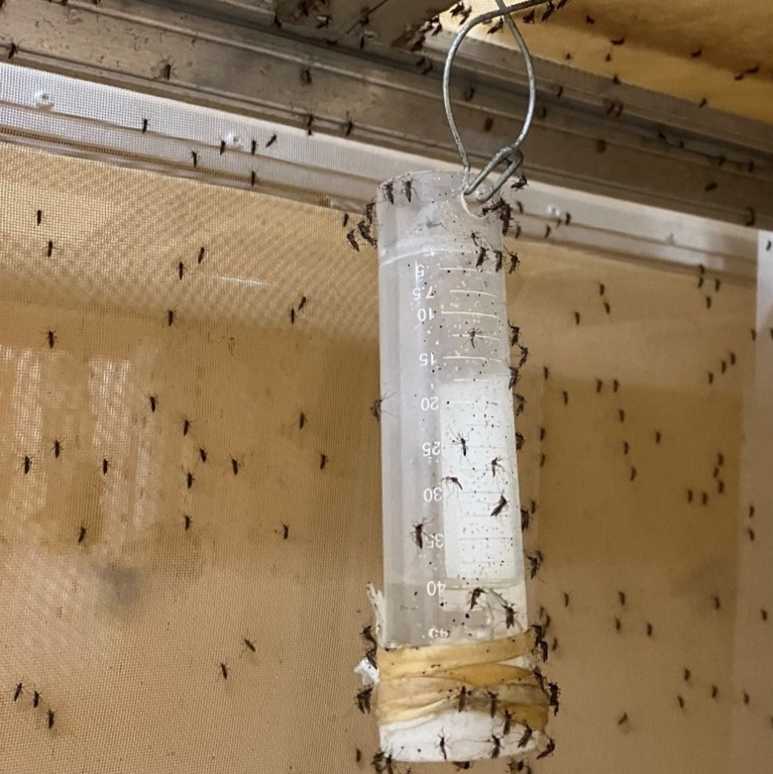
Maintain cages under controlled environmental conditions (e.g., temperature, humidity, and photoperiod) appropriate for Aedes aegypti to support adult survival and mating.
Blood Feeding
1d
In this rearing system, provide the first blood meal on Day 7 after cage installation. Maintain three gonotrophic cycles over a three-week period, offering one blood meal per week.
For the blood feeding we use an artificial membrane feeding system developed in-house (Edwards, T., (2023) U.S. Patent No. US20230035230A1) consisting of Parafilm‱ M (Amcor, Zurich, Switzerland) covered watch glasses filled with 8 ml defibrinated sheep blood (DSB - HemoStat Laboratories, Dixon, CA, USA). See Blood Feeding Protocol for details.
Place one blood-feeding device in each cage for a maximum of 24 hours. During this period, inspect each device and monitor the blood temperature using an infrared thermometer to ensure consistent feeding conditions. The blood temperature should be maintained at 38 °C throughout the feeding period. After feeding, carefully remove the device from each cage.
1d
Assess mosquito engorgement. If feeding is incomplete or insufficient, provide an additional blood meal.
Egg collection
2d
Prepare oviposition cups.
Cut a WypAll paper towel in half horizontally, then fold one half lengthwise.
Line the inside of a 16-oz plastic cup with the folded paper so that:
- Half of the paper remains above the water line.
- The ends of the paper overlap to form a continuous ring (Figure 1).
Figure 1. An ovicup placed in a cage
Add approximately 100 mL of tap water to the cup.
Press the paper firmly against the cup wall to eliminate gaps and ensure full contact.
This seal encourages mosquitoes to lay eggs predominantly on one side of the paper.
Repeat for each oviposition cup as needed.
Two days after blood feeding (Day 9), place one oviposition cup into each cage. Leave cups in place for 48 hours to allow oviposition.
Remove the oviposition cups from cages.
Carefully remove the oviposition paper and hold it over a 5-gallon bucket liner. Gently rinse using a wash bottle filled with tap water to remove debris and any dead mosquitoes. Use minimal water and avoid damaging the paper.
Place oviposition papers on the designated drying rack. Place used cups and rinse materials into a bucket liner and freeze overnight to destroy any remaining eggs. After freezing, clean and thoroughly dry all materials before reuse.
Allow oviposition papers to air dry for approximately one week. Once dry, transfer to labeled gallon-sized bags indicating cohort, date, and cage identification.
Cleanup Procedure Following Egg Collection
After completing all egg collection cycles, remove sugar feeders and disassemble cages.
Place cages and any remaining materials in a freezer for at least 4 hours to ensure all remaining mosquitoes and eggs are destroyed.
Wash cages thoroughly with water and Alconox‱ cleaning solution. Rinse completely and allow all components to air dry before reuse.