Jun 15, 2026
Magnetic bead-based host depletion for metagenomics
- Rhod Evans1,
- Owen Glenn1,
- Natalie Ring1
- 1University of Edinburgh
- Dogstails



Protocol Citation: Rhod Evans, Owen Glenn, Natalie Ring 2026. Magnetic bead-based host depletion for metagenomics. protocols.io https://dx.doi.org/10.17504/protocols.io.bp2l6onn5lqe/v1
Manuscript citation:
Rhodri Evans, Owen J. Glenn, Dylan N. Clements, R. Scott Pirie, Kathryn M. Pratschke, J. Ross Fitzgerald, and Natalie Ring. (In Draft). "A novel magnetic bead-based host depletion method for metagenomics workflows".
License: This is an open access protocol distributed under the terms of the Creative Commons Attribution License, which permits unrestricted use, distribution, and reproduction in any medium, provided the original author and source are credited
Protocol status: Working
We use this protocol and it's working
Created: June 15, 2026
Last Modified: June 15, 2026
Protocol Integer ID: 319172
Keywords: host depletion, metagenomics, DNA purification, host dna from metagenomic sample, host depletion for metagenomic, releasing host dna, host dna, host dna into the supernatant, bacterial dna purification, released host dna, bacterial dna purification protcol, metagenomic, choice of bacterial dna purification protcol, host cell, magnetic bead, metagenomic sample, bacterial dna, most of the bacterial dna, bacterial cell, dna, silicate bead, based host depletion, bead, magnet
Funders Acknowledgements:
PetPlan Charitable Trust
Grant ID: Pathogen detection, surveillance and analysis for equine infections using rapid culture-free sequencing (Ponytails) (project number S24-1327-1366)
European College of Veterinary Surgeons
Grant ID: Resident Research Grant 2023/2024
Disclaimer
DISCLAIMER – FOR INFORMATIONAL PURPOSES ONLY; USE AT YOUR OWN RISK
The protocol content here is for informational purposes only and does not constitute legal, medical, clinical, or safety advice, or otherwise; content added to protocols.io is not peer reviewed and may not have undergone a formal approval of any kind. Information presented in this protocol should not substitute for independent professional judgment, advice, diagnosis, or treatment. Any action you take or refrain from taking using or relying upon the information presented here is strictly at your own risk. You agree that neither the Company nor any of the authors, contributors, administrators, or anyone else associated with protocols.io, can be held responsible for your use of the information contained in or linked to this protocol or any of our Sites/Apps and Services.
Abstract
Reduce host DNA from metagenomic samples while retaining most of the bacterial DNA. Host cells are selectively lysed using 1.4 mm zirconium-silicate beads, releasing host DNA into the supernatant whilst bacterial cells remain intact. Magnetic beads are then used to capture the released host DNA; after pelleting the beads on a magnet, the supernatant is retained and taken forwards for bacterial DNA purification (user's choice of bacterial DNA purification protcol).
Guidelines
Our host depletion protocol is fast, simple and reasonably cost-effective. It is most efficient for samples which are low-to-high host and medium-to-high bacteria (e.g. skin swabs, urine). For samples which are high host and very low bacterial biomass (e.g. joint fluid, CSF), try the original version of this protocol from Alcolea-Medina et al. 2024.
Materials
DNA LoBind 1.5 ml tubes (Eppendorf, catalogue number EP0030108418)
PBS
Ice
Lysing Matrix D 2 ml tubes (MP Biomedicals, catalogue number 116913100)
ProNex Beads from ProNex Size-Selective Purification System (Promega, catalogue number NG2001)
Magnetic rack for 1.5 ml tubes
TissueLyser (or FastPrep, Precellys, etc.)
[OPTIONAL] Thermomixer (e.g. Eppendorf)
Protocol materials
ProNex Size-Selective Purification SystemPromegaCatalog #NG2001
Lysing matrix D tubesMP BiomedicalsCatalog #6913100
Safety warnings
This protocol was optimised for the bead-beating equipment we have in our lab (Qiagen's TissueLyser II). For different equipment, you will probably need to optimise the beating steps.
Before start
Collect your metagenomic sample and ensure it s suspended in at least 500 µl of solution. For example, if you have a swab, first vortex the swab in 500 µl of PBS. We haven't tried this protocol with solid sample types (e.g. tissue, faeces), but it would probably work by placing the solid sample in 500 µl of PBS and then proceeding to the first step. Please let us know if you try this, and if it works...
Host depletion
16m
Add 500 µl of your sample to a 2 ml Lysing Matrix D tube
Metagenomic sample suspended in solution 500 µL Lysing matrix D tubesMP BiomedicalsCatalog #6913100
Bead-beat the sample at 30 Hz for 3 minutes to lyse host cells
00:03:00 minutes Room temperature
Equipment
Tissue Lyser II
NAME
Bead mill
TYPE
Qiagen
BRAND
85300
SKU
LINK
3m
Place the bead-beaten sample tube on ice for at least 1 minute
On ice 00:01:00 minute
1m
Transfer the supernatant (~500 µl) to a fresh 1.5 ml DNA LoBind tube
500 µL
Equipment
DNA LoBind Tube 1.5 mL
NAME
Microcentrifuge tube
TYPE
Eppendorf
BRAND
022431021
SKU
LINK
Add 750 µl ProNex beads and mix by pipetting up and down 10 times
750 µL ProNex Size-Selective Purification SystemPromegaCatalog #NG2001
Incubate at room temperature for 10 minutes with OPTIONAL gentle 300 rpm shaking on a thermomixer
Room temperature 00:10:00 minutes 300 rpm
Equipment
Thermomixer C
NAME
Eppendorf
BRAND
2231000667
SKU
LINK
10m
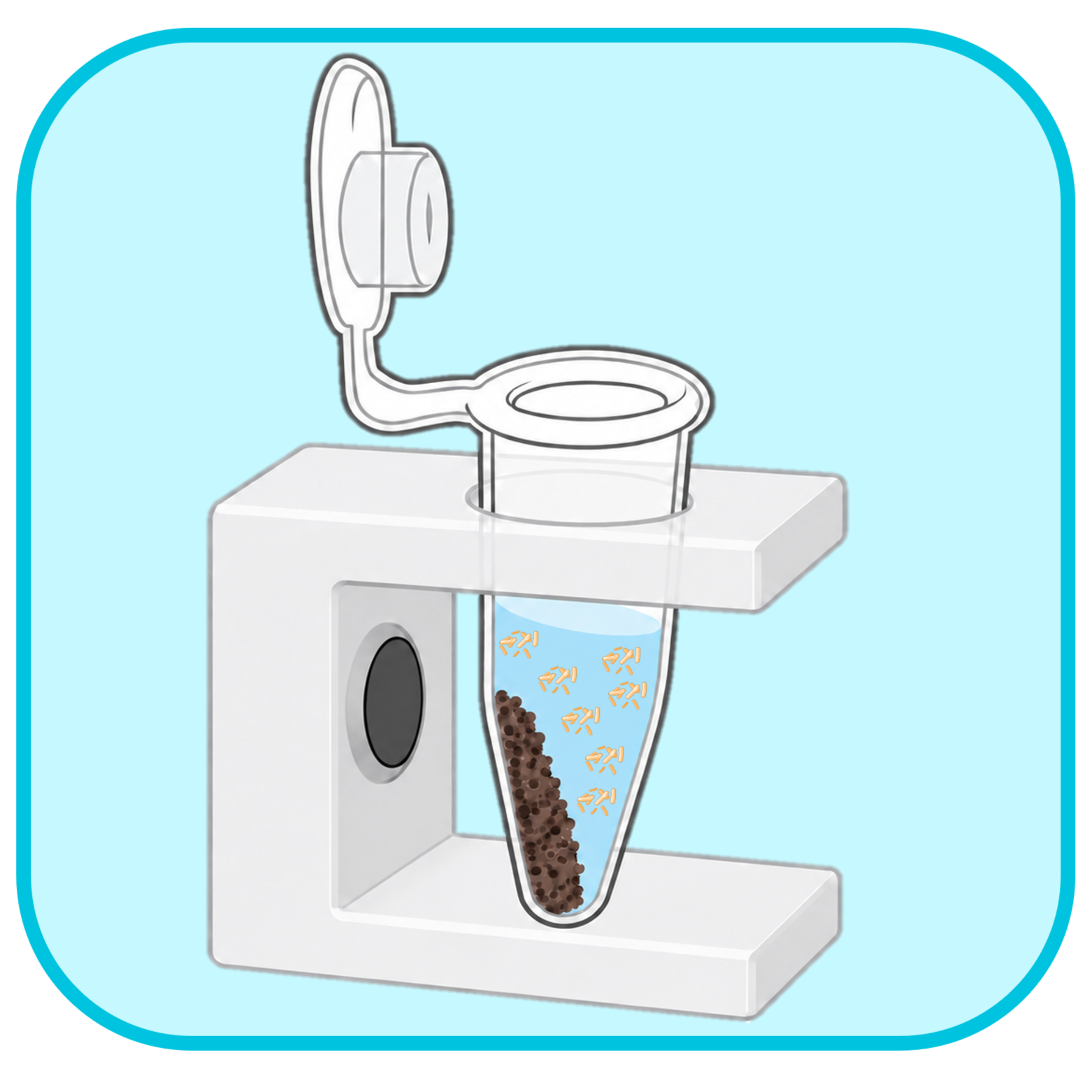
Place tube on a magnetic rack and pellet beads until supernatant is colourless (usually 1-2 minutes)
00:02:00 minutes
Equipment
Magnetic Stand
NAME
Magnetic Stand
TYPE
Thermo Scientific
BRAND
MR02
SKU
LINK
Any magnetic rack that fits your tubes will suffice.
SPECIFICATIONS
2m
Transfer the supernatant to a fresh 1.5 ml DNA LoBind tube
Equipment
DNA LoBind Tube 1.5 mL
NAME
Microcentrifuge tube
TYPE
Eppendorf
BRAND
022431021
SKU
LINK
Metagenomic DNA purification
Proceed with metagenomic DNA purification protocol of your choice
Protocol references
Alcolea-Medina A, Alder C, Snell LB, Charalampous T, Aydin A, Nebbia G, et al. "Unified metagenomic method for rapid detection of microorganisms in clinical samples". Communications Medicine. 2024;4(1):135.
Acknowledgements
Many thanks to the NHS Respiratory Metagenomics Network, from whose protocol this method was adapted.