Oct 10, 2022
Version 2
MagAttract + Metapolyzyme metagenomic gDNA extraction from urine V.2
- 1Roslin Institute & Royal (Dick) School of Veterinary Studies, University of Edinburgh
- Dogstails



Protocol Citation: Natalie Ring 2022. MagAttract + Metapolyzyme metagenomic gDNA extraction from urine. protocols.io https://dx.doi.org/10.17504/protocols.io.n2bvj8o5bgk5/v2Version created by Natalie Ring
Manuscript citation:
Coming soon.
License: This is an open access protocol distributed under the terms of the Creative Commons Attribution License, which permits unrestricted use, distribution, and reproduction in any medium, provided the original author and source are credited
Protocol status: Working
We use this protocol and it's working
Created: October 10, 2022
Last Modified: October 10, 2022
Protocol Integer ID: 71089
Keywords: metapolyzyme metagenomic gdna extraction from urine, protocol for the metagenomic extraction, metagenomic gdna extraction, metagenomic extraction, bacterial dna from urine sample, urine sample, using dog urine, dog urine, reagent, magattract, urine, bacterial dna, metapolyzyme, rapid diagnostics pipeline, nanopore, dna, extraction
Abstract
A protocol for the metagenomic extraction of bacterial DNA from urine samples (optimised using dog urine), for use in a rapid diagnostics pipeline. At the end of the protocol, the DNA is cleaned up and ready for rapid barcoding (SQK-RBK004) library preparation for nanopore sequencing (or whatever other application you want to do).
Unless otherwise stated, all reagents should be included in the listed kits.
Guidelines
This protocol, an adaptation of Qiagen's MagAttract HMW DNA kit, was developed by Natalie Ring and Alison Low for the Dogstails project, a collaboration between the Roslin Institute and the Royal (Dick) School of Veterinary Studies funded by the Dogs Trust. We are grateful to the dogs (and their owners) who donated samples to the R(D)SVS's Hospital for Small Animals, many of which were used in the development of this protocol.
Please follow on Twitter for latest updates, papers and results:
@NatalieAnneRing
Materials
Kits
- Urine sample from which to extract metagenomic gDNA
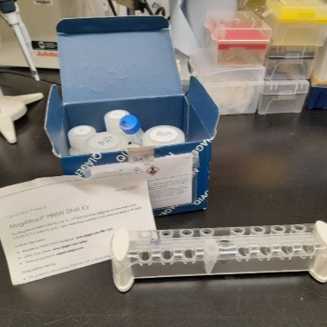
MagAttract HMW DNA kitQiagenCatalog #67563
ProNex Size-Selective Purification SystemPromegaCatalog #NG2001
Qubit® dsDNA HS Assay KitThermo Fisher ScientificCatalog #Q32854
Other reagents
- 50 mM Tris, 10 mM EDTA, ph8.0 ("buffer P1")
- MetaPolyzymeMerck MilliporeSigma (Sigma-Aldrich)Catalog #MAC4L-5MG
- Nuclease-free Water
- Distilled Water
Equipment
Equipment
DNA LoBind tubes, 1.5 mL
NAME
Tubes
TYPE
Eppendorf
BRAND
022431021
SKU
LINK
1.5 mL
SPECIFICATIONS
OR
Equipment
SafeSeal reaction tube, 1.5 ml, PP, PCR Performance Tested, Low DNA-binding
NAME
Tubes
TYPE
Sarstedt
BRAND
72.706.700
SKU
LINK
1.5 mL
SPECIFICATIONS
Equipment
Magnetic Stand
NAME
Magnetic Stand
TYPE
Thermo Scientific
BRAND
MR02
SKU
LINK
Any magnetic rack that fits your tubes will suffice.
SPECIFICATIONS
Equipment
Centrifuge
NAME
Benchtop Centrifuge
TYPE
Eppendorf
BRAND
5405000441
SKU
LINK
Any benchtop centrifuge will suffice
SPECIFICATIONS
Equipment
ThermoMixer
NAME
Benchtop Incubator
TYPE
Eppendorf
BRAND
5382000023
SKU
LINK
Any heat block will suffice
SPECIFICATIONS
Equipment
Mini-centrifuge
NAME
Centrifuge
TYPE
Fisher
BRAND
S67601B
SKU
LINK
Any standard mini centrifuge with adapters for different tube sizes will suffice
SPECIFICATIONS
Equipment
Vortex Mixer
NAME
Vortex Mixer
TYPE
VWR
BRAND
97043-562
SKU
LINK
Protocol materials
Nuclease-free Water
MagAttract HMW DNA kitQiagenCatalog #67563
Qubit® dsDNA HS Assay KitThermo Fisher ScientificCatalog #Q32854
MetaPolyzymeMerck MilliporeSigma (Sigma-Aldrich)Catalog #MAC4L-5MG
ProNex Size-Selective Purification SystemPromegaCatalog #NG2001
Distilled Water
Before start
- "Buffer P1" is required for the metapolyzyme lysis incubation: 50 mM Tris, 10 mM EDTA, pH 8.0
- Metapolyzyme is used here at a concentration of 3.3 mg/ml (resuspend 5 mg lyophilized powder in 1.5 ml PBS pH 7.5)
- We recommend using low DNA-binding tubes throughout, but definitely for the elution/storage of DNA
Extended pre-lysis spin down
Pellet 2x 1.5 ml aliquots of urine in 1.5 ml tubes by centrifuging at maximum speed (~13,000 RPM/16,000 xg) for 20 minutes, then discard supernatant
3 mL urine
16,000 x g, Room temperature, 00:20:00
Note
We have found that this extended spin at the beginning of the protocol results in much better yield of bacterial gDNA, especially in samples with low bacterial abundance
20m
Metapolyzyme & Proteinase K Lysis
Resuspend cell pellets (which might be invisible) and combine in 160 µl buffer P1 (50 mM Tris, 10 mM EDTA, pH 8.0)
160 µL buffer P1
Add 20 µl metapolyzyme (3.3 mg/ml, 5 mg resuspended in 1500 µl PBS) and mix by flicking the tube
20 µL metapolyzyme (3.3 mg/ml)
Incubate on a thermomixer for 60 minutes at 37°C with 900 RPM shaking
900 rpm, 37°C, 01:00:00
1h
Add 20 µl MagAttract proteinase K and mix by flicking the tube
20 µL proteinase K
Incubate on a thermomixer for 30 minutes at 56°C with 900 RPM shaking
900 rpm, 56°C, 00:30:00
30m
MagAttract DNA isolation and washing
Add 150 µl MagAttract buffer AL and mix by pulse vortexing
150 µL buffer AL
Note
Our standard "pulse vortex" is 10 short (<1 second) pulses per tube
Add 15 µl MagAttract Suspension G and 280 µl MagAttract buffer MB and mix by pulse vortexing
15 µL Suspension G
280 µL Buffer MB
Note
Make sure the magnetic beads (Suspension G) are really well mixed before adding them! The whole suspension should be black, not separated into a bead layer and a clear layer. We usually resuspended by vortexing for 10 or more seconds.
Incubate on a thermomixer for 3 minutes at room temperature with 1,400 RPM shaking
1400 rpm, Room temperature , 00:03:00
Spin down briefly, then pellet beads on magnet and remove supernatant
Add 700 µl MagAttract buffer MW1 and incubate on a thermomixer for 1 minute at room temperature with 1,400 RPM shaking
700 µL buffer MW1
1400 rpm, Room temperature , 00:01:00
1m
Repeat steps 10 and 11
1m
Spin down briefly, then pellet beads on magnet and remove supernatant
Add 700 µl MagAttract buffer PE and incubate on a thermomixer for 1 minute at room temperature with 1,400 RPM shaking
700 µL buffer PE
1400 rpm, Room temperature , 00:01:00
1m
Repeat steps 13 and 14
1m
Spin down briefly, then pellet beads on magnet and remove supernatant
Rinse the pelleted beads on the magnetic rack with 700 µl distilled water by pipetting down the opposite wall of the tube, then incubate for 1 minute on the magnetic rack
700 µL distilled water
Remove distilled water
Repeat steps 17 and 18
Spin down briefly, then pellet beads on magnet and remove any remaining supernatant
Add 50 µl nuclease-free water off the magnet, to resuspend the bead pellet
50 µL nuclease-free water
Incubate on a thermomixer for 3 minutes at room temperature with 1,400 RPM shaking
1400 rpm, Room temperature , 00:03:00
3m
Qubit Pre-clean-up quantification
Quantify DNA using Qubit dsDNA HS kit. If DNA concentration is an appropriate concentration for your experiment (for us, this means at least 0.2 ng/µl), continue to clean-up steps.
Qubit® dsDNA HS Assay KitThermo Fisher ScientificCatalog #Q32854
1 µL DNA
199 µL Qubit dsDNA HS working solution
ProNex DNA clean-up
Add 150 µl room temperature ProNex beads to your entire tube of DNA (49 µl)
200 µL ProNex beads
Note
Like the magnetic beads in Suspension G, make sure the ProNex beads are really well mixed (10+ seconds of vortexing) immediately before you use them.
Mix well by slowly pipetting up and down 10 times
Incubate at room temperature for 10 minutes (no shaking needed)
00:10:00
Room temperature
10m
Spin down briefly, then pellet beads on magnet and remove supernatant
Rinse the pelleted beads on the magnetic rack by pipetting 200 µl ProNex Wash Buffer down the opposite wall of the tube, then incubate at room temperature for 60 seconds (no shaking), then remove Wash Buffer
200 µL Wash Buffer
Room temperature
00:01:00
1m
Repeat step 26
Air-dry (lid open) the sample on the magnetic rack for 5 minutes (longer is OK, no more than 60 minutes)
Room temperature
00:05:00
5m
Add 20 µl nuclease-free water off the magnet. Resuspend the pellet by flicking the tube, then incubate at room temperature for 5 minutes (no shaking needed)
20 µL nuclease-free water
Room temperature
00:05:00
5m
Spin down briefly, then pellet the beads on magnet and keep supernatant in a low DNA-binding tube
Qubit post-clean-up quantification
Quantify DNA using Qubit dsDNA HS kit. If DNA concentration is an appropriate concentration for your experiment (for us, this means at least 0.2 ng/µl), continue to library preparation.
Qubit® dsDNA HS Assay KitThermo Fisher ScientificCatalog #Q32854
1 µL DNA
199 µL Qubit dsDNA HS working solution