Jul 10, 2025
Luminol Synthesis Protocol from Locally Available Materials
- Joseph shenekji1,2,
- Kamar Shayah1,
- Raghda Lahdo3,
- Tasneem Hanifa1,
- Shaza AboAlkhir1,
- Rayan wello1,
- Maemona Alkhalil1
- 1department of biotechnology engineering, faculty of technical engineering, university of Aleppo;
- 2Coordinator of Biotechnologysy.org;
- 3Al- Wataniya Private University
- Joseph shenekji: PhD in Biotechnology Engineering - [email protected];
- Kamar Shayah: PhD in Biotechnology Engineering;
- Raghda Lahdo: PhD in Biochemistry - Associate professor
- Reclone.org (The Reagent Collaboration Network)Tech. support email: [email protected]



Protocol Citation: Joseph shenekji, Kamar Shayah, Raghda Lahdo, Tasneem Hanifa, Shaza AboAlkhir, Rayan wello, Maemona Alkhalil 2025. Luminol Synthesis Protocol from Locally Available Materials. protocols.io https://dx.doi.org/10.17504/protocols.io.n92ld63xxg5b/v1
License: This is an open access protocol distributed under the terms of the Creative Commons Attribution License, which permits unrestricted use, distribution, and reproduction in any medium, provided the original author and source are credited
Protocol status: Working
We use this protocol and it's working
Created: July 10, 2025
Last Modified: July 10, 2025
Protocol Integer ID: 222235
Keywords: Luminol, Chemiluminescence, Organic Synthesis, Phthalic Anhydride, 3-Nitrophthalic Acid, Hydrazine, Reduction, Forensics, biotechnology, synthesized luminol, luminol synthesis protocol from locally available material, practical applications of luminol, luminol synthesis protocol, luminol, yielding luminol, phthalic anhydride, hydrazine, condensation reaction with hydrazine, dehydration of phthalic acid, phthalic acid, synthesis, step of the synthesis, fluorescence, amino group, formation of an intermediate compound
Abstract
This protocol outlines a multi-step synthesis of luminol (5-amino-2,3-dihydrophthalazine-1,4-dione) utilizing low-cost materials and minimal resources, making the process accessible for various educational and research settings. The synthesis begins with the dehydration of phthalic acid to produce phthalic anhydride, followed by a nitration step to introduce a nitro group. This is succeeded by a condensation reaction with hydrazine, leading to the formation of an intermediate compound. The final step involves the reduction of the nitro group to an amino group, yielding luminol.
Each step of the synthesis is accompanied by detailed procedures, scientific explanations, and observations, ensuring clarity and reproducibility. The synthesized luminol is assessed for its fluorescence, solubility, and characteristic chemiluminescence properties. Additionally, a field test is conducted on a preserved blood sample to demonstrate the practical applications of luminol in forensic science. This approach emphasizes the use of readily available starting materials and efficient methodologies, highlighting the feasibility of conducting this synthesis with limited resources while maintaining scientific rigor.
Materials
- Phthalic acid
- Sulfuric acid
- Sodium nitrate (NaNO3)
- Hydrazine sulfate (N2H4⋅H2SO4)
- Sodium acetate trihydrate (CH3COONa⋅3H2O)
- Polyethylene glycol (PEG, e.g., PEG 400 or higher)
- Sodium hydroxide (NaOH)
- Sodium metabisulfite (Na2S2O5)
- Aluminum foil (Al)
- Sodium bisulfite (NaHSO3)
- Acetone (CH3COCH3)
- Distilled water
- Household bleach (sodium hypochlorite solution, NaClO)
- Digital thermometer (glass-protected)
- Magnetic stirrer with hot plate
- Beakers (various sizes)
- Round-bottom flask
- Vacuum filtration apparatus (Büchner funnel, filter flask, vacuum pump)
- Evaporating dish
- Test tubes
- UV lamp
- Plastic plate
- Pipettes/Droppers
- Stirring rod
Step 1: Conversion to Phthalic Anhydride
Distillation Setup: Place 16 g of phthalic acid in a beaker. Heat the beaker on a hot plate to a temperature range of 250-300°C. (this reduces time, less temp. could work for longer waiting)
Phthalic acid undergoes thermal dehydration at high temperatures.
The anhydride is formed by the loss of a water molecule from the two adjacent carboxylic acid groups. This process is often accompanied by sublimation, where the solid directly turns into a gas.
Drying and Condensation: As the phthalic acid dries and melts, place a flask filled with cold water over the beaker. This will cool the phthalic anhydride vapor.
White fumes will be observed.
The cold flask acts as a condenser. As the hot phthalic anhydride vapor comes into contact with the cold surface, it desublimes (condenses directly from gas to solid) forming pure phthalic anhydride crystals. This method effectively separates the anhydride from non-volatile impurities present in the starting phthalic acid.
Collection: Carefully collect the phthalic anhydride crystals that form on the bottom of the cold flask, ensuring they are not contaminated by any remaining impurities at the bottom of the heating beaker.
Repeat: Continue the vaporization and collection process until no more phthalic anhydride sublimes.
Step 2: Nitration to 3-Nitrophthalic Anhydride (and subsequent hydrolysis to 3-Nitrophthalic Acid)
Setup: Use a beaker equipped with a glass-protected digital or regular thermometer and a magnetic stirrer with a stirring bar.
Prepare Mixture: In the beaker, combine 45 mL of concentrated sulfuric acid (H2SO4), 13 g of phthalic anhydride, and 19 g of sodium nitrate (NaNO3).
Concentrated sulfuric acid acts as a dehydrating agent and a catalyst for the nitration reaction. It reacts with sodium nitrate to generate the highly reactive nitronium ion (NO2+), which is the active electrophile in aromatic nitration.
Initial Reaction: The mixture will begin to heat spontaneously. Continue stirring until the temperature stabilizes.
Temperature Control: Gradually raise the heater temperature until it reaches 130 °C. Continue stirring for 1 hour and 44 minutes. During this period, the internal temperature of the mixture should reach approximately 110 °C. After this, stabilize the heater temperature within the range of 166–178 °C, continuing to stir for an additional hour.
Precise temperature control is crucial for selective nitration and to prevent side reactions. The initial exothermic reaction is due to the formation of the nitronium ion and the start of nitration. Maintaining specific temperature ranges ensures optimal reaction kinetics and yield. Phthalic anhydride is nitrated primarily at the 3-position due to the directing effects of the anhydride group.
Cooling and Hydrolysis: Remove the mixture from heat and allow it to cool to room temperature.
The mixture will gradually solidify after about 30 minutes, becoming completely solid and milky white.
As the mixture cools, the 3-nitrophthalic anhydride solidifies. The milky white appearance indicates the formation of the solid product.
Hydrolysis: Pour the solidified mixture into 150 mL of cold water with vigorous stirring to ensure homogeneity and to release nitrogen dioxide gas.
Effervescence (gas evolution) will be observed.
The 3-nitrophthalic anhydride undergoes hydrolysis in the presence of water to form 3-nitrophthalic acid. The gas released is likely residual nitrogen oxides.
Allow the mixture to stand overnight for complete hydrolysis.
Filtration and Drying: Filter the mixture using vacuum filtration. Wash the precipitate with 200 mL of water. After washing, allow the solid to dry completely and then crush it into a fine powder. This is 3-nitrophthalic acid
Step 3: Condensation with Hydrazine
Preparation: In a vessel, mix 0.06 g of 3-nitrophthalic acid, 37 mg of hydrazine sulfate (N2H4⋅H2SO4), and 0.084 g of sodium acetate trihydrate (CH3COONa⋅3H2O) with 0.06 mL of water.
Hydrazine sulfate is used as a safer, solid source of hydrazine. Sodium acetate acts as a base to neutralize the sulfuric acid from hydrazine sulfate and to deprotonate hydrazine, making it more nucleophilic for the condensation reaction.
Heating: Gently boil the mixture until it dries.
This initial heating helps remove water, driving the condensation reaction forward.
Solvent Addition and Further Heating: Add 0.24 mL of polyethylene glycol (PEG). Gradually heat the mixture until the reaction temperature reaches 230 °C, within a range of 268–278 °C. Continue heating for 10 minutes.
Polyethylene glycol is a high-boiling point solvent, suitable for reactions requiring elevated temperatures. The condensation reaction between 3-nitrophthalic acid and hydrazine forms a cyclic hydrazide. The two carboxylic acid groups of 3-nitrophthalic acid react with the two amino groups of hydrazine to form a five-membered ring.
(3-nitrophthalic acid + hydrazine → 3-nitrophthalhydrazide + water)
Cooling: Allow the mixture to cool to below 80 °C before handling. It was handled at 55 °C.
Step 4: Reduction to Luminol
Transfer: Transfer the cooled mixture to a larger vessel, using water to aid in the transfer. Add water until the total volume reaches approximately 6 mL.
Add Base: Add 0.78 g of sodium hydroxide (NaOH) and dissolve it completely.
The mixture will turn dark red (reddish-brown).
Sodium hydroxide provides an alkaline environment essential for the subsequent reduction reaction and for the solubility of the intermediates. The color change is due to the formation of a soluble, colored salt of the nitrophthalhydrazide.
Reducing Agent: Add 0.6 g of sodium metabisulfite (Na2S2O5), ensuring any large clumps are broken up. Add another 3 mL of water and ensure everything is dissolved.
Sodium metabisulfite can act as a mild reducing agent, but its primary role here might be to help dissolve the solid and potentially scavenge oxygen.
Aluminum Reaction Setup: Prepare a large beaker with a cold water flask placed on top and a small container inside the large beaker to press down the aluminum foil.
Add Aluminum: Quickly add approximately 0.3 g of cut aluminum foil to the beaker and press it down with the flask.
The reaction will begin, producing hydrogen gas and causing a color change.
This is a reduction reaction using aluminum in an alkaline medium. Aluminum is a strong reducing agent. In the presence of strong base (NaOH), aluminum reacts with water to produce hydrogen gas and aluminum hydroxide. The nascent hydrogen then reduces the nitro group (NO2) of 3-nitrophthalhydrazide to an amino group (NH2), forming luminol.
(3-nitrophthalhydrazide + Aluminum + Sodium Hydroxide + Water → Luminol + Sodium Aluminate + Hydrogen Gas)
Repeat: Add aluminum foil in 0.24 g increments until no further color change is observed, indicating the completion of the reduction.
The dark reddish-brown color will lighten as the nitro group is reduced to the amino group.
Step 5: Purification of Luminol
Filtration: After the reaction has stopped effervescing, break up any solid pieces and filter the mixture. Wash the precipitate with 3 mL of water.
Filtration removes insoluble byproducts, mainly aluminum hydroxide and unreacted aluminum.
Remove Byproducts: Carefully skim off any floating oils using a paper towel or a separatory funnel if available.
This removes non-polar organic impurities that may have formed during the reaction.
Acidification: Dissolve 1.5 g of sodium bisulfite (NaHSO3) in 12 mL of water and add 6 mL of acetone (CH3COCH3). Mix this solution thoroughly with the luminol solution.
Sodium bisulfite and acetone are often used in the purification of luminol. Luminol can form a bisulfite adduct which is more soluble. Upon evaporation, this adduct can decompose, yielding purer luminol. Acetone helps in precipitation and washing.
Evaporation: Pour the upper liquid layer into a large evaporating dish and allow it to dry completely.
Evaporation removes the solvents, leaving behind the crude luminol.
Final Wash: Break up the dry luminol mass and wash it with water to remove any remaining salts. Filter the mixture by vacuum filtration and allow it to dry to obtain the final product.
This final wash removes water-soluble inorganic salts, further purifying the luminol
4. Luminol Testing
4.1. Fluorescence Test
- Place a few milligrams of the synthesized luminol in a test tube with 10 mL of water.
- Shine a UV lamp on the solution.
- Expected Result: A strong blue fluorescence should be observed.
Luminol itself exhibits fluorescence under UV light due to its conjugated π-electron system, which allows it to absorb UV energy and re-emit it as visible light (fluorescence).
luminol vs water under uv directly (left) and with uv filter (right)
4.2. Field Test with Preserved Blood SampleThis test demonstrates the practical application of the synthesized luminol in detecting blood.
Prepare Luminol Solution: Dilute the synthesized luminol with water. Add sodium hydroxide to aid dissolution and adjust the solution to an alkaline pH.
An alkaline environment is crucial for the luminol chemiluminescence reaction to proceed efficiently.
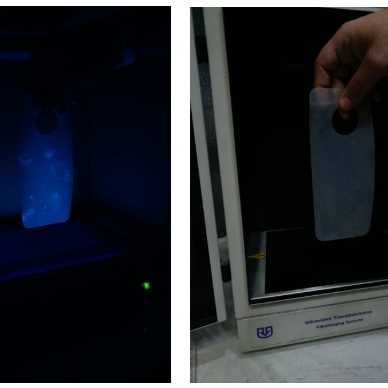
- Apply Blood Spots: Place drops of preserved blood onto a plastic plate.
- Clean Surface: Clean the surface using household bleach solution.
This simulates a real-world scenario where a crime scene might have been cleaned, making blood invisible to the naked eye.
Apply Luminol Solution: Spray or apply the prepared luminol solution onto the areas where blood was previously placed.
The iron (Fe2+ or Fe3+) in the hemoglobin of the blood acts as a catalyst for the luminol oxidation reaction. It facilitates the decomposition of the oxidizing agent (e.g., hydrogen peroxide, which can be formed from hypochlorite or is present as an impurity) into reactive oxygen species. These reactive species then oxidize luminol, leading to the emission of blue light. The intensity and duration of the glow depend on the concentration of blood and the efficiency of the luminol solution.
Interpretation: The observed characteristic blue glow confirms the successful synthesis of luminol and its effectiveness as a blood detection reagent.
Protocol references
"Make Luminol - The Complete Guide" by NurdRage
"Make Luminol From Domestically Available Chemicals"
"Luminol Synthesis" by NileRed
"Making Luminol From Household Chemicals"
"Chemiluminescence of Luminol: A Cold Light Experiment" by RSC Education